Atelier Editions
A contemporary Surrealium colour interpretation, not a claim to recover the artist's intended colours.
artist: Rembrandt van Rijn (Dutch, 1606–1669)
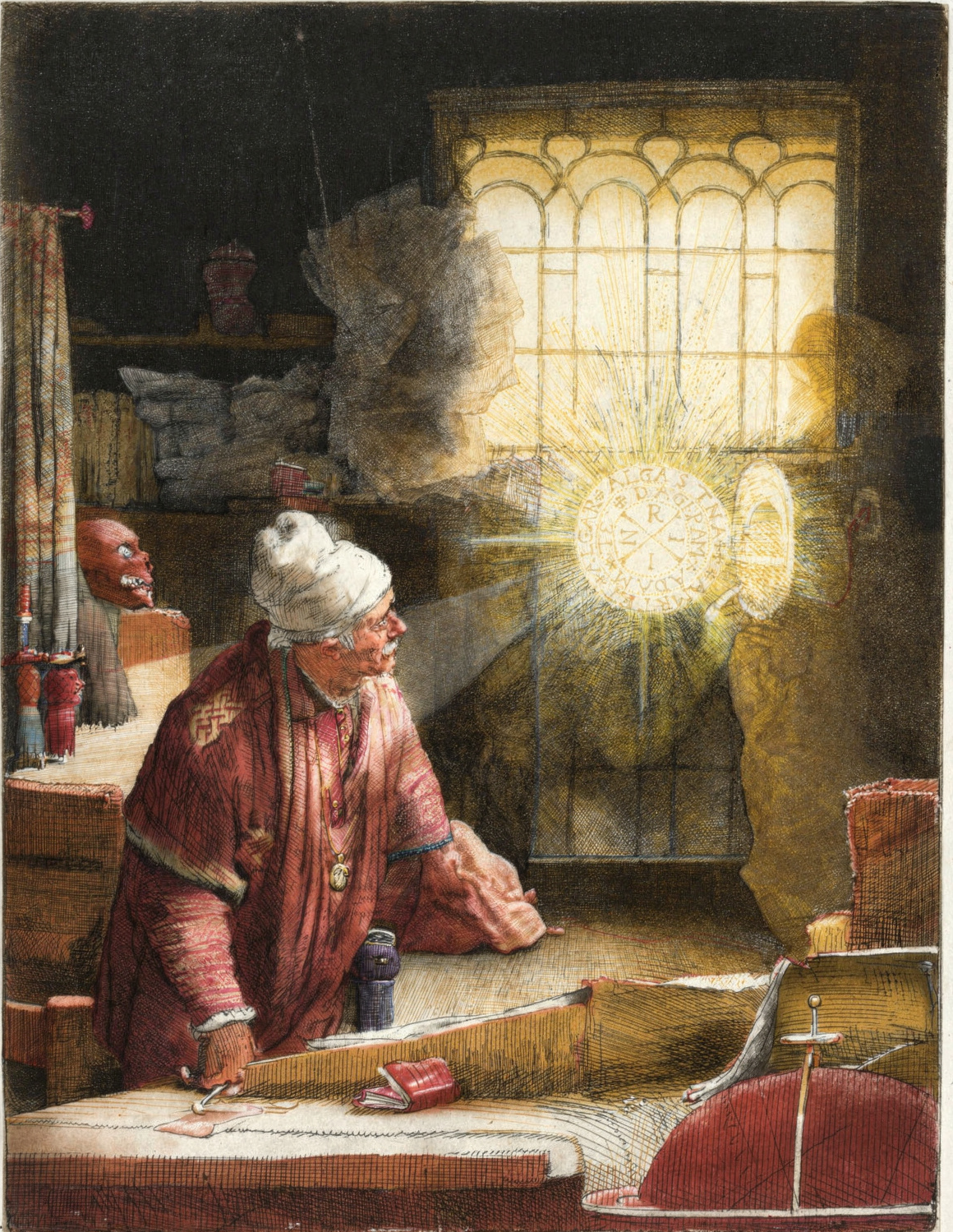
Museum original and attributionIn a study filled with books and curiosities, a scholar is startled from his work by a celestial vision. A glowing disc appears in the window, inscribed with cryptic letters, bathing the room in an ethereal light. This contemporary edition renders Rembrandt's dramatic scene in a palette of deep umber, warm ochre, and restrained crimson, creating a composition of concentrated light and profound shadow that heightens the mystical atmosphere.
This work is a Surrealium Atelier Edition, a contemporary, digitally-assisted color interpretation of the original 1652 monochrome etching by Rembrandt van Rijn (Dutch, 1606, 1669). While Rembrandt’s celebrated masterpiece conveyed its drama through line and shadow alone, our atelier explores a new dimension of the work by introducing a warm, painterly light. This edition is an exclusive interpretation by Surrealium.
The rich, warm tones make this an excellent centerpiece for a study, library, or living room, adding a touch of classic, scholarly depth to both vintage and modern interiors. As a fine-art print or gallery canvas, it invites contemplation. This archival print is available for purchase to all collectors. An active Fable subscription is required to create your own custom interpretations of works in our collection.
Each piece is made to order in the EU as an archival fine-art print on heavyweight, museum-grade matte paper, using pigment-based inks rated to last for generations. This special color edition of Rembrandt's Faust is interpreted and prepared for print by the Surrealium atelier at Kastellet, a 17th-century sea fortress in the Stockholm archipelago.