The Laughing Cavalier
Frans Hals' renowned 17th-century portrait, reproduced as a museum-quality fine-art print or gallery canvas.
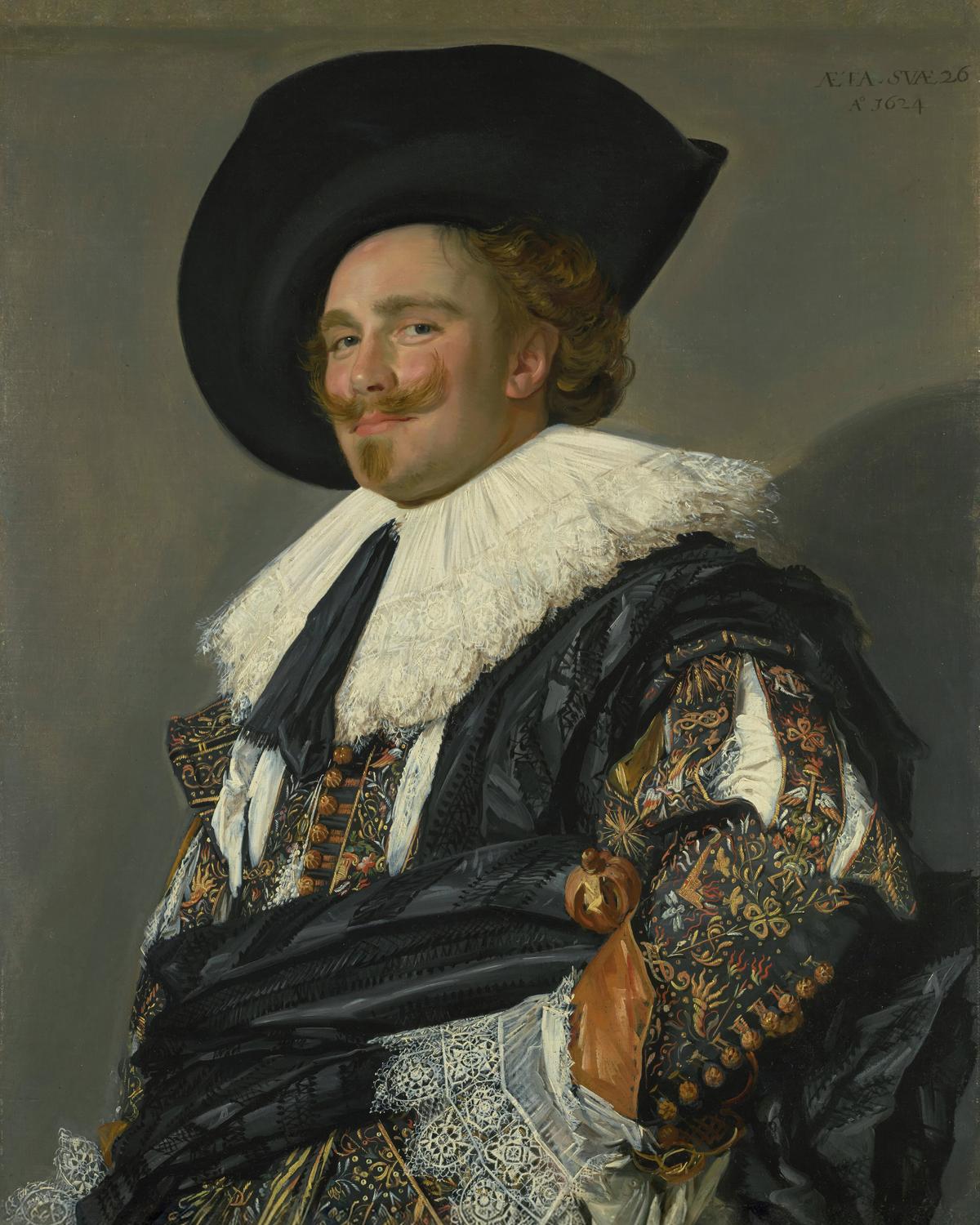
A masterclass in swagger and vitality, this 1624 portrait captures a confident gentleman in three-quarter profile, turning to meet the viewer's gaze. The subject, famously known as the cavalier, sports a spectacular upturned moustache, a trim goatee, and a wide-brimmed black hat tilted at a jaunty angle. His attire is a triumph of Baroque opulence, a doublet densely embroidered with golden motifs, intricate silver lace cuffs, and a voluminous, deeply ruffled white collar that frames his face against the muted grey background.
The palette balances the stark, crisp whites of the lace and the deep blacks of the silk sash and hat against the warm, flushed tones of the subject's face and the rich, metallic threads of his sleeves. The light falls sharply from the upper left, casting a subtle shadow on the wall behind him and illuminating his expression, a look of wry amusement rather than a full laugh, brimming with life. This high-contrast handling of light and dark gives the portrait an undeniable presence and three-dimensionality.
As a statement piece of wall art, this Dutch Golden Age masterpiece brings immediate character and historical weight to a room. It commands attention above a console table, anchors a sophisticated study or library, or adds classic grandeur to a living room. Its dark, rich tones and formal elegance make it a striking addition to vintage, eclectic, or traditional interiors, pairing beautifully with both antique wood finishes and modern minimalist decor.
Painted by Frans Hals in the Netherlands, this work is a pinnacle of 17th-century portraiture, celebrated for its loose, expressive brushwork and psychological immediacy. Now housed in The Wallace Collection, London, it is prepared for print by Surrealium at Vaxholm Fortress, a 16th-century sea fortress in the Stockholm archipelago. Each piece is crafted to order on matte museum-grade paper or gallery canvas using archival pigment inks, ensuring the intricate embroidery and lively expression endure for generations.