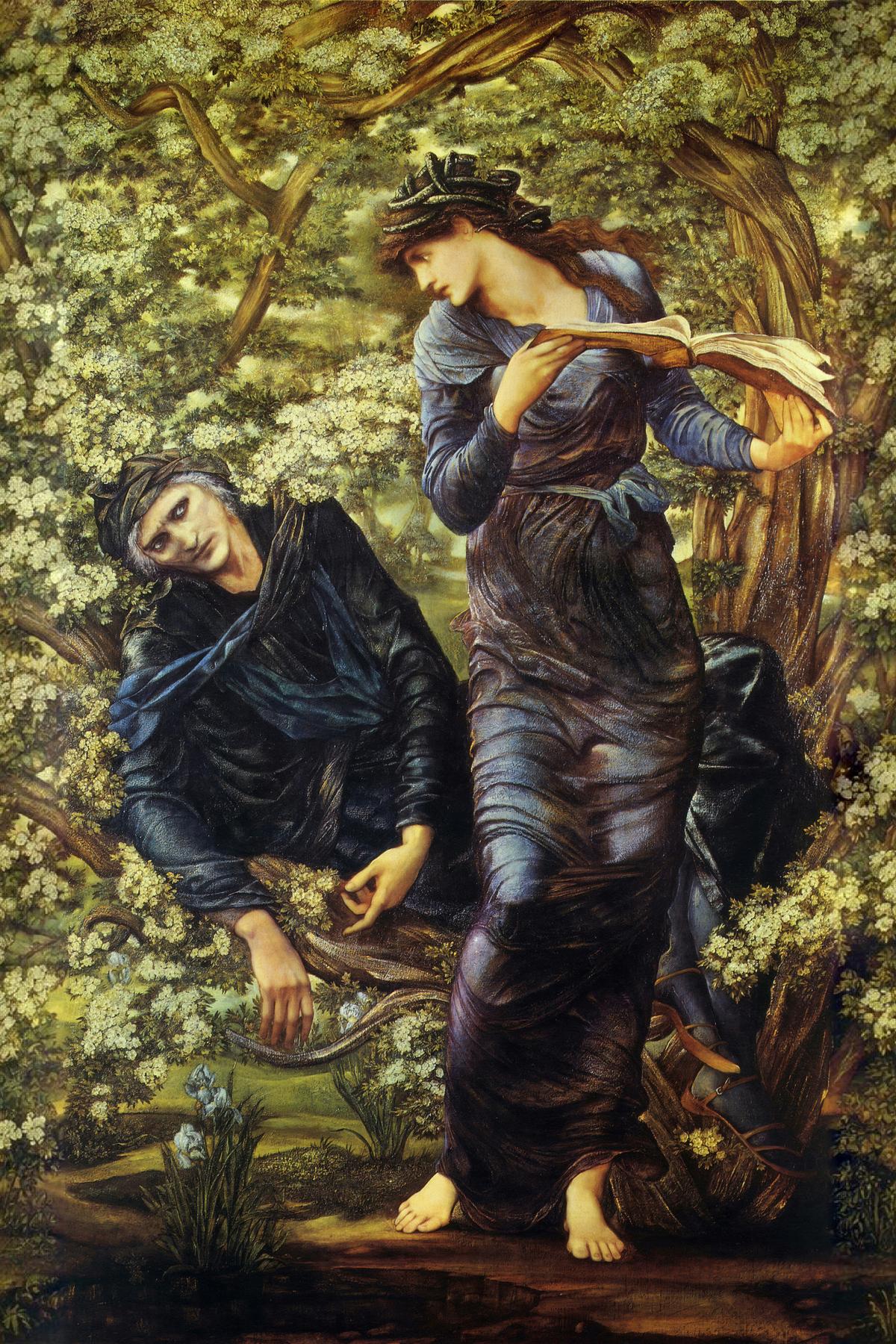
A towering figure in a shimmering, deep purple gown stands reading from an open book, her dark hair bound in snake-like coils. She glances back over her shoulder at an older man, who lies entirely entwined in the pale, twisting branches of a heavily blossomed hawthorn tree. His expression is pale and entranced, physically yielding to the thick weave of bark and white flowers that encircle his body. The dense composition places both figures in a tight, claustrophobic woodland space, illuminated by a cool, ethereal light that highlights the intricate folds of the drapery and the thousands of pale petals.
The palette relies heavily on deep, shadowed blues, metallic purples, and rich earth tones, contrasted against the overwhelming spread of creamy white blossoms and muted greens. This interplay of cool tones and dark shadows creates a mood of quiet enchantment and melancholy. It brings a deeply romantic and slightly mysterious atmosphere to any room, offering a focal point that draws the eye into its labyrinth of organic shapes and rich textures.
This dense, vertical composition is highly suited for intimate spaces that benefit from dramatic, story-driven wall art. It serves as a captivating anchor piece in a bedroom, a quiet reading nook, or above a hallway console table. For those designing a vintage or classically styled interior, this canvas print adds depth and historical romance, pairing beautifully with other mythological or botanical works on an eclectic gallery wall.
Painted between 1872 and 1877 by British artist Edward Burne-Jones, the original oil on canvas resides in the Lady Lever Art Gallery. This archival fine-art print is made to order on matte museum-grade paper using archival pigment inks, ensuring the delicate colors and intricate details are faithfully preserved. The artwork is prepared for print by Surrealium at Vaxholm Fortress, Sweden, straight from the museum's scan, offering a lasting piece of nineteenth-century art as a gallery canvas or framed print.