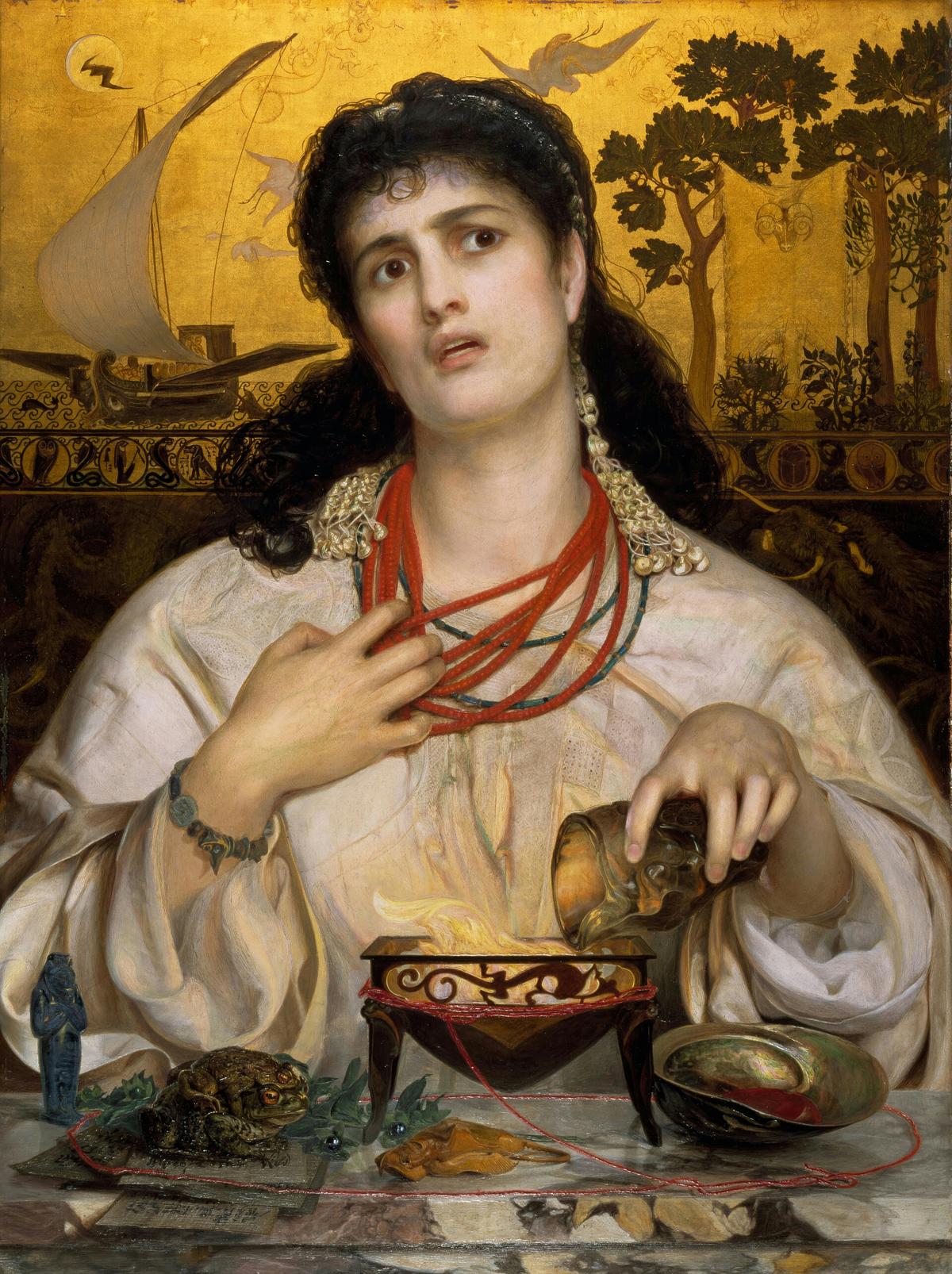
Frederick Sandys’ powerful depiction of Medea centers on a moment of intense, quiet spellcasting. Draped in voluminous white fabric, she clutches a thick necklace of deep red beads with one hand, while the other steadily pours a clear liquid into a glowing brazier. Her pale skin and wide, upward gaze convey both anguish and determination. Before her rests a detailed still life of arcane ingredients, a toad, fresh leaves, a dark figurine, and a curving red thread, all set against a striking, gilded background decorated with classical motifs, silhouetted trees, and a distant sailing ship.
The palette is built on stark, dramatic contrasts. The pristine white of her gown and the luminous gold of the background are pierced by vibrant reds, in the cord, the necklace, and the liquid held in a shell on the table. Rich, shadowed greens and dark, earthy browns anchor the foreground. This intense saturation and meticulous detailing lend an air of suspense and mystery, bringing a compelling, theatrical mood to the space it occupies.
As a work of wall art, this piece demands attention. Its striking gold backdrop and vivid jewel tones make it an extraordinary focal point for a formal living room, a moody study, or a classic gallery wall. Whether chosen as a framed fine-art print or a large gallery canvas, its bold composition and intricate symbolism add a layer of sophisticated, historical intrigue to traditional, maximalist, or dark academia interiors.
Painted between 1866 and 1868 by the English artist Frederick Sandys, a prominent figure associated with the Pre-Raphaelite Brotherhood, the original oil on wood panel is housed in the Birmingham Museum and Art Gallery. This piece is meticulously prepared for print by Surrealium at Vaxholm Fortress, Sweden, from the museum's scan. It is reproduced to order on matte museum-grade paper using archival pigment inks, ensuring every thread, flame, and meticulous detail is preserved with gallery-level fidelity.