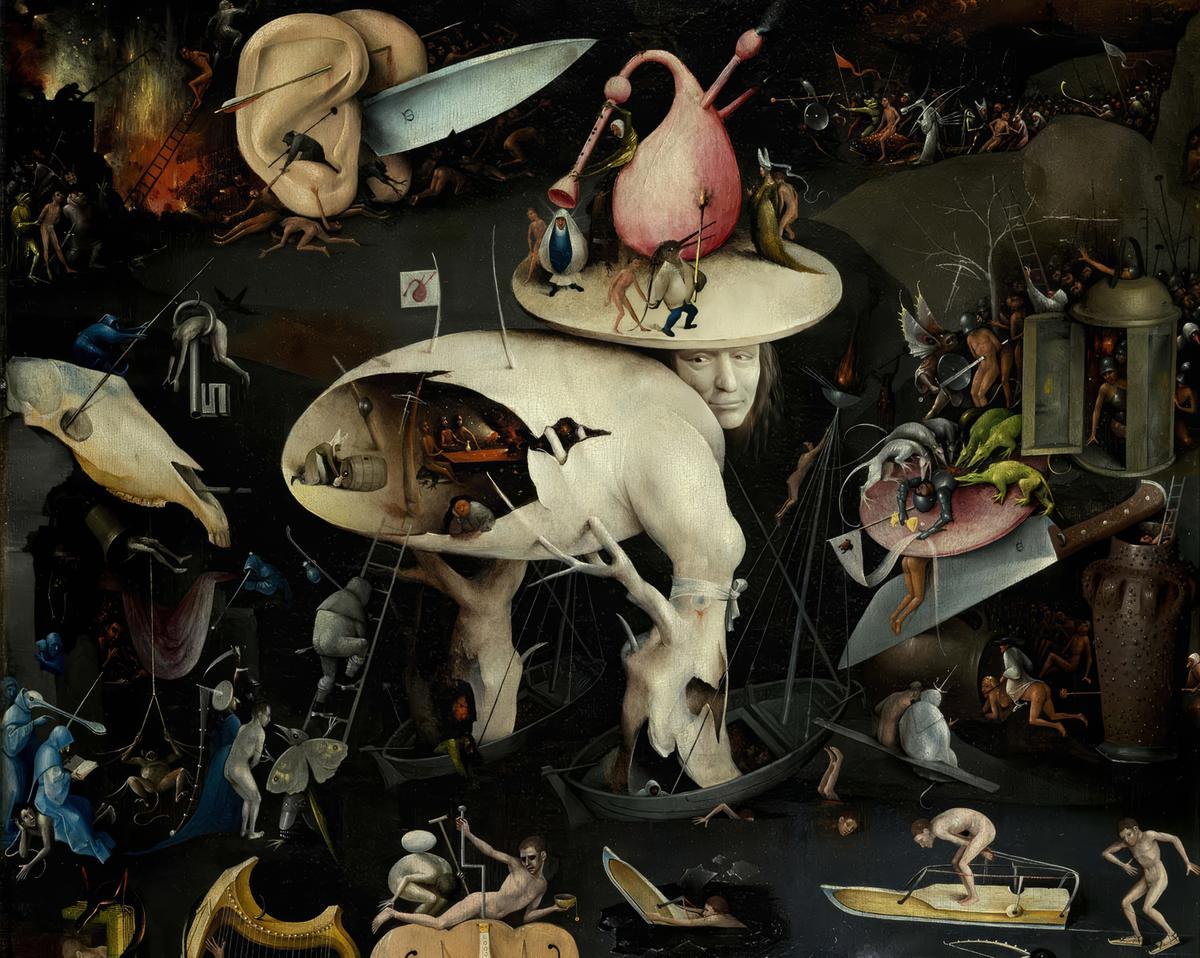
This extraordinary scene drops the viewer into a dark, teeming landscape where scale and logic are abandoned. Giant ears pierced by a blade, a hollowed-out tree-man housing a tiny tavern, and strange, hybrid creatures interact in an atmosphere of bizarre industry and silent chaos. The composition is densely packed with intricate, miniature vignettes, drawing the eye across a surreal expanse lit by distant fires and eerie, localized illumination.
The palette is grounded in deep, shadowy blacks and earthy browns, punctuated by stark whites, muted flesh tones, and flashes of unsettling red and pink. This contrast between the enveloping darkness and the highlighted, grotesque figures creates a magnetic pull. It is a piece that demands close inspection, revealing new, strange details with every viewing, bringing a powerful, dramatic mood to any space.
As wall art, this piece is a bold, intellectual statement. It thrives in a study, library, or a maximalist living room where conversation is encouraged. Whether displayed as a large gallery canvas to immerse the viewer or as a framed fine-art print for intimate study, its dark, complex aesthetic pairs well with eclectic decor, antique elements, or a carefully curated gallery wall focused on historical and surreal imagery.
Created around 1490, 1510 by Netherlandish master Hieronymus Bosch, this work is a detail from the right panel of the famous Garden of Earthly Delights triptych, held in the Museo del Prado. A pioneering work of Renaissance surrealism, it continues to fascinate modern viewers. This piece is prepared for print by Surrealium at Vaxholm Fortress, Sweden, from the museum's scan. Printed on matte museum-grade paper using archival pigment inks, each piece is made to order to ensure the bizarre and brilliant details are preserved for generations.