Atelier Editions
A contemporary Surrealium colour interpretation, not a claim to recover the artist's intended colours.
artist: Giovanni Battista Piranesi (Italian, 1720–1778)
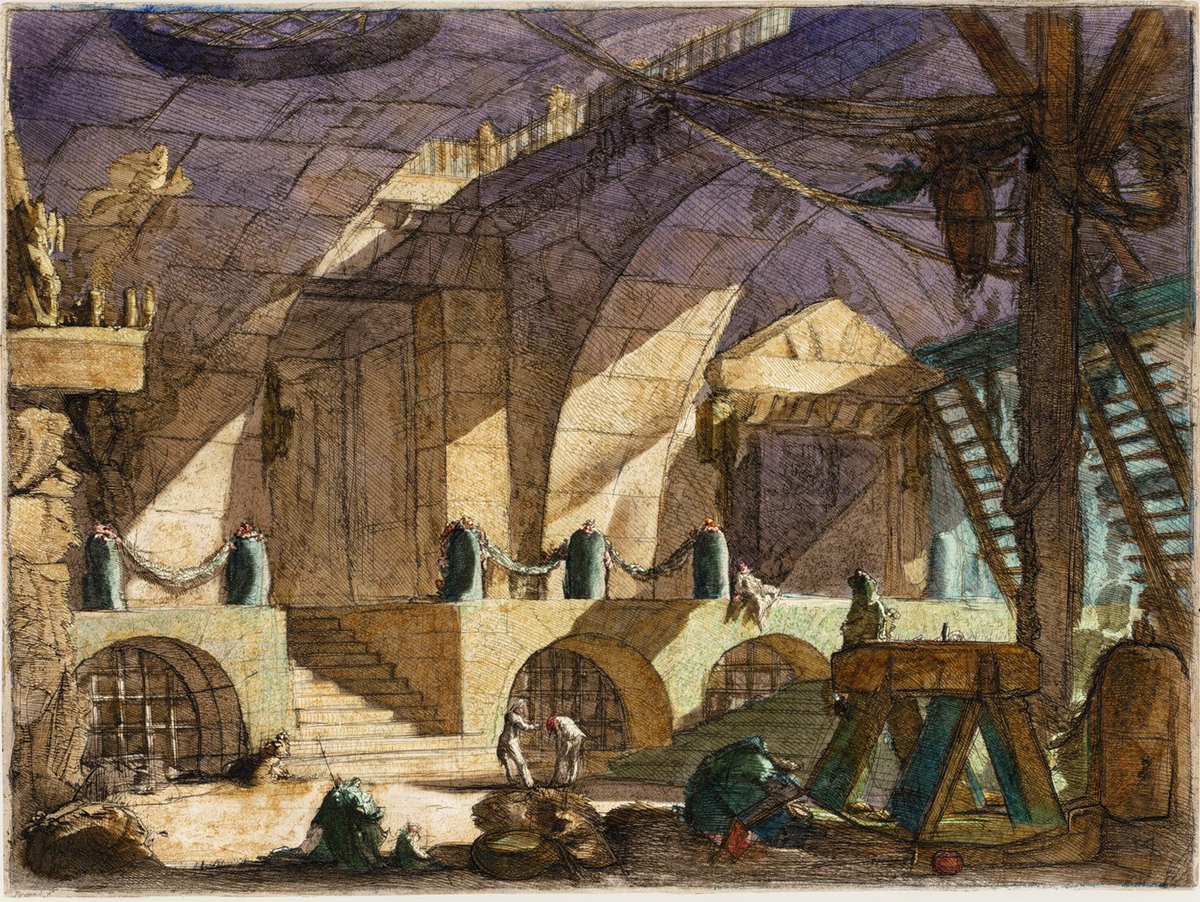
Museum original and attributionGiovanni Battista Piranesi's "Imaginary Prisons" (Carceri d'invenzione) are among the most influential architectural fantasies in art history. The original 1750 etching of The Arched Chamber captures a world of sublime, awe-inspiring dread entirely in black and white, depicting a vast, impossible interior of monumental arches, spiraling staircases, and precarious wooden walkways.
This Atelier Edition is a contemporary, AI-assisted color interpretation by Surrealium. Working from Piranesi's masterful lines, our artists curated a new palette to evoke a different mood: the cool tones of ancient limestone and verdigris contrast with the warmth of bronze and deep blue shadows. The result is a new vision of the masterpiece, one that brings its monumental light and haunting, dreamlike atmosphere to the forefront in full color.
This exclusive Surrealium edition is available to all as an archival fine-art print or gallery-wrapped canvas. Subscribers to the atelier can also use our digital tools to further customize the colors and create their own personal interpretation of Piranesi's vision.
Printed to order on matte, museum-grade paper with archival pigment inks, each piece is designed to last for generations. This edition has been interpreted and prepared by the Surrealium atelier at Kastellet, a 17th-century sea fortress in the Stockholm archipelago, with original linework by Giovanni Battista Piranesi (1720, 1778).