Aries and Musca Borealis
A celestial hand-coloured engraving capturing the Aries constellation, available as an archival fine-art print or gallery canvas.
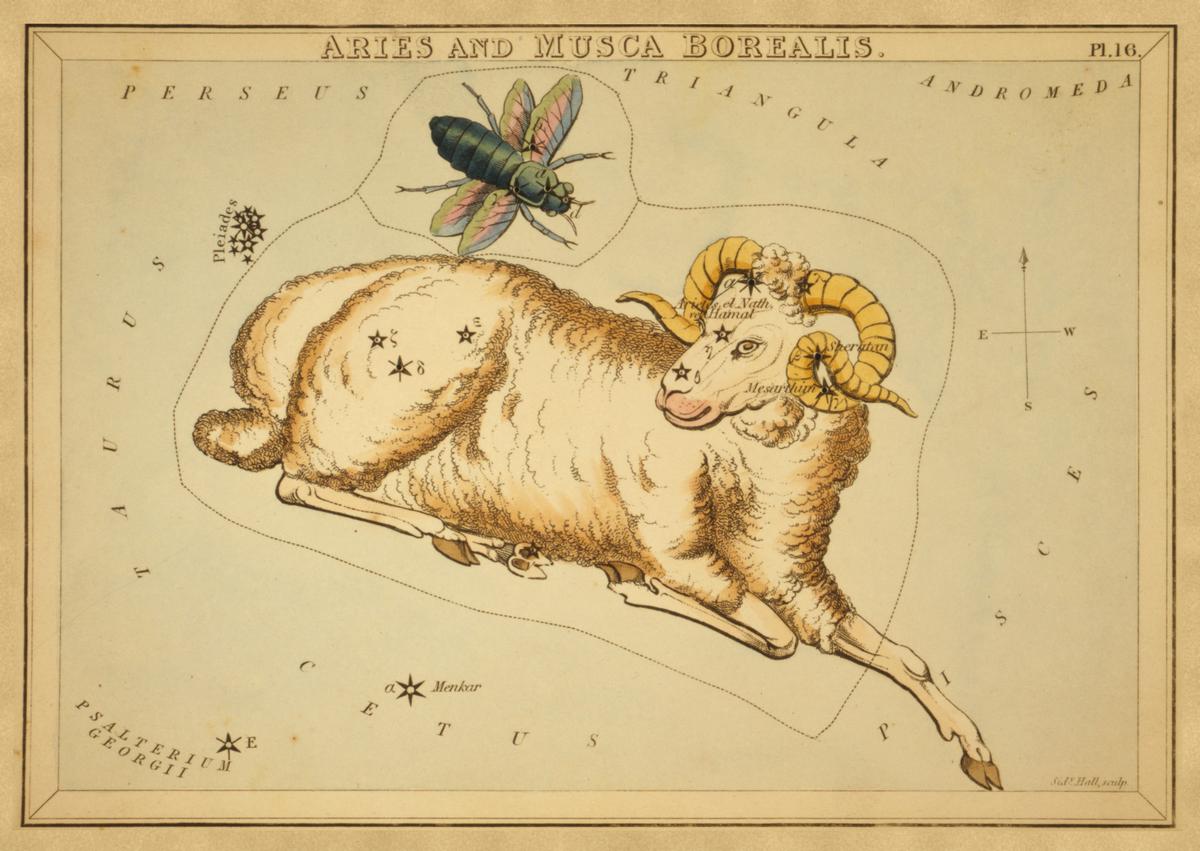
In this fascinating astronomical plate, the ram of the Aries constellation takes center stage, rendered with striking detail and golden, curling horns. Positioned beneath the watchful presence of Musca Borealis, the northern fly, the ram rests upon a pale, parchment-like background mapped with faint celestial boundaries, neighboring constellations, and delicate star markers. The linework is fine and precise, capturing the texture of the fleece and the anatomical structure with the illustrative clarity characteristic of early 19th-century scientific plates.
The palette is warm and inviting, dominated by the soft cream of the background and the gentle ochres, creams, and golden yellows of the ram. Musca Borealis offers a subtle contrast with hints of dark, iridescent blue and pale wings. This subdued, antiquarian color scheme lends the piece a quiet, scholarly atmosphere, making it a sophisticated addition to interiors that favor natural, historic, or celestial motifs.
This constellation chart is ideal for a study, library, or as a distinctive focal point in a living room. Its vintage scientific aesthetic pairs beautifully with traditional, dark academia, or eclectic interiors. As wall art, it brings a sense of wonder and historical inquiry to the space, working well either as a standalone statement piece or as part of a curated gallery wall celebrating exploration and the natural world.
Created by Sidney Hall in 1824 as part of Urania’s Mirror, this hand-coloured engraving represents the intersection of art and astronomy during the Romantic era. Originally from the Library of Congress collection, it is now available as a museum-grade archival fine-art print or gallery canvas. Prepared for print by Surrealium at Vaxholm Fortress, a 16th-century sea fortress in the Stockholm archipelago, using matte museum-grade paper and archival pigment inks, each piece is made to order to preserve the crisp linework and delicate hues of the original scan.