Camelopardalis and Custos Messium
A 19th-century celestial chart by Sidney Hall, available as an archival fine-art print or gallery canvas.
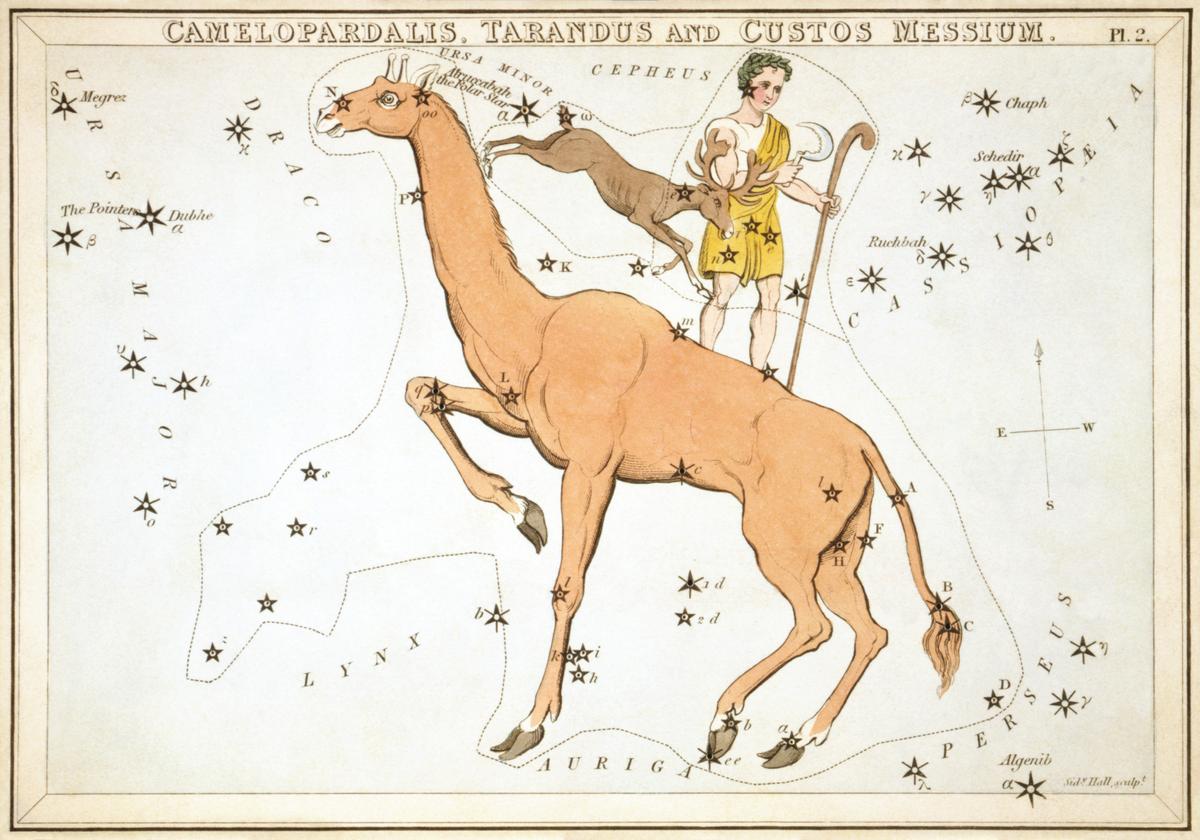
This 19th-century celestial chart maps a section of the northern sky, illustrating the constellations of Camelopardalis (the giraffe), Tarandus (the reindeer), and Custos Messium (the harvest keeper). The figures are drawn with precise, observational lines, standing against a pale, open background punctuated by black, multi-pointed stars of varying magnitudes. The giraffe dominates the composition, its long neck stretching upward, while the smaller reindeer leaps playfully nearby and the harvest keeper stands watch with his curved sickle.
The palette is soft and antiquarian, relying on muted earthen tones. Pale tans, warm ochres, and gentle yellows colour the figures, contrasting softly against the creamy, aged-paper white of the background. Fine, dotted lines trace the boundaries of the constellations, adding a delicate, scientific elegance to the romanticized mythological figures. The typographic headers and star names provide a handsome typographic texture across the upper and lower margins.
This piece brings a quiet, intellectual charm to any room. It is a natural choice for a home library, a study, or a sophisticated nursery where the night sky is celebrated. Its vintage aesthetic and clean lines make it a versatile addition to a gallery wall, pairing beautifully with natural wood frames, leather furnishings, and botanical or scientific illustrations.
Created by Sidney Hall in 1824 for the celestial atlas Urania's Mirror, this hand-coloured engraving reflects the Romantic era's fascination with astronomy and myth. Today, it is available as a museum-quality fine-art print or canvas. Prepared for print by Surrealium at Vaxholm Fortress in the Stockholm archipelago, it is rendered on matte, museum-grade paper using archival pigment inks, ensuring these ancient stars continue to shine for generations.