Flatfish, scorpion fish, and shells, from an untitled series of chuban prints
A masterly study of marine life by Hokusai, available as a museum-quality archival fine-art print or gallery canvas.
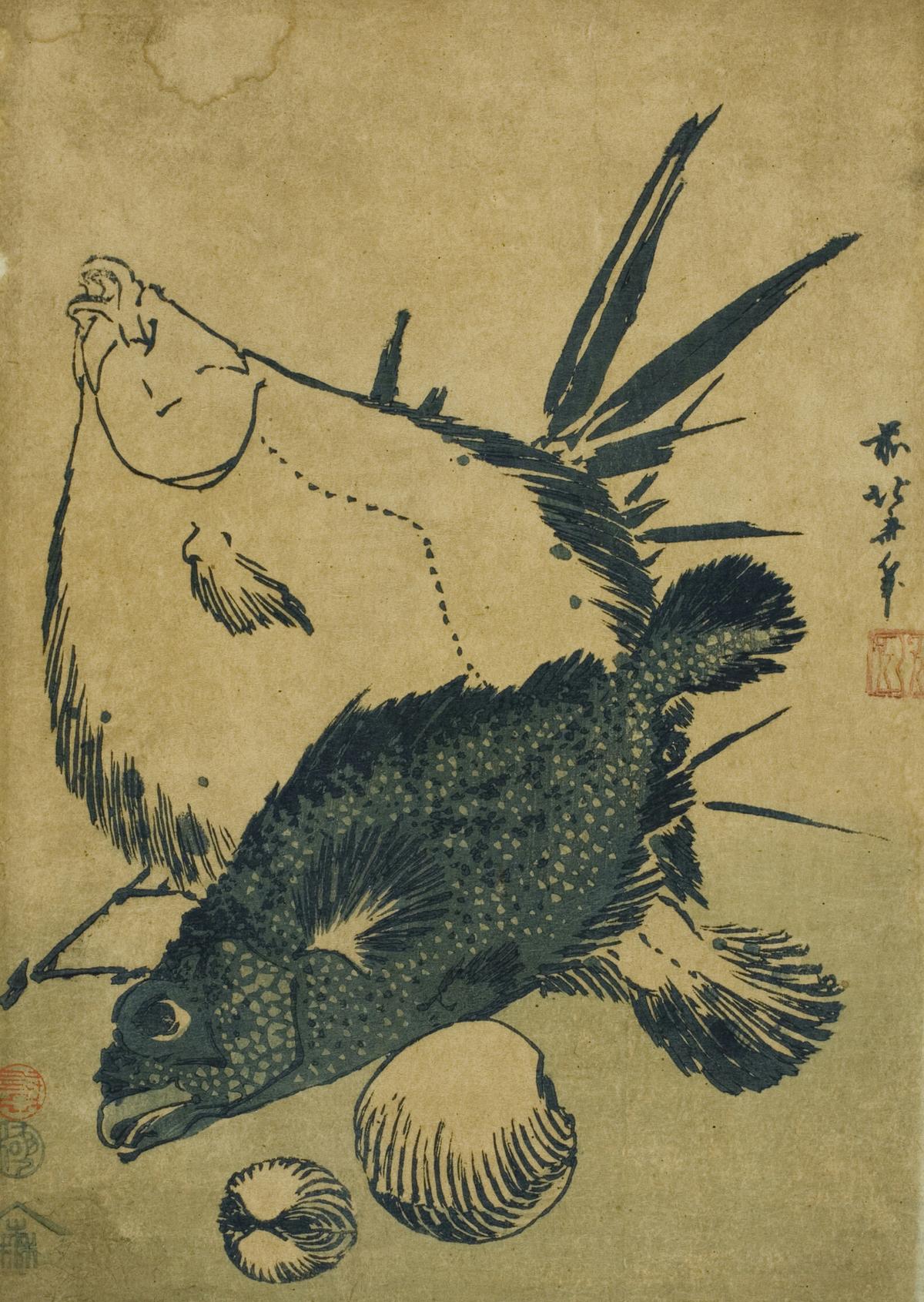
Two fish and a pair of ribbed sea shells rest against a neutral void in this quiet marine study. Sharp, calligraphic outlines define the pale flatfish with its spiky fins, while the scorpion fish below is rendered with dense, dark stippling that creates a sense of rough, mottled texture. The arrangement is masterfully balanced, drawing the eye down a diagonal path from the pale, open mouth of the top fish to the rounded forms of the shells resting at the bottom.
The color palette is remarkably restrained, relying on the contrast between deep indigo black ink and the warm, aged tone of the underlying paper. Subtle variations in ink density provide volume and weight to the aquatic subjects, contrasting beautifully against the flat, unadorned background. This minimalist approach brings a serene, contemplative mood to a space, grounded by the earthy beige and striking dark navy tones.
This piece acts as a compelling focal point for a coastal interior, a quiet reading nook, or a thoughtful dining room. As a framed fine-art print or gallery canvas, it pairs seamlessly with minimalist, vintage, or classic aesthetics. It makes an excellent addition to a curated gallery wall, where its crisp lines and organic subjects can balance more colorful or abstract artworks.
Created by the celebrated Japanese artist Katsushika Hokusai around 1831, this piece originates from an untitled series of chuban woodblock prints. Now held in the collection of the Art Institute of Chicago, it reflects the artist's keen observation of the natural world. This piece is prepared for print by Surrealium at Vaxholm Fortress, Sweden, from the museum's scan. Each archival fine-art print is made to order using matte museum-grade paper and archival pigment inks, ensuring the delicate linework and rich contrasts are preserved for generations.