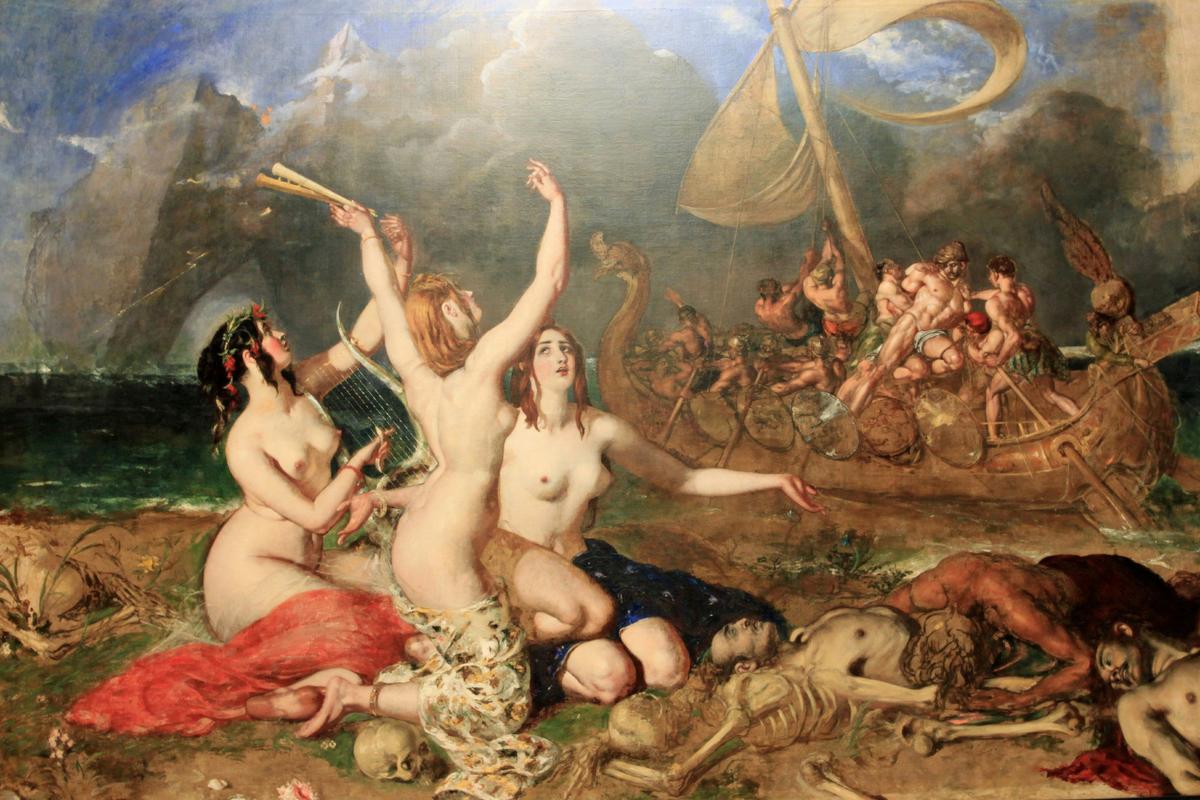
In this dramatic composition, a classical narrative unfolds against a brooding, stormy seascape. To the left, a trio of pale, alluring sirens sing from a sandy shore, their instruments raised toward the sky as they beckon. Before them lies a grim scattering of remains, a testament to past victims. In the background, a heavily manned ancient vessel battles the churning waves. At its center stands a muscular figure bound to the mast, straining against his restraints to heed the fatal call, while his crew rows desperately, their backs bent with effort beneath a billowing sail and a turbulent, overcast sky.
The palette is a striking study in contrasts, signature to the era's taste for high drama. Luminous flesh tones of the foreground figures stand out against the deep, murky blues and greens of the sea and the bruised, purplish greys of the storm clouds. Touches of crimson and gold in the drapery add vivid warmth to an otherwise perilous scene, creating a sense of movement and intense emotion that anchors the composition.
This monumental work commands attention, making it an ideal centerpiece for a study, a formal dining room, or a well-appointed living space. As a large canvas print, its historical weight and dynamic energy anchor a classic aesthetic. For a gallery wall, a framed fine-art print offers a striking narrative element, inviting closer inspection of the intricate details and the artist's masterful handling of light and anatomy.
Painted in 1837 by British artist William Etty, a leading figure of Romanticism renowned for his historical and mythological subjects, this scene, held by the Manchester Art Gallery, is a vivid interpretation of the classical epic. This piece is offered as a museum-grade archival fine-art print on matte paper or a gallery-wrapped canvas, produced to order with archival pigment inks. Each edition is prepared for print by Surrealium at Vaxholm Fortress, Sweden.