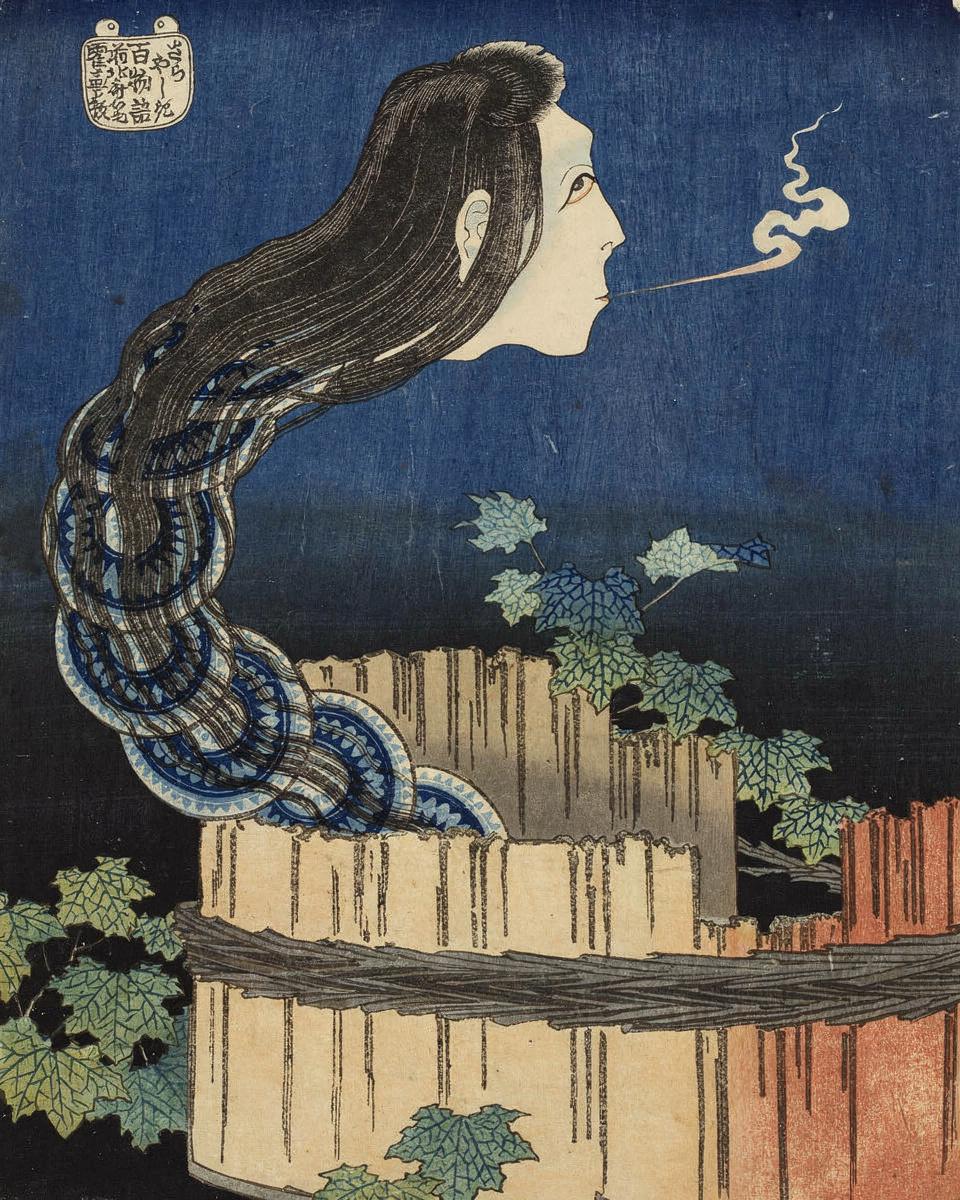
In this classic scene from Japanese folklore, the ghost of Okiku rises from a well, her spectral form composed of the very plates she was accused of breaking. Her serpentine body twists upward as her head is thrown back, hair flowing, in a silent, ethereal scream. Katsushika Hokusai uses a stark, dramatic composition to capture the climax of this famous tale, focusing all attention on the haunting figure emerging from the darkness.
The palette is defined by deep indigo and black, contrasted with the pale, ghostly blue of the porcelain plates that form Okiku's body. This stark color scheme creates an atmosphere of chilling suspense, bringing the supernatural mood of Edo-period ghost tales into any space. It adds a layer of dramatic, historical storytelling to a room, inviting curiosity and conversation.
As a striking piece of wall art, "The Mansion of the Plates" commands attention in a living room, study, or hallway. Its bold graphic quality complements both modern and classic interiors, serving as a captivating focal point or as a key piece in a curated gallery wall dedicated to Japanese art or mythic storytelling.
Originally created circa 1831 by the master of ukiyo-e, Katsushika Hokusai, this work is a celebrated example from his "One Hundred Ghost Tales" series. This museum-quality reproduction is printed on archival, acid-free matte paper using pigment inks for lasting color and detail. Each print is restored and certified by the Surrealium atelier at Kastellet, a 17th-century sea fortress in the Stockholm archipelago.