Famous horse paintings: 14 masterworks from Wouwerman to Stubbs and Géricault
Painters have always loved horses and feared getting them wrong. These fourteen got them right, from a Dutch grey in 1646 to a Romantic stallion running from wolves.
A horse is one of the hardest things in the world to paint. It is all muscle and movement, it will not stand still, and anyone who rides will spot a wrong leg at once. For centuries painters of horses were specialists, paid as much as portrait painters and sometimes more.
These are fourteen of the most famous horse paintings, from the Dutch Golden Age to the Romantics, each restored from its museum scan. Some are portraits of famous horses, some are portraits of horses that were simply loved.
The Dutch grey
The first painters to make a living from horses were Dutch. In the seventeenth century, Philips Wouwerman painted so many grey and white horses that collectors came to expect one in every picture he sold.
1. The Grey Horse
Philips Wouwerman, The Grey Horse, 1646. Rijksmuseum, Amsterdam.
A grey horse stands on a rise against a huge sky, and the man holding it is almost an afterthought. Wouwerman's pale horses became his signature. He painted hundreds of pictures in his lifetime, and many of them have a white horse somewhere in the light.
2. The "Piebald" Horse
Paulus Potter, The "Piebald" Horse, c. 1650–1654. J. Paul Getty Museum, Los Angeles.
Paulus Potter died at twenty-eight and is best known for a life-size bull. This spotted horse, standing alone in a Dutch meadow, is a portrait in the full sense: no rider, no story, just the animal and its remarkable coat.
Stubbs and the English horse
In eighteenth-century England, racing and hunting made horses status symbols, and George Stubbs became the greatest horse painter who ever lived. He had spent eighteen months dissecting horses to draw The Anatomy of the Horse, published in 1766, and no one before him had understood how a horse is built.
3. Bay Hunter by a Lake
George Stubbs, Bay Hunter by a Lake, 1787. Tate, London.
A bay hunter stands in profile by a lake, posed as calmly as a gentleman in a portrait. Look at the light on the shoulder and flank: under the glossy coat you can see every muscle Stubbs had studied.
4. A Grey Horse Galloping in a Field
George Stubbs, A Grey Horse Galloping in a Field, 1793. Royal Collection.
A grey horse gallops across an open field with nothing to stop it. Stubbs paints it with legs flung forward and back, the way artists showed galloping horses until photography proved in the 1870s that no horse ever moves like that. It hardly matters: the picture feels like speed.
5. Horses in a Thunderstorm
Sawrey Gilpin, Horses in a Thunderstorm, 1798. Royal Academy of Arts, London.
Gilpin, a contemporary of Stubbs, wanted to give horses the drama of history painting. Three horses panic under a tree as lightning cracks the sky. It is a picture about fear, and about how a horse feels it with its whole body.
6. A Grey Pony and a Black Charger in a Stable
Jacques-Laurent Agasse, A Grey Pony and a Black Charger in a Stable, 1804.
The Swiss painter Agasse made his career in London painting animals for English patrons. In a dim stable, a grey pony and a big black charger stand together like an odd couple. It is a quiet, affectionate picture of two horses who are clearly used to each other.
The Romantic horse
For the French Romantics the horse was passion itself: wild, noble and dangerous. Théodore Géricault rode, painted and studied horses obsessively, and his circle turned them into heroes of history and poetry.
7. Turkish Horse in a Stable
Théodore Géricault, Turkish Horse in a Stable, 1811. Musée du Louvre, Paris.
Géricault painted this at twenty, around the time he was drawing horses in the imperial stables at Versailles. A fine-boned horse waits in an ornate saddle, its dark coat almost melting into the shadows. You can feel the young painter's love for the animal in every stroke.
8. Head of a White Horse
Théodore Géricault, Head of a White Horse, c. 1815. Musée du Louvre, Paris.
Just a head, out of the dark: ears pricked, eyes bright, nostrils flared. Géricault painted it as a study, but it is one of the most intense horse portraits ever made. He died at thirty-two, after a series of riding falls.
9. Marengo
James Ward, Marengo, 1824.
Marengo was Napoleon's grey Arab stallion, named after one of his victories. He was captured at Waterloo and brought to England, where James Ward painted him against a burning sky, still every inch an emperor's horse. His skeleton survives at the National Army Museum in London.
10. Mazeppa and the Wolves
Horace Vernet, Mazeppa and the Wolves, 1826. Musée Calvet, Avignon.
In Byron's poem Mazeppa, a young page is tied to the back of a wild horse and sent galloping across the steppe. Vernet shows the worst moment, with wolves closing in through the trees. The story was a favourite of the Romantics, and Vernet painted it more than once.
The horse portrait
By the mid-nineteenth century, owners wanted their horses painted the way they wanted their children painted: beautiful, recognisable and in their best light. Alfred de Dreux became the favourite horse painter of the French court.
11. Horsewoman (Amazon)
Alfred de Dreux, Horsewoman (Amazon), 1848.
An elegant rider sits side-saddle on a white horse, with a little spaniel running at their heels. De Dreux painted horses for the French royal family and later for Napoleon III, and his pictures are pure elegance: silk, silver light and a horse that moves like a dancer.
12. Horses in Freedom
Alfred de Dreux, Horses in Freedom, c. 1850. Museo Nacional de Bellas Artes, Buenos Aires.
A bay horse in a wide field, its coat shining like polished wood, with others grazing far behind. De Dreux painted the horse almost like a portrait sitter, head turned in profile, and the empty landscape around it says freedom.
13. The Arab Tent
Edwin Landseer, The Arab Tent, 1866. Wallace Collection, London.
Landseer, better known for his dogs, painted a white Arab mare resting with her foal in a tent hung with skins. It is a fantasy of the East as Victorians imagined it, and a tender picture of a mother and her young.
14. Man with Lance Riding through the Snow
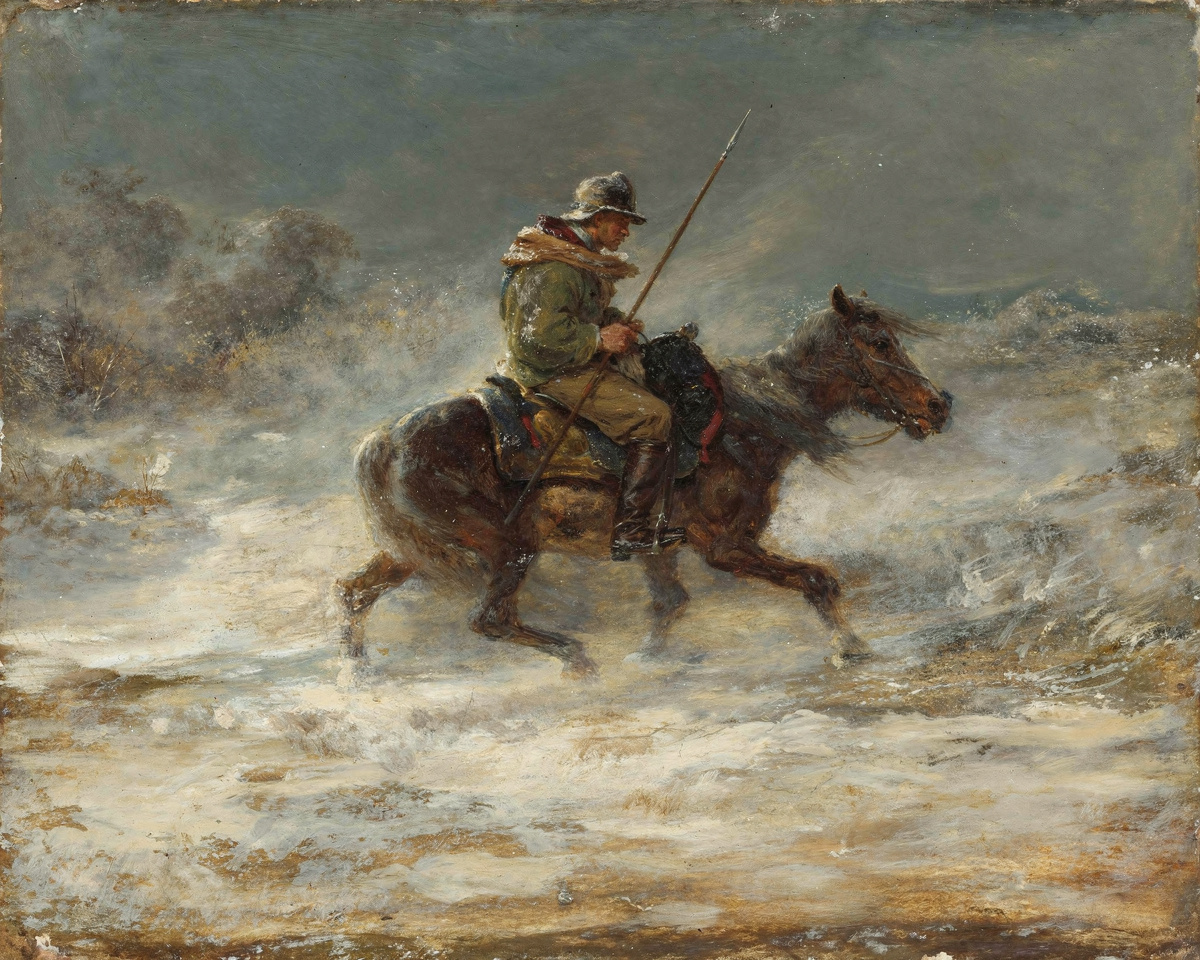
Adolphe Schreyer, Man with Lance Riding through the Snow, 1875. Art Institute of Chicago.
Schreyer spent years travelling in Eastern Europe and North Africa, painting horsemen on the move. Here a rider pushes his horse through a blizzard, the snow whipped up around them in loose, rapid paint. It is the most wintry picture here, and a natural choice for a Christmas card.
Common questions
What is the most famous horse painting?
George Stubbs's Whistlejacket, a life-size portrait of a racehorse painted around 1762 and now in the National Gallery, London, is usually called the most famous horse painting in the world. Géricault's horses and Rosa Bonheur's The Horse Fair are close rivals.
Who was the greatest painter of horses?
George Stubbs, the English painter who dissected horses to understand their anatomy and published The Anatomy of the Horse in 1766. In France, Théodore Géricault and Alfred de Dreux were the great horse painters of the nineteenth century.
Why did old paintings show galloping horses with all four legs outstretched?
Before photography no one could see exactly how a horse's legs move at a gallop. In the 1870s Eadweard Muybridge's photographs showed that a galloping horse never stretches all four legs at once, and painters slowly changed how they drew them.
Can I have my horse painted like a masterwork?
Fable makes portraits from photos in the manner of old masters, and any painting here can be printed or sent as a card from Fable Cards.
Every painting here is restored from its museum scan and printed to order. For the dogs that shared their stables, read Famous dog paintings, and for the cats who ruled the house, Famous cat paintings.