The history of the Christmas card, in twelve Victorian cards
In 1843 a busy civil servant had too many letters to write and asked a painter friend for help. Fifty years later Britain was posting millions of Christmas cards. Here is how it happened, card by card.
Every Christmas card you have ever sent goes back to one afternoon in 1843. Henry Cole, a London civil servant with a talent for new ideas, had a stack of Christmas letters to answer and no time to write them. So he asked his friend, the painter John Callcott Horsley, to design a printed card he could simply sign.
Within fifty years the Christmas card had become a Victorian obsession, with robins, mistletoe, frogs, rabbits and Father Christmas posted by the million. Here is that story in twelve original cards from the archives, each restored by Fable from the museum's own copy, and two paintings that shaped them. Every card can still be sent this Christmas, with your own words inside.
A shilling each
The Penny Post, introduced in 1840, let anyone send a letter anywhere in Britain for a penny. Henry Cole had helped bring it in, and three years later he used it for something new. Horsley's card was printed as a lithograph, coloured by hand, and about a thousand copies were sold at a shilling each, a high price at the time.
1. The first Christmas card
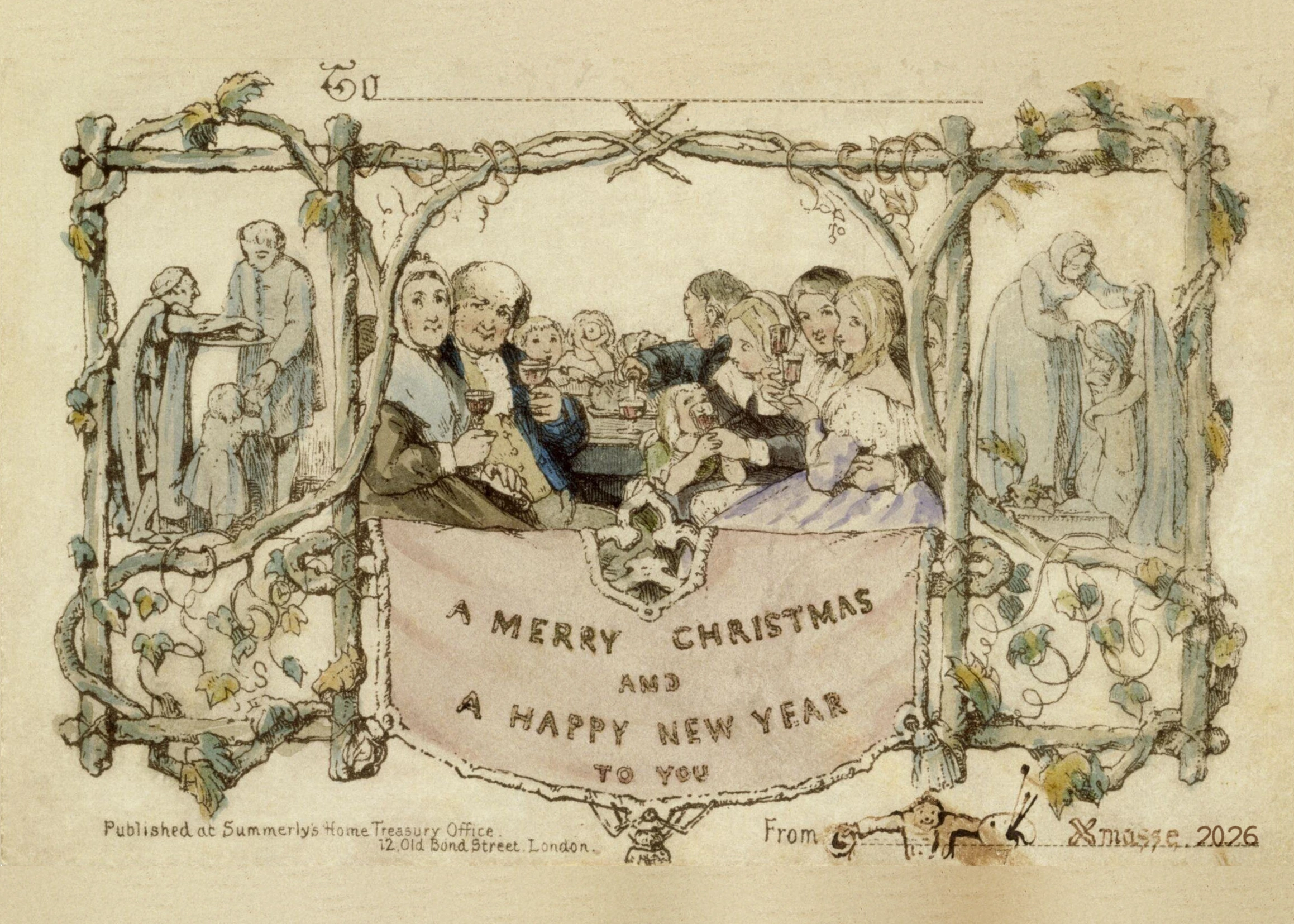
John Callcott Horsley, the first Christmas card, 1843. Victoria and Albert Museum, London. Restored by Fable from the V&A copy; the printed year re-lettered for this Christmas in the card's own hand.
Horsley drew a family at a Christmas party raising their glasses, with scenes of charity on either side: feeding the hungry and clothing the cold. It was criticised at the time because one of the children is drinking wine. The greeting printed on it, A Merry Christmas and a Happy New Year to you, is the one we still use.
2. The second Christmas card
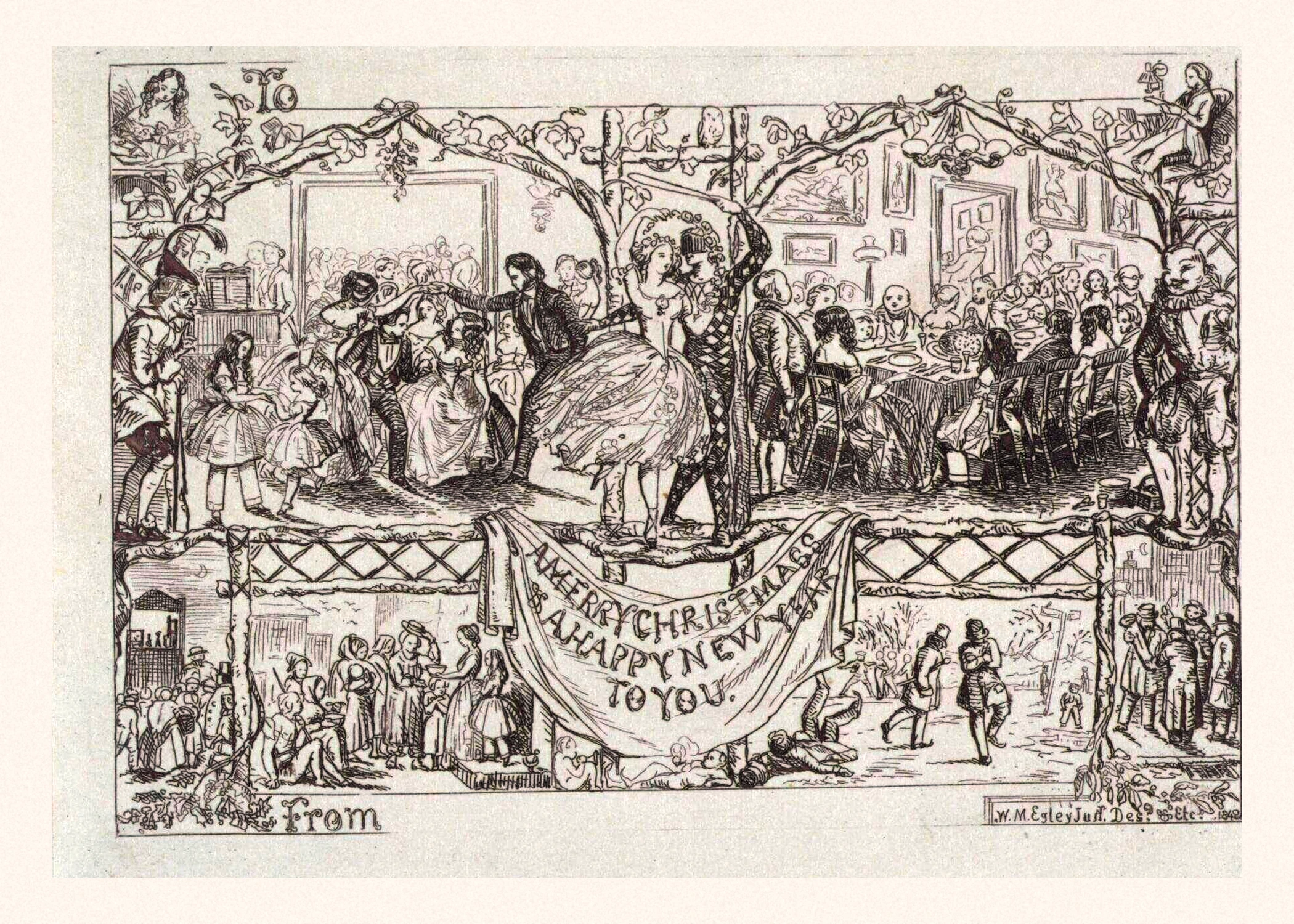
William Maw Egley, the second Christmas card, 1848. Victoria and Albert Museum, London. Restored by Fable from the museum's copy.
Five years later the illustrator William Maw Egley etched his own card, crowded with life: a Christmas ball, a banquet and the street outside, all hung with garlands around a central banner. It is a whole Victorian Christmas on one small sheet, with To and From left blank to fill in.
3. Queen Victoria's Christmas Tree
William Corden the Younger, Queen Victoria's Christmas Tree, 1850–51. Royal Collection.
In 1848 the Illustrated London News showed Queen Victoria and Prince Albert's family around their Christmas tree at Windsor, and the tree became the symbol of a modern family Christmas. This painting of the Queen's own tree shows the scene that card makers would copy for the rest of the century.
Robins, holly and lace
As colour printing became cheaper, cards poured out of the printers. Some were edged with embossed paper lace, some cut into shapes, and many were tiny enough to slip into a letter. A few motifs appeared again and again, and some of them are still with us.
4. Robins by a snowy church
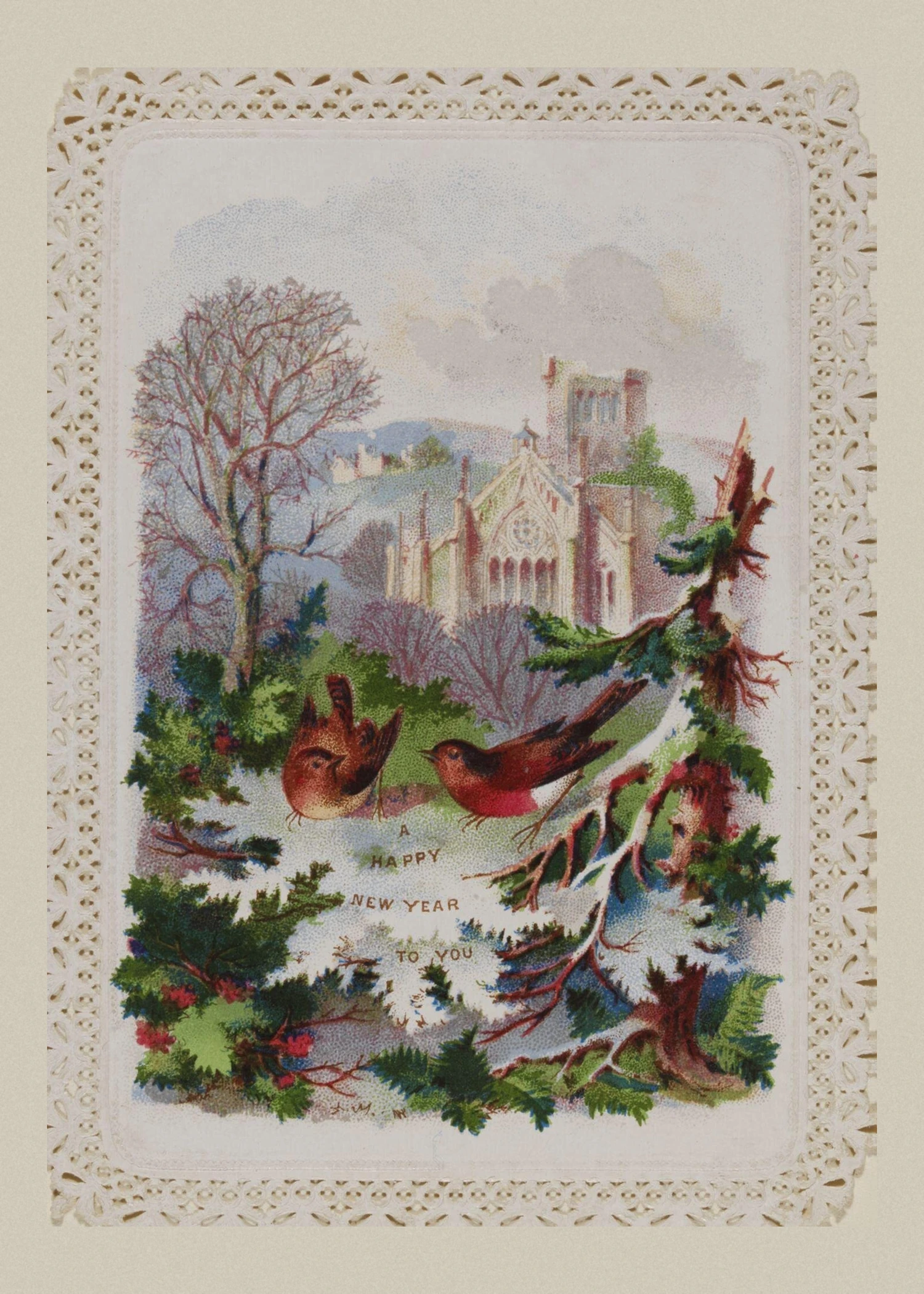
Robins by a snowy church, c. 1870s. Victoria and Albert Museum, London. Restored by Fable from the museum's copy.
Why so many robins? Victorian postmen wore red coats and were nicknamed robins, so a robin on a card was a little joke about the post itself. Over time the bird simply became part of Christmas. This one sits in holly before a snowy church, framed in a border of paper lace.
5. Robin on a Christmas box
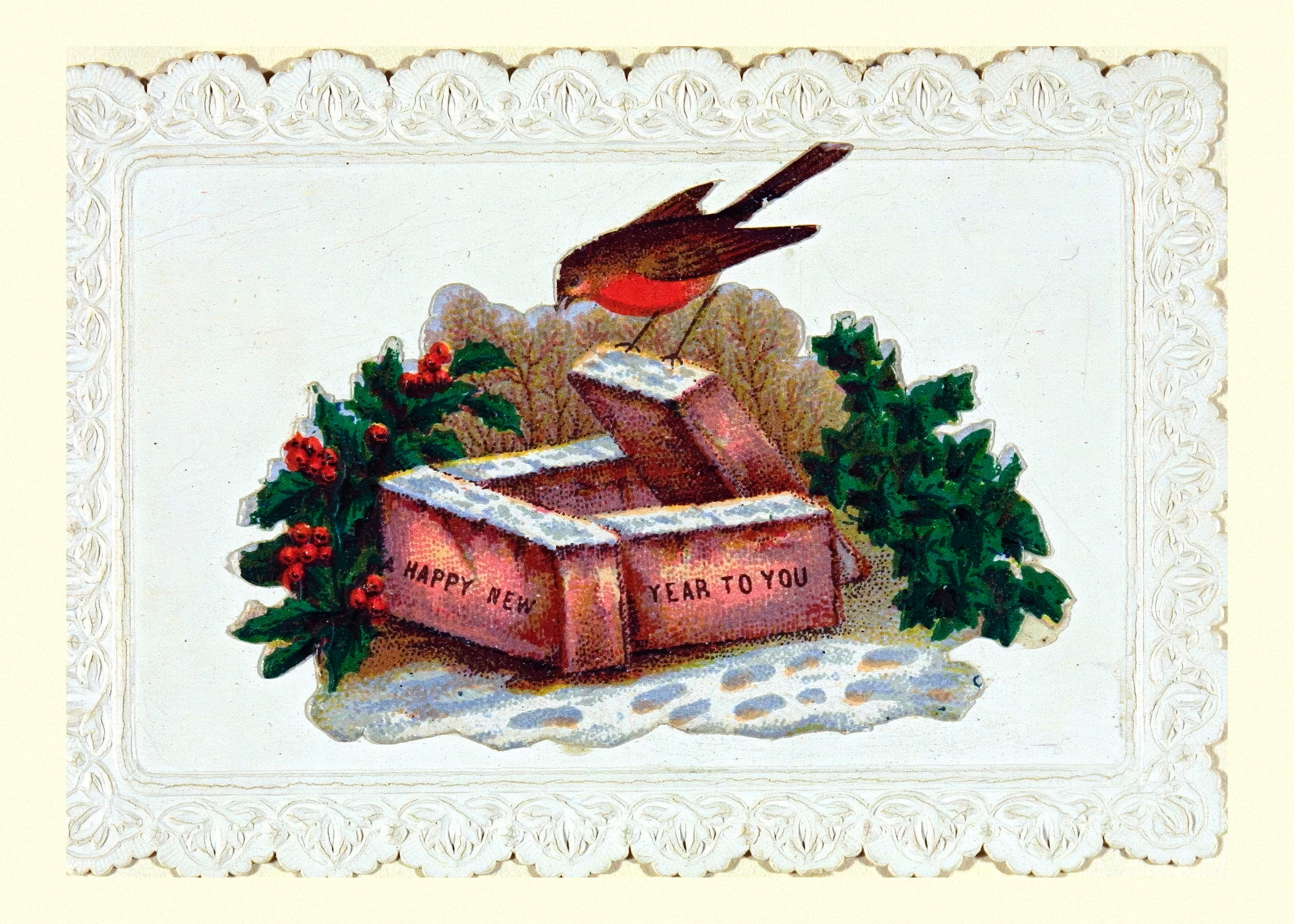
Robin on a Christmas box, c. 1870s. Victoria and Albert Museum, London. Restored by Fable from the museum's copy.
A robin perches on a red box tied up for New Year, with holly on either side. The Christmas box was the gift of money or food given to tradespeople and servants after Christmas Day, which is where Boxing Day gets its name. The embossed paper lace around the picture was a mark of a good card.
6. May Christmas bring delight
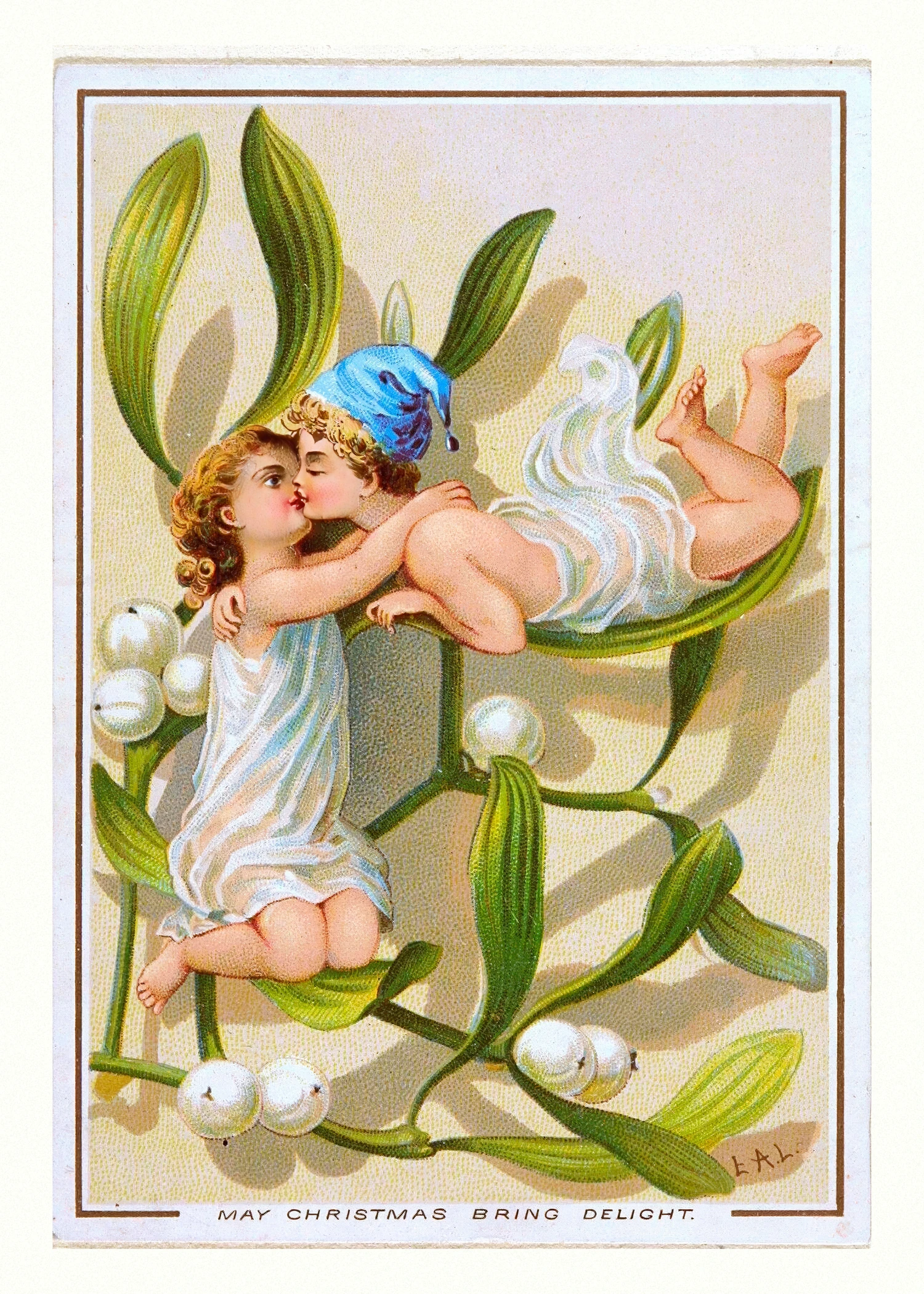
E.A.L., May Christmas bring delight, c. 1850–1899. Victoria and Albert Museum, London. Restored by Fable from the museum's copy.
Two little cherubs kiss on a giant sprig of mistletoe. Kissing under the mistletoe was a Victorian Christmas custom, and every kiss was supposed to cost one berry. The designer signed only with the initials E.A.L., and the card is all charm.
When artists took over
By the 1870s publishers were hiring real artists. Walter Crane, one of the great illustrators of the age, designed cards for Marcus Ward of Belfast, and in America Louis Prang ran competitions with large cash prizes for the best Christmas designs.
7. A Christmas figure
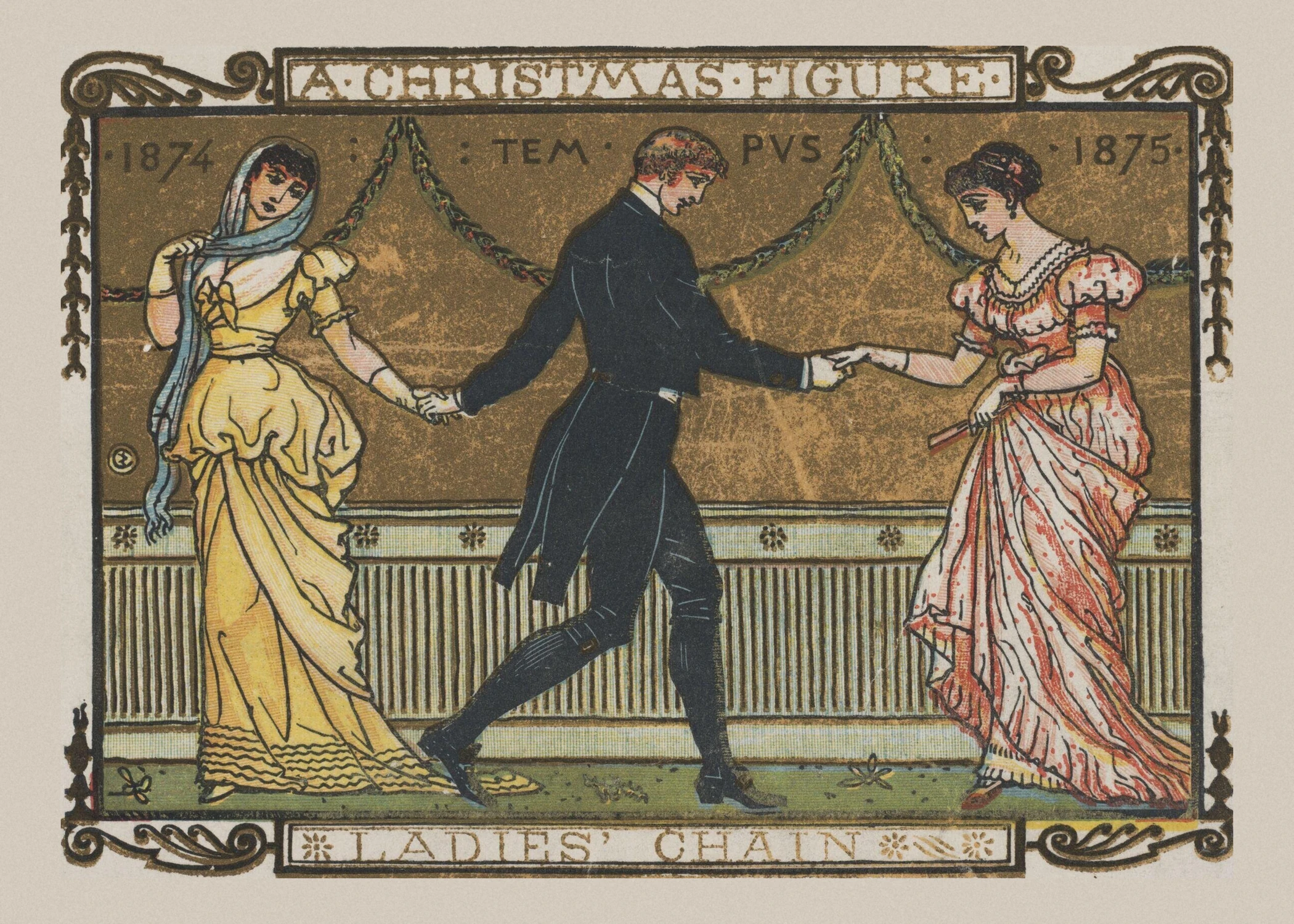
Walter Crane, A Christmas figure, 1875. Victoria and Albert Museum, London. Restored by Fable from the museum's copy.
Walter Crane's card is a pun: a Christmas figure is a dance step, and this one is the Ladies' Chain, danced at parties across the New Year from 1874 to 1875. The gold ground and elegant line are pure Aesthetic Movement, and they make most cards of the time look clumsy.
8. The frog band
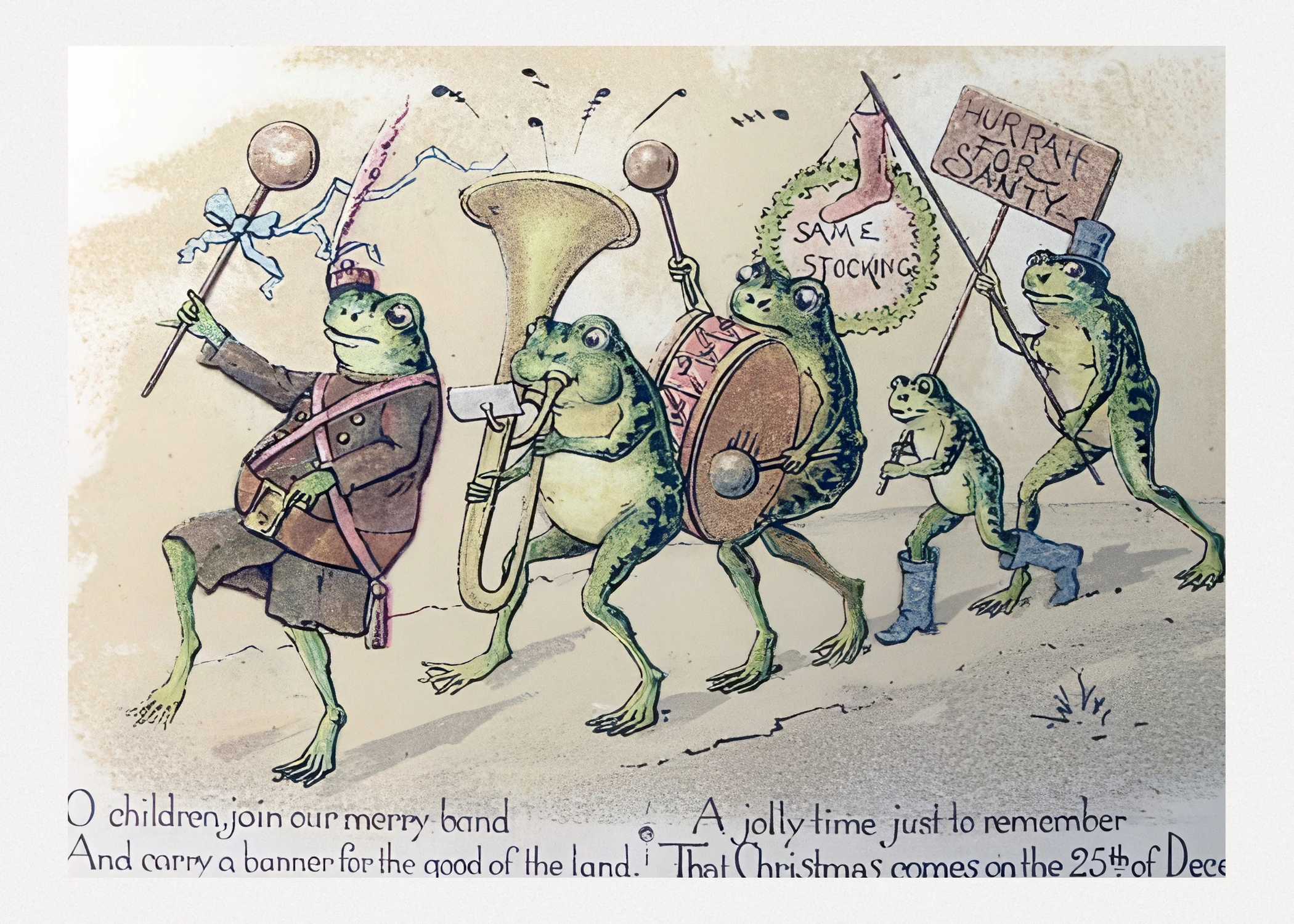
L. Prang & Co., Christmas card, the frog band, c. 1880s. Boston. Restored by Fable from an archive copy (Wikimedia Commons).
Louis Prang, a German immigrant printer in Boston, is often called the father of the American Christmas card; he began selling them in the United States in 1875. Not all his cards were solemn. Here a band of frogs marches through the snow with a tuba, a drum and a banner reading Hurrah for Santy. Victorians loved animals behaving like people on their cards.
9. Bird's Nest and Ferns
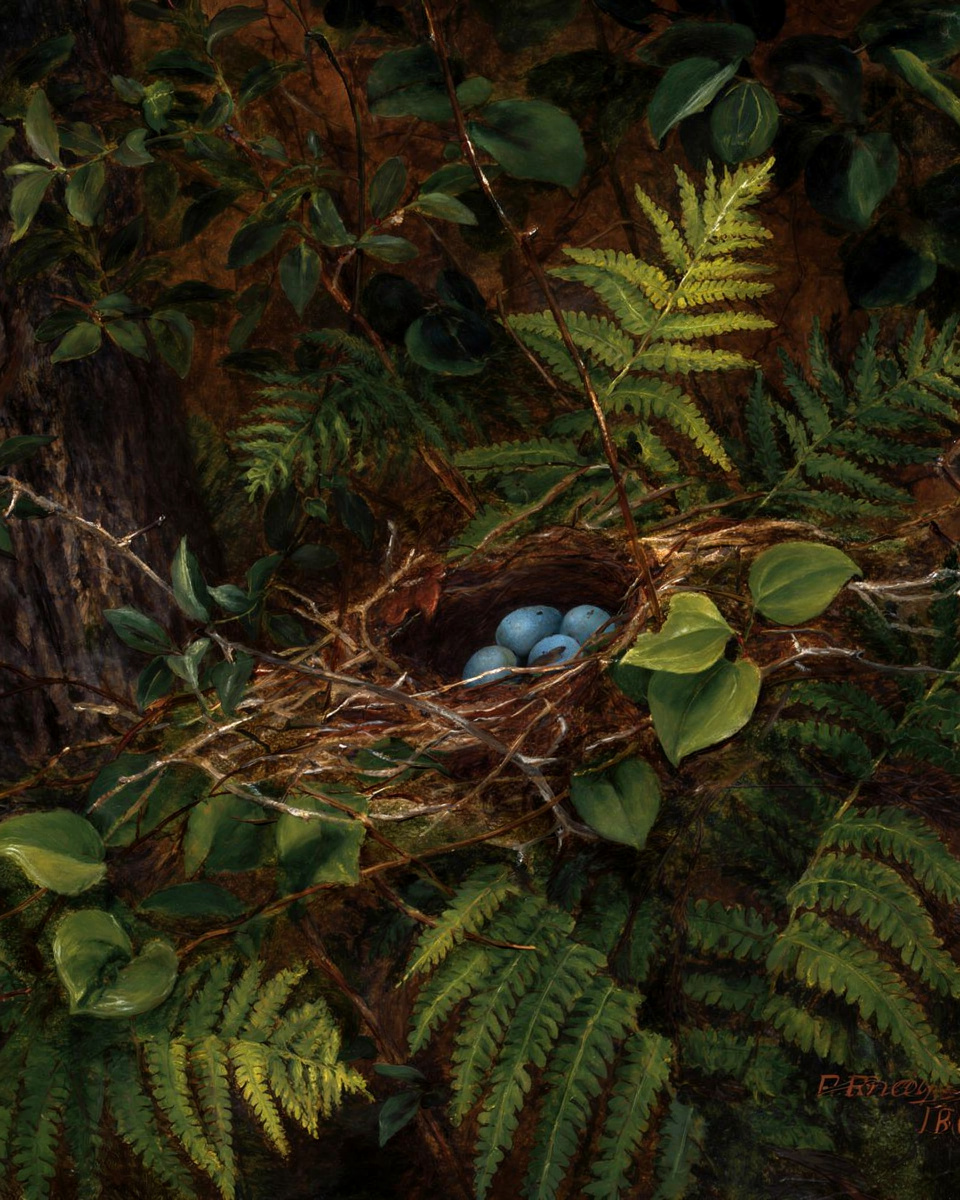
Fidelia Bridges, Bird's Nest and Ferns, 1863. Art Institute of Chicago.
Fidelia Bridges was one of the painters Prang hired. She was a careful observer of birds and plants, and from 1881 she designed cards and chromolithographs for him. Her quiet nature studies, like this nest of blue eggs among ferns, show the delicacy Prang wanted in his best cards.
10. Merry Old Santa Claus
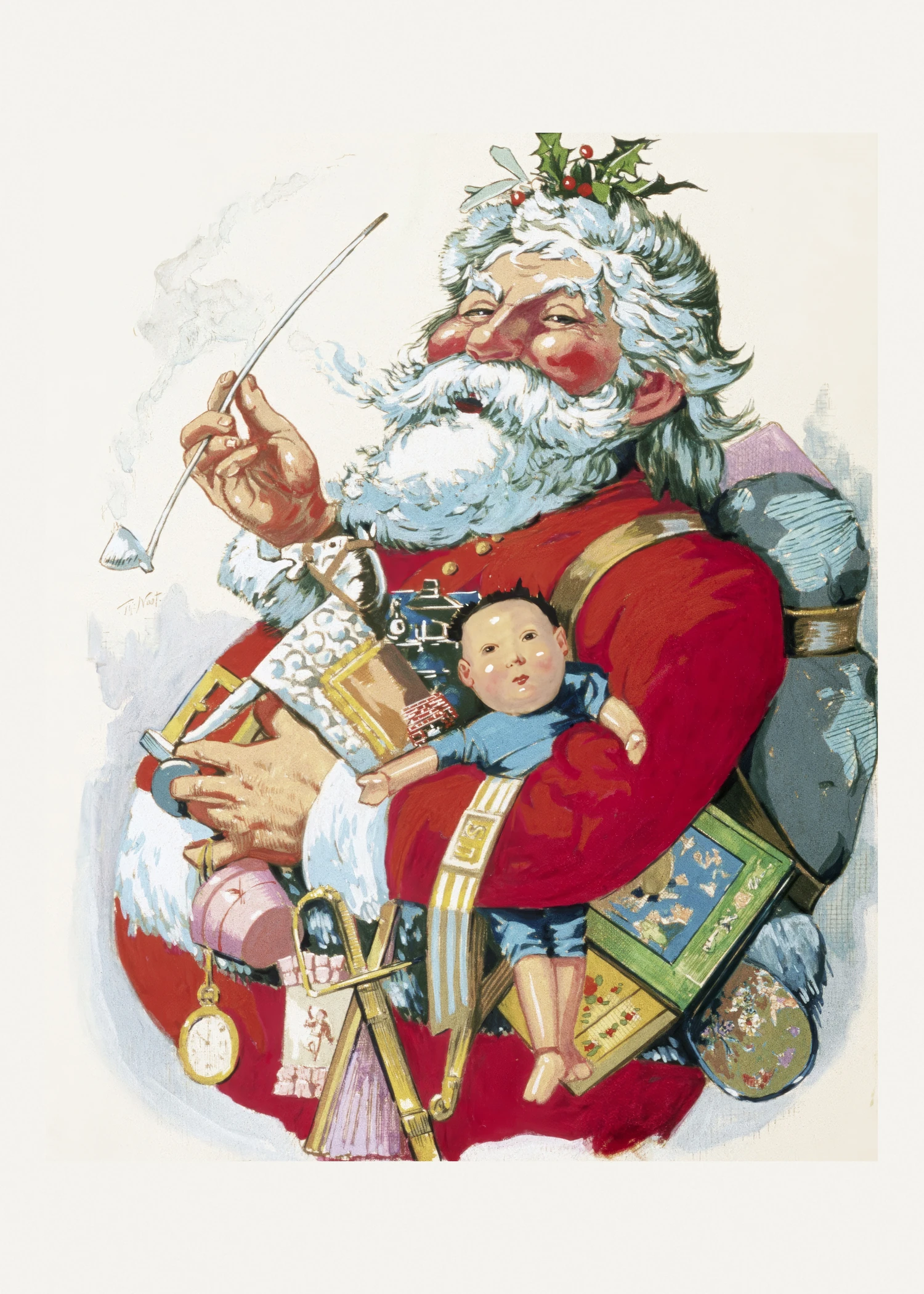
Thomas Nast, Merry Old Santa Claus, Harper's Weekly, 1 January 1881. Restored by Fable from an archive copy (Wikimedia Commons).
The cartoonist Thomas Nast drew Santa Claus for Harper's Weekly for over twenty years, and this 1881 picture fixed his look for good: round belly, white beard, red suit, pipe and arms full of toys. Card makers on both sides of the Atlantic copied him for decades.
The golden age
By the late 1880s Christmas cards were big business. Raphael Tuck & Sons in London became the most famous card publisher in the world, and in 1893 received a royal warrant. Cards were printed in Germany, sold in Britain and America, and collected into albums by the million.
11. Highlanders at Christmas
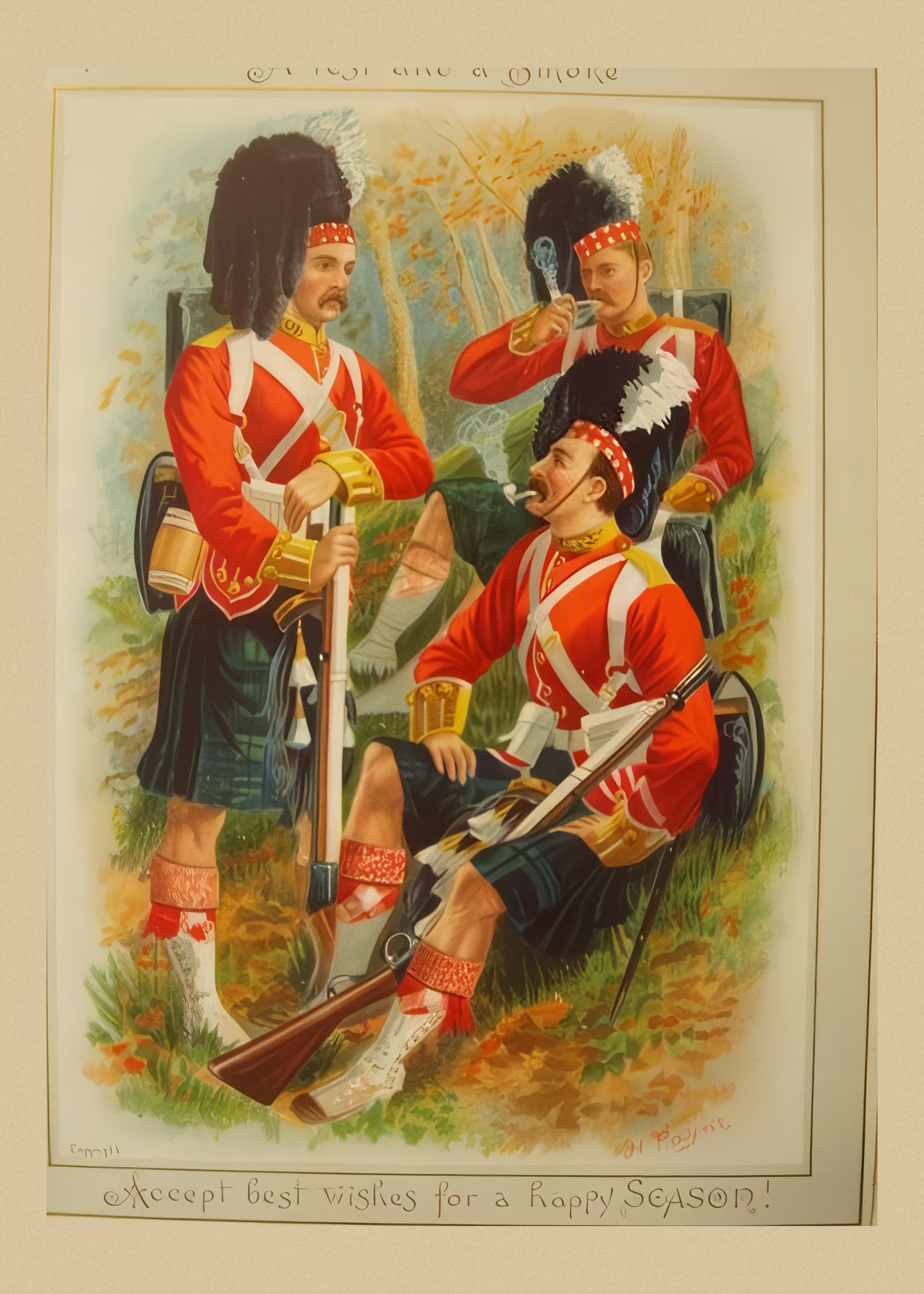
Harry Payne, Highlanders at Christmas, c. 1887. Raphael Tuck & Sons. Victoria and Albert Museum, London. Restored by Fable from the museum's copy.
Harry Payne specialised in soldiers, and Tuck published his military cards to send to and from regiments around the world. Three Highlanders take a rest and a smoke under the trees, with best wishes for a happy season. It is a card made for a soldier far from home.
12. The happy pair
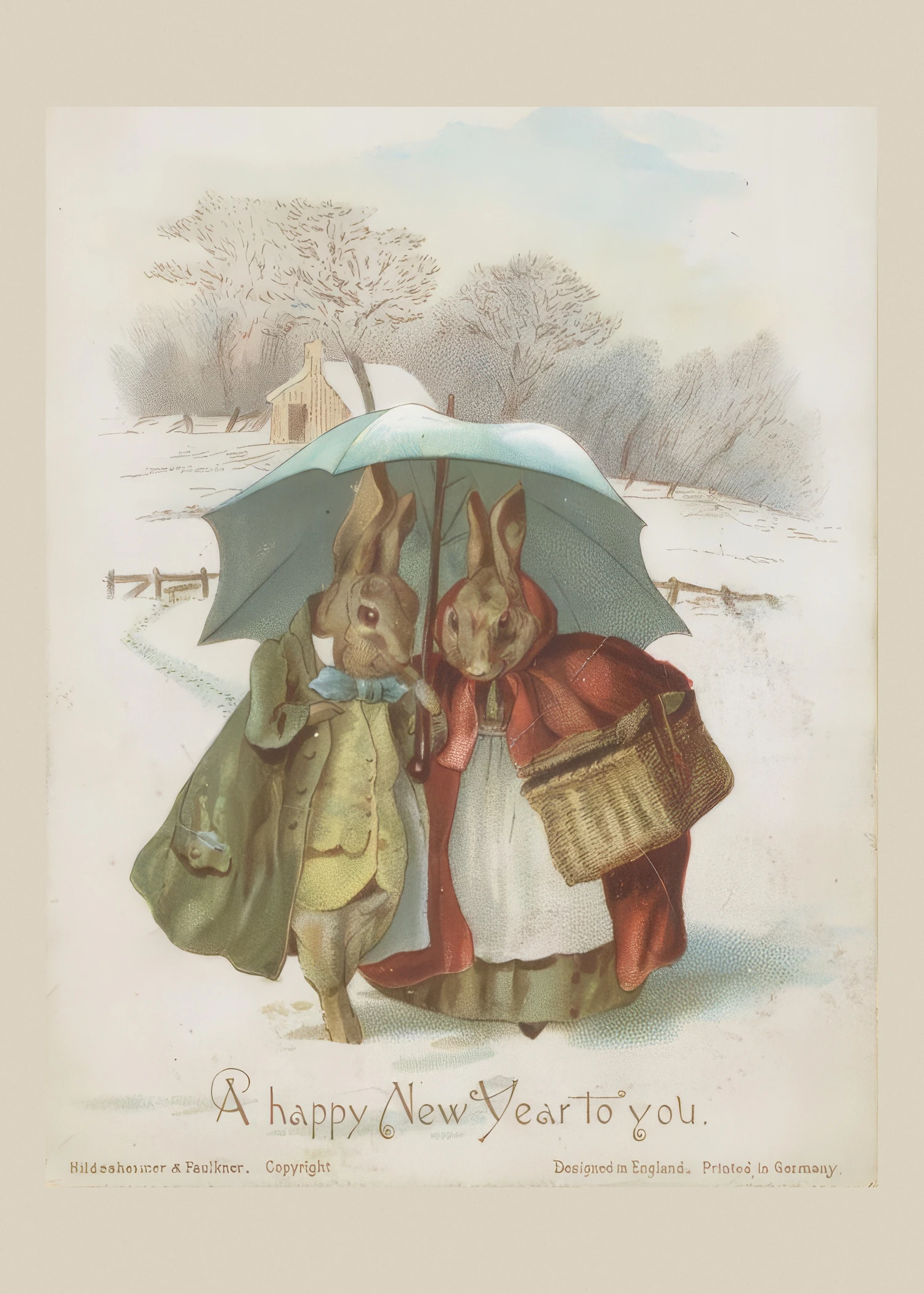
Beatrix Potter, The happy pair, 1890. Hildesheimer & Faulkner. Victoria and Albert Museum, London. Restored by Fable from the museum's copy.
In 1890, at twenty-four, Beatrix Potter sold a set of drawings of her pet rabbit Benjamin Bouncer to the card publisher Hildesheimer & Faulkner. It was the first money she ever earned from her art, years before Peter Rabbit. Here two rabbits in coats and capes walk out together under one umbrella in the snow.
13. Father Christmas with a sack of toys
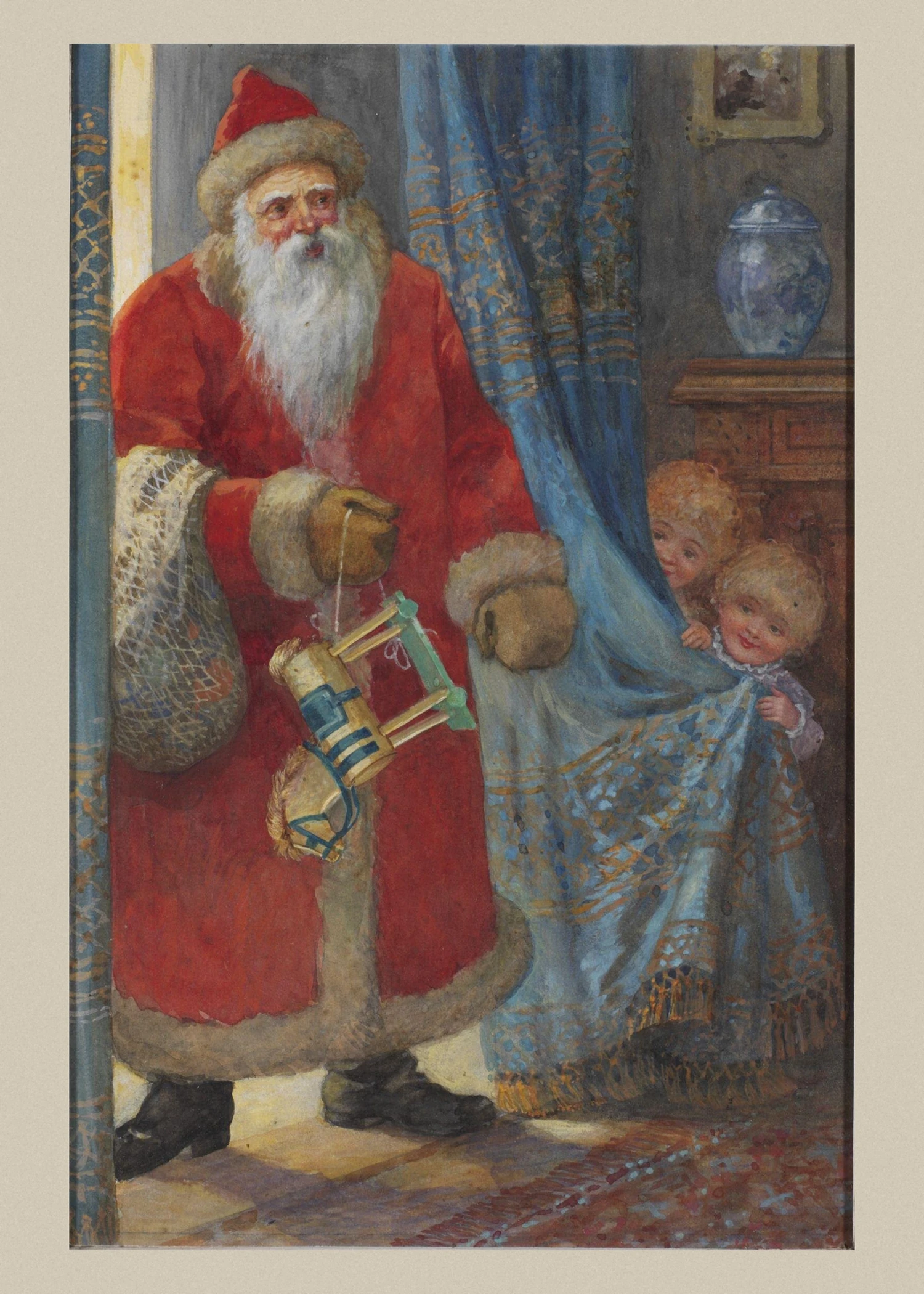
K. Röger, Father Christmas with a sack of toys, c. 1890. Ernest Nister. Victoria and Albert Museum, London. Restored by Fable from the museum's copy.
Father Christmas in a long, fur-trimmed red robe arrives with his sack, while two children peep out from behind the curtain. The publisher Ernest Nister printed his cards and books in Nuremberg, the centre of fine colour printing, and this one has the rich depth of a small oil painting.
14. Children under the Christmas tree
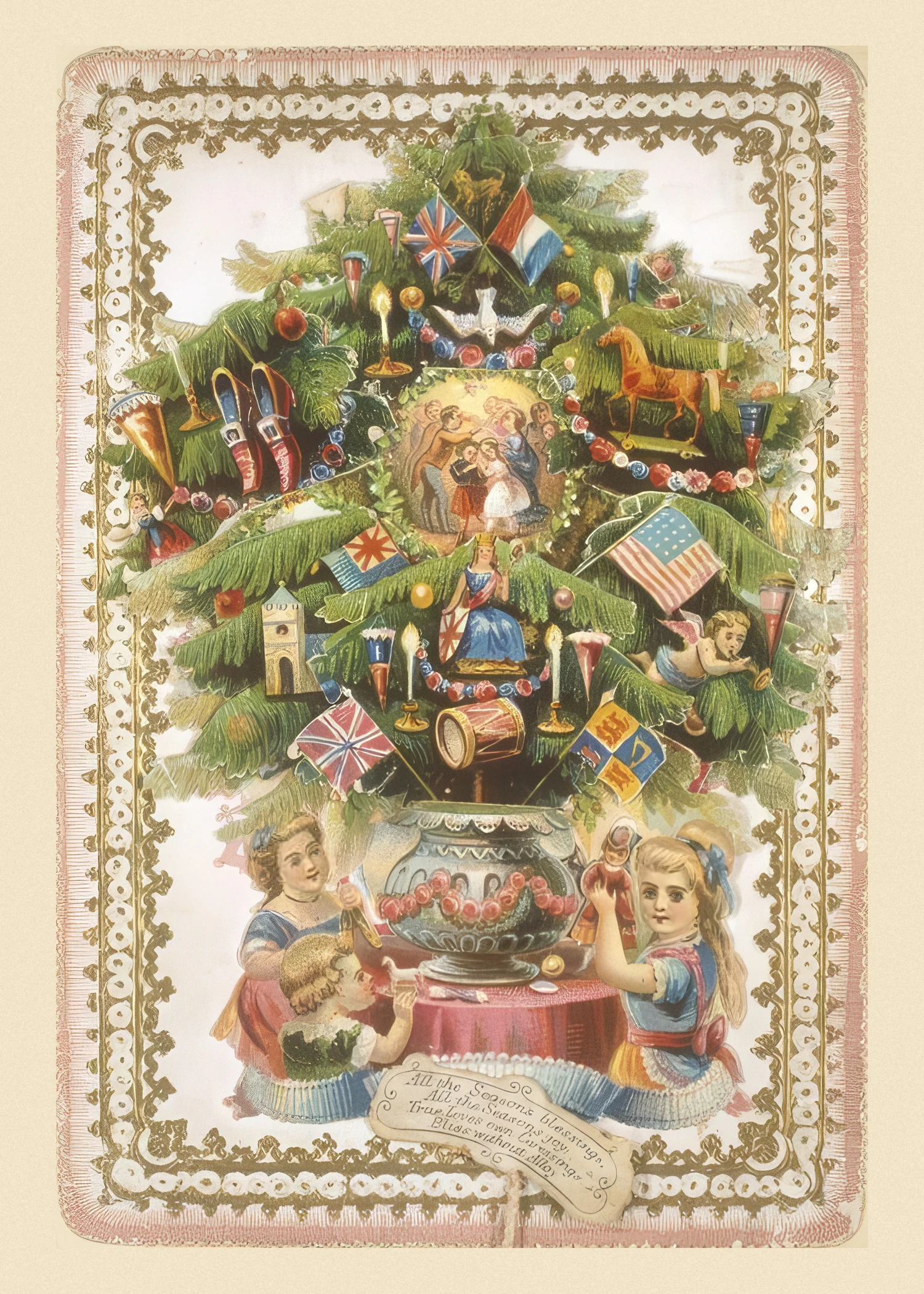
Children under the Christmas tree, 1870s–1890s. Victoria and Albert Museum, London. Restored by Fable from the museum's copy.
Every Victorian Christmas is on this one card: a tree hung with toys, candles and the flags of many nations, children playing at its foot, and a border of gilt and lace. Forty years after Horsley, the family Christmas he drew had become the whole world's.
Common questions
Who sent the first Christmas card?
Sir Henry Cole, a London civil servant, in 1843. He asked the painter John Callcott Horsley to design it, and about a thousand copies were printed and sold for a shilling each.
Why are robins on Christmas cards?
Victorian postmen wore red coats and were nicknamed robins, so robins on cards were a playful nod to the post that delivered them. The bird became a lasting symbol of Christmas.
Who made the first Christmas cards in America?
Louis Prang, a German-born printer in Boston, began selling Christmas cards in the United States in 1875 and is often called the father of the American Christmas card.
Did Beatrix Potter design Christmas cards?
Yes. In 1890 she sold drawings of her rabbit Benjamin Bouncer to the publisher Hildesheimer & Faulkner, who printed them as Christmas and New Year cards. It was her first sale as an artist.
Can I still send a Victorian Christmas card?
Yes. Fable has restored these cards and dozens more from museum archives, without changing their pictures, and you can send any of them with your own message inside from the Victorian cards shelf.
These cards were made to be sent, and now they can be again. Each one is restored from the archive's own copy, printed to order, and opens with your words inside. See them all on the Victorian cards shelf, and for the paintings that inspired them, read Christmas in art: 14 paintings from the Nativity to the Christmas tree.