Twenty historic Christmas cards you can send this year
Victorian cards restored from the archive, Carl Larsson at home, Christmas paintings by the masters, and your own family in the picture: a guide to what you can make with Fable Cards.
Long before anyone bought a pack of Christmas cards, Victorian printers, painters and publishers were inventing them: robins and holly, Father Christmas with his sack, families around the tree. Fable Cards lets you send those cards again.
Here are twenty cards you can make today, drawn exactly as they print: real Christmas cards from the 1800s restored from museum archives, Carl Larsson's paintings of Christmas at home, Christmas paintings by the masters, and one painted with your own family in it. Each opens in the card designer with one tap, ready for your words.
Cards from the 1800s, sent again
Fable has restored dozens of real Christmas cards from museum archives, most of them from the Victoria and Albert Museum in London. Each is cleaned from the museum's own copy without repainting, so every robin, lace border and line of lettering is the one the Victorian printer made. On these cards the front stays exactly as it was printed. You choose the card, write your message, and it is printed inside.
1. The first Christmas card, 1843
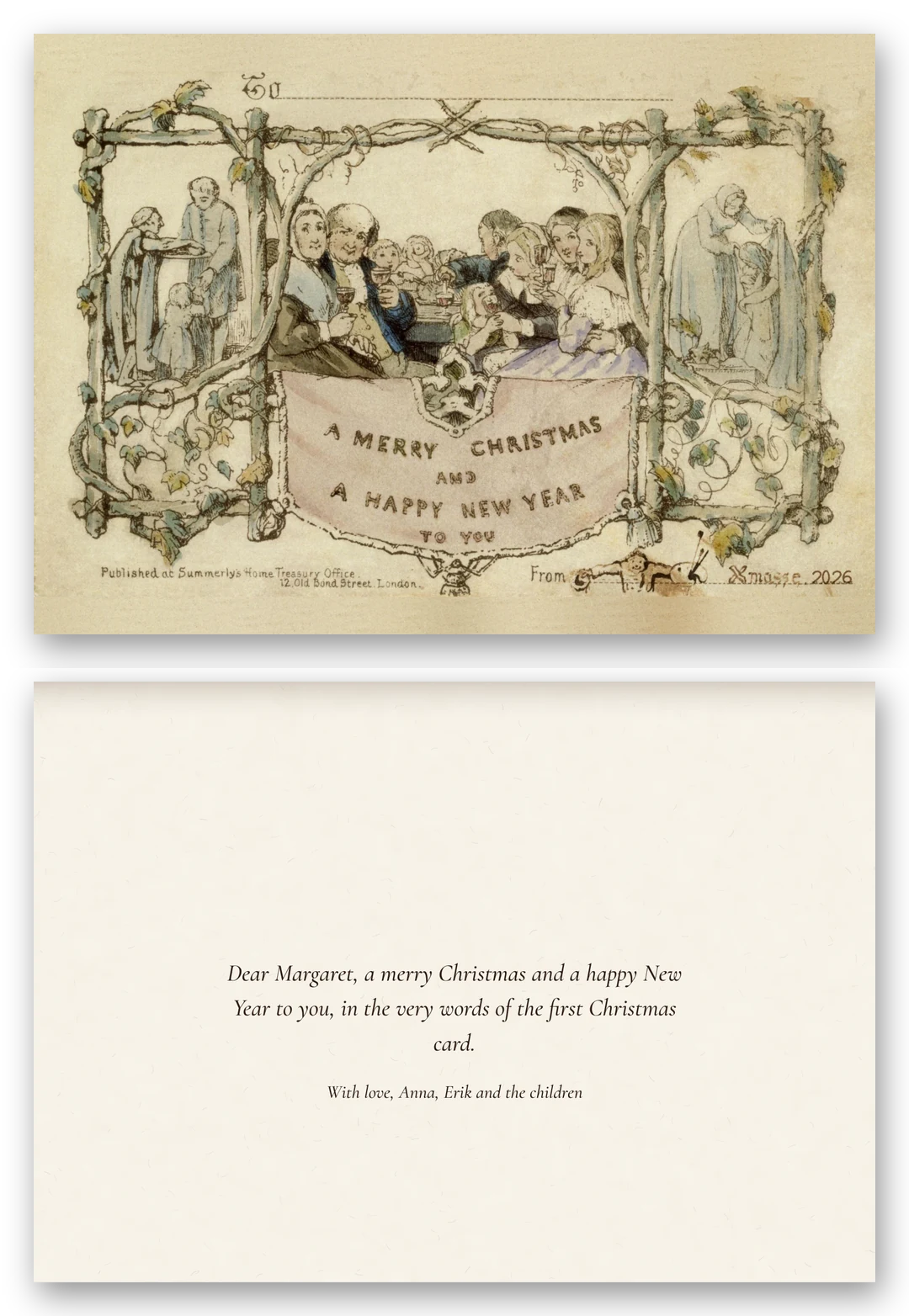
John Callcott Horsley, the first Christmas card, 1843. Victoria and Albert Museum, London. Restored by Fable from the museum's copy, the printed year re-lettered for this Christmas in the card's own hand. Shown as a Fable card: the front as it was printed, your words inside.
Start where it all began. Horsley's card still says exactly what we want to say, A Merry Christmas and a Happy New Year to you, and it leaves To and From blank on the front just as it did in 1843. Your own message and sign-off are printed inside, set in a quiet engraved italic so the front keeps the stage.
2. A happy New Year, the tree
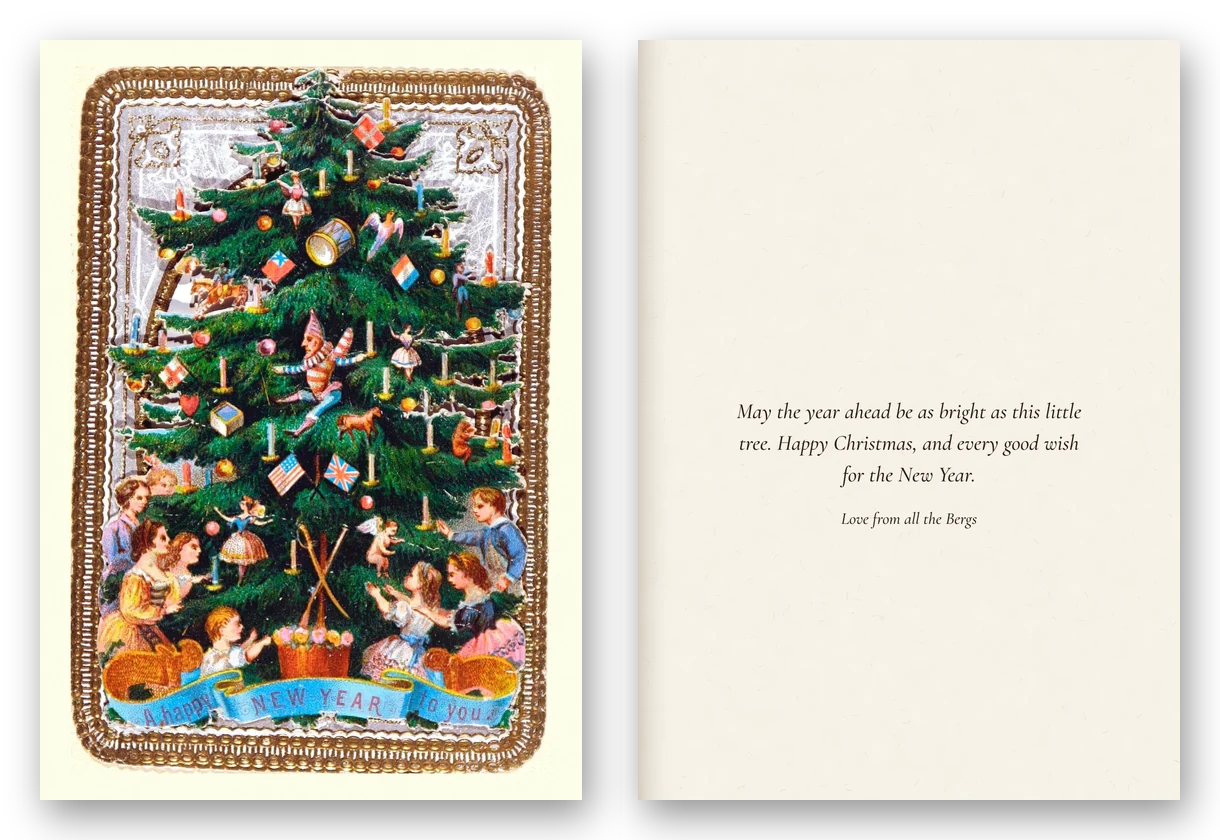
A happy New Year (the tree), c. 1870s. Victoria and Albert Museum, London. Restored by Fable from the museum's copy. Shown as a Fable card: the front as it was printed, your words inside.
A whole Christmas in one small card: a tree hung with candles, flags and toys, children gathered at its foot, and a frame of gilt paper lace. Because its printed greeting is for the New Year, it is a lovely card to send late, or to anyone you will not see until January.
3. Father Christmas filling a stocking
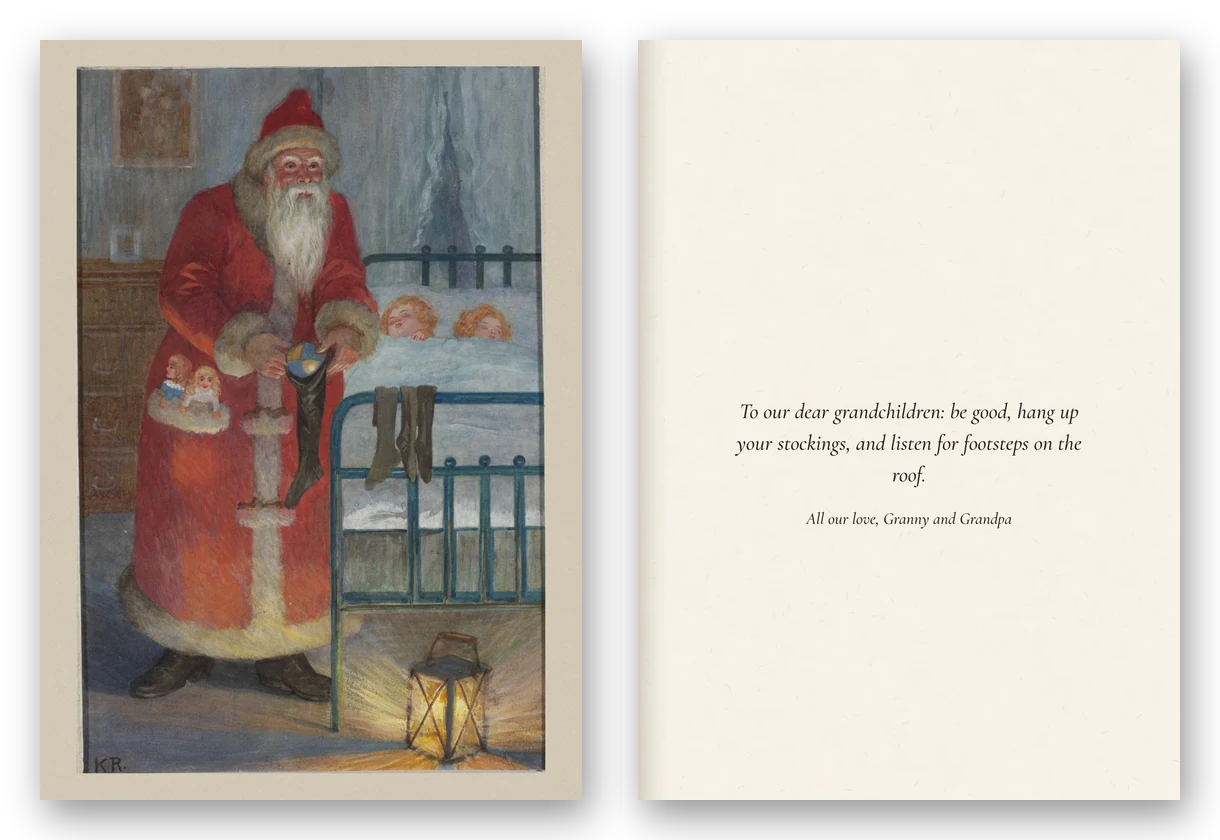
K. Röger, Father Christmas filling a stocking, c. 1890. Ernest Nister. Victoria and Albert Museum, London. Restored by Fable from the museum's copy. Shown as a Fable card: the front as it was printed, your words inside.
Father Christmas in a long, fur-trimmed robe, tiptoeing to the end of the bed while two children sleep. It reads like a page from a picture book, which is exactly what its publisher, Ernest Nister, was famous for. A perfect card from grandparents to grandchildren.
4. Lady in the snow
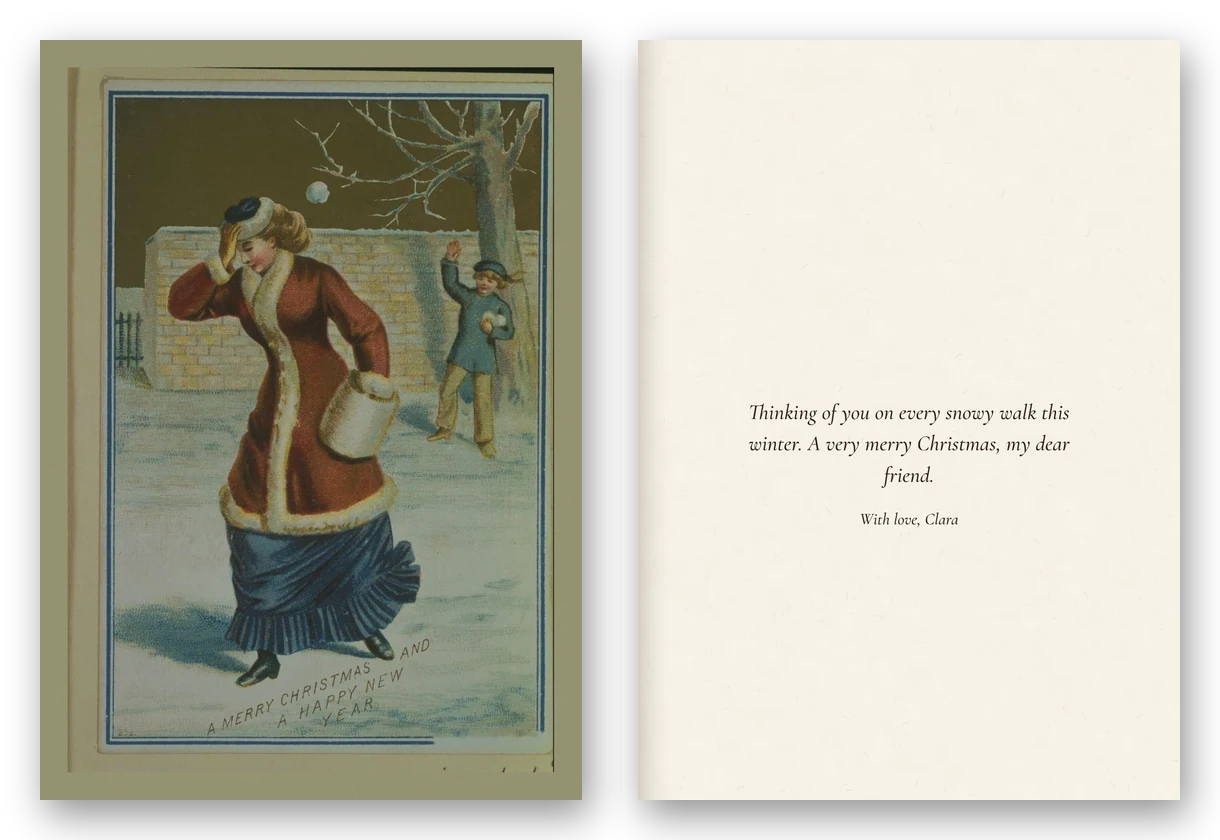
Lady in the snow, c. 1865–1885. Victoria and Albert Museum, London. Restored by Fable from the museum's copy. Shown as a Fable card: the front as it was printed, your words inside.
A fashionable lady in a fur-trimmed coat, caught by a snowball from a boy behind the wall. It is playful and elegant at once, and makes a charming card for a friend, a sister or anyone who loves a winter walk.
5. Robin in a holly wreath
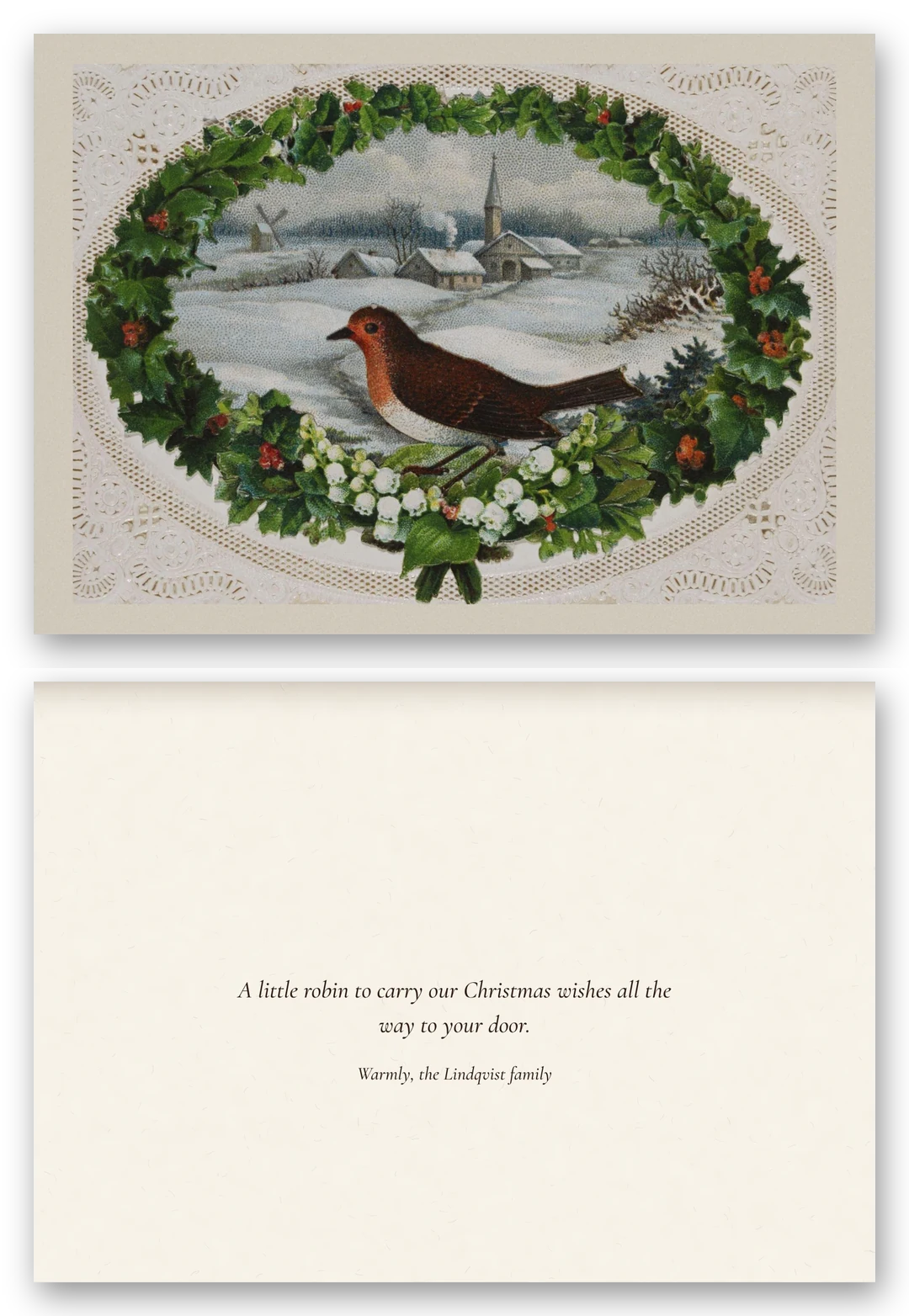
Robin in a holly wreath, c. 1870s. Victoria and Albert Museum, London. Restored by Fable from the museum's copy. Shown as a Fable card: the front as it was printed, your words inside.
The robin is the oldest friend of the Christmas card. Victorian postmen wore red coats and were nicknamed robins, so a robin on a card was a small joke about the post that carried it. This one sits in a ring of holly around a snowy village, framed in embossed paper lace. It is wide, so it opens from the top.
6. The rabbits' Christmas party
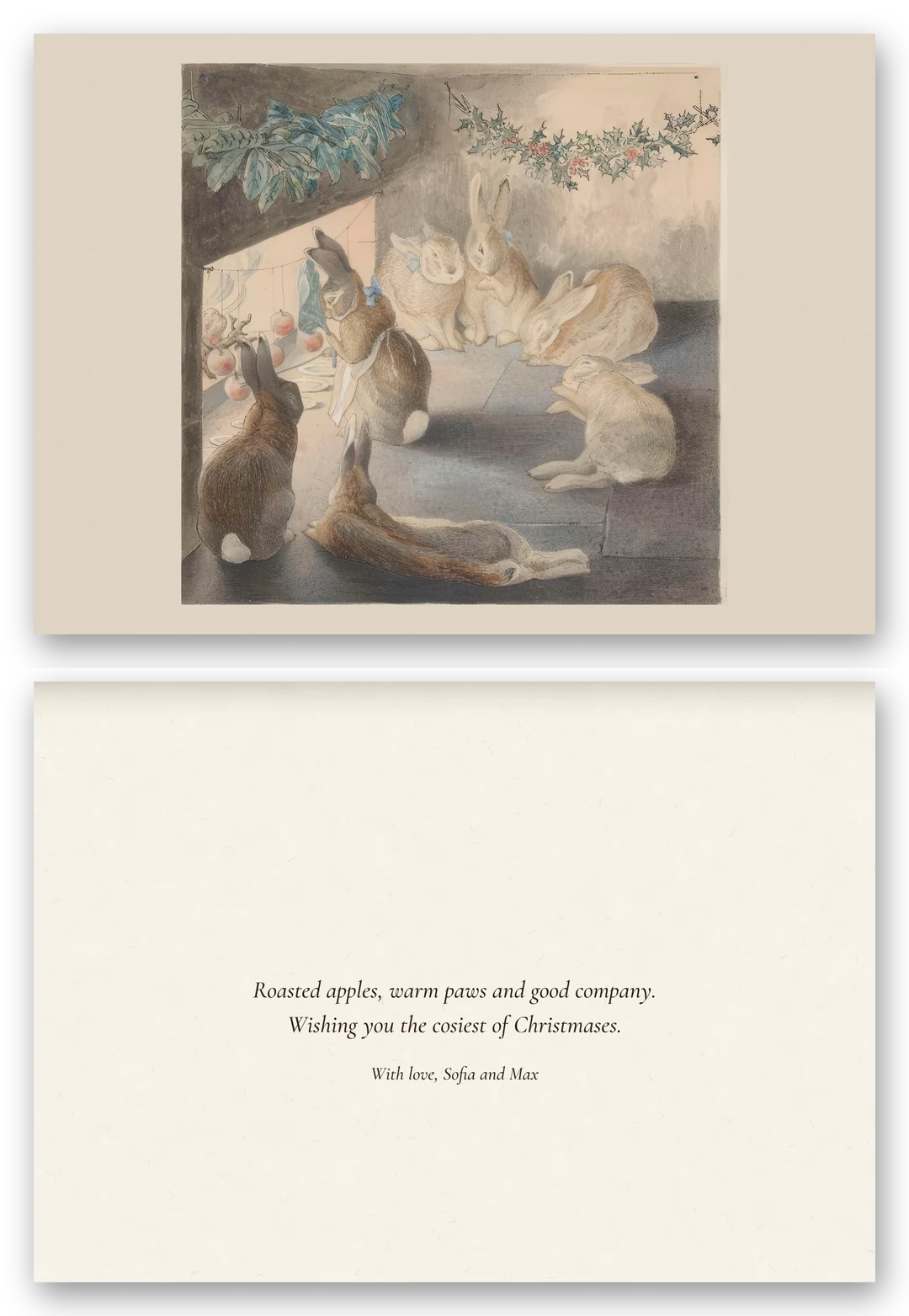
Beatrix Potter, The rabbits' Christmas party: roasting apples, c. 1892. Victoria and Albert Museum, London. Restored by Fable from the museum's copy. Shown as a Fable card: the front as it was printed, your words inside.
Years before Peter Rabbit, Beatrix Potter drew rabbits for Christmas cards. In this watercolour they gather by the fire to roast apples under a garland of holly. It is soft and quiet, and lovely for anyone who grew up with her books.
7. Welcome old Father Christmas
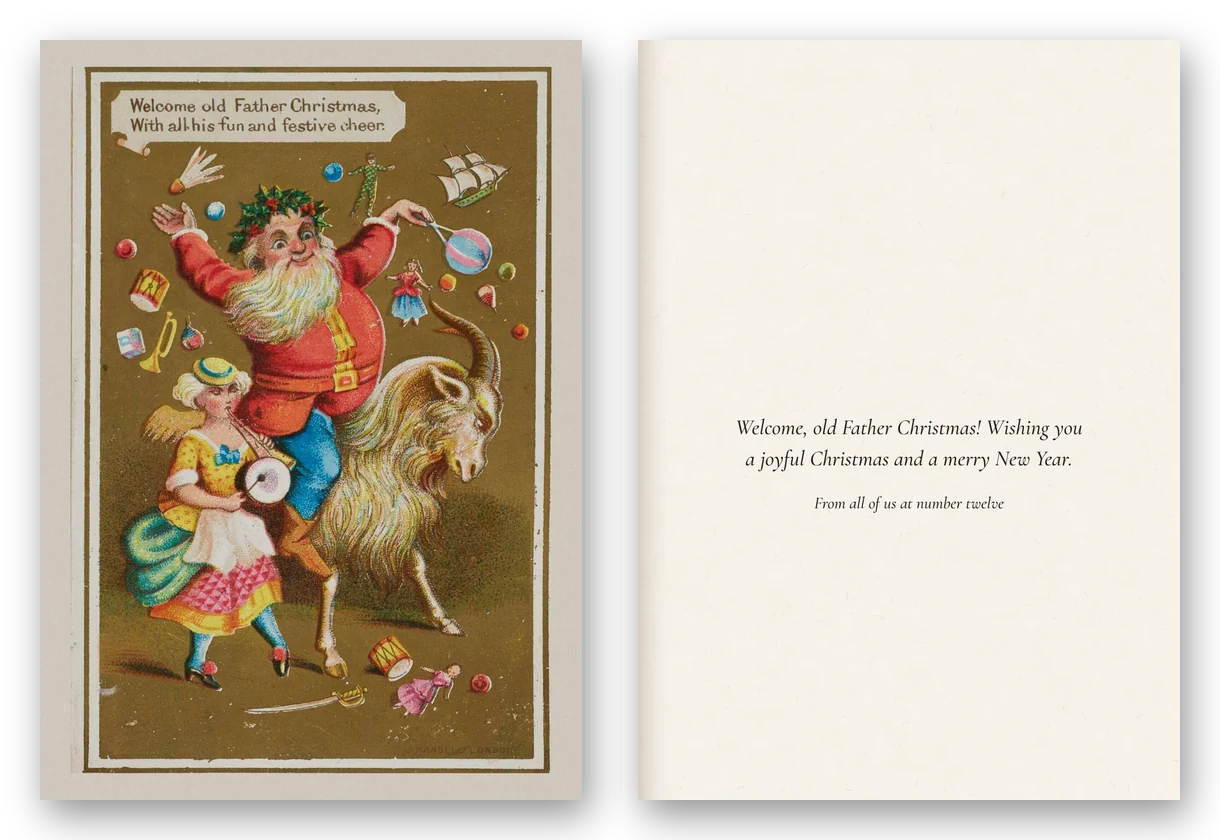
Welcome old Father Christmas (riding a goat), c. 1880s. Victoria and Albert Museum, London. Restored by Fable from the museum's copy. Shown as a Fable card: the front as it was printed, your words inside.
Not every Victorian Father Christmas was solemn. This one wears a crown of holly, rides a goat and scatters toys across a gold ground, with a printed verse welcoming him with all his fun and festive cheer. It is the most cheerful card in the archive, for a house full of children.
8. Girl with the Christmas pudding
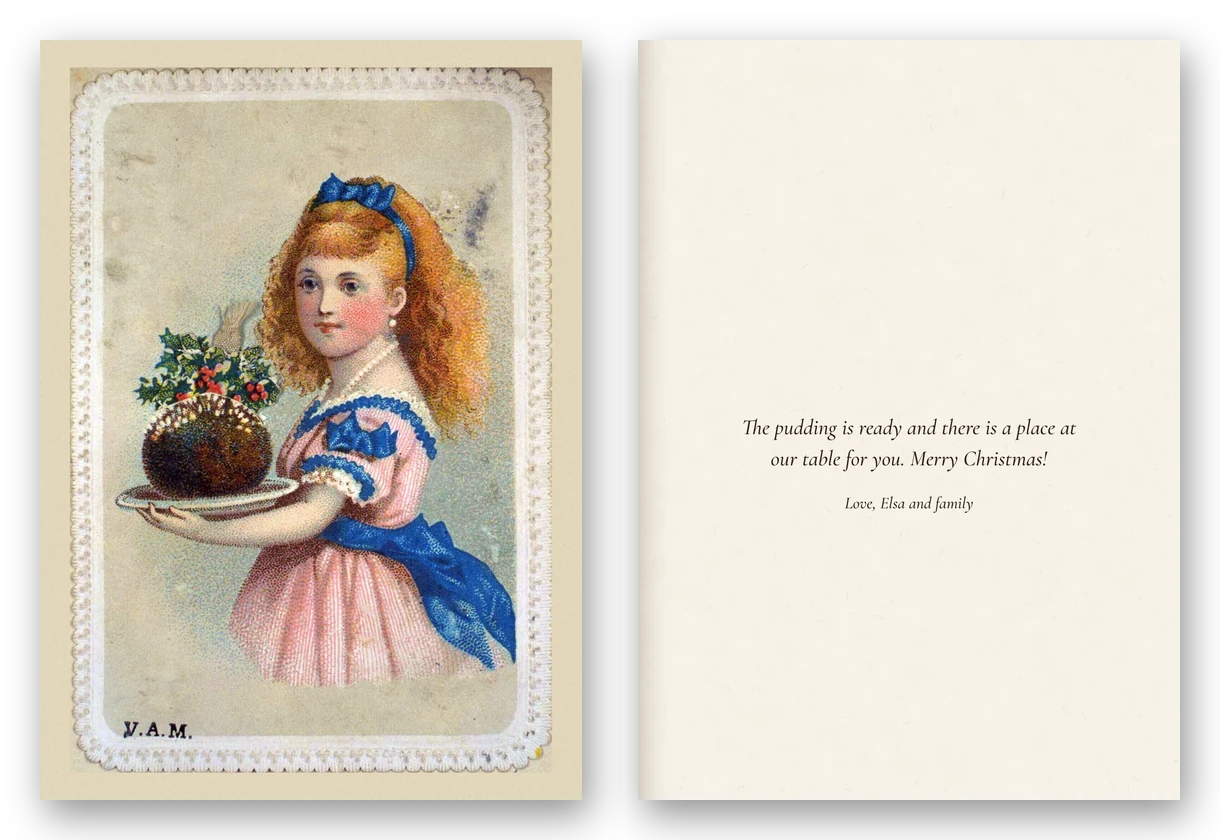
Girl with the Christmas pudding, 1865–90. Victoria and Albert Museum, London. Restored by Fable from the museum's copy. Shown as a Fable card: the front as it was printed, your words inside.
A girl in her best pink dress carries the pudding in, a sprig of holly on top. It is the card for an invitation to Christmas dinner, or simply for anyone who makes the pudding in your family.
9. Christmas window
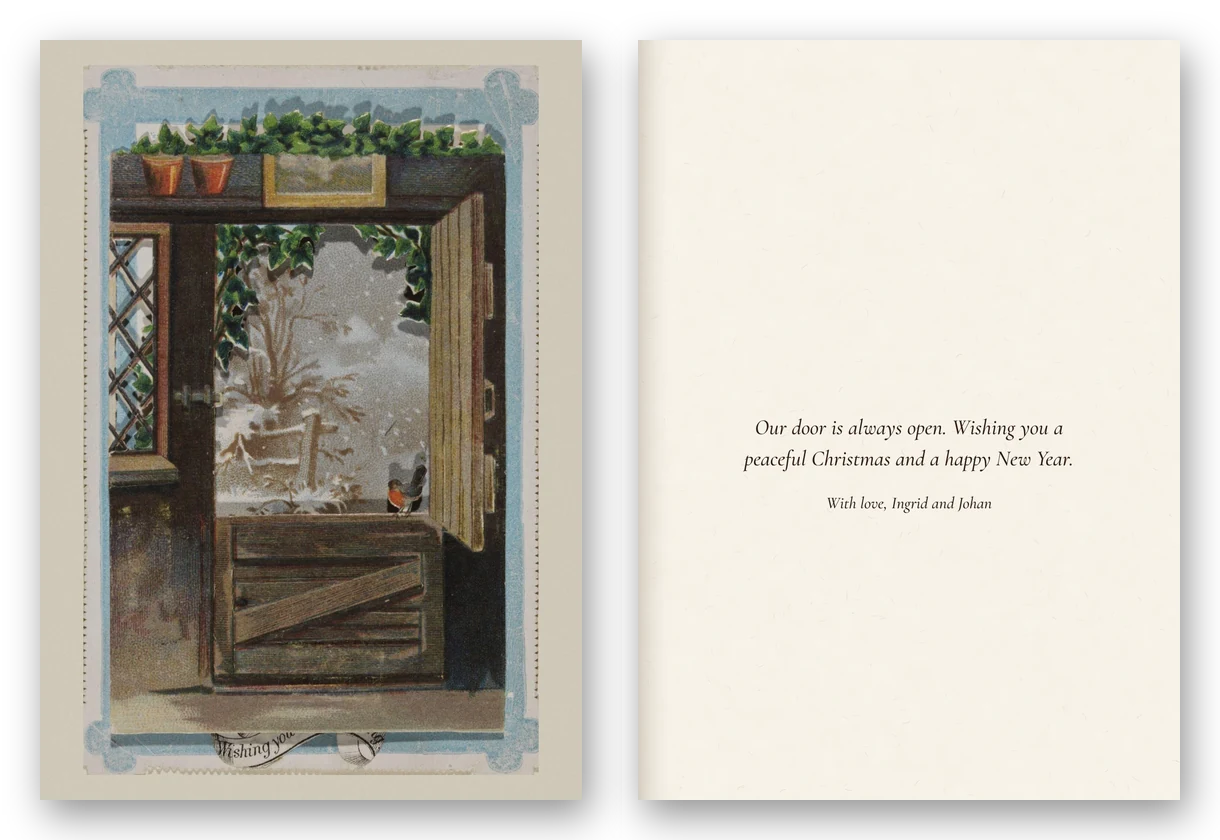
Christmas window, c. 1870s. Victoria and Albert Museum, London. Restored by Fable from the museum's copy. Shown as a Fable card: the front as it was printed, your words inside.
An open window onto a snowy garden, holly above and a small robin on the sill. It is gentle and a little nostalgic, a card that says our door is open to you.
Carl Larsson's Christmas at home
Carl Larsson painted his family's home in Sundborn, in Dalarna, for over twenty years, and his watercolours of everyday life there, published as the book A Home in 1899, shaped how Swedes still picture Christmas: red cottages in snow, candles, a laid table and children everywhere. These cards set his paintings whole on the card, with your greeting lettered beside or below them, or let the painting fill the front.
10. The Yard and Washhouse
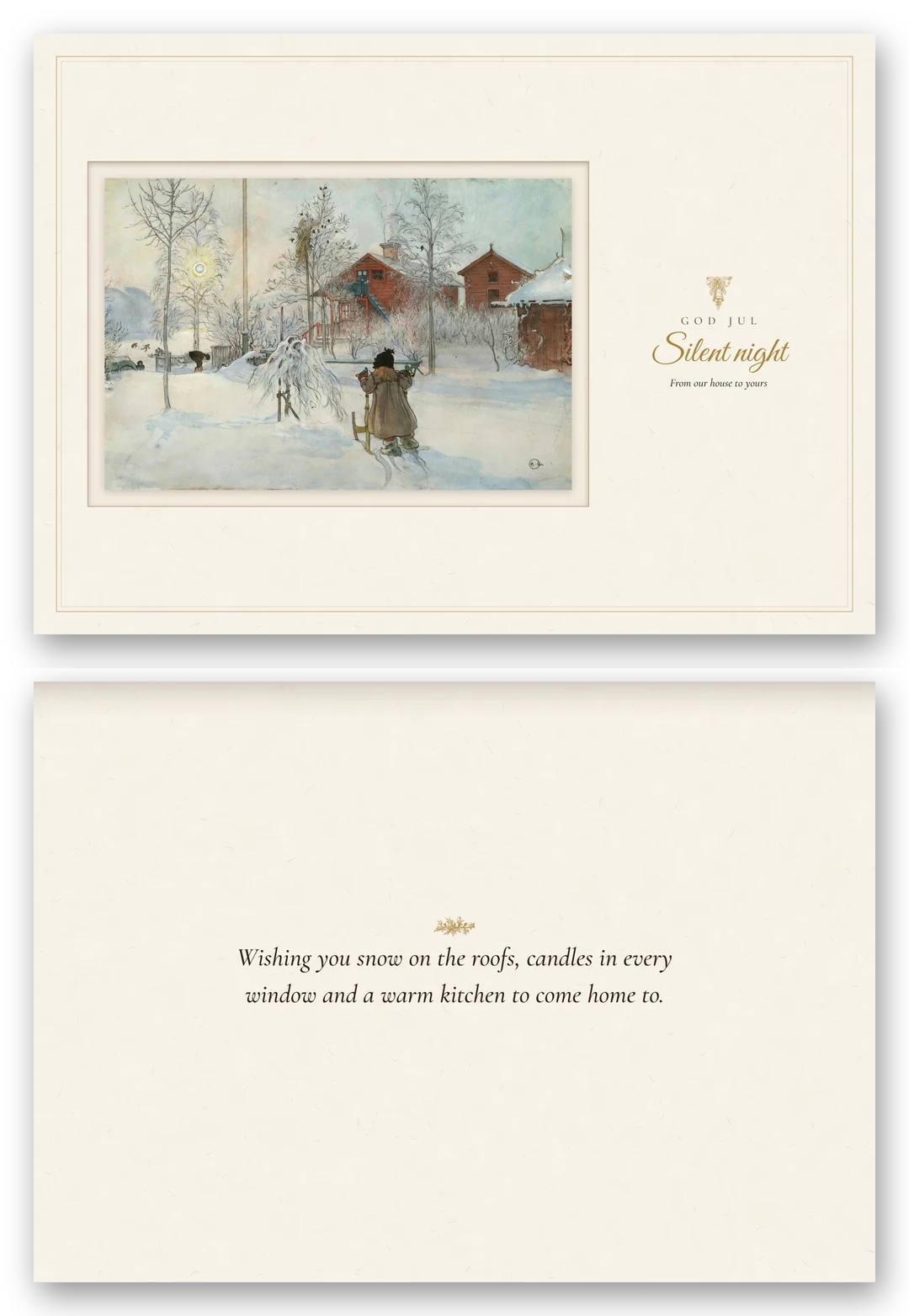
Carl Larsson, The Yard and Washhouse, from A Home, 1899. Watercolour. Nationalmuseum, Stockholm. Shown as a wide Fable card in the Silent Night lettering on ivory paper.
A child pushes a kicksled across a snowy yard toward the red washhouse, with a low winter sun behind the birches. Set as a wide card with God Jul above the greeting, it is about as Swedish as Christmas gets. Wide cards print folded along the top.
11. Between Christmas and New Year
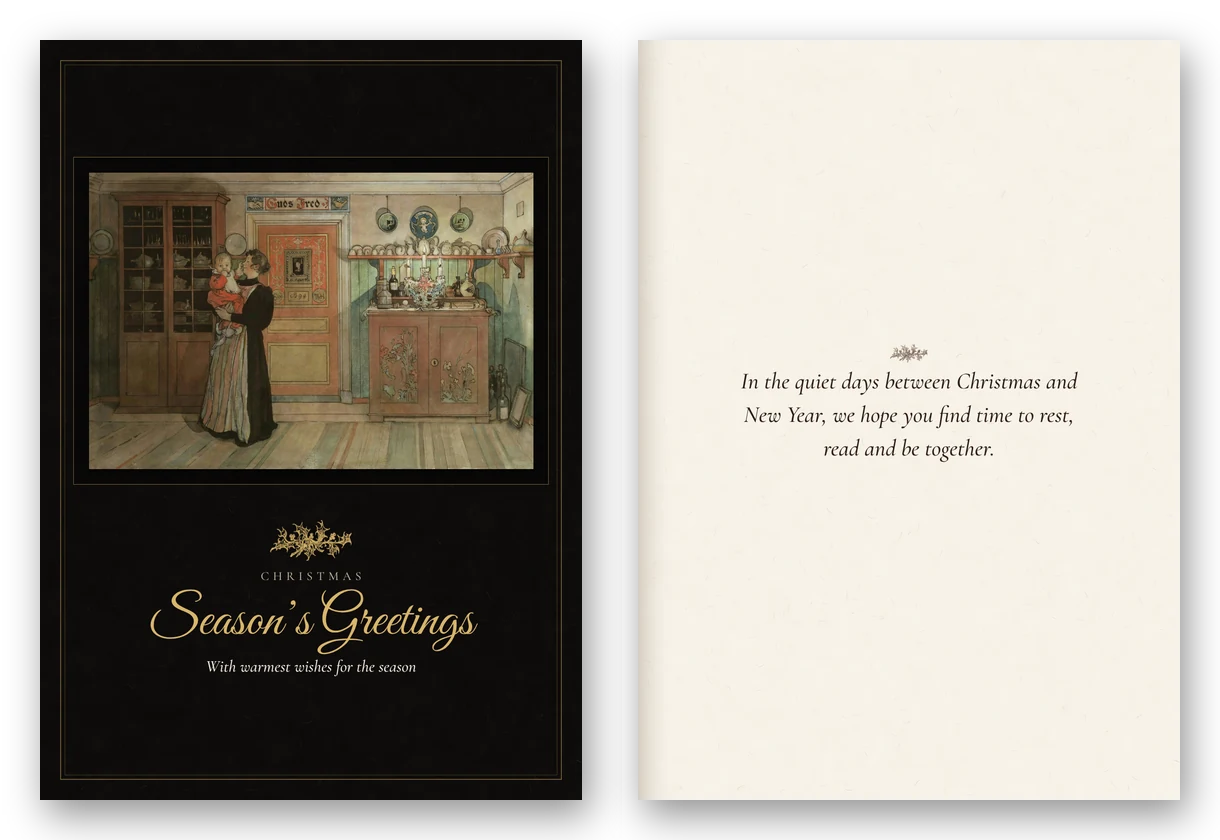
Carl Larsson, Between Christmas and New Year, from A Home, 1899. Watercolour. Nationalmuseum, Stockholm. Shown as a tall Fable card in the Noël Gilt lettering on dark paper.
A mother lifts a small child in a room lit by three candles, under a painted sign reading Guds Fred, God's peace. Because the painting is warm and dark, the card is printed on a deep paper with gold script, the way the designer chooses paper from the painting itself.
12. When the Children Have Gone to Bed
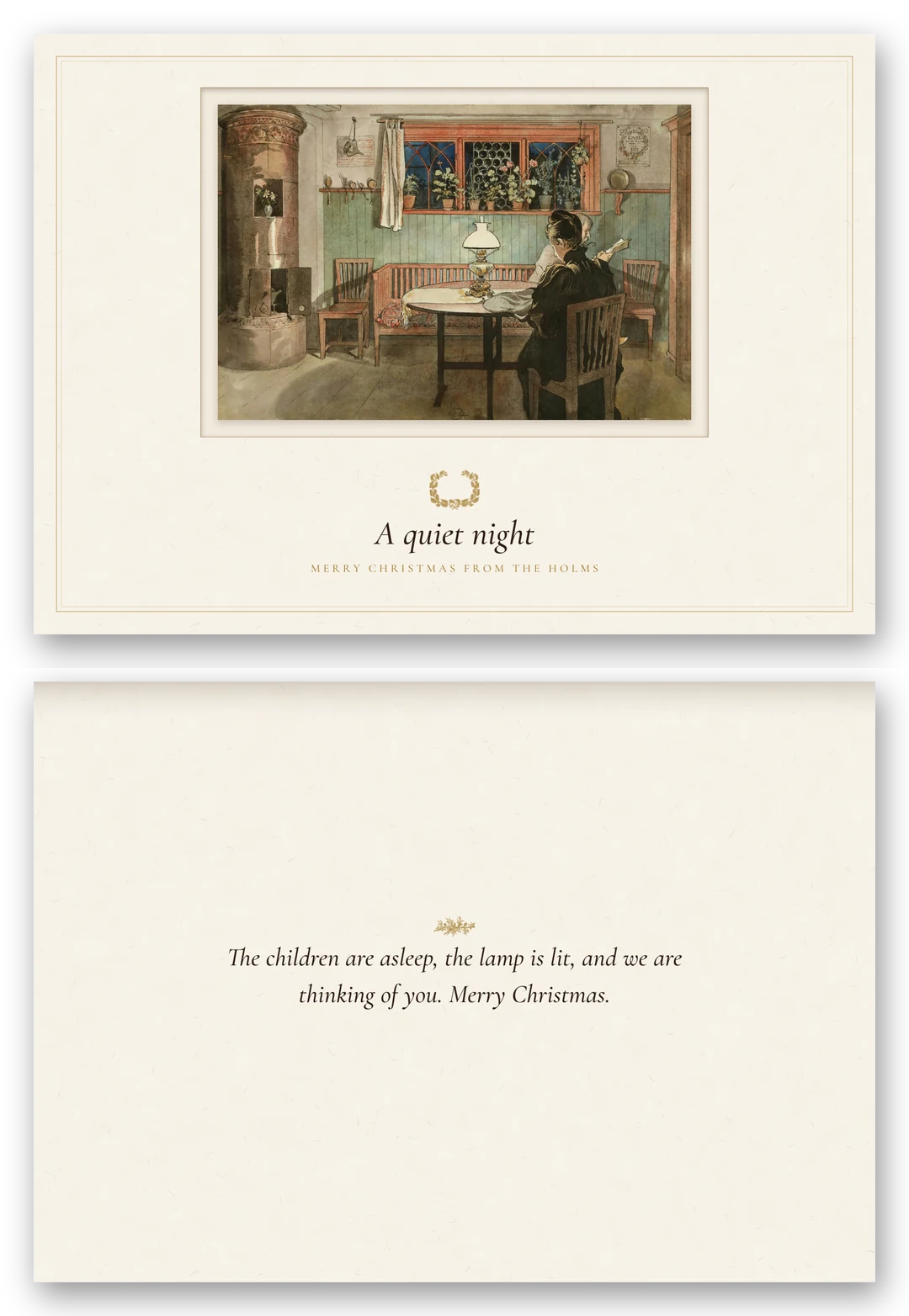
Carl Larsson, When the Children Have Gone to Bed, from A Home, 1899. Watercolour. Nationalmuseum, Stockholm. Shown as a wide Fable card in the Evergreen lettering.
The house is finally quiet: a lamp on the table, the stove doors open, geraniums against a dark blue window. With the greeting set beneath the painting it becomes a card for the people you think of when the day is done.
13. Christmas Eve
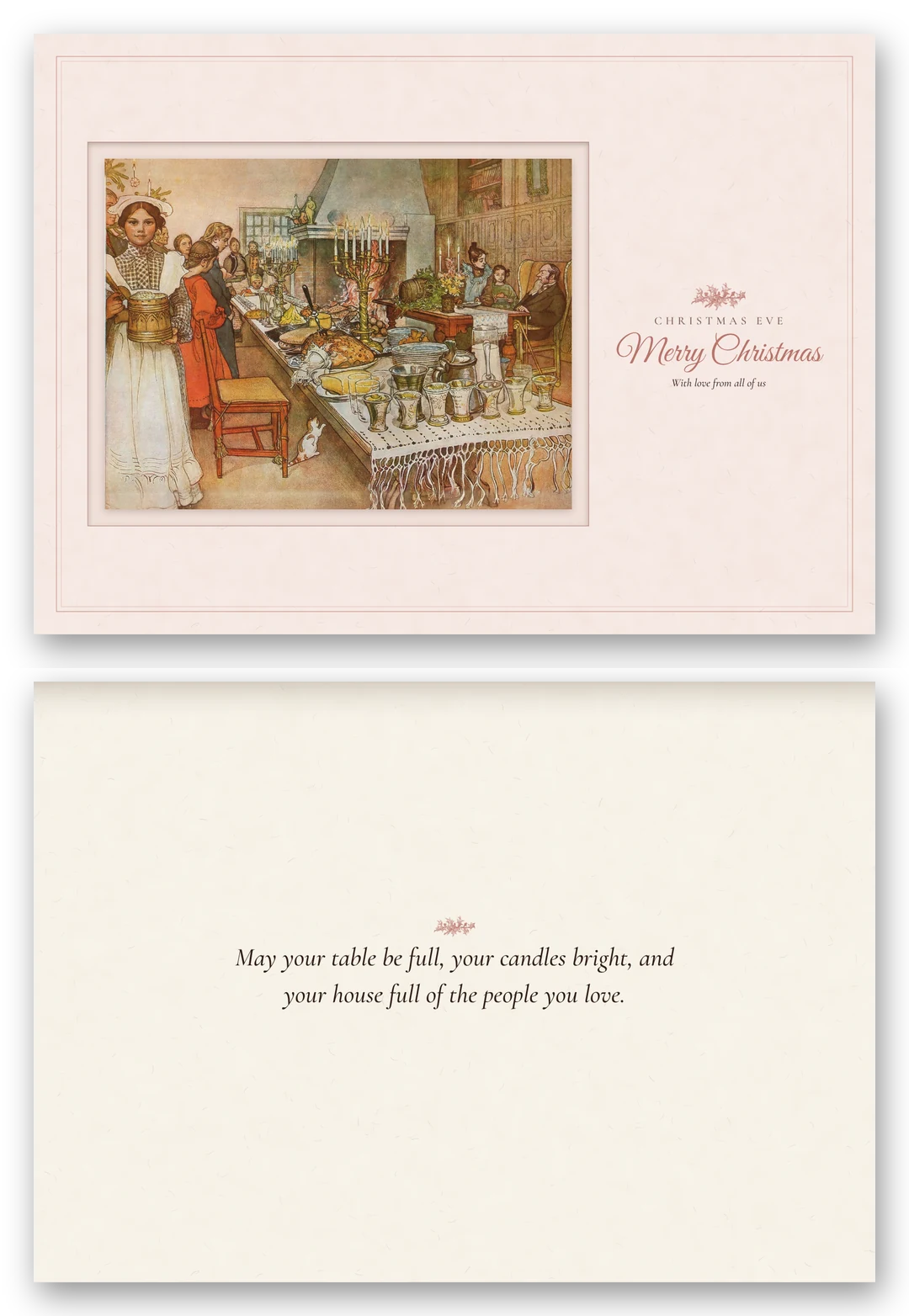
Carl Larsson, Christmas Eve, 1904. Bonnier Portrait Collection. Shown as a wide Fable card in the Noël Gilt lettering on blush paper.
A long table laid for the feast, candles, a roaring fire and the whole family gathered. Larsson's Christmas Eve is the painting to send if your Christmas happens on the 24th. The designer picked a soft blush paper from the painting's own colours.
14. Getting Ready for a Game
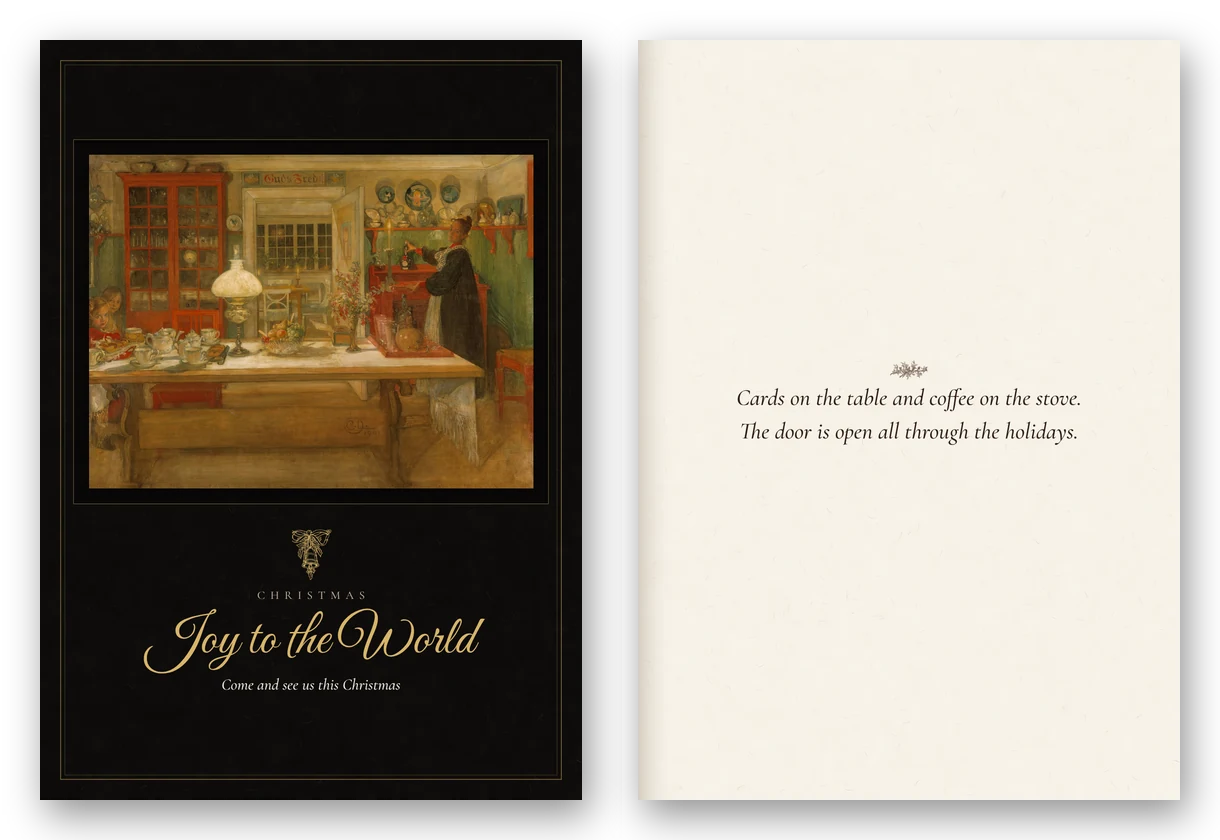
Carl Larsson, Getting Ready for a Game, 1901. Oil on canvas. Nationalmuseum, Stockholm. Shown as a tall Fable card in the Silent Night lettering on dark paper.
A table set by lamplight, glasses ready, two girls waiting at the edge of the room. It is an invitation in a picture, so it suits a card that asks friends round between the holidays.
15. Girl and Rocking Chair, as a full cover
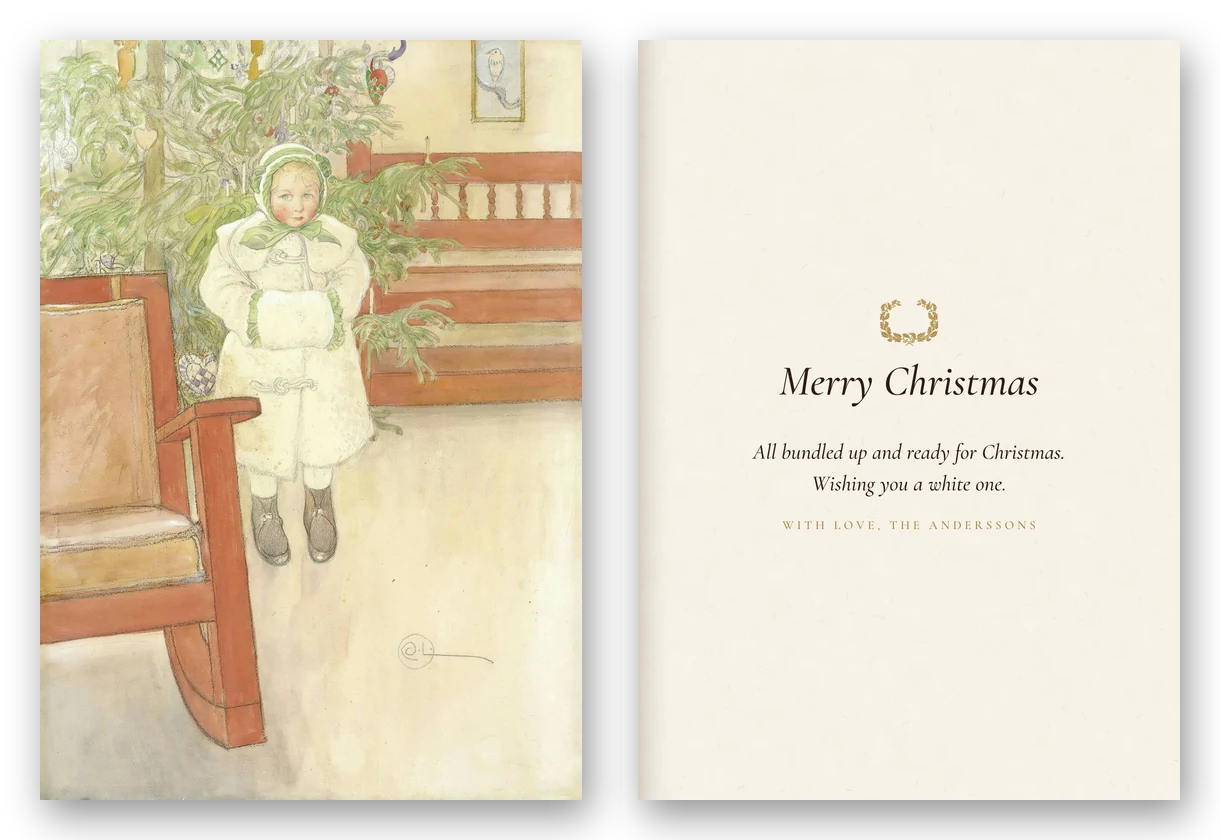
Carl Larsson, Girl and Rocking Chair, 1907. Malmö Art Museum. Shown as a Full cover Fable card: the painting fills the front and the lettering moves inside.
A little girl bundled up in white, next to the red rocking chair and the tree. When a painting's shape is close to the card's, the designer offers Full cover: the picture fills the whole front, trimmed only slightly at the edges, and the greeting moves inside with your message.
Christmas paintings by the masters
Fable's Masterworks hold restored paintings of Christmas from before 1900, from Danish forests to a royal drawing room. Each can be sent as a card: the painting is never cropped on the plate, the paper is chosen from its colours, and you can change the lettering, the paper and the words.
16. Felling the Christmas Tree
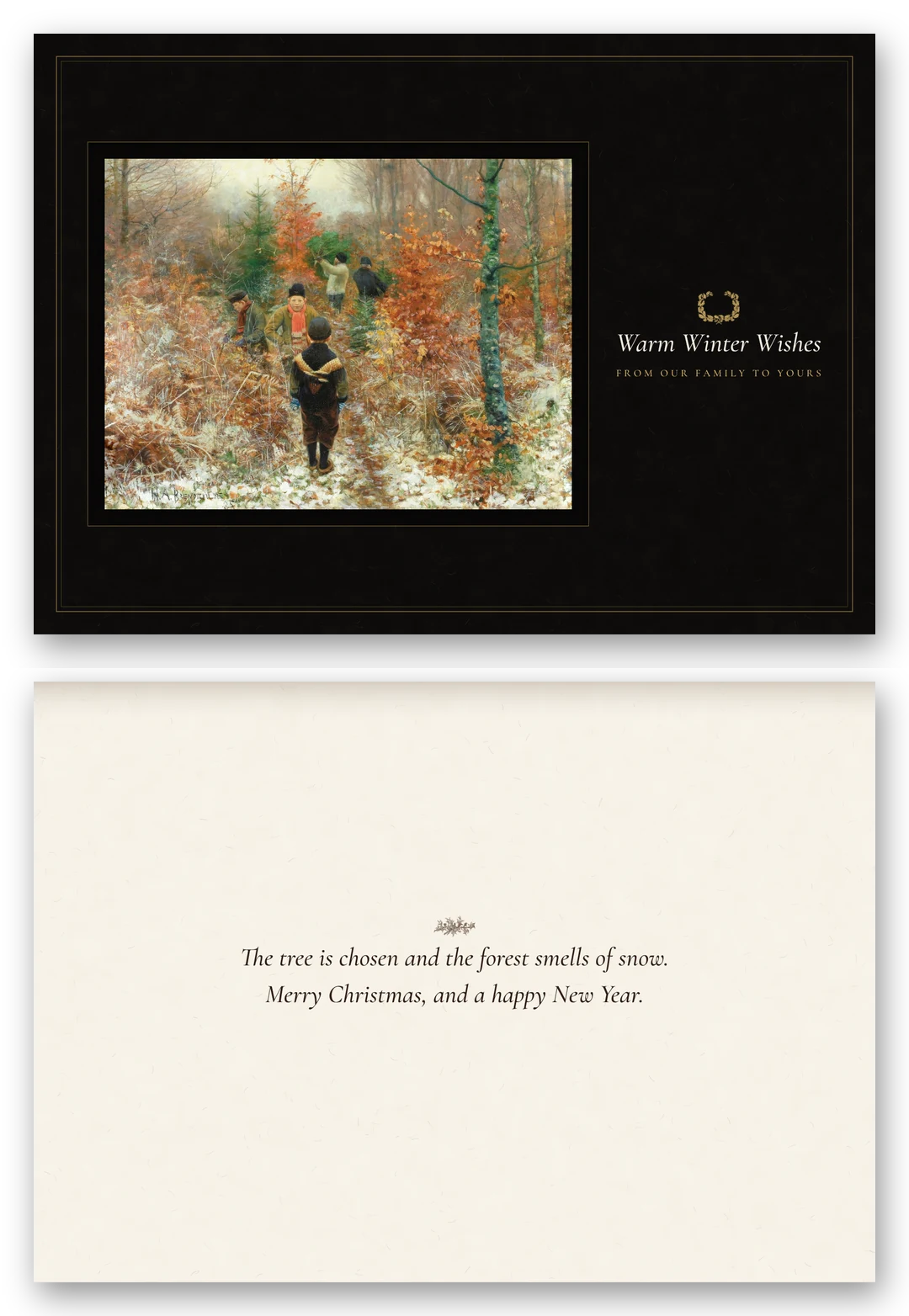
Hans Andersen Brendekilde, Felling the Christmas Tree, 1885. Oil on canvas. Shown as a wide Fable card in the Evergreen lettering on dark paper.
Boys in scarves head into a frosty Danish wood to bring the tree home, with autumn leaves still on the ground. Any painting in the Christmas Masterworks can become a card like this one, set whole on the front with your greeting beside it.
17. Grandmamma's Christmas Visitors
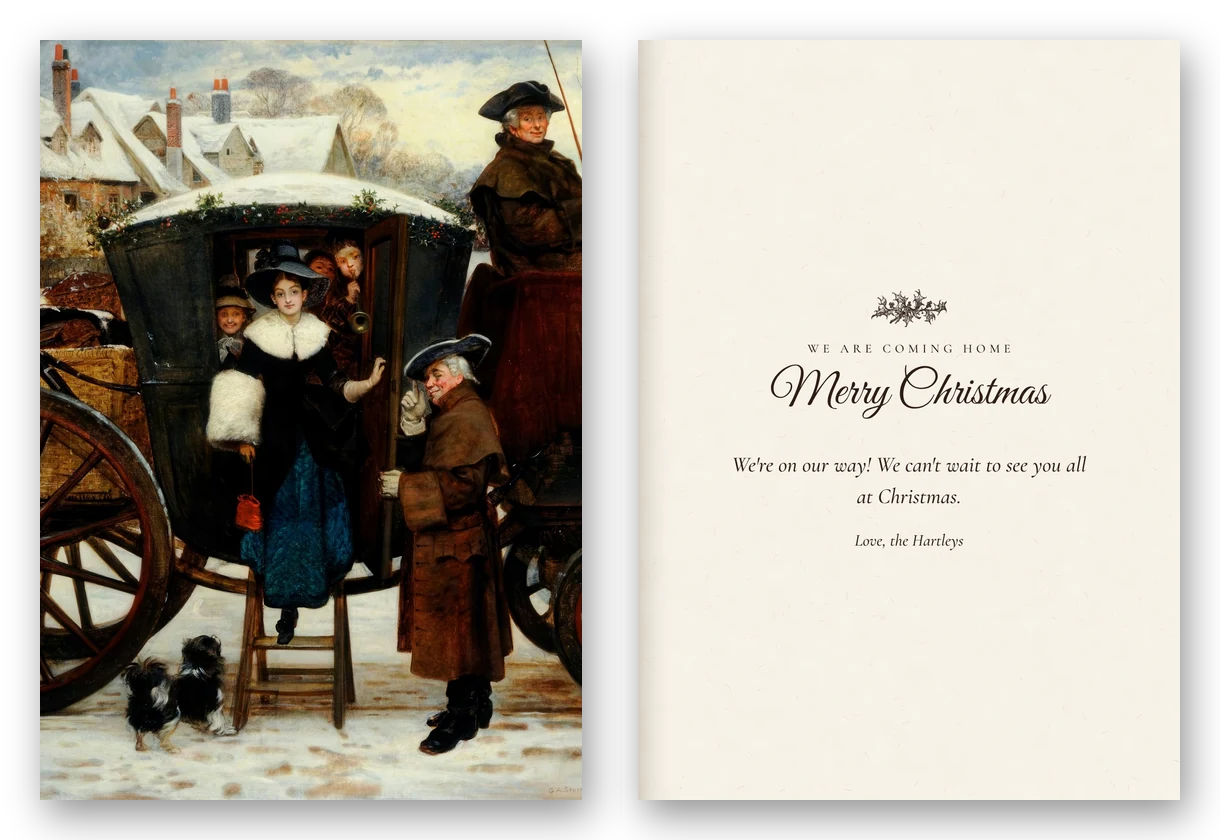
George Adolphus Storey, Grandmamma's Christmas Visitors, 1873. Oil on canvas. Sheffield Museums. Shown as a Full cover Fable card in the Noël Gilt lettering.
A carriage draped in holly pulls up in the snow, and the family climbs down to visit Grandmamma. As a full cover card it says one thing beautifully: we're coming home for Christmas.
18. Selling Christmas Trees
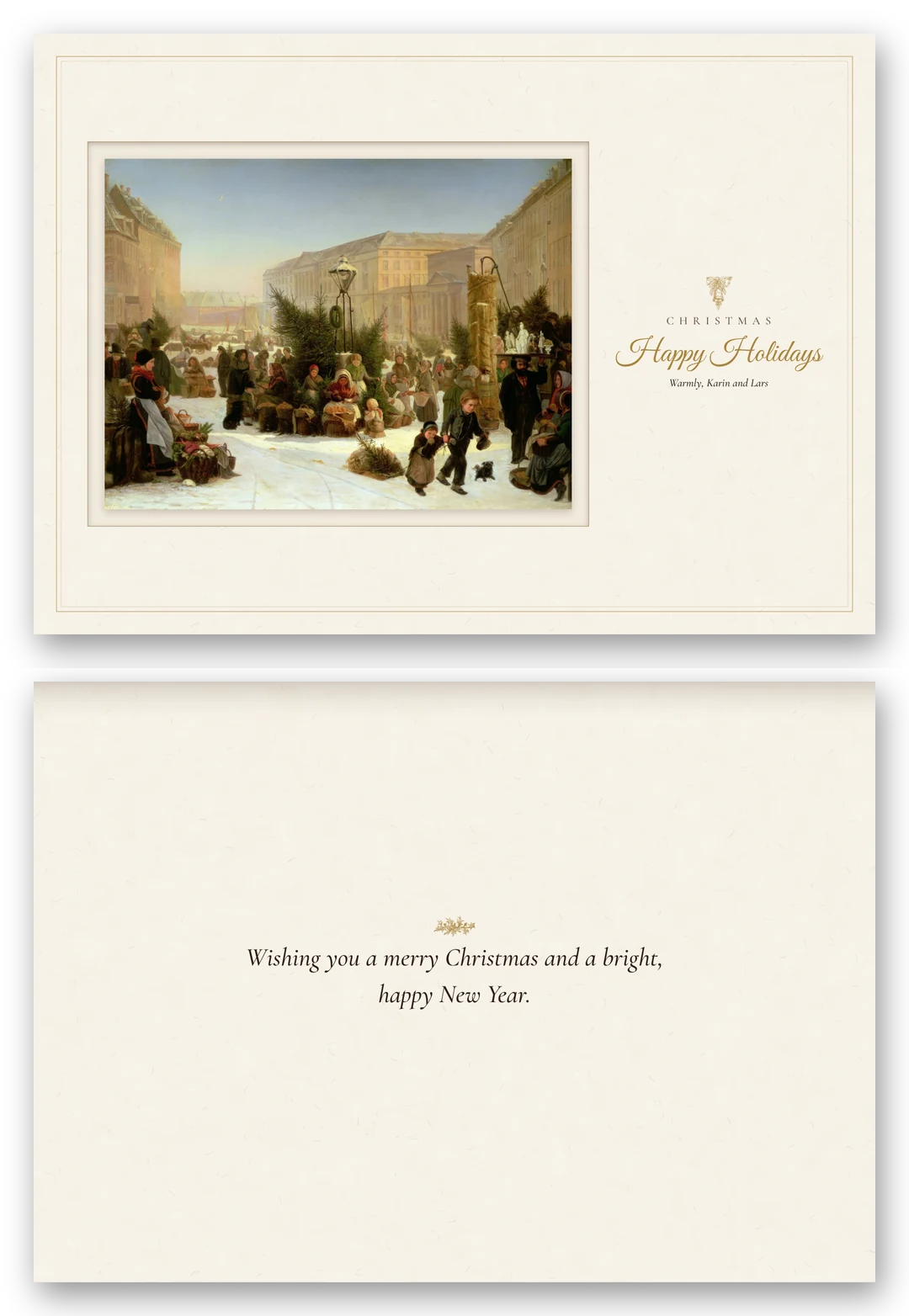
David Jacob Jacobsen, Selling Christmas Trees, before 1871. Oil on canvas. Shown as a wide Fable card in the Silent Night lettering.
A market square in the snow, stalls of firs and baskets, and two children dragging their tree home on a sled. A good card for a city family, or for a business sending season's greetings.
19. Queen Victoria's Christmas Tree
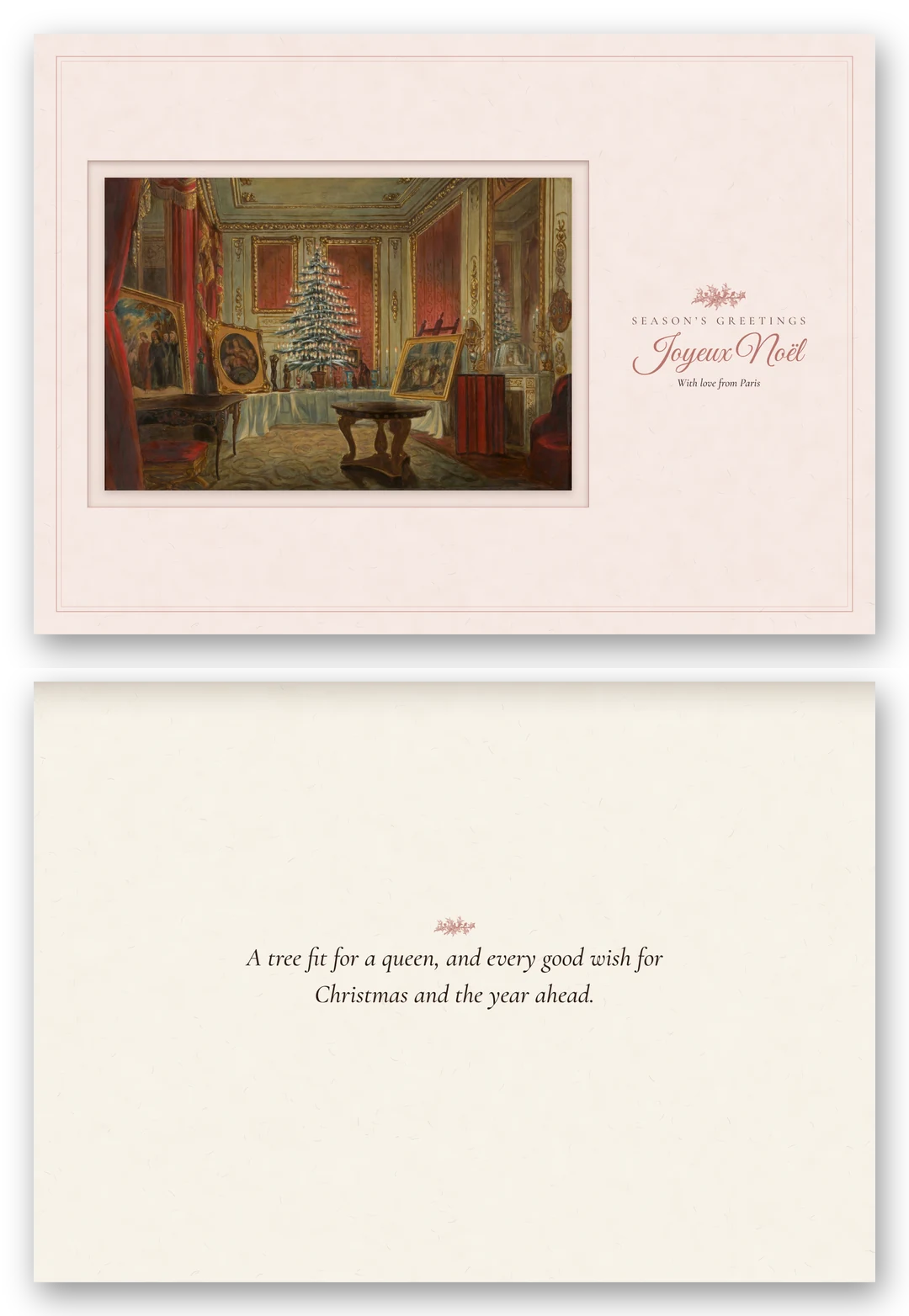
William Corden the Younger, Queen Victoria's Christmas Tree, 1850–51. Royal Collection. Shown as a wide Fable card in the Noël Gilt lettering on blush paper.
The royal tree that made the Christmas tree fashionable across Britain, standing in a red palace room among gifts and pictures. Lettered here in French, it shows that any greeting can be written in your own words.
Or put your family in the painting
The button below opens the card straight on the photo step: choose up to four photos, and your Christmas portrait is painted there and then. You see it before you write a word.
20. Your own family, painted around the tree
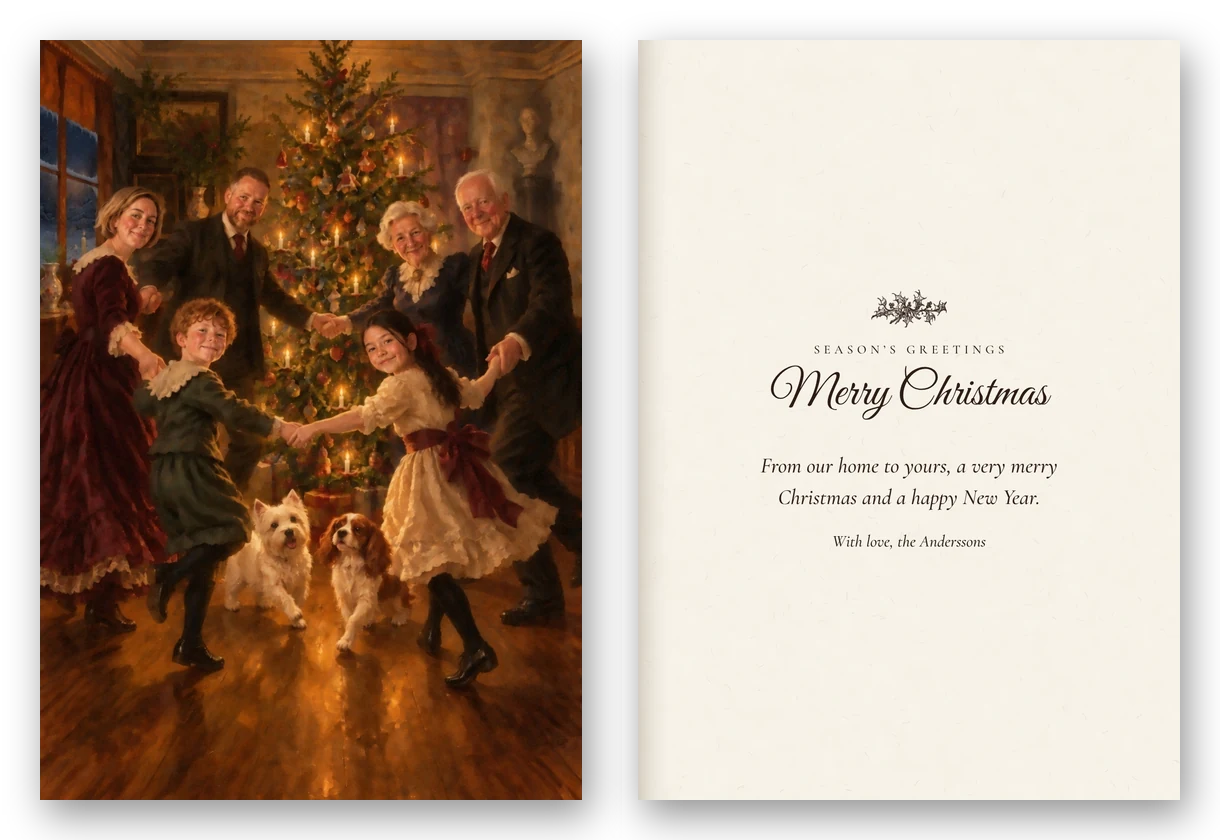
Christmas Around the Tree, after Viggo Johansen's Glade jul, 1891. Approved Fable demo portrait, made from demo photos; not a customer. Shown as a Full cover Fable card.
Every card above starts with a picture that already exists. This one starts with yours. Choose a Christmas painting, add a few photos of the people you love, and Fable paints them into the master's own scene, then sets the portrait on the card. This example was painted from demo photos in the style of Viggo Johansen's Glade jul.
Common questions
Are these real Victorian Christmas cards?
Yes. The Victorian cards are restored from museum copies, most from the Victoria and Albert Museum in London, without repainting. Their fronts are printed exactly as they were made, credited to the artist and archive on the back.
Can I change the words on a Victorian card?
The front stays as it was printed, including its greeting. Your message and your sign-off are printed inside, so the card still feels like your own.
Can I order printed cards or send them online?
Both. Every card can be sent as a link, or printed as folded 5 × 7 inch cards in packs of 20, 50, 100 or 250.
What is a Full cover card?
When a painting's shape is close to the card's, you can let it fill the whole front. It is trimmed only slightly at the edges, and the greeting moves inside. Other paintings are always shown whole on their plate.
Can I put my own family into a Christmas painting?
Yes. Choose a Christmas painting, add up to four photos, and Fable paints your family into the scene in the master's style. You see the portrait before you write a word, and then send it as a card or a print.
Every card here is a starting point. Open any of them, change the lettering or the paper, write your own words and see the card exactly as it will print. Browse all the Victorian cards and the Christmas paintings, and to learn where these cards came from, read The history of the Christmas card, in twelve Victorian cards.