The history of tarot, from Renaissance cards to the reading deck
Tarot began as a card game at the courts of fifteenth-century Italy. Here is how it became the deck we read today.
Tarot began as a game. For its first three centuries it was played, not read: a pack of ordinary playing cards with a fifth suit of allegorical pictures added, made for the courts of northern Italy in the 1440s. The fortune-telling, the Egyptian legends and the Major Arcana came much later, in eighteenth-century Paris.
That gap between what tarot was and what it became is the most interesting part of its story. Here it is, in order, with the surviving cards that tell it.
Draw your three cards Create your Renaissance portrait
Playing cards reach Europe
Playing cards arrived in Europe in the late fourteenth century, most likely modelled on the packs of the Mamluk sultanate in Egypt. The earliest European records date from 1367, in Bern, and within a few decades cards were being made across the continent.
These were four-suit packs, close to the ones still played today, though a court could commission its own: the pack now at the Met Cloisters in New York, painted in the Southern Netherlands around 1475–1480, has suits of hunting horns, hound collars, leashes and nooses. In Italy the suits were cups, coins, swords and batons, and they still are: an Italian or Spanish pack carries the same four signs as the oldest tarot.
A fifth suit of triumphs
Sometime before 1440, someone in northern Italy added a fifth suit: a run of picture cards that outranked all the others. They were called trionfi, triumphs, and they gave us the word trump.
The oldest firm record is a Florentine court entry of 1440, recording two packs given to Sigismondo Pandolfo Malatesta of Rimini. Between 1440 and 1450, triumph packs appear in Milan, Ferrara, Florence and Bologna. An earlier Milanese pack, described by Martiano da Tortona and probably made between 1418 and 1425 for Filippo Maria Visconti, had a suit of classical gods. It is lost, but it shows the idea was in the air at the Visconti court.
The subjects of the triumphs came from the art around them: the Emperor and the Pope, the virtues, Love, the Wheel of Fortune, Death, the Sun and the Moon, the Last Judgement and the World. Many historians read them as a procession, like the one in Petrarch's poem Triumphs, where each figure is overcome by the next.
The painted cards of Milan
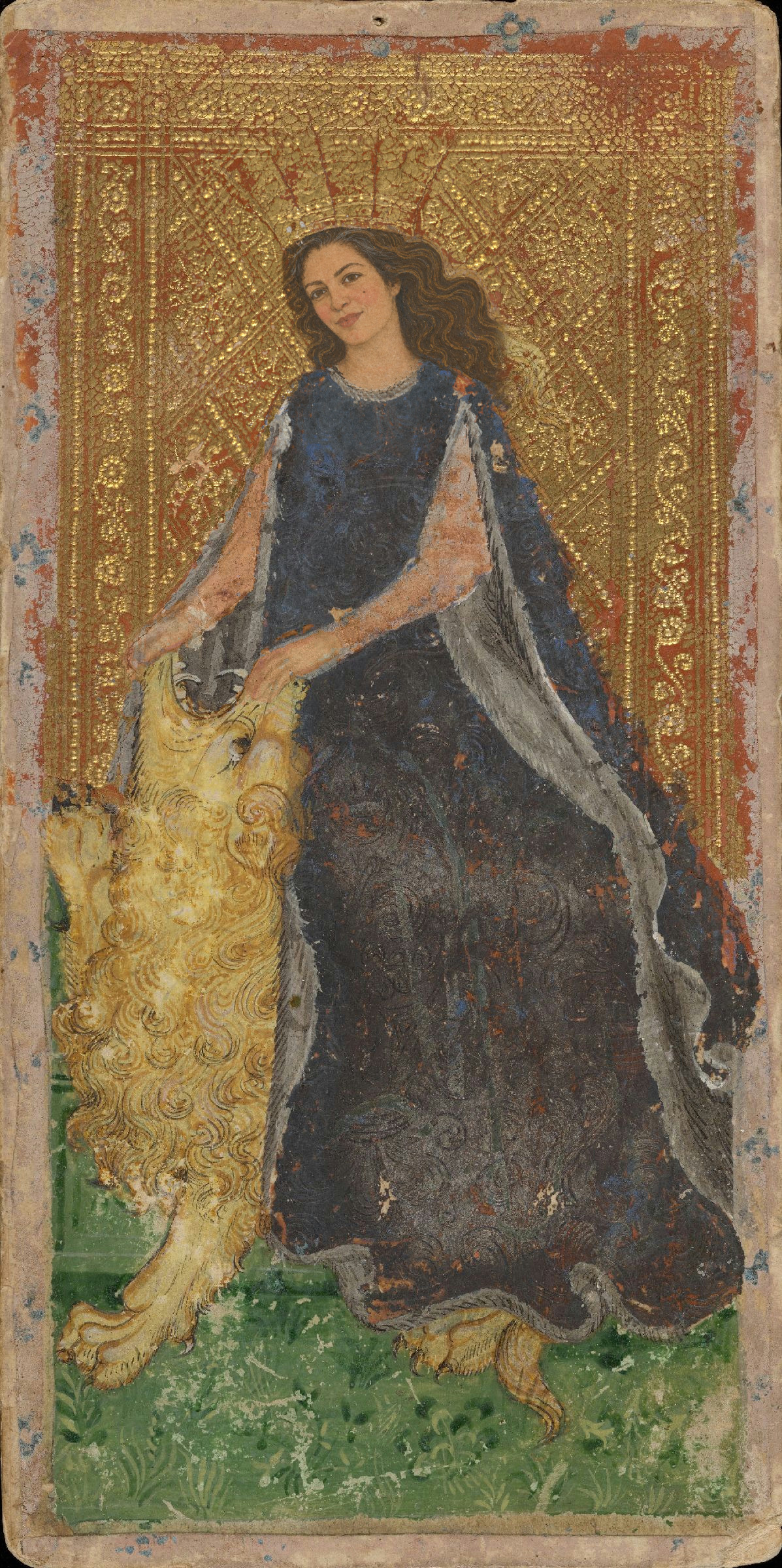
The oldest tarot cards that survive were painted for the Dukes of Milan. They are luxury objects, painted on pasteboard with tooled gold grounds, and no complete deck has come down to us.
The Visconti di Modrone cards at Yale, often called the Cary-Yale tarot, may be the oldest of them, dated by some scholars to 1442–1447. Sixty-seven cards survive. They are unusual in having six court cards to a suit, and the three theological virtues, Faith, Hope and Charity, among the triumphs.
The best known is the Visconti–Sforza deck, painted in Milan from about 1450 for the court of Francesco Sforza and his wife, Bianca Maria Visconti. Seventy-four of its cards survive, divided between the Morgan Library & Museum in New York, the Accademia Carrara in Bergamo and the Colleoni family. Its Devil and Tower are lost.
Read the story of the Visconti–Sforza tarot Read the story of the Cary-Yale Visconti tarot
Prints for everyone else
Painted cards were for dukes. Everyone else played with printed ones. By the late fifteenth century, tarot cards were being cut in wood and printed in sheets, then coloured with stencils and cut apart. Few survive, because cards were used until they wore out; most of what we have are uncut sheets that never reached the table.
The most remarkable printed deck of the period is the Sola Busca tarot, engraved in metal around 1490 and coloured by hand in Venice in 1491. It is the oldest complete 78-card tarot deck known, and the only early deck whose numbered cards each carry a full scene.
Read the story of the Sola Busca tarot
From trionfi to tarot
The word tarot came later than the cards. Around 1502, in Brescia, the game appears as tarocho, and tarocchi became its Italian name; the French made it tarot. During the Italian Wars, French and Swiss soldiers carried the game north. The pattern later called the Tarot de Marseille has Milanese roots, and the oldest surviving deck made in Marseille is Philippe Vachier's of 1639.
For the next two centuries tarot was one of the most popular card games in Europe. It still is, in places: French Tarot is the second most played card game in France, and tarot games are played in Austria, Switzerland, Denmark and southern Germany.
Paris, 1781: the invention of a mystery
In 1781 the scholar Antoine Court de Gébelin, writing in the eighth volume of his Monde primitif, announced that the tarot was the book of ancient Egypt, its pictures a hidden doctrine that had survived as a game. There was no evidence for it, and none has been found since. But the idea took hold.
Within a few years the Parisian Etteilla published the first deck designed for divination, around 1789. An anonymous manuscript from about 1750 already lists meanings for the cards of the Bolognese tarot, so people were reading cards before Court de Gébelin. He gave the practice a mythology. The historian Michael Dummett called the result "the most successful propaganda campaign ever launched".
The occult tarot and the modern deck
In the nineteenth century, Éliphas Lévi folded tarot into his system of magic in his Dogme et rituel de la haute magie (1854–1856), and the occultist Paul Christian gave us the terms Major Arcana and Minor Arcana. In London the Hermetic Order of the Golden Dawn made tarot part of its teaching.
Two of its members made the deck most people picture today. Arthur Edward Waite wrote the instructions and Pamela Colman Smith drew the cards, published by William Rider & Son in December 1909. Smith gave every numbered card a scene. The best-known earlier deck to do so was the Sola Busca, whose photographs had reached the British Museum in 1907, and some of her images follow it closely.
Read the story of the Rider–Waite–Smith tarot
Reading the old cards today
The cards of the fifteenth century were never meant to tell fortunes. Their makers meant them to be beautiful, to be played with and to show the ideas of their age: fortune, virtue, death and the order of the world. That is why they still repay attention. The pictures are the same pictures the later readers would use, seen before anyone told them what to mean.
Fable's tarot reading draws from these decks. Every card you turn is a real historic card, or, where the original is lost or has never been photographed for open use, a reconstruction labelled as one. Your reading ends with a portrait painted for you from your reading, in the historic style of the deck.
Draw your three cards Create your Renaissance portrait
Sources: Michael Dummett, The Game of Tarot (1980); Giordano Berti, Storia dei tarocchi (2007); The Morgan Library & Museum, MS M.630; Beinecke Rare Book and Manuscript Library, Yale University, Visconti di Modrone tarot cards; The Metropolitan Museum of Art, 26.101.5; Pinacoteca di Brera, Il segreto dei segreti (2012). Card images are public-domain museum photographs and Fable reconstructions, credited where shown.