The Visconti–Sforza tarot: the cards of the Dukes of Milan
Painted in gold and tempera for the court of Francesco Sforza, divided between New York and Bergamo, with four cards lost. The story of the most famous tarot deck.
The Visconti–Sforza tarot is the most famous deck of cards ever made, and nobody has held all of it at once for well over a century. Its cards are divided between a library in New York, a museum in Bergamo and a private family collection. Four are lost.
It is also the deck behind most of what we imagine when we hear the word tarot: the Fool in rags, the Hanged Man upside down, the Wheel of Fortune with its riders. Here is what it is, who made it, and how Fable shows it whole.
Draw your three cards from the Visconti deck Create your Renaissance portrait
A deck for the Duke of Milan
The cards were painted in Milan from about 1450, for the court of Francesco Sforza and his wife, Bianca Maria Visconti. Francesco was a condottiere, a soldier for hire, who had married the only child of Filippo Maria Visconti, the last Visconti duke, in 1441, and took Milan for himself in 1450.
The deck carries the families' devices and mottoes through its pictures, among them the French motto A bon droyt, "by good right", which appears on three of the cards in New York. These were luxury objects, made to be admired as much as played.
Gold, tempera and pasteboard
Each card is painted on thick pasteboard, about 17 by 9 centimetres. The triumphs and court cards stand on grounds of gold, tooled with patterns that catch the light as the card moves. The numbered cards have a cream ground with a twining flower-and-vine pattern, the suit signs painted over it.
Most of the cards are attributed to the workshop of Bonifacio Bembo, a painter of the Sforza court, though some scholars give them to Francesco Zavattari. A few triumphs, among them Temperance, Fortitude and the Sun, were painted later, around 1480, by another hand, perhaps to replace cards that had worn out or gone missing.
Seventy-four cards in three places
A full tarot deck has 78 cards: 22 triumphs and 56 suit cards. Seventy-four of the Visconti–Sforza cards survive:
- 35 at the Morgan Library & Museum in New York, bought by J. Pierpont Morgan in 1911 from a dealer in Paris; they had belonged to Count Alessandro Colleoni of Bergamo.
- 26 at the Accademia Carrara in Bergamo.
- 13 still in the Colleoni family.
The lost four are the Devil, the Tower, the Three of Swords and the Knight of Coins. Their absence has long fed speculation that the Devil and the Tower were never painted at all, or were removed because their subjects were thought unlucky. No one knows.
To see the originals in New York, the Morgan shows all 35 of its cards on its own website.
The older Visconti deck at Yale
The Visconti–Sforza cards have an older sibling. The Visconti di Modrone tarot, at the Beinecke Library at Yale, was made for the Visconti court and is dated by some scholars to 1442–1447. Sixty-seven of its cards survive. It has six court cards to a suit, and Faith, Hope and Charity among its triumphs, and its pictures are crowded with the same gold, armour and heraldry.
The Morgan's Visconti–Sforza cards include no Emperor and no World. In Fable's reading those two come from the Yale deck, its nearest relation, and are captioned as such.
Read the story of the Cary-Yale Visconti tarot
The order of the triumphs
The Visconti cards carry no numbers or names. The order we use now was fixed later, and it varied from city to city. What the pictures show is clear enough: the Fool and the Magician, the Popess and the Empress, the Emperor and the Pope, Love, the Chariot, the virtues, the Wheel of Fortune, the Hermit, the Hanged Man, Death, and then the heavens, Star, Moon and Sun, ending with Judgement and the World.
Some of the figures may be portraits. The Popess has been read as Manfreda da Pirovano, a relative of the Visconti and a leader of a small heretical sect, and the lovers as a wedding couple from the families, but none of these readings can be proved.
Draw your three cards from the Visconti deck
How Fable shows the whole deck
When you draw from the Illuminated Card, Cloisters Court or Baroque Allegory worlds in a Fable tarot reading, you see this deck, all 78 cards of it.
The 35 cards in New York are shown from the Morgan's own photographs, enlarged without repainting and cut at the card's edge. The Emperor and the World come from Yale. The other 41 are Fable reconstructions: the Bergamo cards, which have no open photographs, and the four that are lost. Each was made from the deck's own cards in the same suit as references, checked by eye for the number of pips and the look of the gold and tempera, and is labelled as a reconstruction wherever it appears.
The Devil and the Tower were the hardest. No picture of either survives, so their reconstructions follow late-Gothic images of the same subjects, made in the manner of the deck. They are what the cards might have looked like, not what they were.
Your portrait, painted from your reading
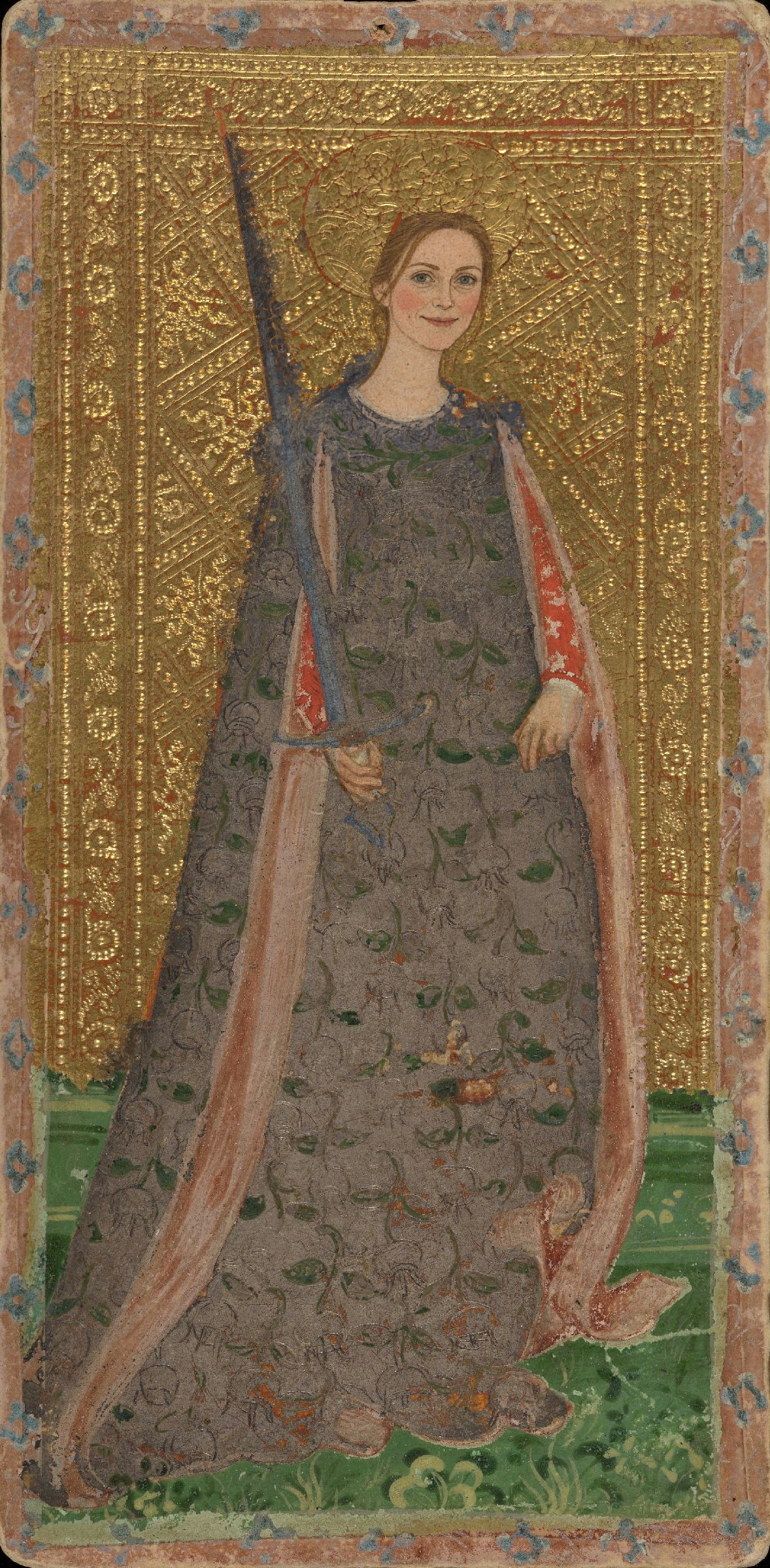
A Fable reading ends with a portrait painted for you from your reading, in the historic style of the deck: the gold, the tooled ground and the flat, bright colour of the cards the Visconti commissioned.
Draw your three cards from the Visconti deck Create your Renaissance portrait
For how tarot grew from these cards into the reading deck we know, read the history of tarot.
Sources: The Morgan Library & Museum, MS M.630, catalogue record; Beinecke Rare Book and Manuscript Library, Yale University, Visconti di Modrone tarot cards (Playing Cards Gen 965); Michael Dummett, The Visconti–Sforza Tarot Cards (1986); Gertrude Moakley, The Tarot Cards Painted by Bonifacio Bembo (1966); Giordano Berti, Storia dei tarocchi (2007). Yale images are public domain under Yale's open-access policy. Reconstructions are Fable's own and are marked as such.