The Cary-Yale Visconti tarot, painted for the last Duke of Milan
Older than the Visconti–Sforza deck, with Faith, Hope and Charity among its trumps and women knights in its suits. The 67 cards at Yale, and the ones that are lost.
The Cary-Yale Visconti tarot is one of the oldest tarot decks in the world, painted in gold for the last Visconti Duke of Milan in the 1440s. Sixty-seven of its cards survive, all of them at Yale. It is older than the more famous Visconti–Sforza deck, larger, and stranger: its trumps include Faith, Hope and Charity, and its suits have women knights.
Here is what the deck is, who it was made for, and how Fable shows it whole.
Draw your three cards Create your Renaissance portrait
A deck for Filippo Maria Visconti
Filippo Maria Visconti ruled Milan from 1412 until his death in 1447, the last of his family to hold the city. Tarot was born at courts like his: the earliest records of trionfi, the triumph cards that became tarot, come from northern Italy in the 1440s, and the Milanese court had a taste for painted cards. His biographer, Pier Candido Decembrio, recorded that he paid 1,500 gold pieces for a pack of painted cards of gods and birds.
The Cary-Yale deck is dated to about 1442–1447. Its pictures are full of Visconti heraldry: the imperial eagle on the Empress's shield and the biscione, the blue serpent of the Visconti arms.
Gold you can feel
The cards are painted in tempera on pasteboard and laid with gold and silver leaf. On the triumphs and court cards the gold ground is raised and tooled with a punch, in diamond and flower patterns that catch the light as the card moves. Each card is framed by a narrow border of small blue flowers. The deck is usually attributed to the Milanese workshop of Bonifacio Bembo, though some scholars give it to the Zavattari family of painters.
The Chariot shows a woman, not a warrior, enthroned under a canopy and drawn by white horses. Some have seen in her a portrait from the court, but nobody knows who she is.
The Lovers, at the top of this article, stand beneath a canopy hung with shields that alternate the white cross of Savoy and the Visconti serpent, while a blindfolded Cupid aims from above. Filippo Maria married Maria of Savoy in 1428, and some historians read the card as a picture of that marriage, which would place the deck earlier than the 1440s.
Sixty-seven cards, and some unlike any other deck
Sixty-seven cards survive: 11 triumphs, 17 court cards and 39 numbered cards. They are not quite the deck we know.
Among the triumphs are Faith, Hope and Charity, the three theological virtues, found in no other tarot. The suits seem to have had six court cards each rather than four, with a woman knight and a maid beside the king, queen, knight and page. Whether the full deck had the 22 trumps of later tarot, or more, is still argued over.
Death on horseback
Some of the triumphs show the subjects that every later deck kept. Death rides a grey horse and sweeps his scythe across a heap of the fallen. Judgement shows the dead rising from their tombs at the sound of the angels' trumpets.
The numbered cards are simpler: suit signs painted over a patterned ground. The Ace of Coins is a single great ring of gold with the blue Visconti serpent at its centre.
How it came to Yale
The deck is also called the Visconti di Modrone tarot, after the Milanese family that once owned it. It entered the playing-card collection of the American collector Melbert B. Cary Jr., which came to Yale's Beinecke Rare Book and Manuscript Library, and it takes its common name from him and from the university. Yale has photographed all of its cards and made them free for anyone to use.
How Fable shows the whole deck
A tarot reading needs 78 cards. Fable's reading shows the 61 Yale cards that belong to a standard deck from Yale's own photographs, edge to edge, and fills the 17 that are lost with reconstructions: fourteen triumphs, among them the Fool, the Star, the Moon and the Sun, and three suit cards. Each reconstruction is painted in the manner of the surviving cards and is labelled as a reconstruction wherever it appears. They show what the cards might have looked like, not what they were.
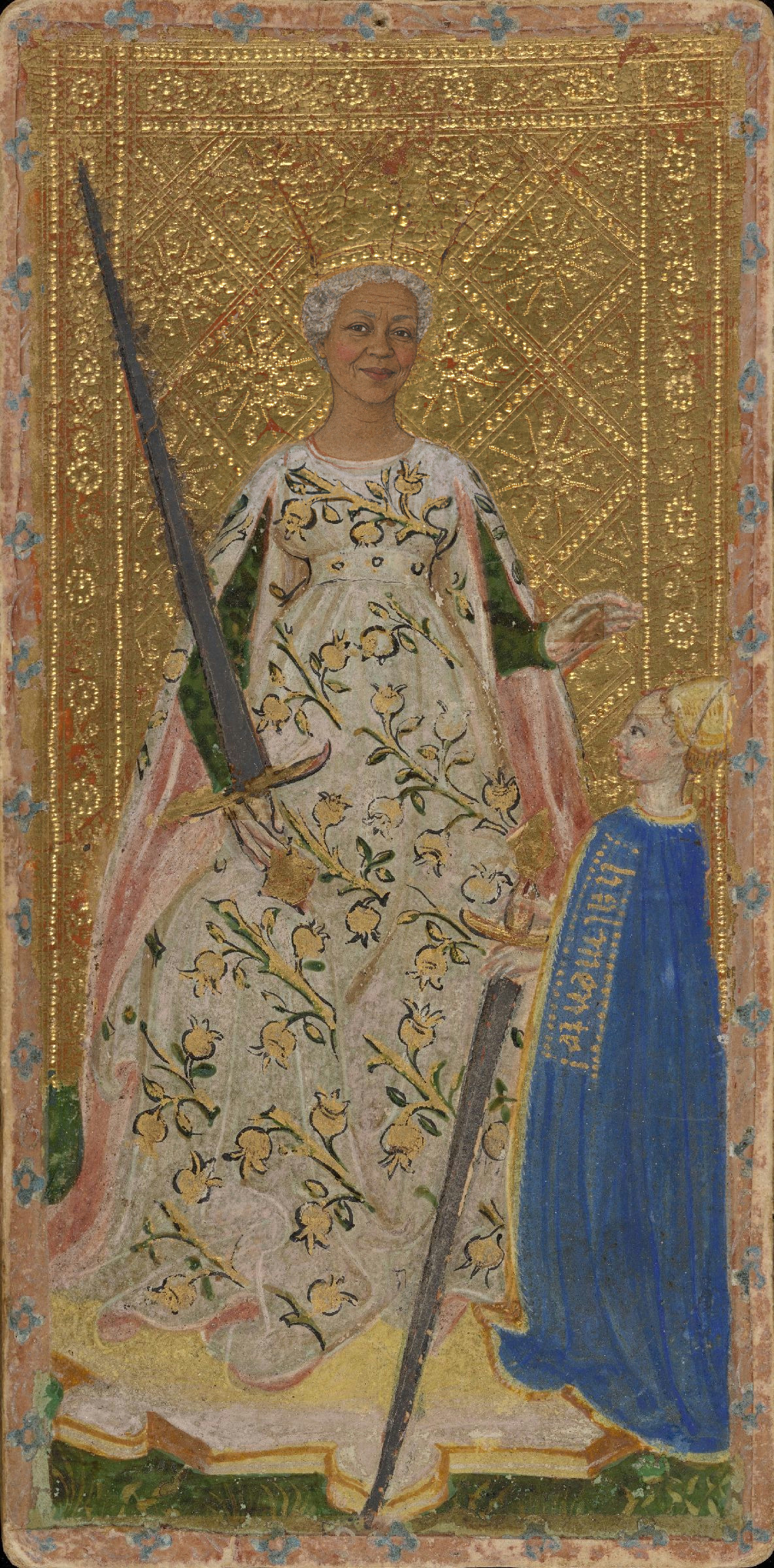
Your reading ends with a portrait painted for you from your reading, in the historic style of the deck.
Draw your three cards Create your Renaissance portrait
For the deck the Sforza made after it, read the Visconti–Sforza tarot, and for the whole story, the history of tarot.
Sources: Beinecke Rare Book and Manuscript Library, Yale University, Visconti di Modrone tarot cards (Cary Collection of Playing Cards, PLAYING CARDS GEN 965), catalogue record; Michael Dummett, The Visconti–Sforza Tarot Cards (1986); Stuart R. Kaplan, The Encyclopedia of Tarot, vol. 1 (1978); Giordano Berti, Storia dei tarocchi (2007). Card images: Yale University, public domain under Yale's open-access policy. Reconstructions are Fable's own and are marked as such.