Carl Larsson and Scandinavian art: 14 prints for a Nordic home
Carl Larsson’s Sundborn watercolours, the Skagen painters, Hammershøi’s quiet rooms and the folk tales of Swedish art: fourteen pictures from the north.
Much of what the world calls Scandinavian style began in a painter’s house. In the 1890s Carl Larsson and his wife Karin made a home in Sundborn in Dalarna, with painted furniture, light walls and red and green woodwork, and Carl painted their family life in a series of watercolours. Published as the book A Home, they taught generations how a Nordic house could look.
This list starts with Larsson and travels around the north: the painters of Skagen in Denmark, Hammershøi’s silent rooms in Copenhagen, Bruno Liljefors’s animals, and the water sprites and fairies of Swedish folklore. Every picture can be ordered as a print, and several are the source of a Fable portrait style.
1. The Cottage (Stugan)
Carl Larsson, The Cottage (Stugan). From A Home, 1899. Watercolour. Nationalmuseum, Stockholm.
The cottage at Lilla Hyttnäs, the Larssons’ house in Sundborn, painted for A Home in 1899. Red timber, white trim and a garden left to grow wild: it is the picture of a Swedish summer house that everyone carries in their head. It is also the masterwork behind Fable’s Cottage style.
A sunny, welcoming picture for a hallway or a kitchen.
Create your portrait in this style
2. Breakfast under the Big Birch
Carl Larsson, Breakfast under the Big Birch. From A Home, 1896. Watercolour. Nationalmuseum, Stockholm.
Larsson’s family eats outdoors under the big birch in the summer of 1896, children in striped shirts and sun hats, a dog waiting for scraps. It is the most famous Swedish summer breakfast ever painted, and the table still stands in the garden at Sundborn.
A joyful picture for a dining room, a kitchen or a summer house.
Create your portrait in this style
3. The Dining Room
Carl Larsson, The Dining Room. From A Home, 1899. Watercolour. Nationalmuseum, Stockholm.
The dining room at Sundborn, with its painted woodwork, carved table and red and green trim, was Larsson and Karin’s manifesto. Their mix of country furniture, light walls and bold colour became the model for the Swedish interior.
A natural choice for a dining room, especially one with painted woodwork.
4. Flowers on the Windowsill
Carl Larsson, Flowers on the Windowsill. From A Home, 1894. Watercolour. Nationalmuseum, Stockholm.
One of the Larsson daughters waters the geraniums on a wide windowsill, painted in 1894. White walls, many panes of glass and pots of flowers: the room is almost all light.
A fresh, bright picture for a kitchen, a child’s room or a sunny hall.
5. Crayfishing
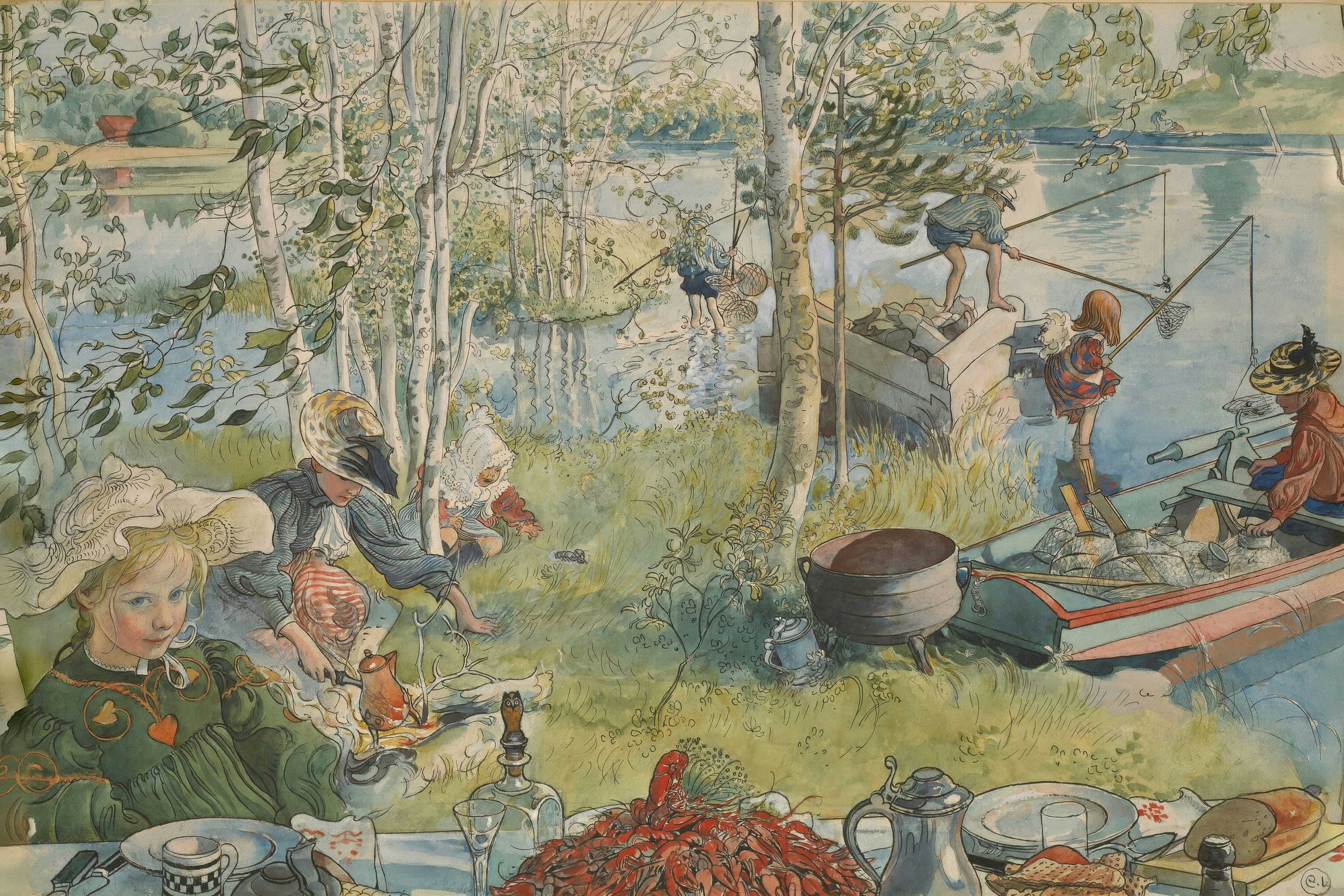
Carl Larsson, Crayfishing. From A Home, 1899. Watercolour. Nationalmuseum, Stockholm.
In August Swedes go crayfishing and hold crayfish parties, and Larsson painted his children at it in 1899: nets in the water, a boat, a little fire on the shore and birch trees all around.
A summer picture for a summer house, a kitchen or a family room.
6. The Yard and Washhouse
Carl Larsson, The Yard and Washhouse. From A Home, 1899. Watercolour. Nationalmuseum, Stockholm.
Winter at Sundborn: a low sun, a snowy yard and a child pushing a kicksled toward the red washhouse. Larsson loved the Swedish winter as much as the summer. This picture is also the masterwork behind Fable’s Yard and washhouse style.
A crisp, quiet picture for a hallway or a bedroom in winter.
Create your portrait in this style
7. Karin by the Shore
Carl Larsson, Karin by the Shore, 1908. Malmö Art Museum.
Karin Larsson was a trained painter herself and designed much of the furniture and textiles in their home. In this picture of 1908 she stands by the lake in a wide white hat, with orange lilies in front of her.
A calm, summery portrait for a bedroom or a living room.
8. Sunlight in the Blue Room
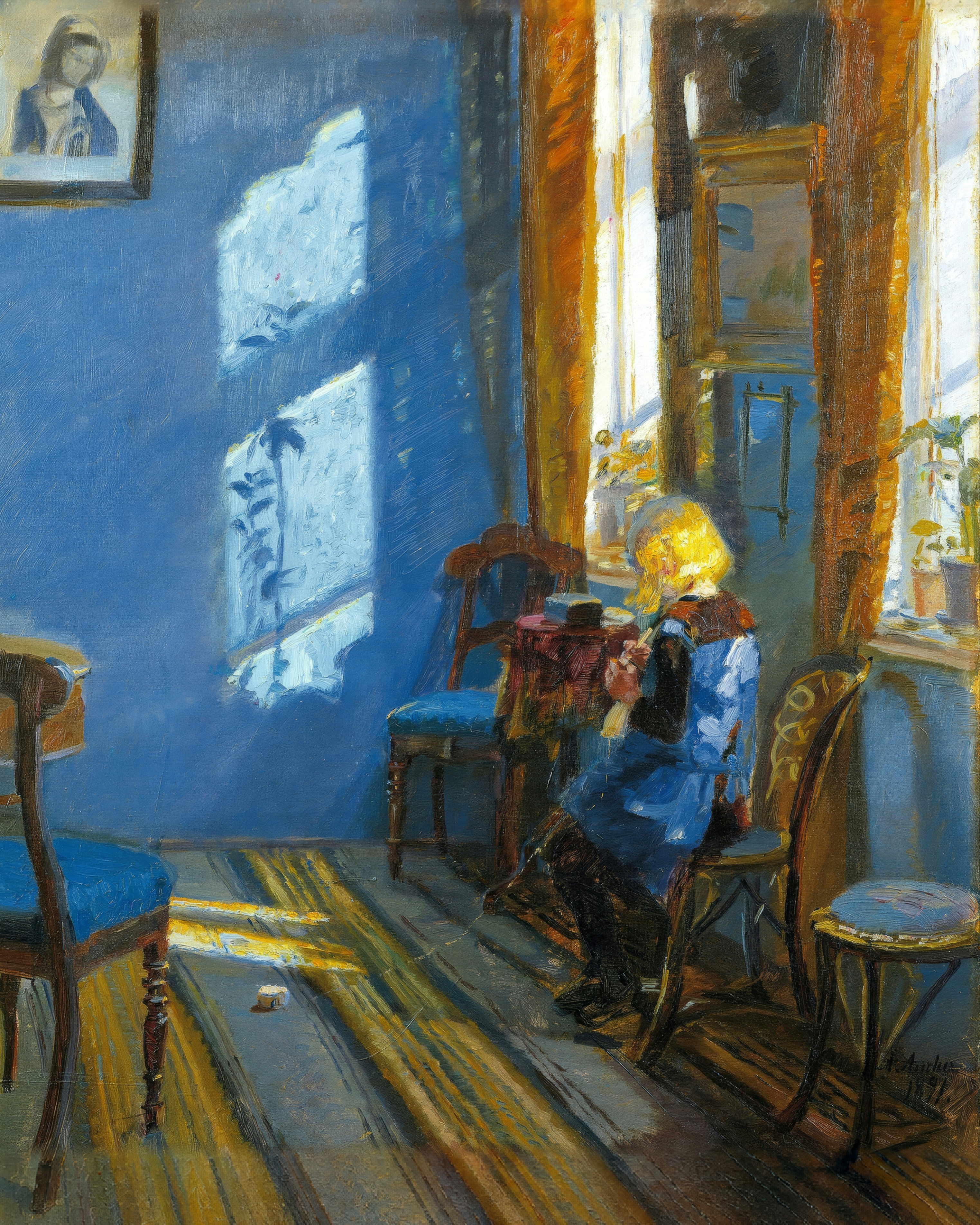
Anna Ancher, Sunlight in the Blue Room, 1891. Oil on canvas.
Anna Ancher was born in Skagen and became its greatest painter of interiors. In this picture of 1891 her daughter Helga sits sewing in the blue room, but the real subject is the light: bright patches of sun on the walls and floor.
A luminous picture that lifts a dim hallway or a north-facing room.
9. Summer Evening at Skagen
Peder Severin Krøyer, Summer Evening at Skagen, 1892. Oil on canvas. Skagens Museum.
P.S. Krøyer painted the famous blue hour of Skagen: the long summer evening when sea and sky turn the same blue. Here, in 1892, his wife Marie stands on the beach with their dog. It is the masterwork behind Fable’s Summer evening at Skagen style, for a portrait of you and your dog.
A dreamy blue picture for a bedroom, and a beautiful style for owners and their dogs.
Create your portrait in this style
10. Marie and Vibeke Embroidering at Home in Skagen
Peder Severin Krøyer, Marie and Vibeke Embroidering at Home in Skagen, 1898. Watercolour.
Krøyer painted his wife Marie and their daughter Vibeke sewing together at home in Skagen in 1898. Pale green dresses, red poppies and soft daylight make it one of his gentlest pictures.
A soft, family picture for a bedroom, a sewing room or a nursery.
11. Interior of Courtyard, Strandgade 30
Vilhelm Hammershøi, Interior of Courtyard, Strandgade 30, 1899. Oil on canvas. Städel Museum, Frankfurt.
Vilhelm Hammershøi painted the rooms and courtyard of his Copenhagen flat at Strandgade 30 in greys and whites, often without a single person. This courtyard of 1899 is all walls, windows and silence. Today he is one of the most admired painters of the north.
A quiet, minimal picture for a calm bedroom, a study or a grey and white interior.
12. Cat Hunting Birds
Bruno Liljefors, Cat Hunting Birds, 1883. Oil on canvas. Gothenburg Museum of Art.
Bruno Liljefors was Sweden’s great painter of wildlife, and he watched animals the way a hunter does. In 1883 he painted a farm cat in the long grass with its prize, alert and proud. It is the masterwork behind Fable’s Cat hunting birds style.
A natural, lively picture for a country house, and a striking style for a cat portrait.
Create your portrait in this style
13. The Water Sprite
Ernst Josephson, The Water Sprite (Strömkarlen), 1884.
In Nordic folklore the strömkarl plays the fiddle in the waterfall and can teach his music to anyone brave enough to ask. Ernst Josephson painted him in 1884, lost in his song among the rushing water. It became a symbol of the artist’s wild inspiration.
A dramatic, mythical picture for a music room or a study.
14. Dancing Fairies (Älvalek)
August Malmström, Dancing Fairies (Älvalek), 1866.
On summer nights, Swedish folk tales say, the elves dance in the mist over the meadows. August Malmström painted them in 1866 as pale figures rising from the evening fog, and the picture became one of the best loved in Swedish art.
A magical picture for a child’s room, a bedroom or anyone who grew up with Nordic tales.
Scandinavian pictures suit Scandinavian rooms: pale walls, wood floors, painted furniture and plenty of daylight. Larsson’s watercolours look best with light wood frames or none, and they are lovely in a kitchen, a child’s room or a summer house. Hammershøi and the Skagen painters bring calm to a bedroom or a study. Every print here is made from a museum scan and printed whole. For the season Larsson loved most, read our winter landscape paintings, and for his garden, see garden paintings.
Questions
Who was Carl Larsson?
Carl Larsson (1853–1919) was a Swedish painter best known for his watercolours of family life at Lilla Hyttnäs, his house in Sundborn. His book A Home, published in 1899, helped shape the Scandinavian interior style.
Can you visit Carl Larsson’s house?
Yes. Carl Larsson-gården in Sundborn, Dalarna, is still owned by the family and open to visitors, with the rooms much as he painted them.
Who were the Skagen painters?
They were a group of Scandinavian artists who gathered in the fishing village of Skagen in northern Denmark from the 1870s, including P.S. Krøyer, Anna and Michael Ancher. They are famous for their blue summer evenings and sunlit interiors.
How do I decorate with Scandinavian art prints?
Choose light, airy pictures, hang them a little low and leave space around them. Light wood frames, white walls and simple furniture let the colours of Larsson or the Skagen painters shine.