The Haywain Triptych: what Bosch's cart of hay means
Everyone grabs at the hay while the cart rolls toward hell. Four prints from Bosch's Haywain and what each one shows.
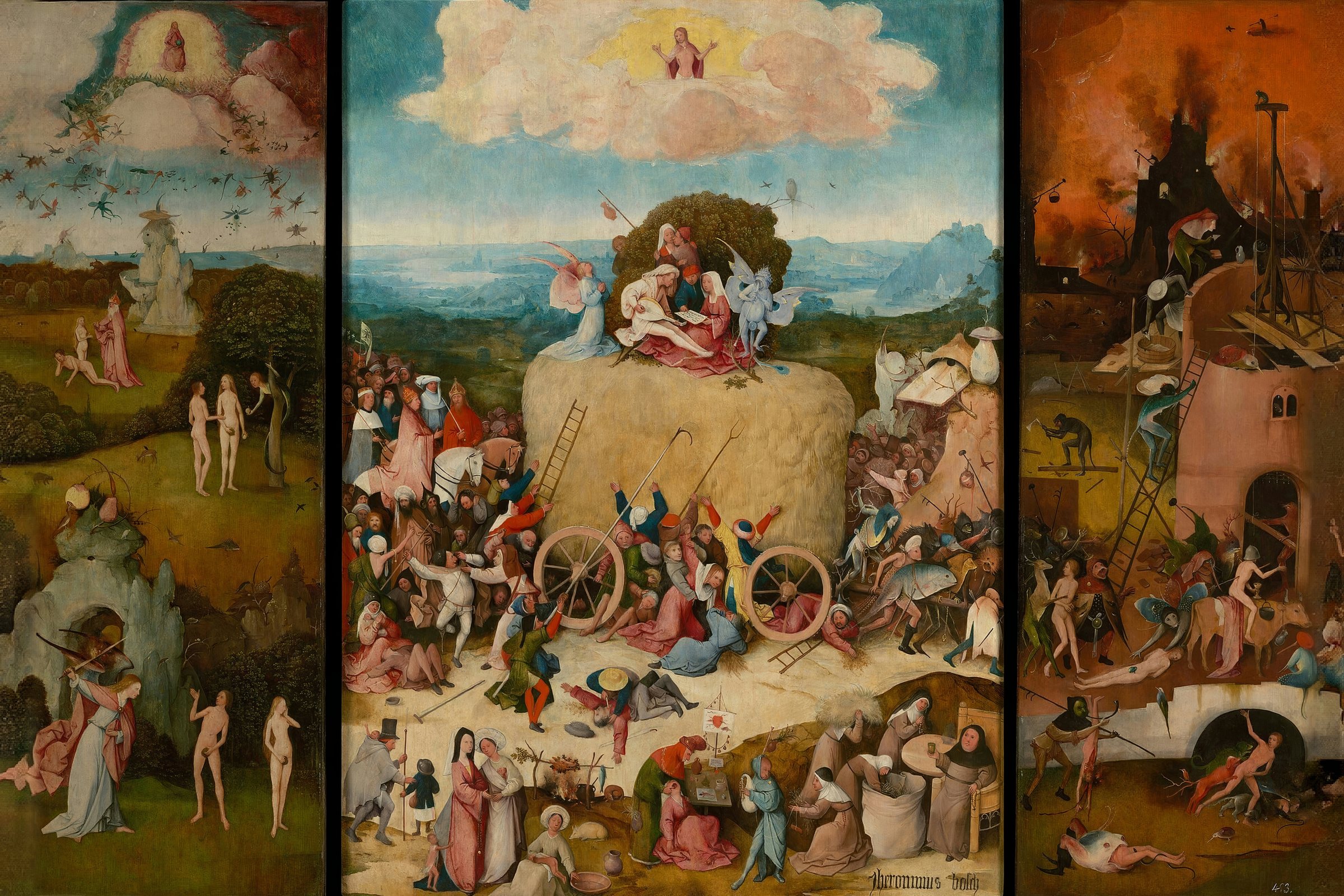
Hieronymus Bosch — The Haywain Triptych, c. 1512–1515. Museo del Prado, Madrid. The whole triptych, open.
A Flemish proverb says that the world is a haystack, and everyone plucks from it what he can. Bosch painted that idea as a huge cart of hay rolling across a landscape, pulled by demons, while people of every rank fight to grab a handful: a pope and an emperor ride behind it, peasants stab each other beside its wheels, nuns stuff hay into a sack. Read left to right, the triptych runs from the fall of the angels and Adam and Eve to the cart's destination: hell. Here are four prints Surrealium has cut from it.
See every print marked on the whole painting
1. The Haywain: Central Panel
Hieronymus Bosch — The Haywain: Central Panel. Museo del Prado, Madrid. Surrealium print; complete composition.
The centre panel in full: the cart of hay, the crowd round it and the procession of the powerful behind. High above, Christ appears in the clouds with his wounds showing, and nobody looks up. That small figure is the key to the whole picture.
The whole story in one print, rich in detail and with a wide, open sky.
2. Lovers on the Hay
Hieronymus Bosch — Lovers on the Hay. Museo del Prado, Madrid. Surrealium print; complete composition.
On top of the hay, untouched by the fight below, a group of lovers make music. An angel kneels on one side looking up in prayer; on the other, a blue demon plays a pipe. The lovers listen to the demon.
The painting's most famous detail: music, romance and a warning in one balanced composition.
3. The Nuns and the Sack
Hieronymus Bosch — The Nuns and the Sack. Museo del Prado, Madrid. Surrealium print; complete composition.
In the bottom right corner, a fat friar sits at a table while nuns gather hay and stuff it into a sack for him. It is Bosch's sharpest jab at the clergy of his day: even those sworn to poverty grab what they can.
A lively, earthy group of figures with plenty of humour.
4. The Infernal Ascent
Hieronymus Bosch — The Infernal Ascent. Museo del Prado, Madrid. Surrealium print; complete composition.
The right wing is hell, where demons are building a tower. Some carry beams, some climb ladders, and sinners are led in beneath. Above, the sky burns red. Unlike the Garden's hell, this one is still under construction, as if more guests are expected.
Fierce reds and oranges in a tall, narrow shape: a dramatic vertical print.
The Haywain is quieter than The Garden of Earthly Delights and easier to read, but no less full. Each detail here is a museum-quality print, and the page Bosch's triptychs, detail by detail shows where every one sits in the whole painting.
Bosch's triptychs, detail by detail · The Surrealium Collection