The esoteric world of Hilma af Klint
Séances, spirit guides, a temple that was never built: the hidden beliefs behind the planets, swans and golden suns of Sweden's first abstract painter.
For most of the twentieth century, nobody outside a few spiritual societies knew these paintings existed. Hilma af Klint was a respected Stockholm landscape and portrait painter. In private, she spent her life painting what she believed the spirit world was showing her: planets, spirals, swans that turn into circles, golden suns over pyramids of colour.
This is the esoteric world behind those pictures, told from her own notebooks and from the curators and biographers who have read them. Fourteen of the paintings are shown here as print masters, and in a room, so you can see how a vision from 1915 holds a wall today.
The circle around the altar
Hilma af Klint went to her first séance at seventeen, in 1879. By 1896 she and four friends from Stockholm's art world, Anna Cassel, Cornelia Cederberg, Sigrid Hedman and Mathilda Nilsson, had formed a circle they called The Five. Every week they prayed, read the New Testament and sat at an altar marked with a cross and a rose, the old emblem of the Rosicrucians. Then they waited for the High Masters, the spirits they believed spoke through them, and wrote and drew whatever came. One guide gave the instruction that still sounds like the whole of her career: "Take the pencil, Hilma."
In January 1906 a guide called Amaliel offered her a task. She was to paint pictures for a temple. The others in the circle had already said no. She accepted at once, and later wrote: "This became the great commission, which I carried out in my life."
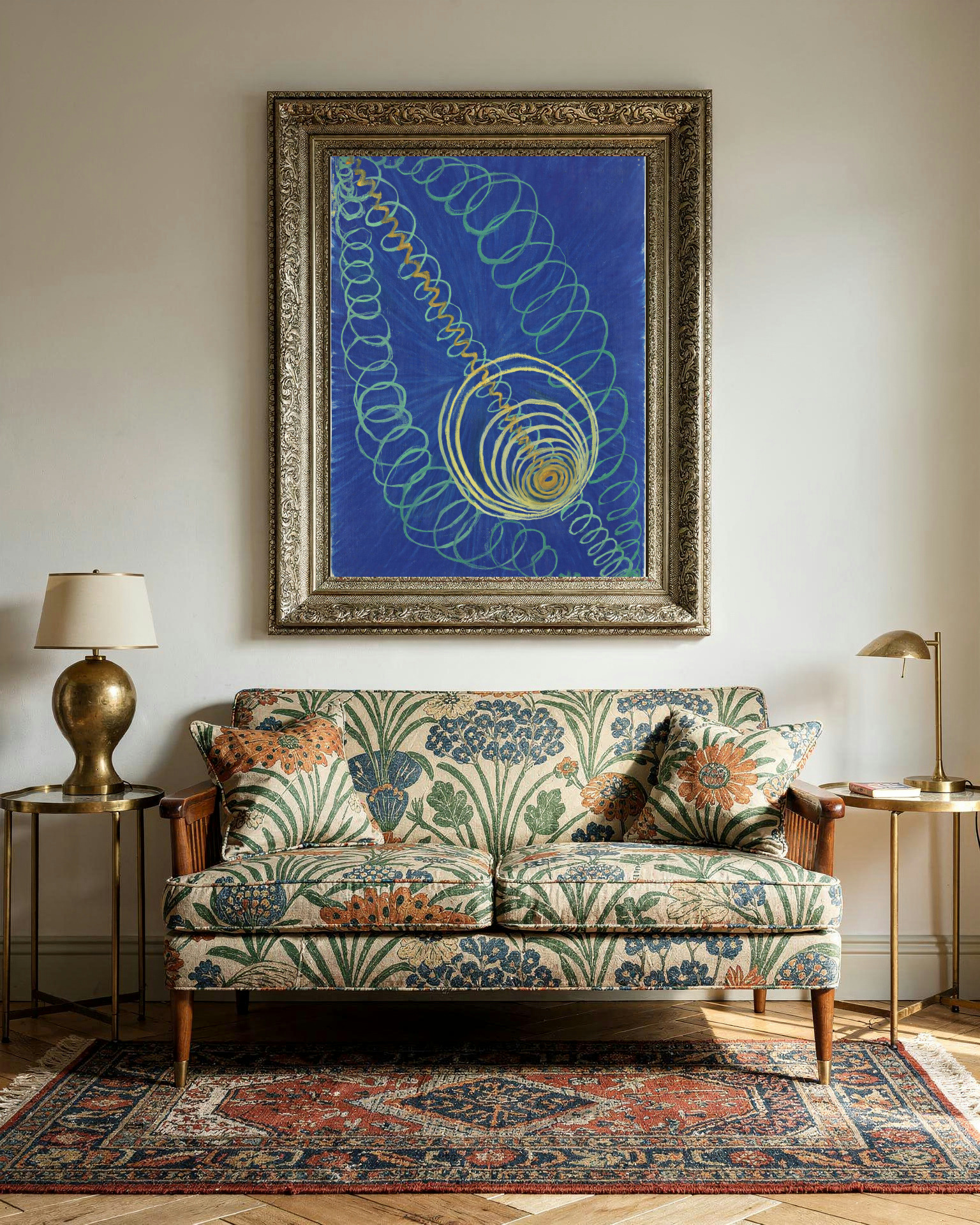
1. Primordial Chaos, No. 16
Hilma af Klint, Primordial Chaos, No. 16, 1906–1907. Hilma af Klint Foundation, Stockholm.
The commission began in November 1906 with a group of small canvases called Primordial Chaos: the world before it takes form, drawn as spirals and coils turning on a deep blue ground. She did not think of them as decoration. She later compared these pictures to "charts and logarithms for a seaman", which is fitting for a woman from a family of naval officers. They are maps, made to be read.
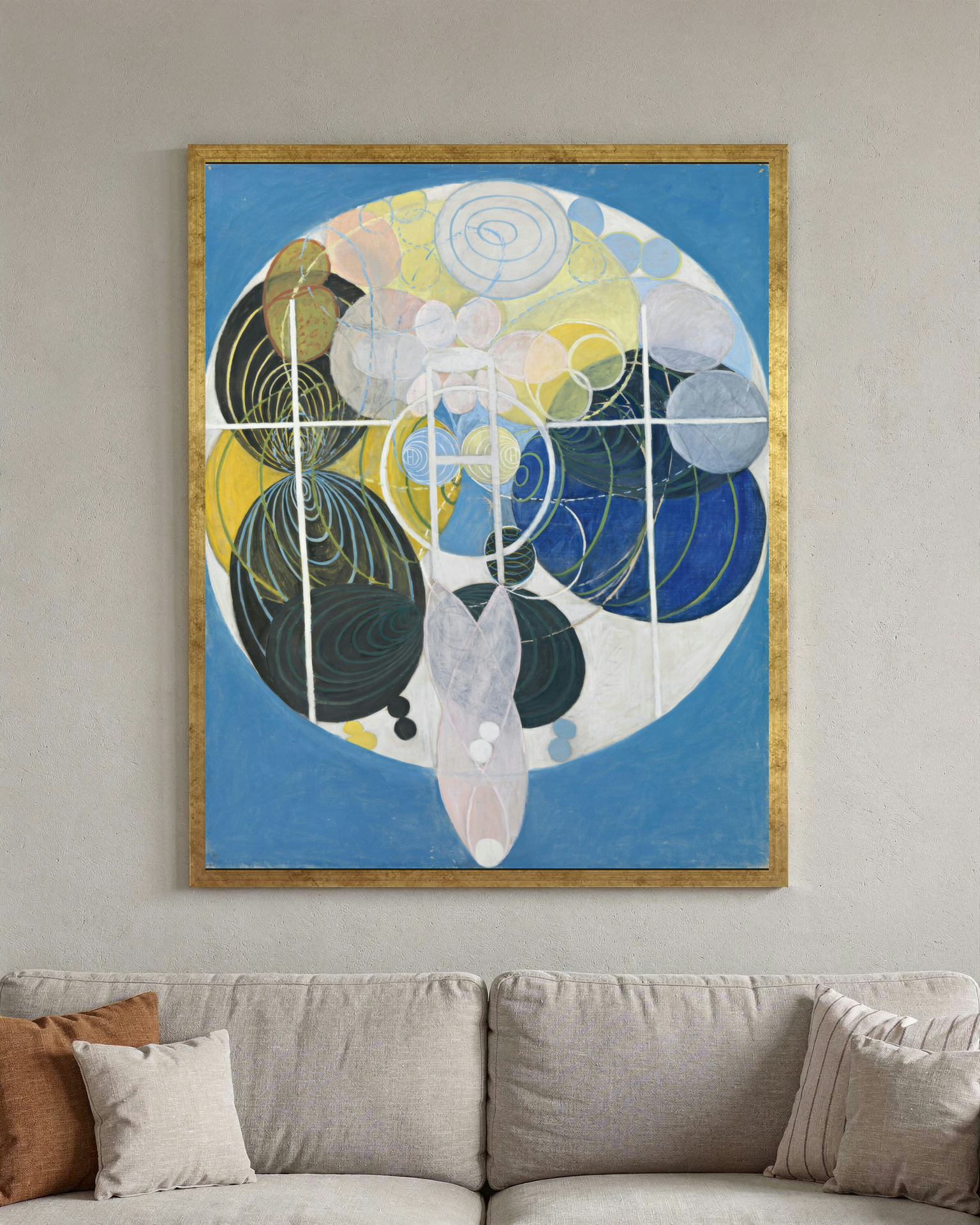
2. The Key to the Work up to this Point
Hilma af Klint, The Key to the Work up to this Point, 1907.
A single sphere fills the canvas like a planet seen from space, quartered by a white cross and crowded with smaller worlds. The title is her own, and it says what the picture was for: a key to everything she had painted so far. She worked in series and numbered everything, and she kept long lists explaining what her letters and shapes meant. The pictures were never meant to be pretty puzzles. They were a system.
Painted through her
She described how the first paintings came in words that are still quoted in every museum that shows her: "The pictures were painted directly through me, without any preliminary drawings, and with great force. I had no idea what the paintings were supposed to depict; nevertheless I worked swiftly and surely, without changing a single brush stroke."
The guides asked for some of these pictures to be "as big as barn doors", and in 1907 she painted ten of them, each over three metres tall. In eighteen months she finished more than a hundred works, years before Kandinsky made his first abstract painting.
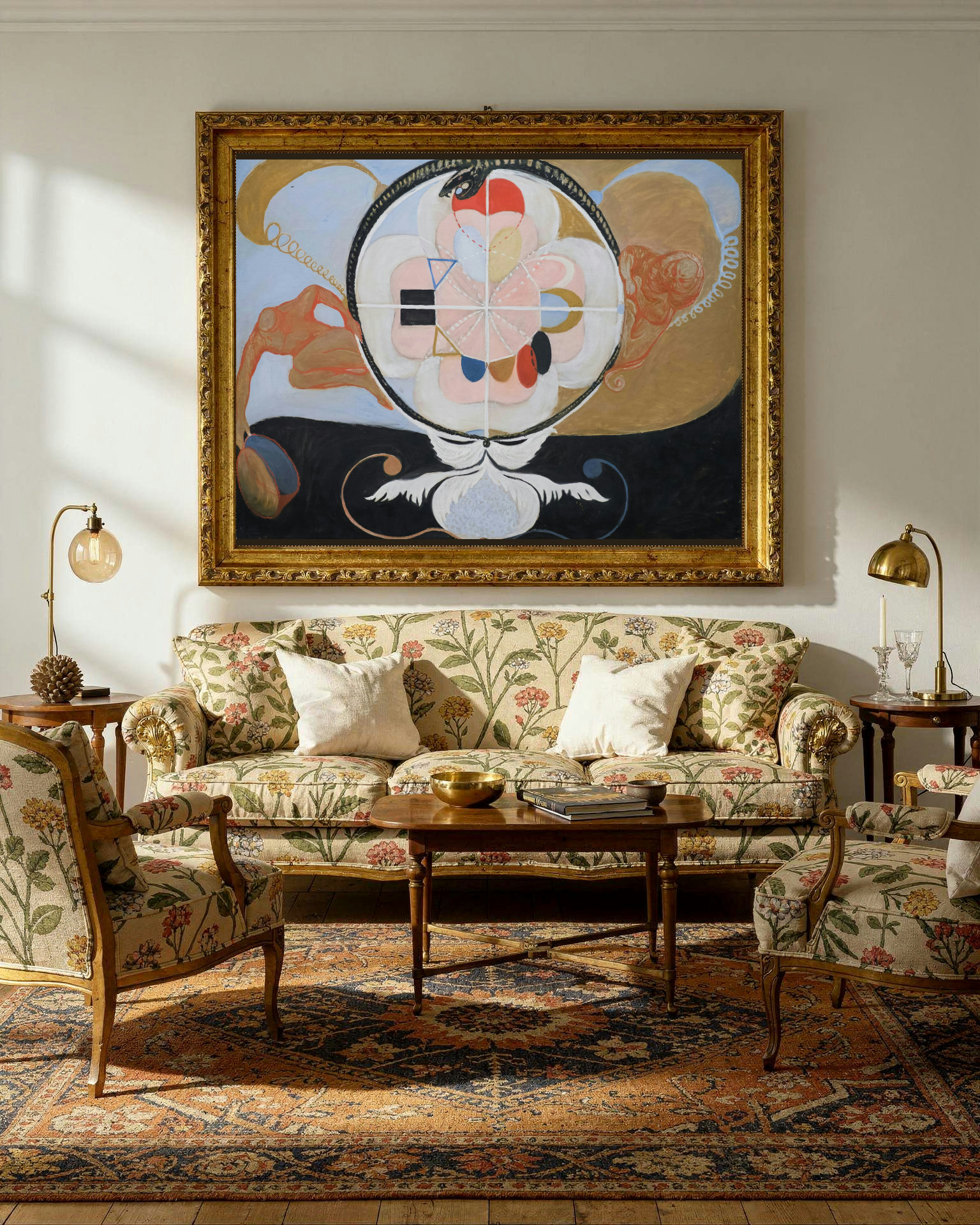
3. Evolution, No. 13
Hilma af Klint, Evolution, No. 13, 1908. Hilma af Klint Foundation, Stockholm.
Moderna Museet describes the Evolution group as a picture of how the world and matter arose from the spirit. Here a black serpent swallows its own tail, the ancient sign of a cycle with no beginning or end, around a flower built from circles and crescents. By April 1908 the first part of the Temple held 111 paintings. That year The Five broke apart, and she met Rudolf Steiner, whose view of the work was cool. She did not paint for the Temple again for four years.
The rose and the cross
In 1913 she bought a lake house called Furuheim on the island of Munsö in Lake Mälaren, close to the island where she had spent her childhood summers. That year she painted the US Series and began the Tree of Knowledge. She also showed seventeen of her spiritual paintings at an exhibition organised by the Theosophical Society in Stockholm, one of the very few times they were seen in her lifetime.
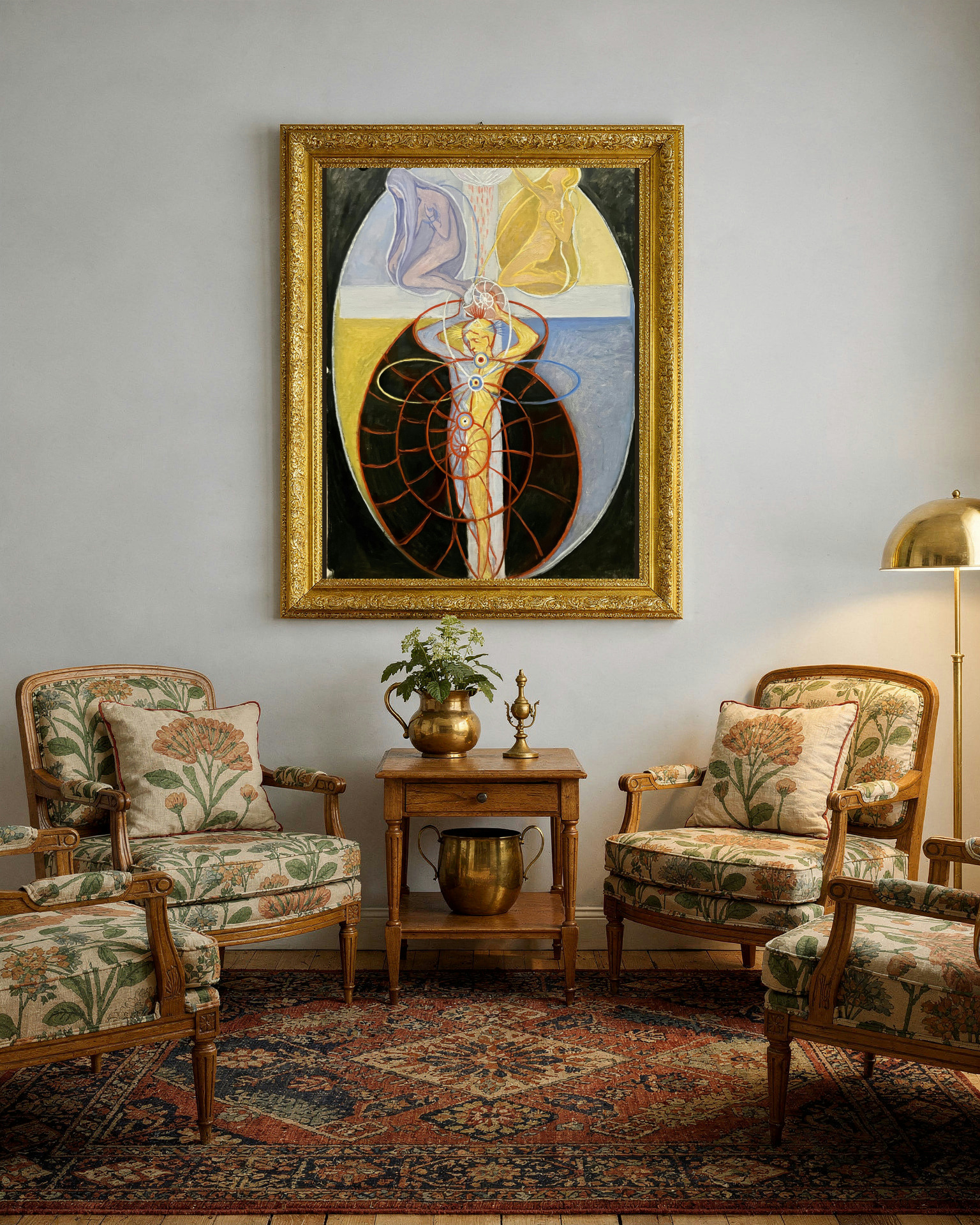
4. The US Series, Group VIII, No. 1
Hilma af Klint, The US Series, Group VIII, No. 1, 1913. Hilma af Klint Foundation, Stockholm.
When she went back to work in 1912 something had changed. She no longer felt her hand was being guided, and her own reading, of esoteric Christianity and Steiner's writing on the Rosicrucians, came into the pictures. The 1913 US Series is full of crosses, figures and light. Here a glowing figure stands at the centre of a cosmic egg, half gold and half black, the two worlds she painted all her life held in one shape.
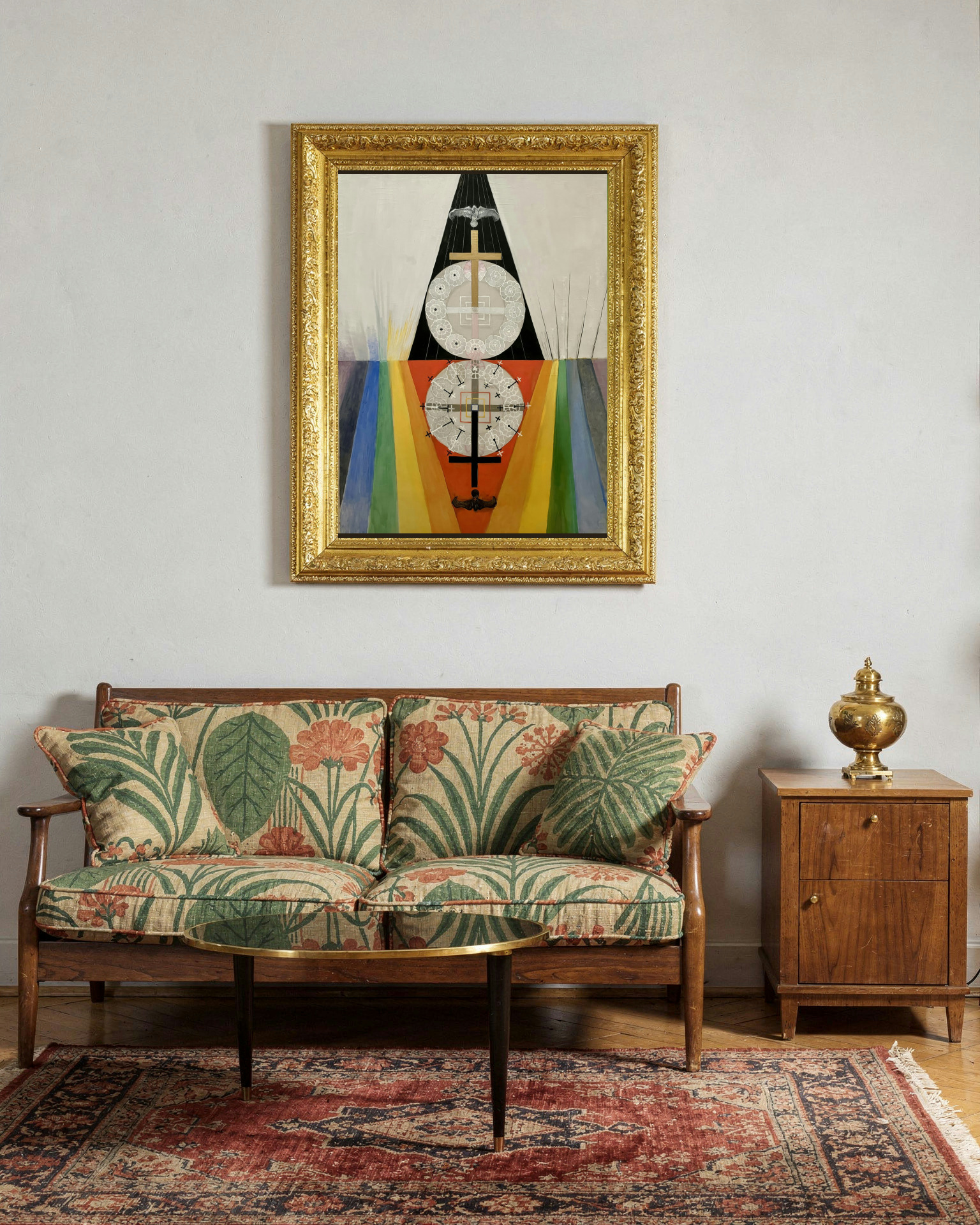
5. The US Series, Group VIII, No. 7
Hilma af Klint, The US Series, Group VIII, No. 7, 1913. Hilma af Klint Foundation, Stockholm.
Two white discs, each marked with a cross, rise one above the other inside a tall dark triangle, and a white bird waits at the top. Below, the colours of the spectrum fan out like light through a prism. The cross, the bird and the rainbow all belong to the Christian and Rosicrucian language she was now using, but the composition is pure geometry. It reads as a diagram of an ascent, from coloured earthly light to white spirit.
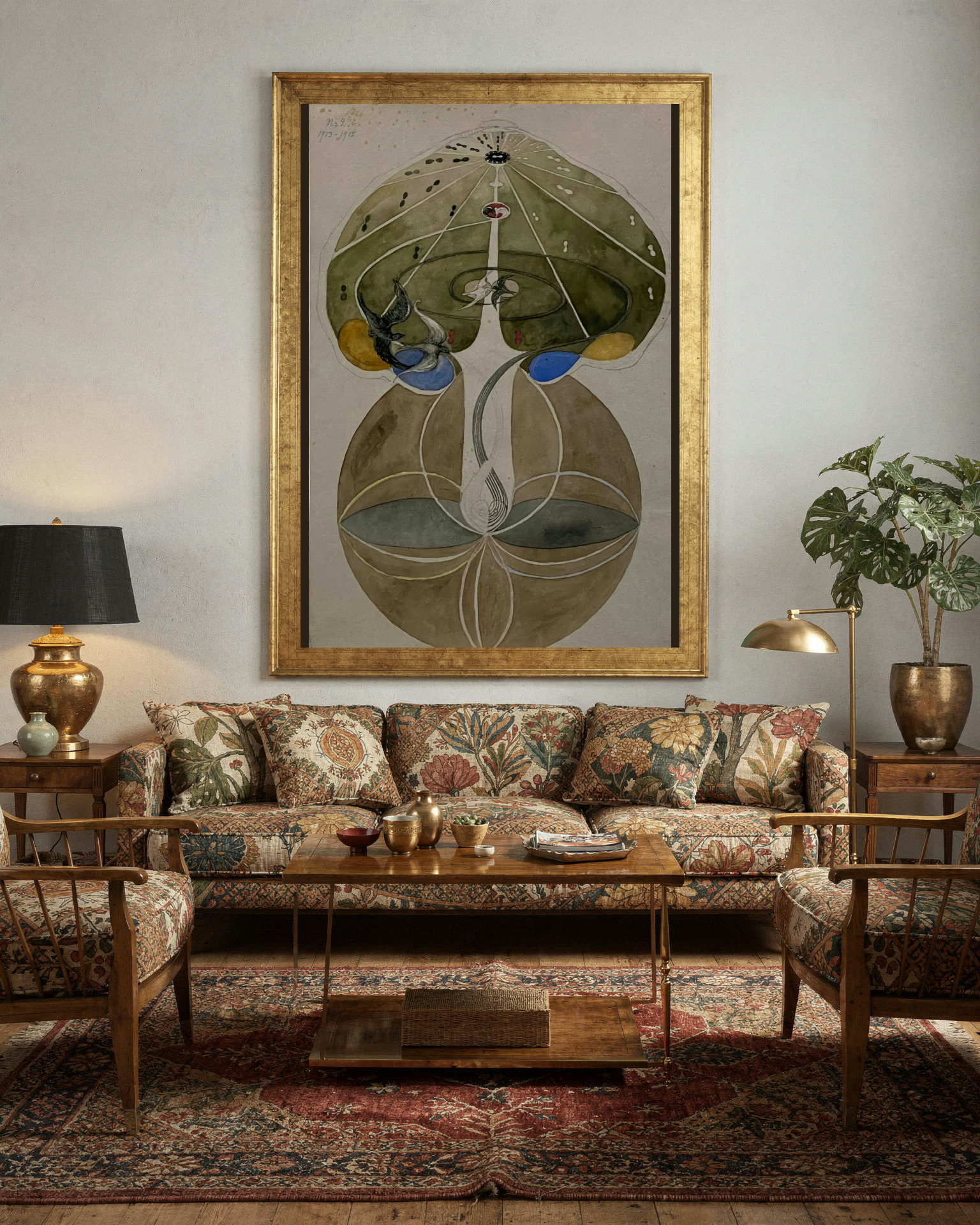
6. Tree of Knowledge, No. 2
Hilma af Klint, Tree of Knowledge, No. 2, 1913–1915.
The Tree of Knowledge is a set of eight watercolours, drawn slowly and precisely, more like botanical plates than visions. The crown above and the round earth below mirror each other, the esoteric idea of "as above, so below". Her biographer Julia Voss writes that in these sheets she "captured world knowledge on a sheet of paper and compressed it into a diamond". In 1927 she gave the whole series to the Goetheanum, Steiner's centre in Switzerland.
Swans at the edge of the world
Moderna Museet sums up the whole Temple in one sentence: it was meant "to convey the knowledge of how all is one, beyond the visible dualistic world". Light and dark, male and female, spirit and matter: her pictures keep splitting the world in two so they can show the two halves meeting. Nowhere is that clearer than in the swans and doves of 1914 and 1915, painted in Stockholm while the war went on around neutral Sweden.
7. The Swan, No. 9
Hilma af Klint, The Swan, No. 9, 1915. Hilma af Klint Foundation, Stockholm.
She began the Swan series in 1914, the year the First World War broke out. In many traditions the swan stands for the soul and the ethereal, and here she uses a white swan and a black one, striving to become one. By the ninth canvas the birds have turned into pure geometry, curving forms in black, white and colour meeting at the centre of a circle.
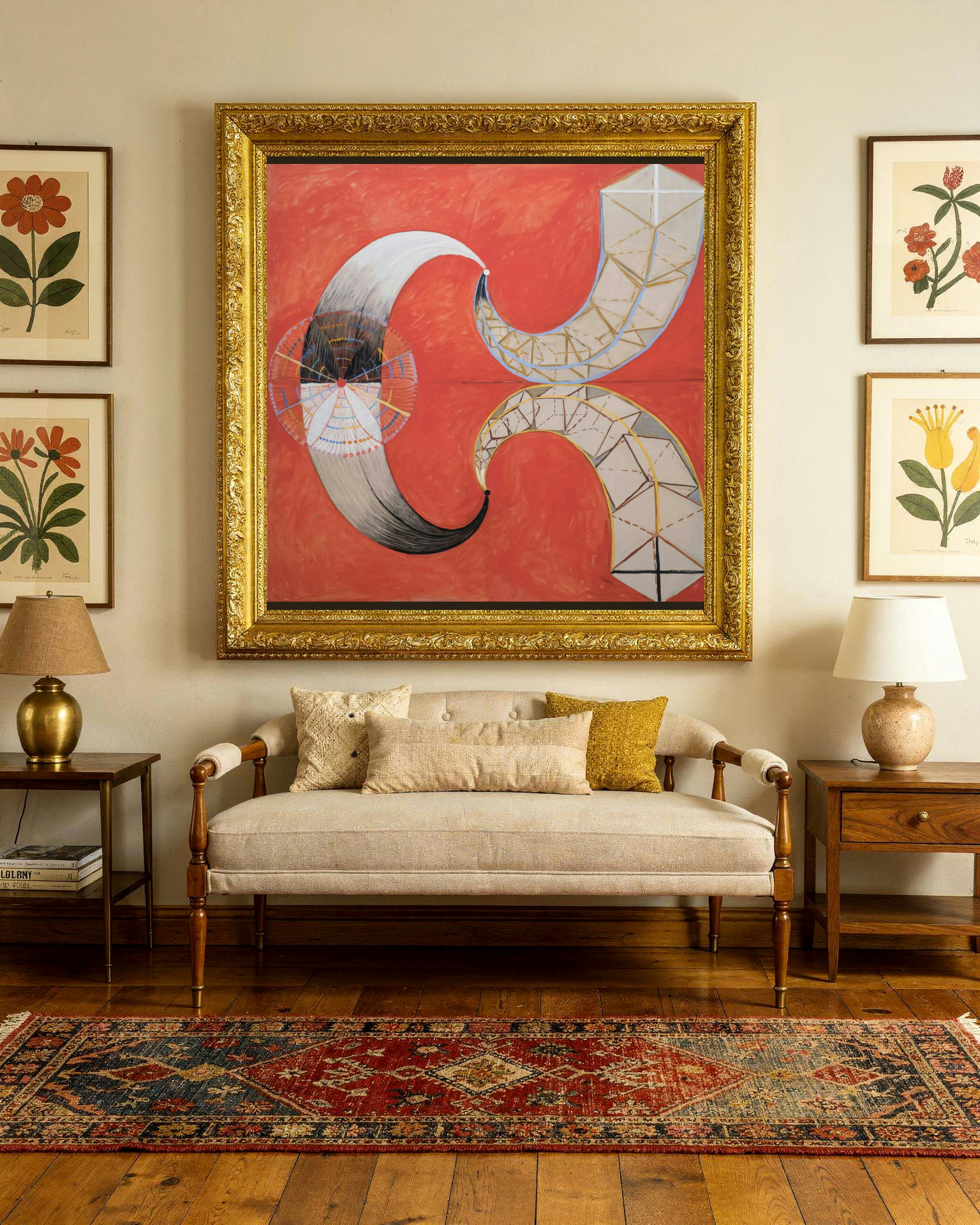
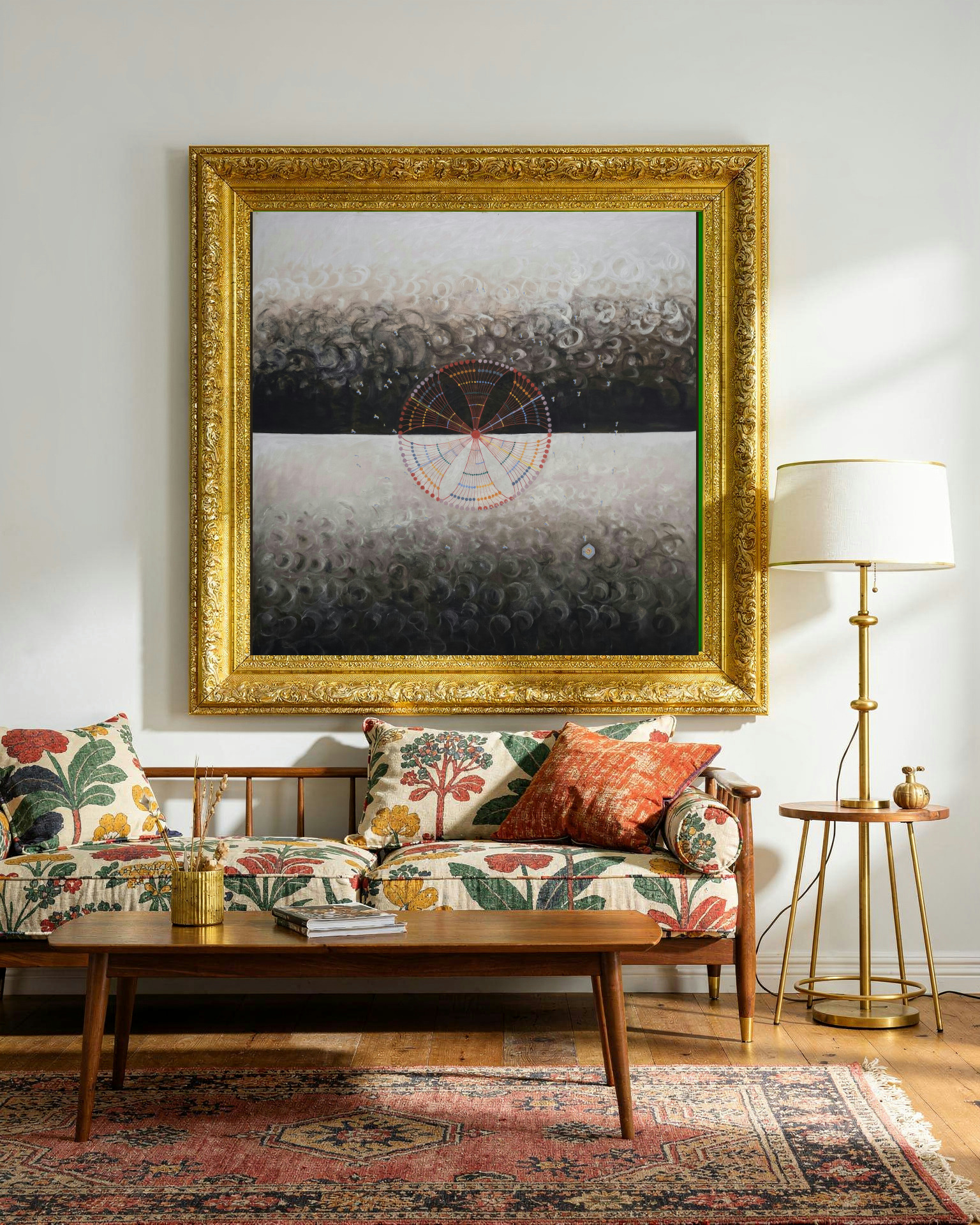
8. The Swan, No. 10
Hilma af Klint, The Swan, No. 10, 1915. Hilma af Klint Foundation, Stockholm.
The swans are gone. What is left is a horizon between two banks of dark cloud, and in the middle a small circle drawn like an instrument dial, red lines radiating from its centre. It looks like a planet seen through a telescope or a sun about to rise. Hung in a room, it works the way a window does.
9. The Swan, No. 12
Hilma af Klint, The Swan, No. 12, 1915. Hilma af Klint Foundation, Stockholm.
A prism of every colour stands on the horizon, joining a white sphere in the sky to a brown one below it, as if light were passing between heaven and earth. It is one of the clearest pictures of her central idea: two worlds, one above and one below, joined by a single shape. The rainbow bands are painted with almost scientific care.
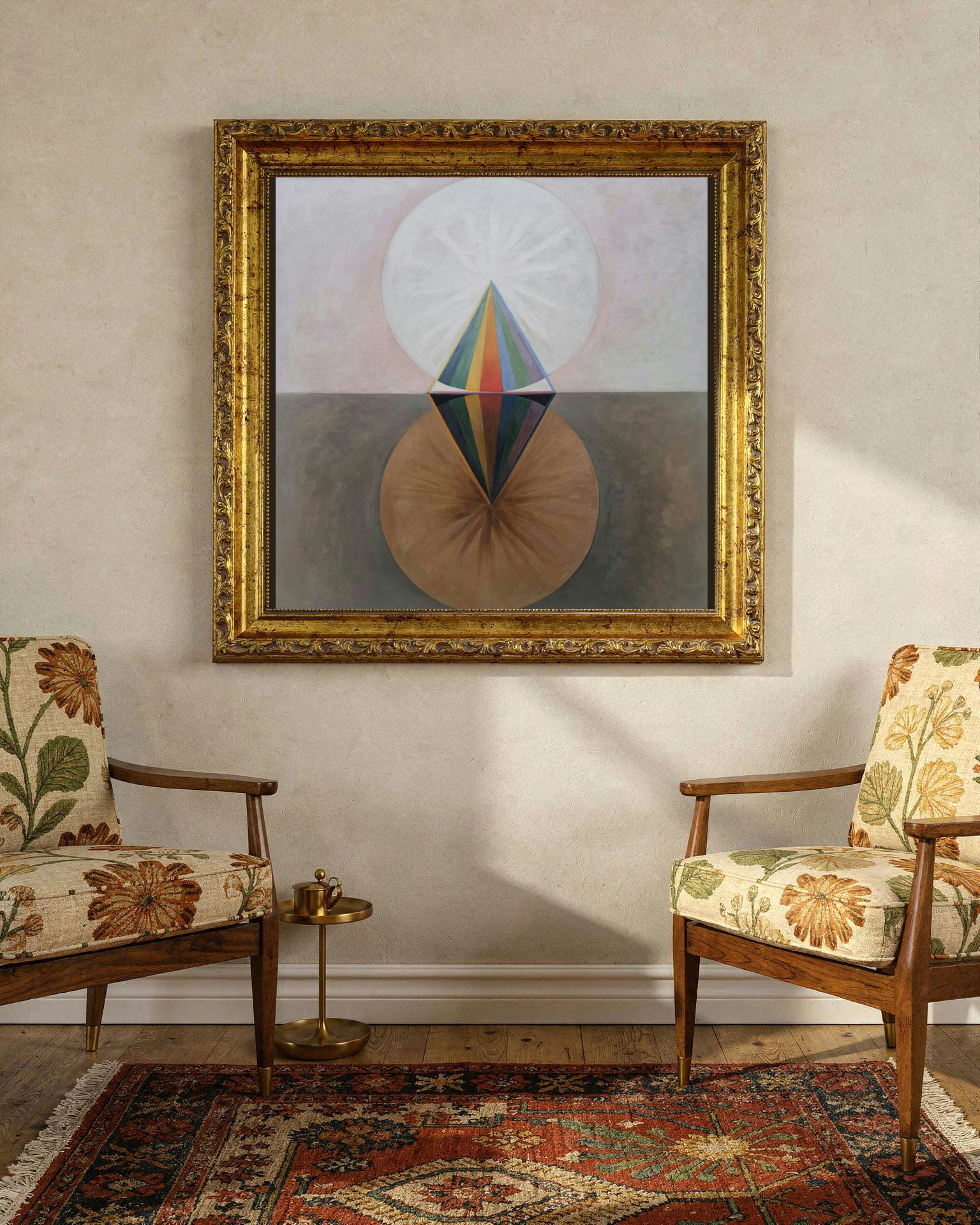
10. The Swan, No. 14
Hilma af Klint, The Swan, No. 14, 1915. Hilma af Klint Foundation, Stockholm.
One pale sphere, alone on black. It could be a full moon, a planet or a seed, and she leaves it open. In a series about two birds becoming one, this may be the moment of union itself: no black swan and no white swan, only the round form they turned into. It is the quietest painting she ever made, and one of the most modern.
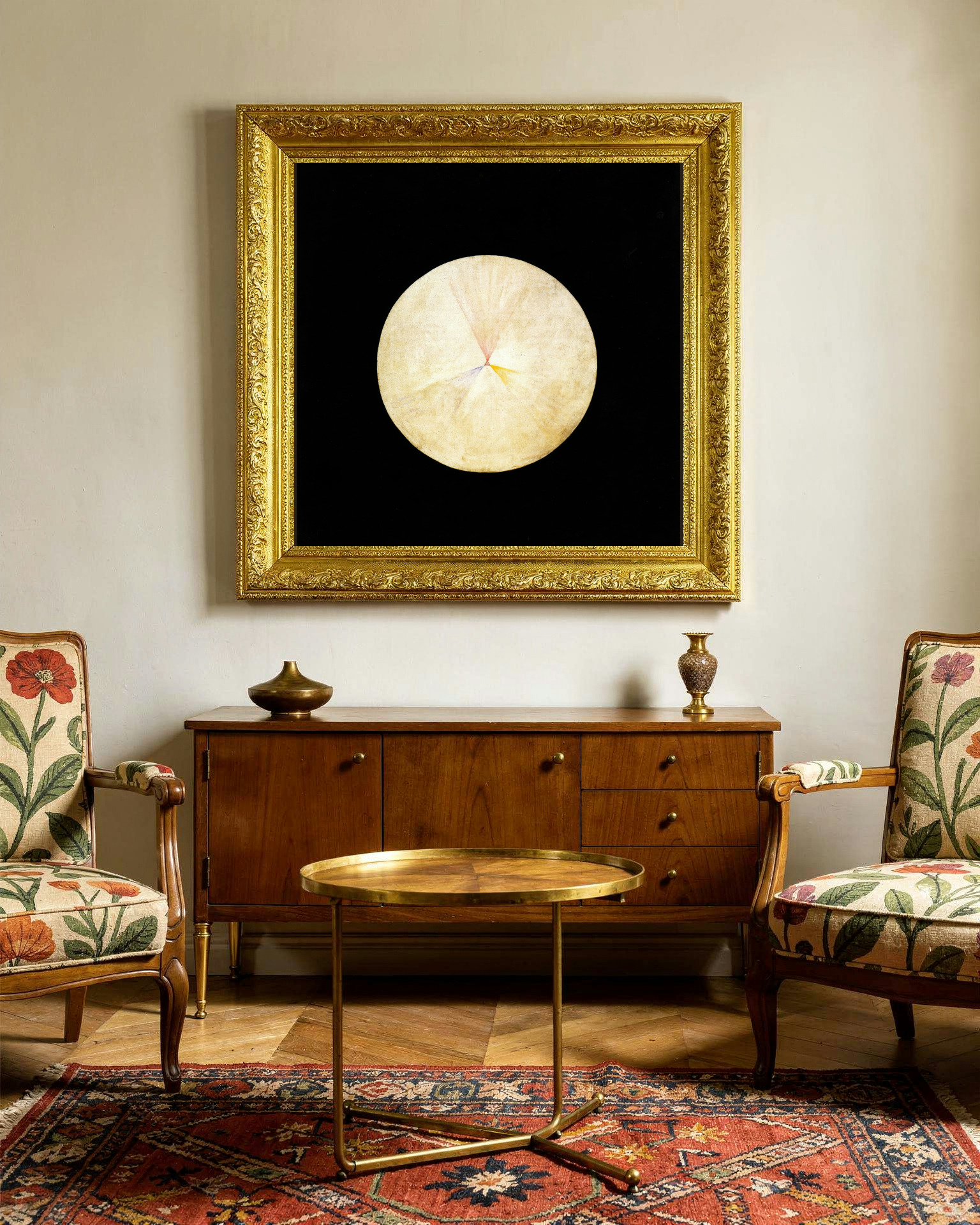
11. The Swan, No. 18
Hilma af Klint, The Swan, No. 18, 1915. Hilma af Klint Foundation, Stockholm.
A black disc hangs on a red ground like an eclipse, with a small bright target at its heart and thin rays of light cutting across. Painted in Stockholm in 1915, it looks forward to the hard-edged abstraction of the 1960s. The red here is not decoration. Colours carried meanings in her notebooks, and she worked them out with the same care she gave to her geometry.
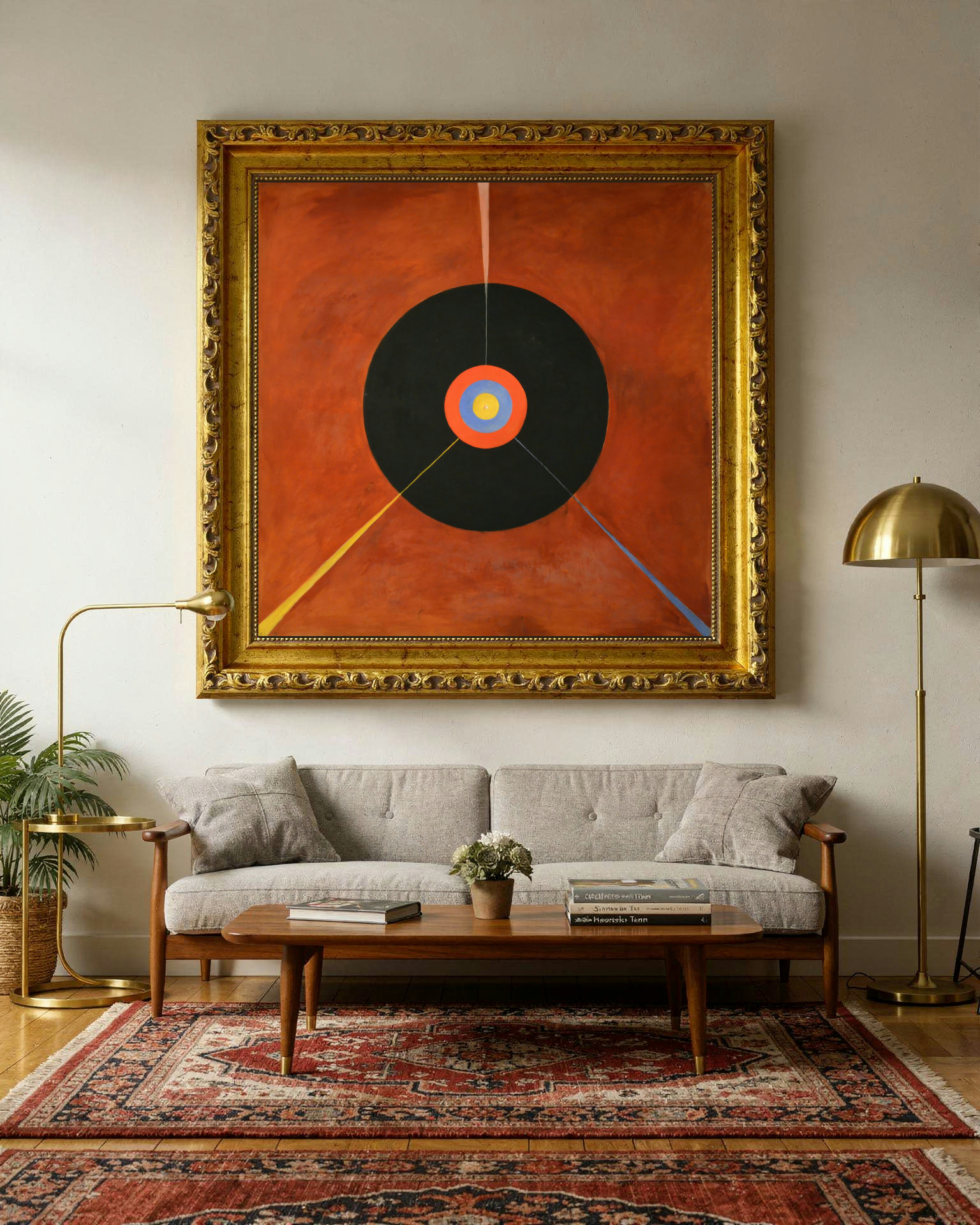
12. The Dove, No. 2
Hilma af Klint, The Dove, No. 2, 1915. Hilma af Klint Foundation, Stockholm.
The Dove series followed the swans, and the dove is the old Christian sign of the spirit. In this tall black canvas a single ray falls from a small star straight down onto a striped cube, spirit touching matter. Hung on a wall it reads almost like a column of light, and it holds a room with very little.
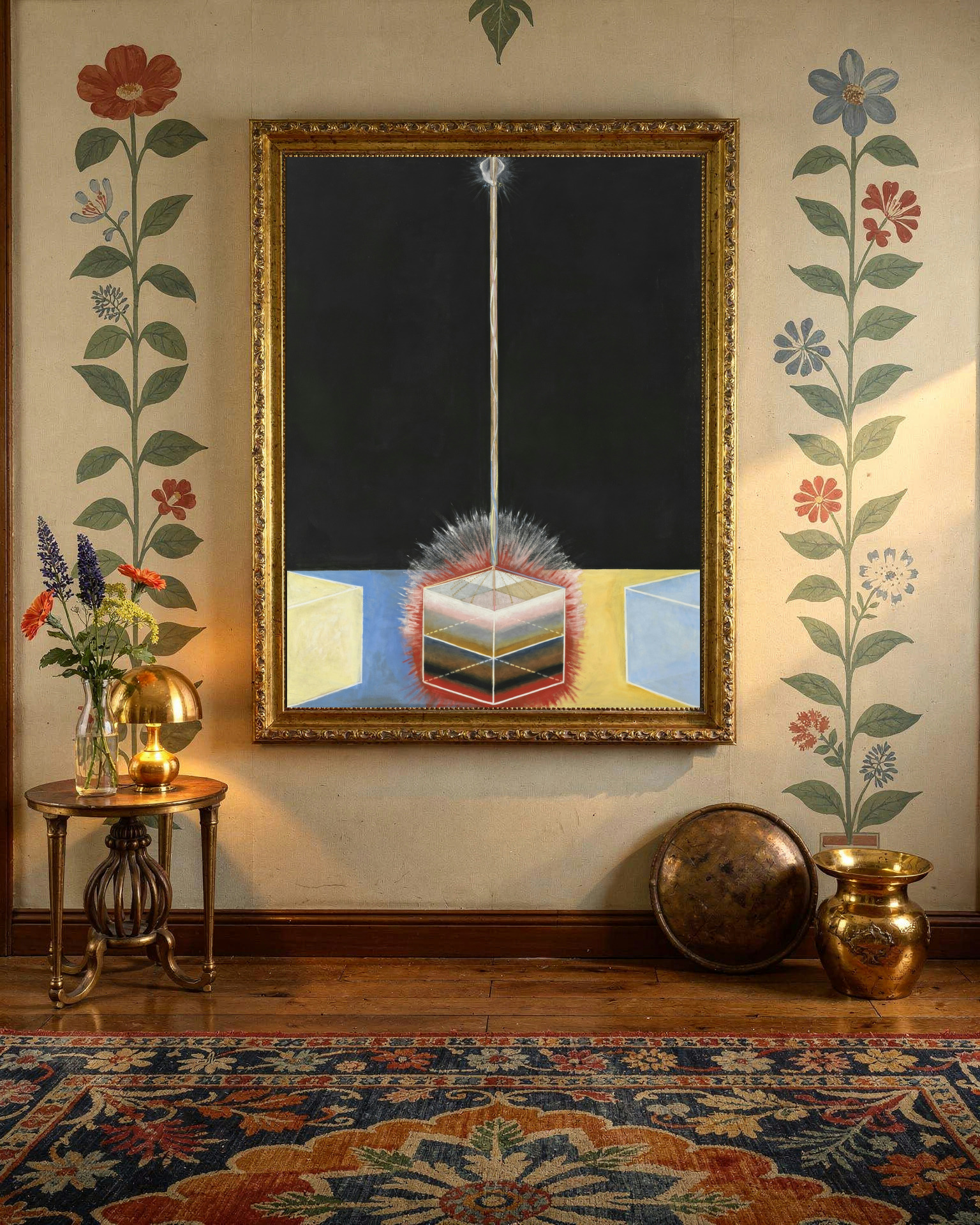
The summit of the temple
In 1915 she finished the Paintings for the Temple: 193 works over nine years. She never knew exactly what the temple was. Later, in 1931, she sketched a spiral building for it on the island of Ven in the strait between Sweden and Denmark, and wrote of "a museum to show what lies behind the forces of matter". It was never built.
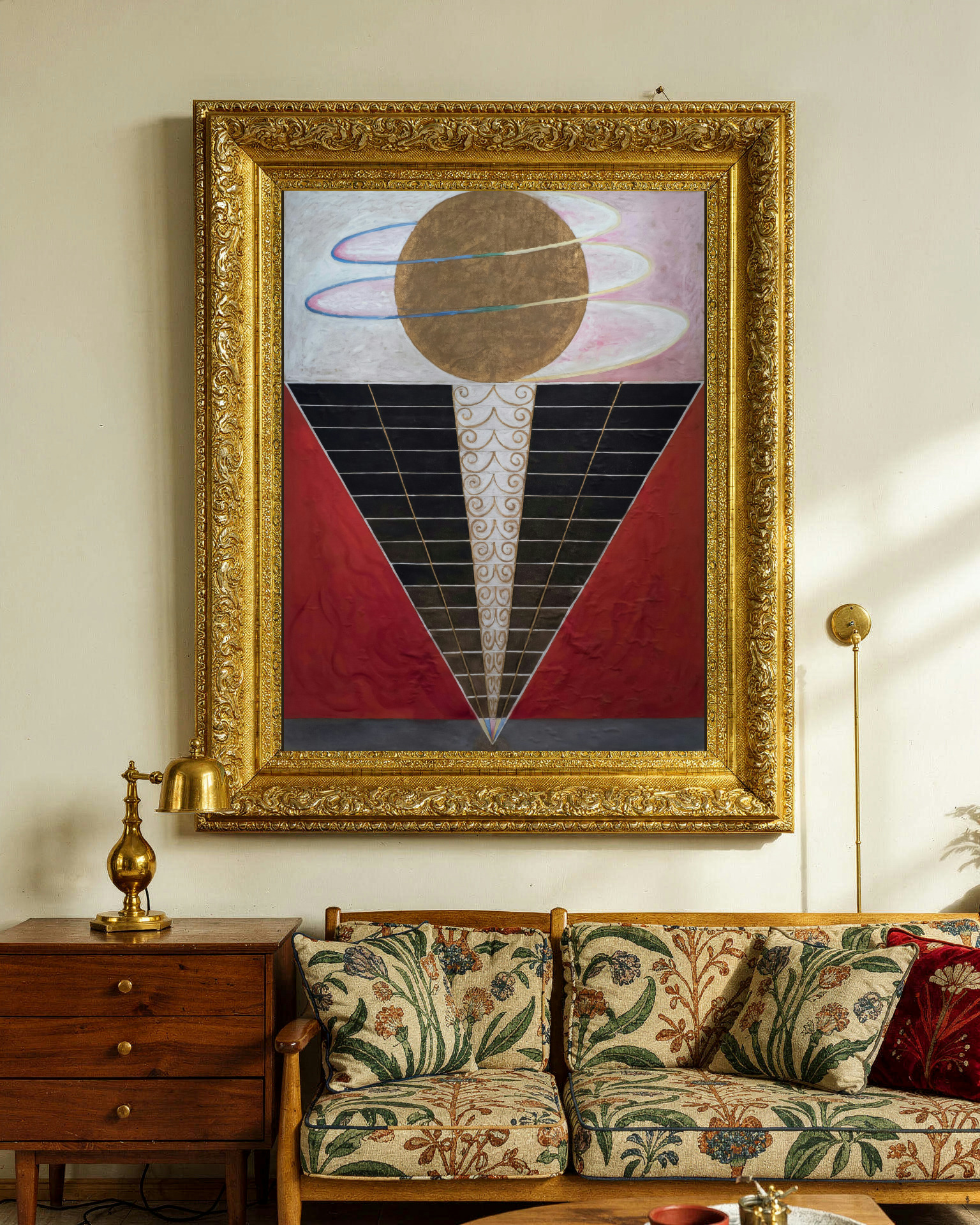
13. Altarpiece, No. 2
Hilma af Klint, Altarpiece, No. 2, Group X, 1915. Hilma af Klint Foundation, Stockholm.
The Temple ends with three Altarpieces, which sum up the journey of the whole cycle: the spirit travelling down through the material world and then turning upwards again. In this one a golden sphere with rings like Saturn's sits above a triangle pointing down, the descent. The gold is real metal leaf, and the canvas is almost two and a half metres tall. She imagined the Altarpieces in the innermost room of her temple, the last thing a visitor would see.
After the temple
When the cycle was finished she spent years trying to understand what she had painted. In 1917 she wrote Studies of the Life of the Soul, some 2,000 pages long. From 1920 she spent long periods at the Goetheanum in Switzerland. In 1932 she marked her notebooks with an X, meaning they were not to be opened until twenty years after her death, and she died in Djursholm, outside Stockholm, in 1944. She left about 1,300 paintings and 124 notebooks of over 26,000 pages.
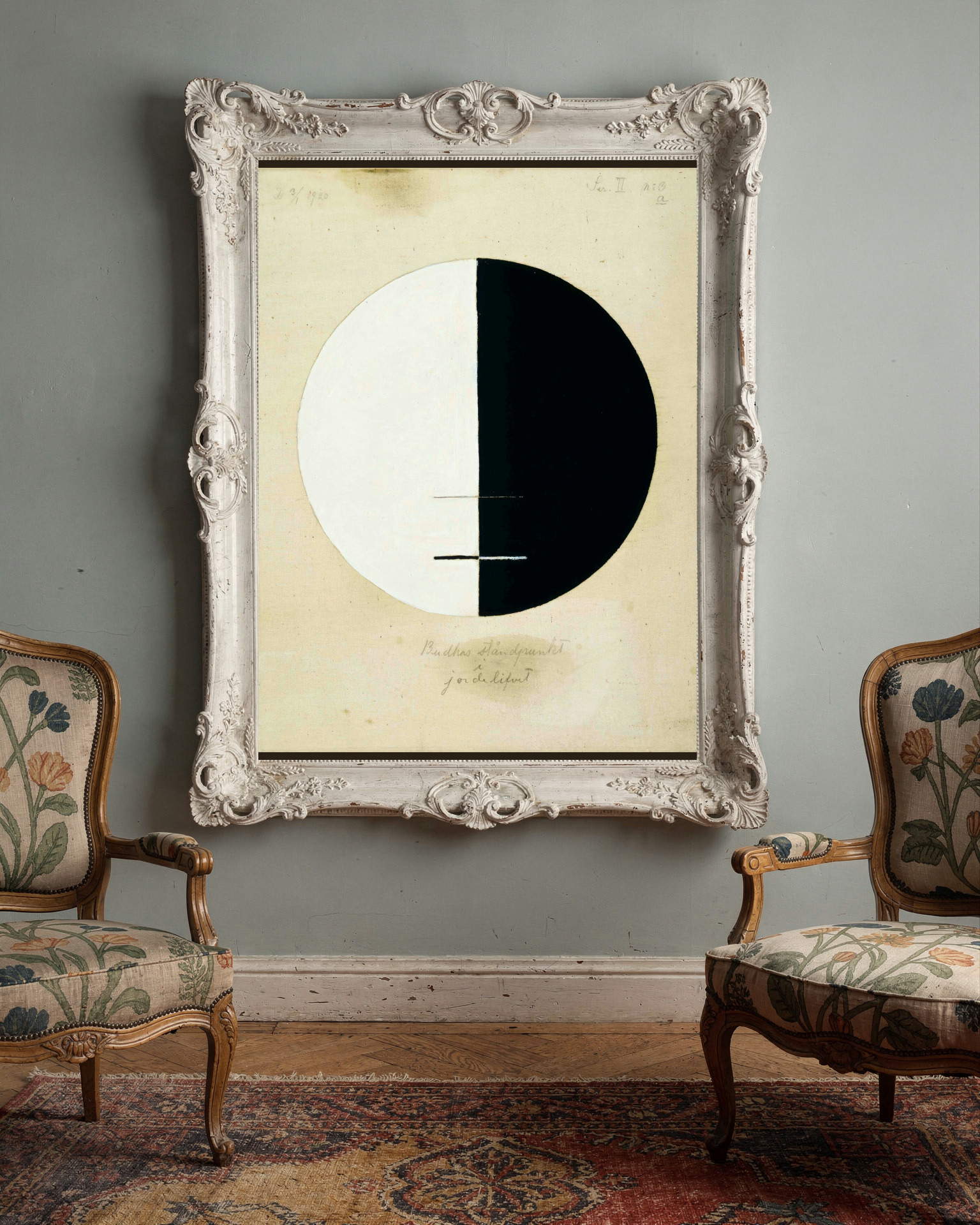
14. Buddha's Standpoint in the Earthly Life, No. 3a
Hilma af Klint, Buddha's Standpoint in the Earthly Life, No. 3a, 1920. Hilma af Klint Foundation, Stockholm.
In 1920, the year she first travelled to Dornach, she painted a series of small works on the great world religions. Each religion, in her reading, rested on a split into opposites, and none of them reached unity. Here Buddhism is a circle cut cleanly in half, white and black, with her pencilled notes still below it. It is a diagram, a meditation and, a century on, a perfect minimalist print.
Common questions
What did Hilma af Klint believe?
She was a spiritualist from her teens and took part in séances all her life. She read Theosophy and joined the Theosophical Society in 1904, drew on Rosicrucian and esoteric Christian ideas, and later became a lifelong member of Rudolf Steiner's Anthroposophical Society. Her paintings try to show a single spiritual reality behind the divided, visible world.
Who were The Five?
A circle of five women artists in Stockholm, Hilma af Klint, Anna Cassel, Cornelia Cederberg, Sigrid Hedman and Mathilda Nilsson, active from 1896 to 1908. They held weekly séances, recorded messages from guides they called the High Masters and made automatic drawings years before the Surrealists.
Did spirits really paint her pictures?
She believed the first paintings were made through her, writing that she had no idea what they were meant to depict. From 1912 she felt her own judgement shaping the work. Historians do not have to share her beliefs to see how seriously she worked: she numbered, catalogued and explained everything in her notebooks.
What did Rudolf Steiner think of her paintings?
She met Steiner in 1908 and showed him the Temple paintings. His response was critical, and she stopped work on the series for four years. She stayed devoted to his ideas, and in the 1920s he advised her not to destroy her paintings, because they could be of use.
Every painting in this story is prepared for print at Vaxholm Fortress from its museum scan and printed to order, as a framed print or on canvas. See all of them, in her own order, in the Hilma af Klint series.
Sources: the Hilma af Klint Foundation's biography and chronology; Moderna Museet's guide to her central works; Hilma af Klint: Notes and Methods (University of Chicago Press, 2018); Julia Voss, Hilma af Klint: A Biography (University of Chicago Press, 2022); Jo Applin in the London Review of Books (2023); Jillian Steinhauer in The New Republic (2019).