Knights and ladies: ten paintings of medieval romance
Armour and veils, quests and farewells, enchantresses in the forest. The Victorians' dream of chivalric love, from Tristan to La Belle Dame sans Merci.
No age loved the Middle Ages like the nineteenth century. Tennyson rewrote King Arthur, Wagner set Tristan and Lohengrin to music, Keats wrote of a knight enchanted by a fairy, and painters from the Pre-Raphaelites onwards filled exhibitions with knights in armour and ladies in long sleeves. Their medieval love stories are about devotion and danger in equal measure: the knight leaves, the lady waits, and sometimes the lady is not what she seems. Here are ten of them.
1. The Accolade
Edmund Blair Leighton — The Accolade, 1901. Complete composition.
Edmund Blair Leighton's best-known picture shows a queen knighting a young man who kneels before her in a red surcoat, the sword resting on his shoulder. Courtiers watch from the shadows. Nothing is said, but the way she looks down at him makes it a love story.
Ivory, crimson and stone, painted with great finish: the classic image of chivalry.
2. The Shadow
Edmund Blair Leighton — The Shadow, 1909. Complete composition.
A knight is about to leave, perhaps for the Crusades. His lady, in a white gown with long hanging sleeves, traces the outline of his shadow on the castle wall, so that something of him will stay. Blair Leighton borrowed the idea from an ancient legend of the first drawing ever made.
Bright, simple and touching, with the sea behind: one of the loveliest farewells in the collection.
3. Tristan and Isolde (Yseult in the Forest)
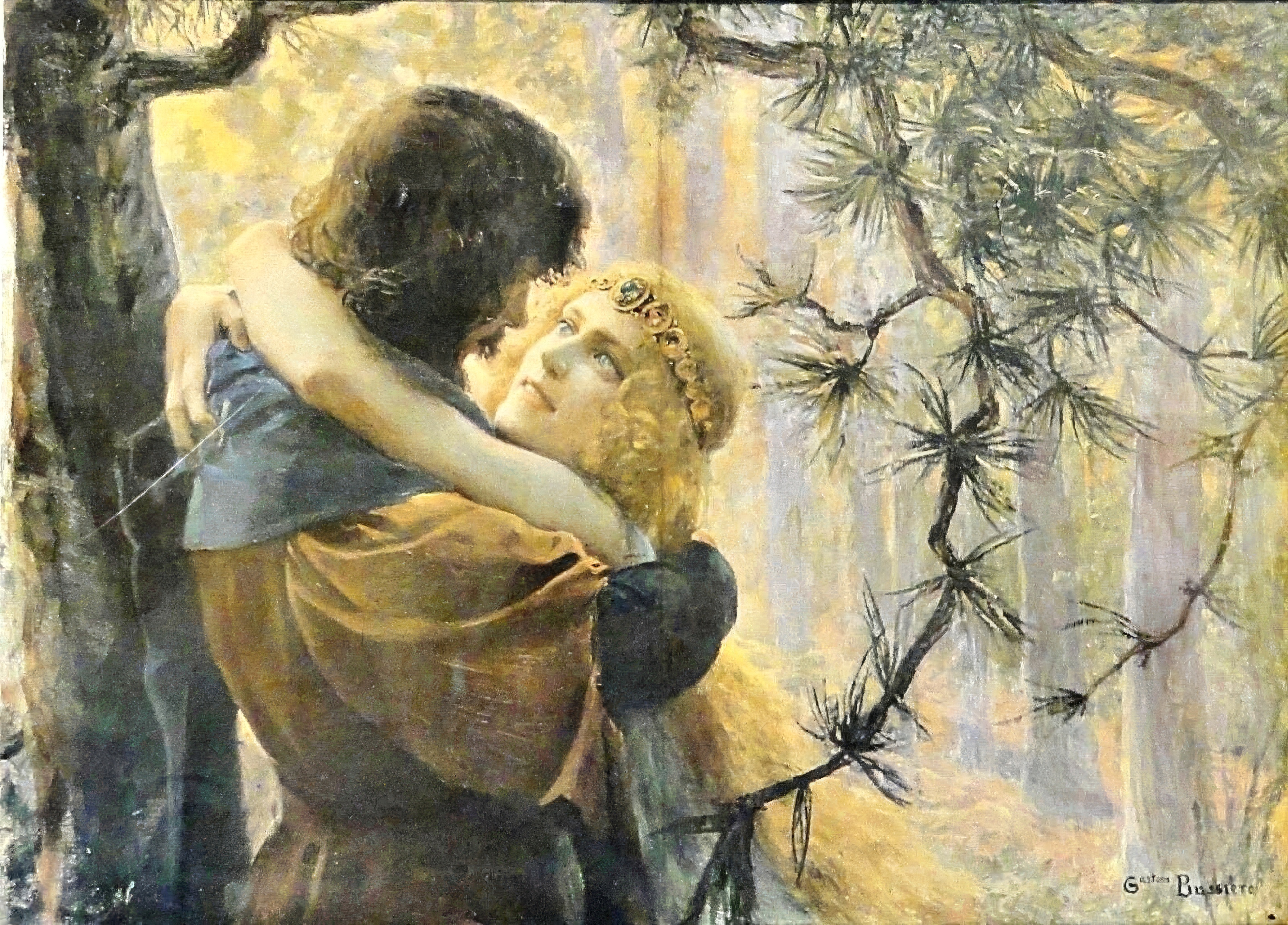
Gaston Bussière — Tristan and Isolde (Yseult in the Forest), 1911. Complete composition.
Gaston Bussière shows Tristan and Isolde, here called Yseult, in the forest where they fled from King Mark. He holds her close among the pine branches, her blonde hair crowned with a thin gold circlet, the light pale and silvery around them.
Soft blues and silvers: the most tender of the Tristan pictures, and good in a bedroom.
4. Lancelot and Guinevere
N. C. Wyeth — Lancelot and Guinevere, 1917. The Boy's King Arthur (Scribner, 1917). Complete composition.
N. C. Wyeth's Lancelot and Guinevere, made for The Boy's King Arthur in 1917, has the clarity of a film still: the knight in silver mail and the queen in white beside a latticed window, ivy on the wall, a moment that cannot last.
Strong shapes and calm colour: a picture that reads well from across a room.
5. Una and the Red Cross Knight (study)
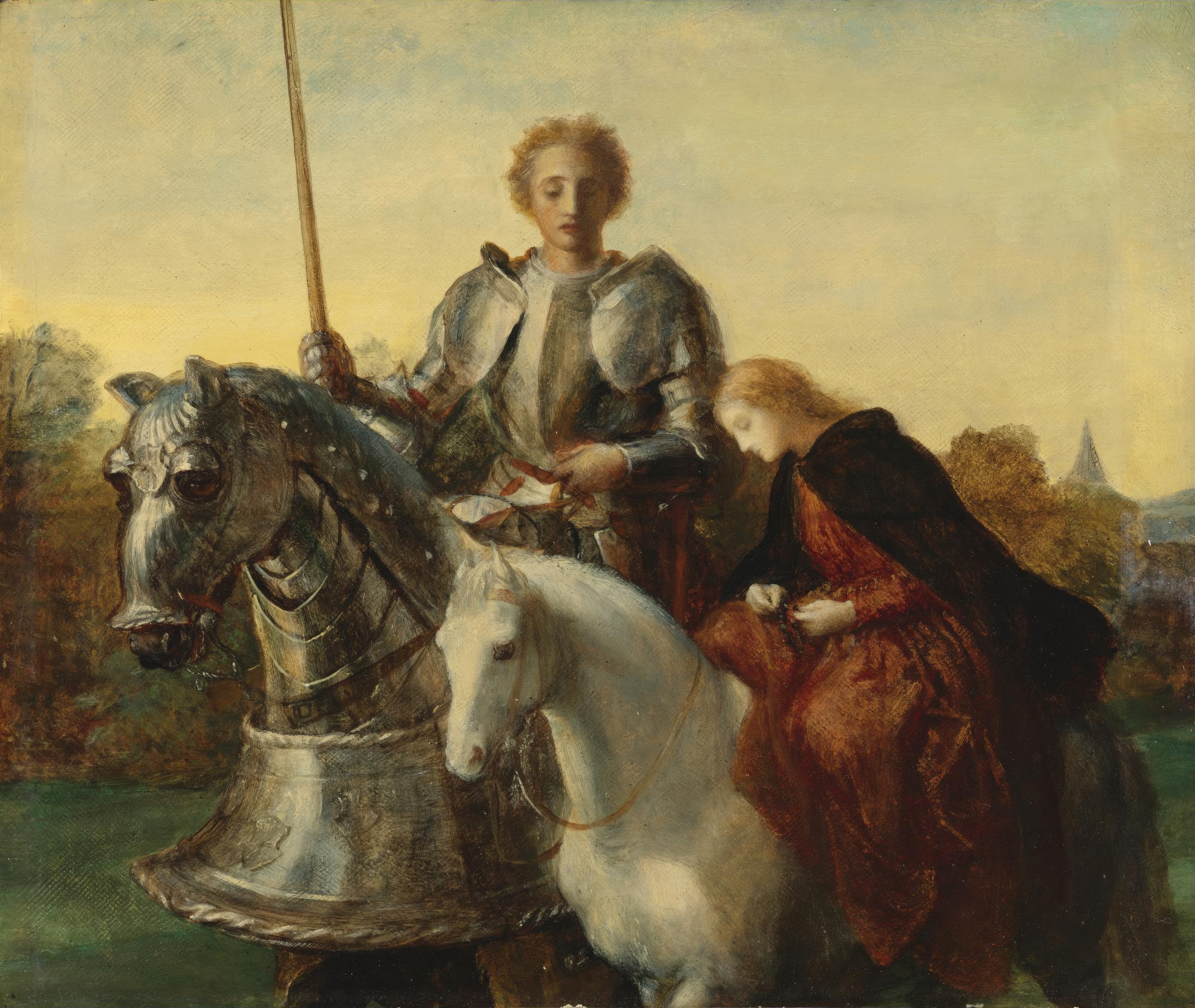
George Frederic Watts — Una and the Red Cross Knight (study), 19th c. Complete composition.
In Spenser's The Faerie Queene, Una travels with the Red Cross Knight to free her parents from a dragon. George Frederic Watts paints the knight in silver armour on his white horse with Una leaning against him, her head bowed, a sketch-like study full of evening light.
A painterly study in silver and gold: subtle, and lovely in a study or library.
6. The False Knight
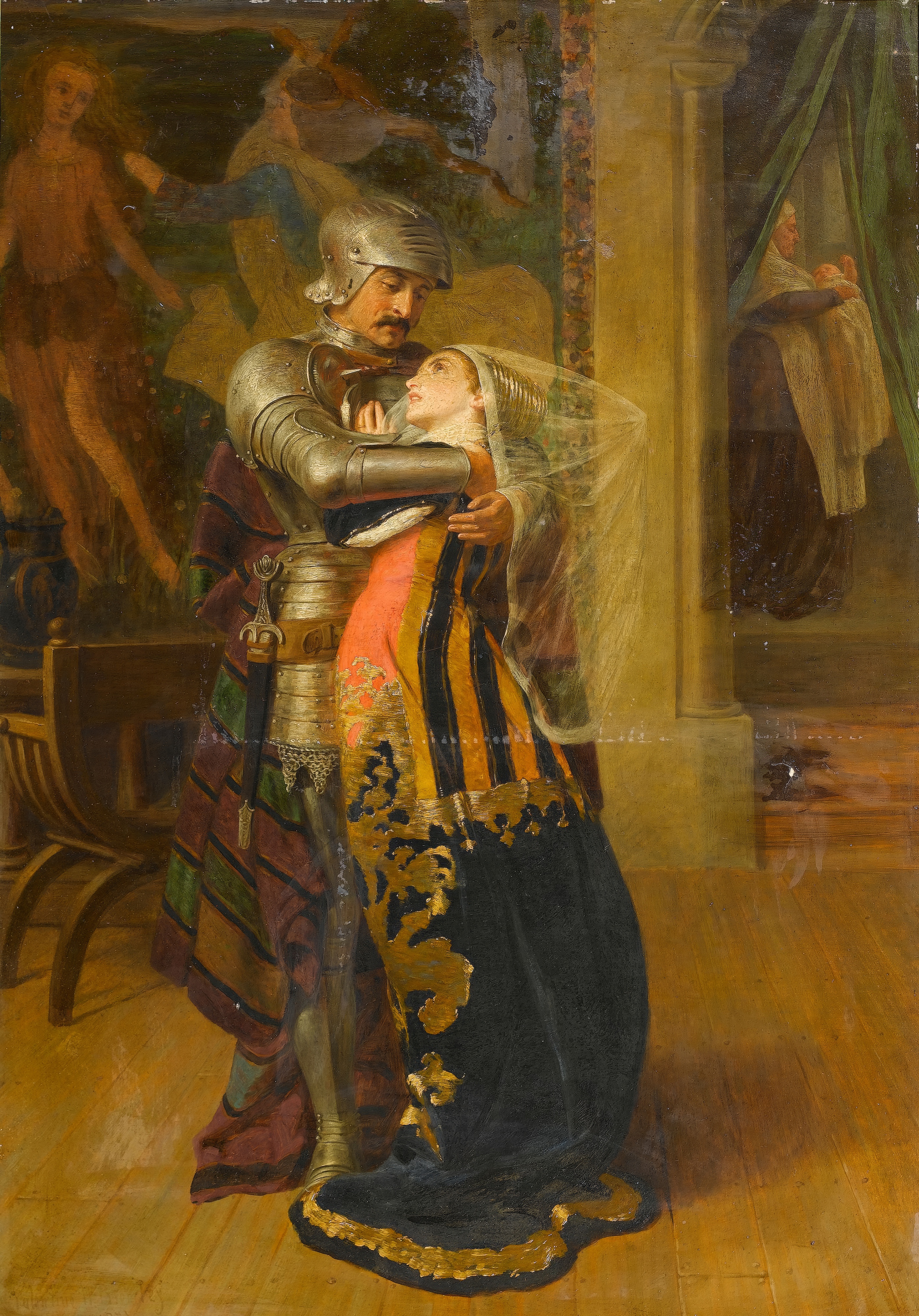
Valentine Walter Bromley — The False Knight, 1871. Complete composition.
Valentine Walter Bromley's False Knight embraces a lady in a veil and a striped gown, his face hidden in his helmet. The title gives the story away: in the old ballads, the false knight is the one who woos and betrays.
Rich colour and a twist in the tale: a picture that makes people ask about it.
7. La Belle Dame sans Merci
John William Waterhouse — La Belle Dame sans Merci, 1893. Hessisches Landesmuseum, Darmstadt. Complete composition.
Keats's ballad tells of a knight who meets a beautiful fairy in the meadows, is enchanted, and wakes alone on a cold hillside. Waterhouse turns the tables on the knight: the lady sits in the grass and draws him down to her with a strand of her own hair, while he leans in, helmet still on.
Waterhouse at his most romantic, deep reds in a green wood: a true Pre-Raphaelite treasure.
8. La Belle Dame sans Merci
Frank Dicksee — La Belle Dame sans Merci, 1902. Bristol Museum & Art Gallery. Complete composition.
Frank Dicksee tells the same poem from the other side. The lady rides the knight's black horse and leans down to him, her rose-pink veil flying, while he walks beside her, looking up, already lost. A wild rose climbs at the edge of the meadow.
Rose pink against dark green and a black horse: dramatic, glamorous and full of movement.
9. Lamia
John William Waterhouse — Lamia, 1905. Complete composition.
In another poem by Keats, Lamia is a serpent who takes a woman's form to win a young man of Corinth. Waterhouse paints her kneeling before a knight in armour, gazing up at him, with a snakeskin tangled in her robes as the only warning.
Dark and mesmerising: a picture with a secret, for anyone who loves a story.
10. Elsa and Lohengrin
Gaston Bussière — Elsa and Lohengrin, 1910. Musée des Ursulines, Mâcon. Complete composition.
Wagner's Lohengrin arrives in a boat drawn by a swan to save Elsa and marry her, on condition that she never asks his name. Gaston Bussière shows the two embracing beside dark water under lilac blossom, the moment before the question that will end everything.
Jewel colours and moonlit water: Symbolist romance at its most decorative.
Seen together they make a little romance of their own: a knighting, a parting, a quest, an enchantment. Each painting is in the Love Stories collection and can be printed as it is, whole; each also has its own portrait style, so you and the one you love can be painted into the story.
Walk through the Love Stories room · The Love Stories collection