A museum walk after hours: Masterworks by lantern light
A lantern, four rooms and a wall drawn to scale. How to walk our collection one story at a time, from Saint George to the myths of Le Temple des Muses.
Most of us know a museum by day: the queue, the crowd at the famous picture, the guard who asks you to step back. We know it less well after closing time. The rooms go quiet. A painting you passed at noon seems to be waiting. That second museum, the one after hours, is the idea behind the Masterworks museum walk.
It is a short visit through our own collection, one room at a time. Each room holds a single art series: one legend or one illustrated book, from its first picture to its last. You walk it at your own pace, on a phone or a big screen, and at the end you can see any work on a wall of your own at its true size.
The lantern at the door
The walk opens in the dark, on one painting. A lantern moves across it by itself: the painter's face, the brush in his hand, the palette, and then something over his shoulder. Then the lights come up slowly, like a dimmer.
Böcklin painted himself at 45, listening, brush raised, as if he had just heard a note. Behind him Death plays a fiddle with a single string. It is a painting about inspiration and about time, and few pictures are better for meeting in the dark. Look at the painter's eyes: he does not turn round. He knows who is there.
A room for every story
From the entrance, a door opens for each series. Inside, the works hang in their order, and you move along the wall with a swipe or the arrows. Double-tap a painting you would live with to save it. Tap Look closely and drag a magnifying glass across the surface, to study a dragon's scales or the folds of a sleeve the way you would lean in at a gallery.
At the end of each room there is one small question, such as which of two paintings came first, or which plate comes first in the book. How far you walked is kept for the next time you come back.
Saint George and the Dragon
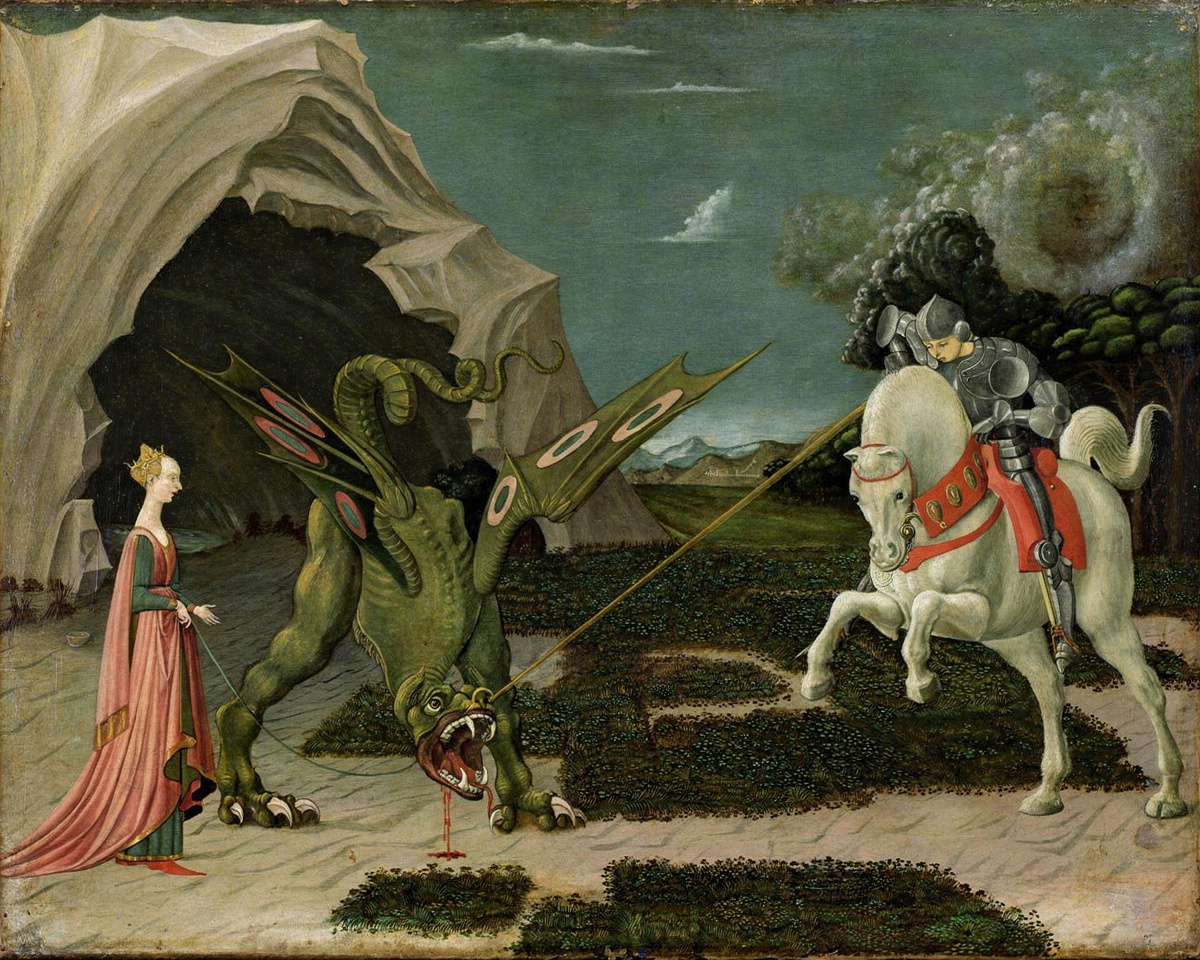
Paolo Uccello, Saint George and the Dragon, c. 1470. The National Gallery, London.
The first room follows the most painted fight in Western art, from Byzantine icons to the Pre-Raphaelites. Uccello's version is the one many people picture: the princess holds the dragon on a leash made from her own girdle, and a storm spirals in the sky behind the lance.
Walk the Saint George room Buy as is
Sirens and Sea Monsters
Gustave Moreau, Galatea, c. 1880. Musée d'Orsay, Paris.
The second room goes under the water. Mermaids, sirens and the creatures sailors swore they saw hang side by side. In Moreau's Galatea the sea nymph rests with her eyes closed in a grotto of coral and sea flowers, while the one-eyed giant Polyphemus watches her from the rock above.
Walk the Sirens room Buy as is
Atalanta Fugiens
Matthäus Merian the Elder, after Michael Maier, The Dragon Eating its Tail, from Atalanta Fugiens, Oppenheim, 1618.
The third room is a book. Michael Maier's Atalanta Fugiens has fifty alchemical emblems, each with a motto, a short poem and a fugue for three voices, engraved by Matthäus Merian. Walking it in order is the closest thing to turning its pages. Emblem fourteen is the dragon that devours its own tail, the old sign of a world that ends where it begins.
Walk the Atalanta Fugiens room Buy as is
Le Temple des Muses
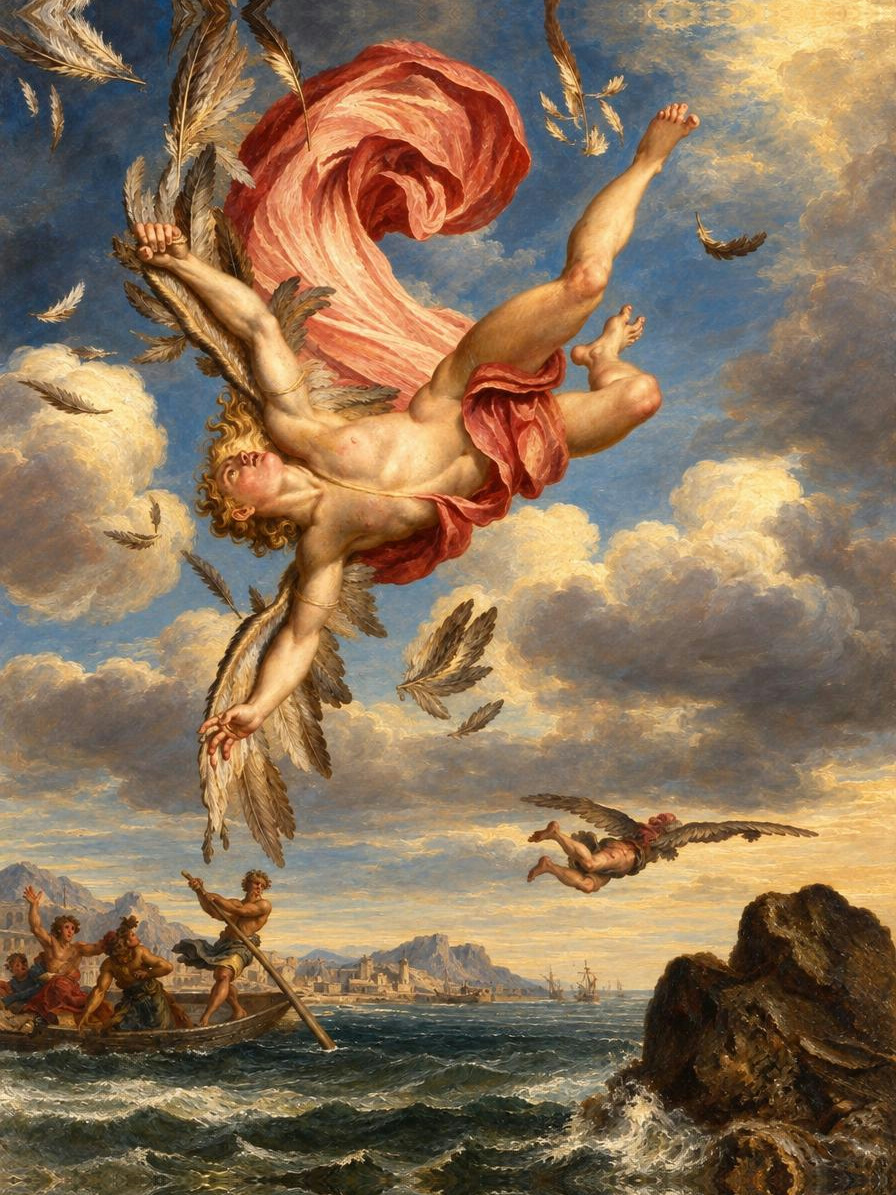
The Fall of Icarus, after Bernard Picart, Le Temple des Muses, Amsterdam, 1749. Fable Atelier colour edition of the engraved plate.
The last room holds the classical myths as an eighteenth-century reader met them, in engraved plates from Le Temple des Muses. Here they hang in our Atelier colour editions, each engraving brought into colour without changing a figure. Icarus is a good place to stop: the boy who flew too close to the sun, falling past his father into the sea.
Walk the Temple des Muses room Buy as is
Your wall, at its true size
The hardest part of choosing a painting is imagining it at home. So every room ends with a wall drawn to scale. Pick the work you liked, choose a wall above a sofa, a bed or a sideboard, then a colour and a finish for it, and the painting hangs there at the real size of each print or canvas.
It hangs the way galleries hang, with the middle of the picture at 57 inches, about 145 centimetres, from the floor. A figure stands beside it for scale. You can drag the painting to another spot, compare every size at once, show the measurements, or dim the room to evening light. Where a work has a photographed room, you can see it there too.
Every visit ends with a ticket to keep: the rooms you walked and the works you saved. Sign in and it carries over to Your Fable, so you can pick up in the room where you stopped.
Before you go
A museum after hours rewards slowness. Choose one room tonight rather than four. Stay with a picture until you notice something you missed: the hand at the top of an icon, the skull behind a painter, the tail in a dragon's mouth. That is usually the work you will want to live with.