Valentine’s gifts for art lovers: 14 romantic masterpieces
Burne-Jones’s Love Song, Paolo and Francesca in Böcklin’s darkness, a love letter by Harunobu and Cupid by Barocci: fourteen romantic works to give on Valentine’s Day, from tender to tragic.
Painters have always known that love is not one feeling. It is a song in a walled garden, a letter written in bed, a whirlwind that will not let two lovers go, and sometimes a dog waiting by the cupboard.
The fourteen works below run from tender to tragic, from Renaissance Italy to Edo Japan to Victorian London. Each can be given as a print. If you would rather give a portrait of the two of you, Fable makes one from a photo in the manner of the old masters, and the preview is free.
1. The Love Song
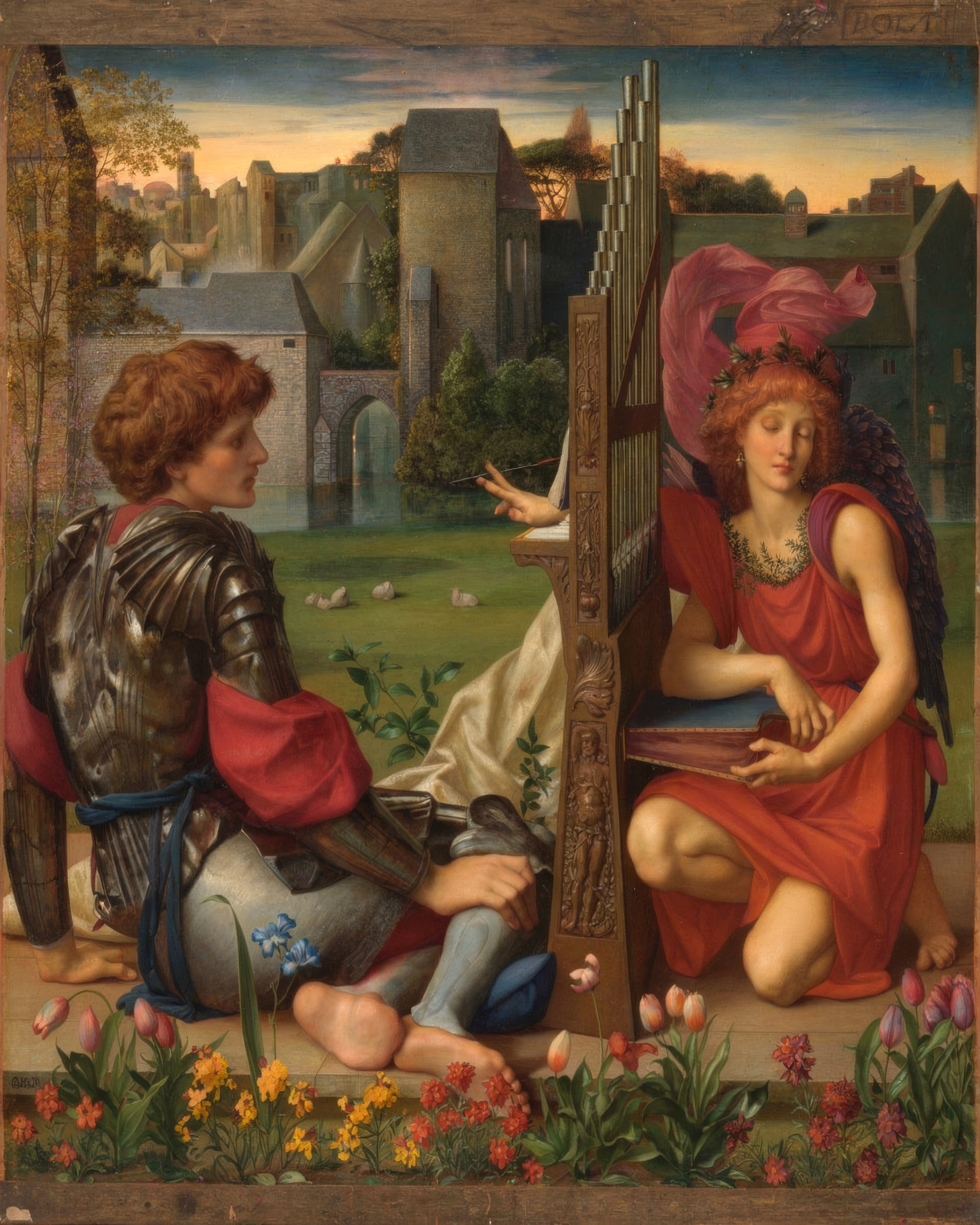
Sir Edward Burne-Jones, The Love Song, 1868–77. Oil on canvas. The Metropolitan Museum of Art, New York.
Burne-Jones worked on The Love Song for nearly ten years. A woman plays a portable organ in a twilight garden, Love himself works the bellows, and a knight in armour listens, lost. It is the most beautiful love song in Victorian painting.
2. Writing a Love Letter in Bed
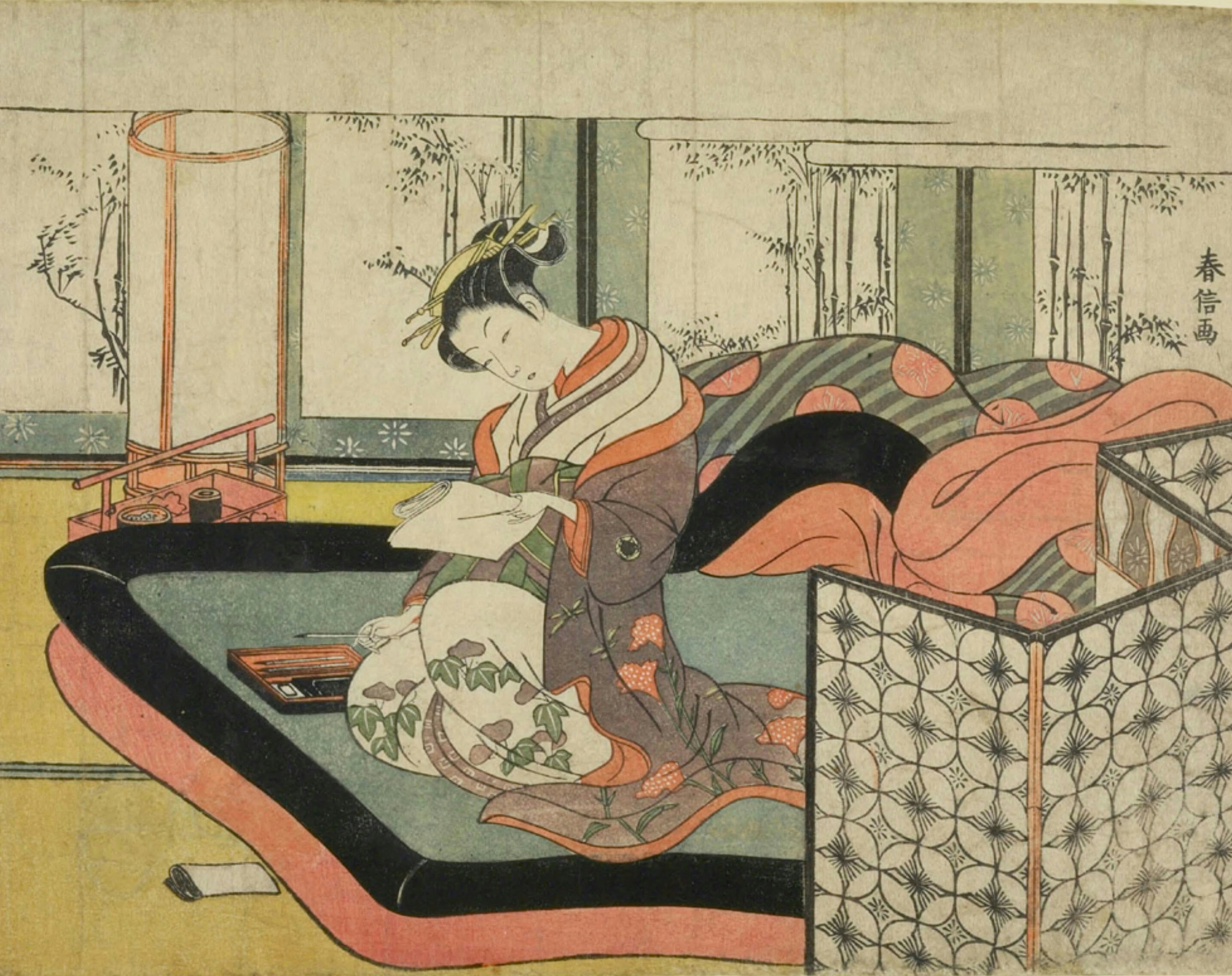
Suzuki Harunobu 鈴木春信, Writing a Love Letter in Bed, Edo period, circa 1765-1770. Ukiyo-e woodblock print; ink and color on paper. Harvard Art Museums.
Harunobu’s young woman writes a love letter in bed, late at night. Everything in the print is soft: the bedding, the colours, the gesture of the brush.
A quiet, intimate print for a bedroom.
3. The Founts of Love
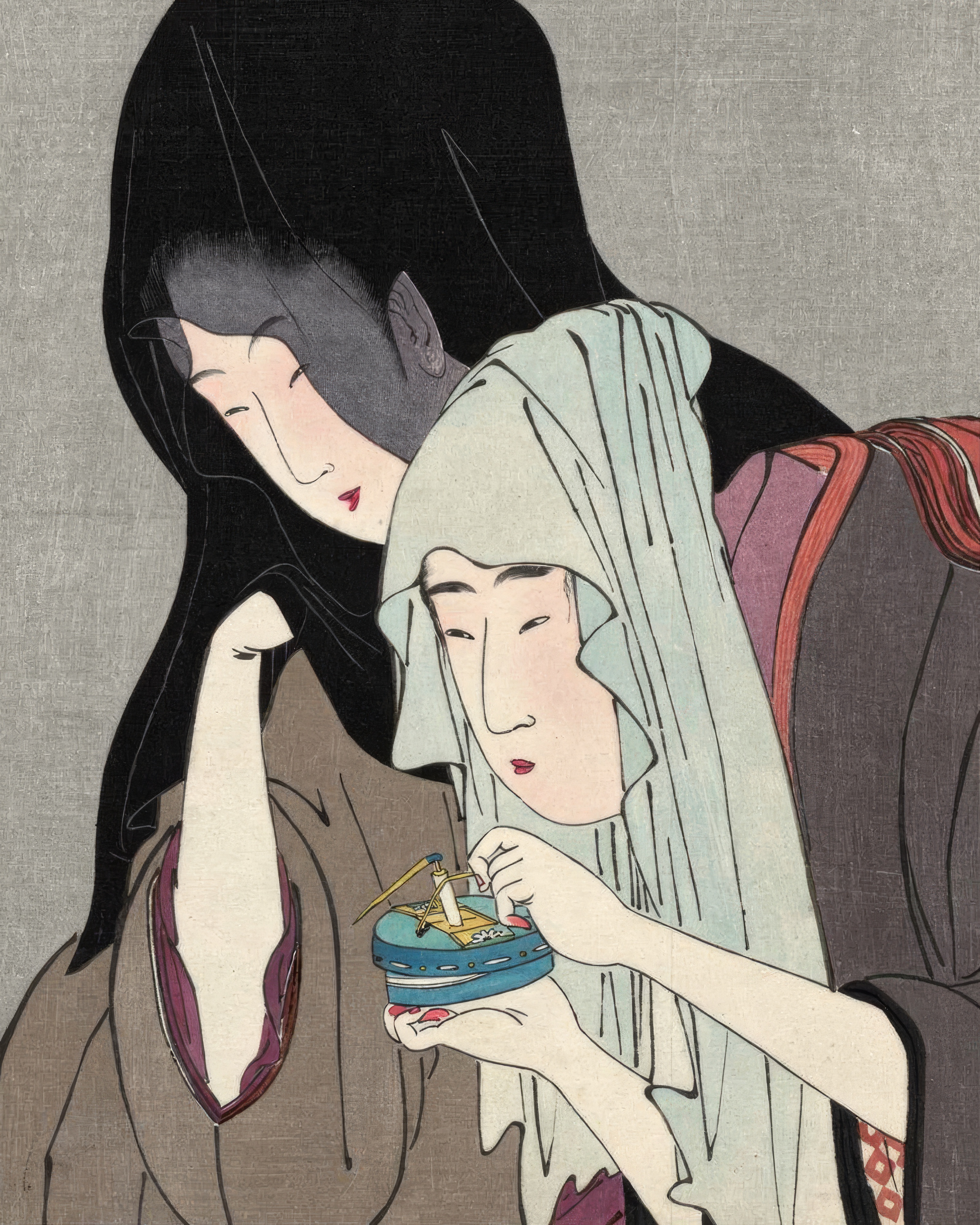
Kitagawa Utamaro 喜多川歌麿, The Founts of Love, c. 1798-1799. Woodblock print (nishiki-e); ink and color on paper. Harvard Art Museums.
Utamaro’s series The Founts of Love shows famous lovers from the Japanese stage. Jihei, a paper merchant, and Koharu, a courtesan, were the doomed couple of Chikamatsu’s great love tragedy; here they are simply two faces, close together.
Pale and elegant, for a minimal room.
4. A Nayika and Her Lover
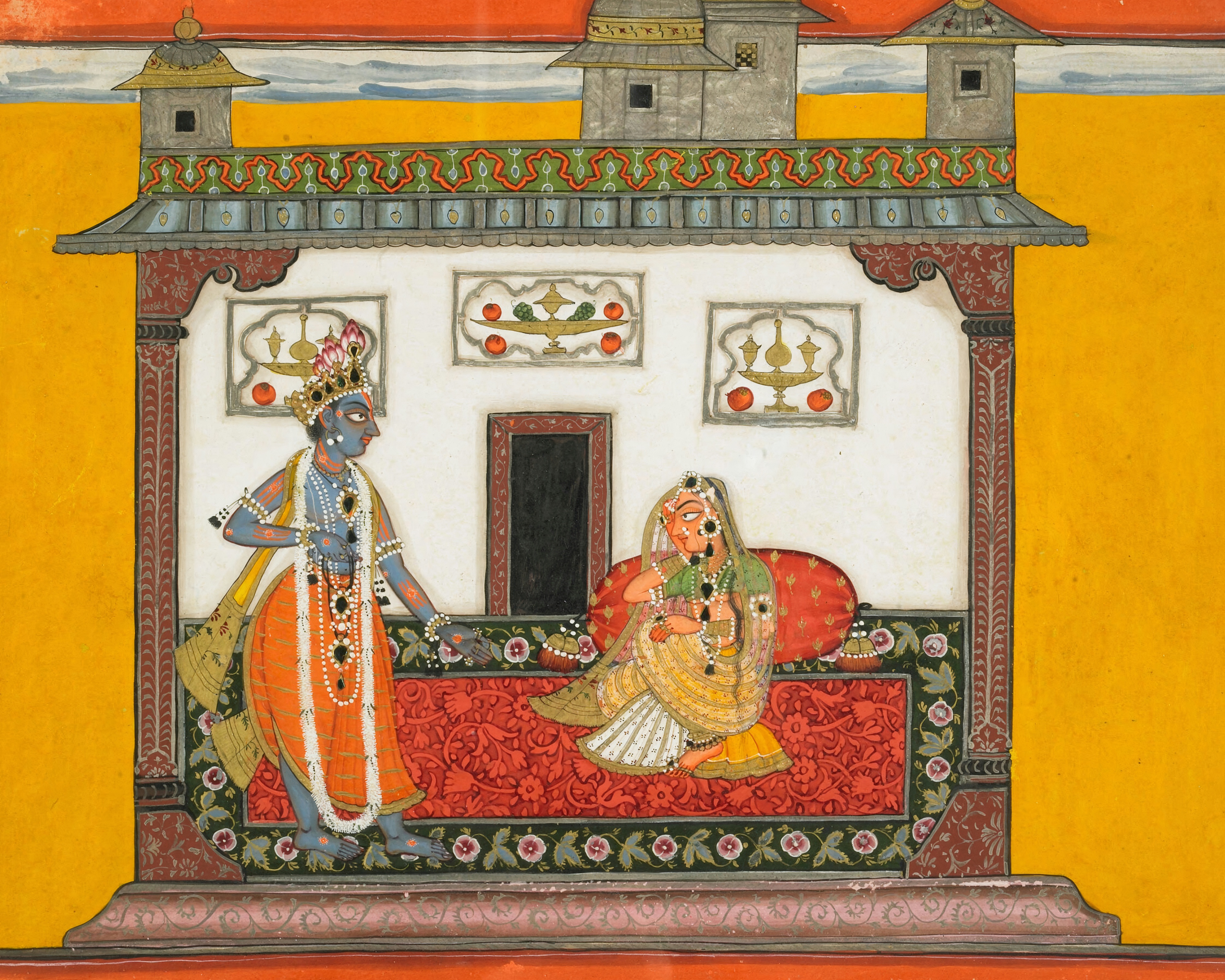
A Nayika and Her Lover, c. 1660-1670. Opaque watercolor, gold, and beetle-wing cases on paper. Harvard Art Museums.
The Rasamanjari was a Sanskrit poem cataloguing every kind of lover. This page, painted with gold and real beetle-wing cases for glittering green, shows a heroine and her beloved on a terrace.
Jewel-like colour for a small wall.
5. Cupid Drawing His Bow
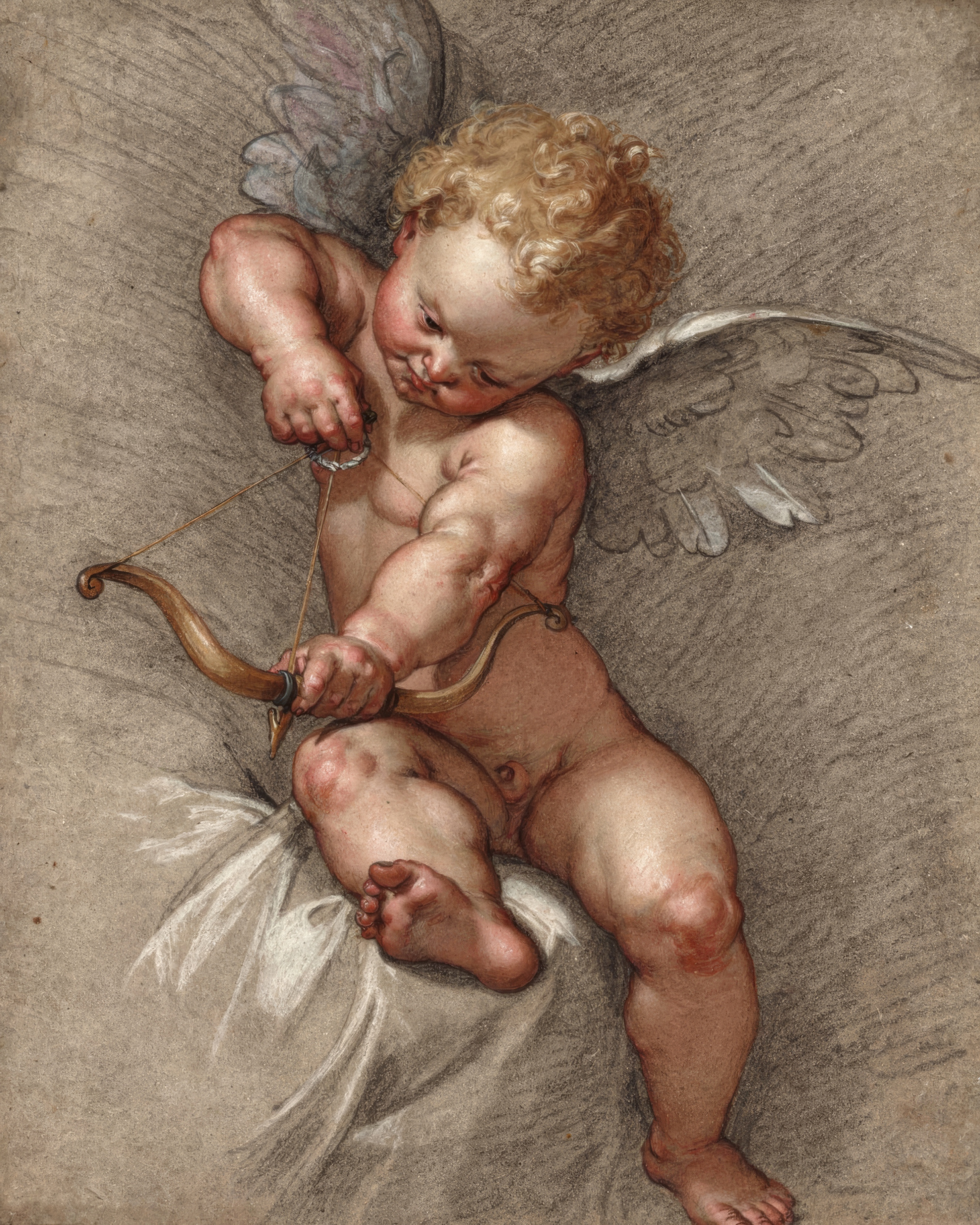
Federico Barocci, Cupid Drawing His Bow, c. 1560s. Black chalk with pastel (stumped in places), heightened with white chalk, squared with black chalk; framing lines in graphite. Cleveland Museum of Art.
Federico Barocci drew Cupid in black chalk and soft pastel, turning to catch our eye as he takes aim. You are next, it says.
Soft pinks and browns that suit a bedroom or dressing room.
6. The Triumph of Venus
François Boucher, The Triumph of Venus, 1740. Oil on canvas. Nationalmuseum, Stockholm.
Boucher’s Triumph of Venus, painted in 1740 and now in Stockholm, is the Rococo at full speed: the goddess of love in a whirl of nymphs, tritons, cherubs and pearly flesh.
Pastel and gold; it lifts a pale room.
7. Cupids in Conspiracy
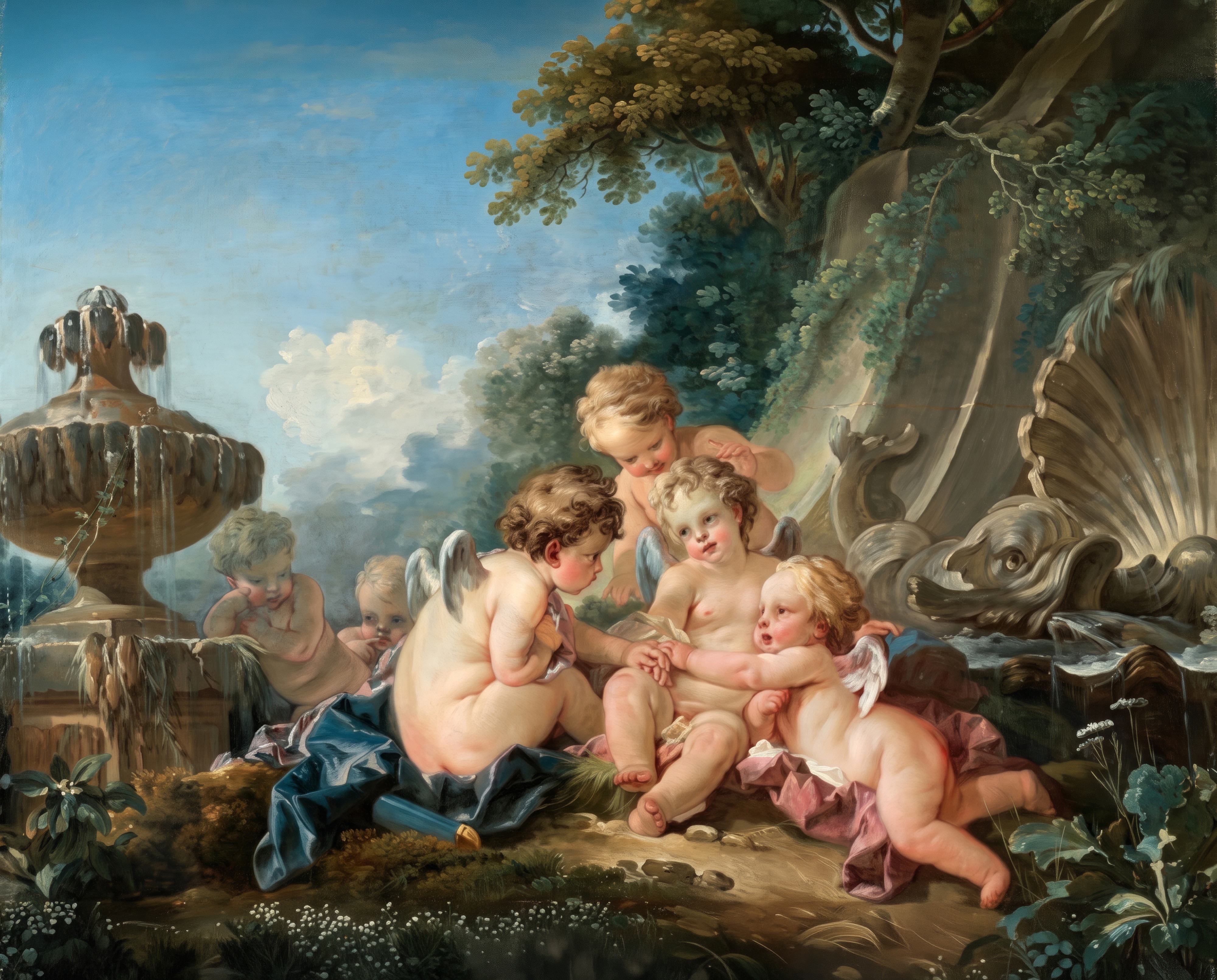
François Boucher, Cupids in Conspiracy, 1740s. Oil on canvas. Cleveland Museum of Art.
Another Boucher: a band of cupids plotting in the woods, clearly up to something. Light, funny and very French.
A playful gift that does not take love too seriously.
8. The Fisherman and the Syren
Frederic Leighton, The Fisherman and the Syren, c. 1856–58. Oil on canvas. Bristol Museum & Art Gallery.
Frederic Leighton painted this young fisherman in the arms of a siren in the 1850s, from a ballad by Goethe. Love as a force that pulls you under.
Dramatic and romantic, for a dark wall.
9. Paolo and Francesca
Arnold Böcklin, Paolo and Francesca, 1893.
Böcklin painted Dante’s lovers Paolo and Francesca in 1893, clinging together in the dark. The embrace that doomed them is also the one that keeps them together forever.
The most passionate picture on this list.
10. Dante and the Lovers' Shade
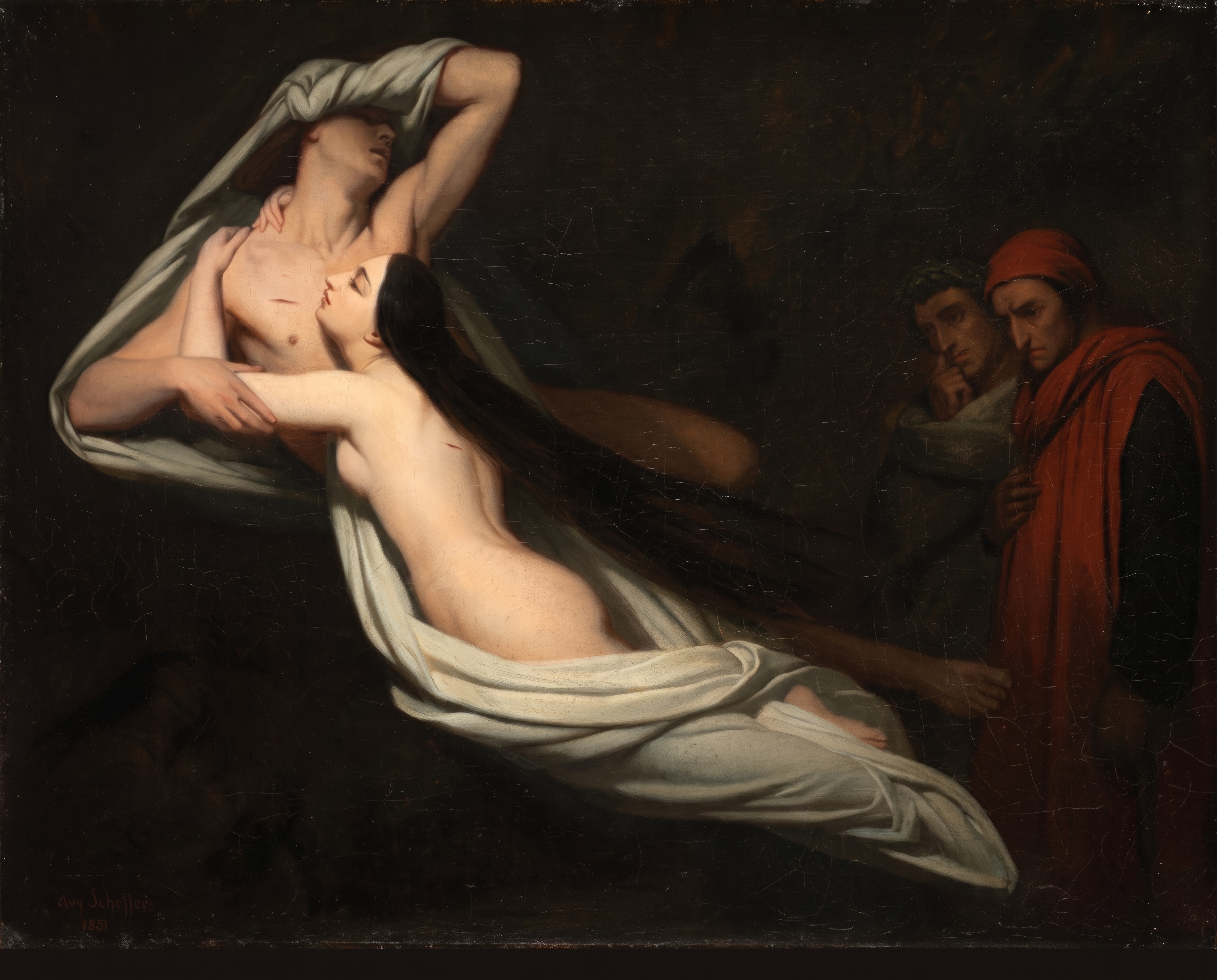
Ary Scheffer, Dante and the Lovers' Shade, 1851. Oil on fabric. Cleveland Museum of Art.
Ary Scheffer’s version of the same story was the most famous painting of its day. Dante and Virgil watch the lovers float past, wrapped in each other, through the storm of the second circle of hell.
Pairs dramatically with the Böcklin.
11. The Circle of the Lustful (The Whirlwind of Lovers)
William Blake, The Circle of the Lustful (The Whirlwind of Lovers), 1824–27.
William Blake illustrated Dante at the end of his life. In this watercolour the lovers are caught in a vast whirlwind, and Dante has fainted at their story.
A visionary picture for a reader of Dante.
12. Orpheus at the Tomb of Eurydice
Gustave Moreau, Orpheus at the Tomb of Eurydice, ca 1891.
Orpheus went down to the underworld for his wife Eurydice and lost her at the last moment. Moreau shows him mourning at her tomb by moonlight: love that outlasts death.
A deep, romantic picture for someone who loves myth.
13. The Honeymoon
Arnold Böcklin, The Honeymoon, 1878.
Böcklin’s second Honeymoon, from 1878: a woman in red on stone steps in the shade, with a bright Mediterranean coast below. A first journey together, about to begin.
For a couple planning their honeymoon.
14. Cupboard Love
Briton Rivière, Cupboard Love, 1881. Oil on canvas. The New Art Gallery Walsall.
Briton Rivière’s Cupboard Love is a joke about the other kind of love: the dogs adore the woman, but they adore the cupboard where the treats live even more.
For the couple whose dog comes first, and who can laugh about it.
A romantic print says something a card cannot: that you thought about the kind of love you share. Choose the story that fits yours, or send your favourite photo together and see it as a portrait.
Questions
What is the most romantic painting?
Many would say Klimt’s The Kiss or Hayez’s The Kiss. Among the works here, Burne-Jones’s The Love Song and Harunobu’s lovers are the most tender, and Böcklin’s Paolo and Francesca the most passionate.
Is art a good Valentine’s gift?
Yes. It lasts far longer than flowers, and a love story from art history, or a portrait of the couple, makes the gift personal.
Who were Paolo and Francesca?
Lovers from Dante’s Inferno. Francesca da Rimini fell in love with her husband’s brother Paolo while they read a romance together; both were killed, and Dante meets them blown forever on the wind in the circle of the lustful.