Planisphaerium Braheum
This 1660 celestial map brings intricate astronomical detail and classical elegance to any space as a gallery canvas or fine
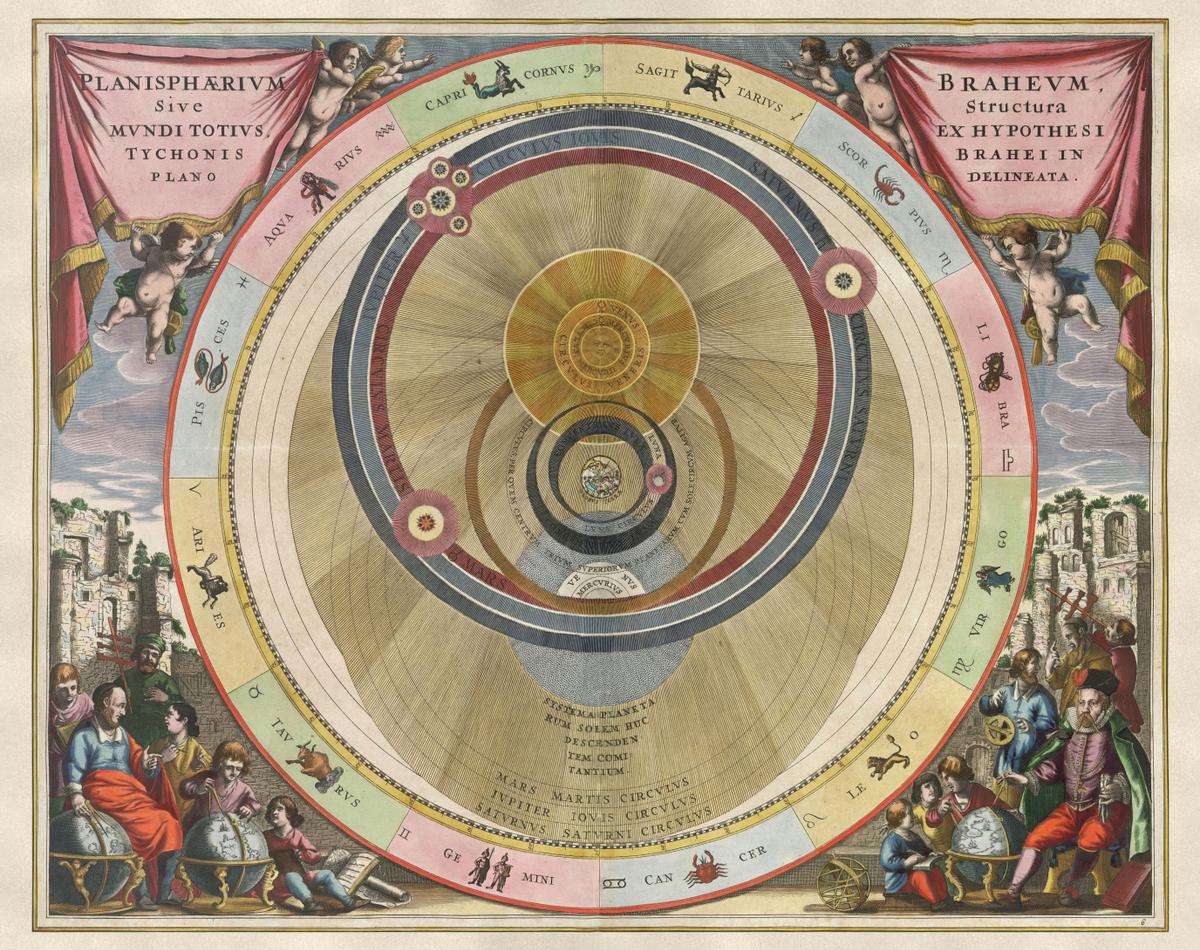
The image presents a magnificent seventeenth-century celestial diagram. A great outer ring charts the signs of the zodiac in soft pastel blocks, encircling a complex web of concentric orbits. At the center rests a small, detailed rendering of the Earth, while a brilliant golden sun radiates light from an offset orbit. In the upper corners, cherubs unfurl sweeping pink banners bearing Latin inscriptions. Below, gathered among classical stone ruins, groups of scholars and astronomers pore over terrestrial globes, compasses, and grand texts under a serene sky.
The palette is a masterclass in antiquarian warmth. Golden beige and parchment tones ground the intricate geometry, offset by bands of deep crimson, muted indigo, and celestial blue. Warm pinks and rich greens in the figures robes add depth to the lower vignettes. This combination of structural linework and soft hand-coloured washes creates a mood of quiet intellectual wonder, making the piece feel both monumental and remarkably delicate.
As a vintage wall art focal point, this piece commands attention. It brings a sophisticated academic elegance to a classic study, a grand home library, or an eclectic living room. Styled as a large gallery canvas above a console or framed as a fine-art print in a cozy bedroom, the map bridges historic scholarly aesthetics with modern interior design. It serves beautifully as an anchor piece for a curated gallery wall.
Originally published in the Netherlands by Andreas Cellarius in 1660 for his grand star atlas Harmonia Macrocosmica, this Baroque engraving illustrates a historical model of the planetary system. We offer this intricate work as an archival fine-art print or canvas, using museum-grade matte paper and fade-resistant pigment inks made to order. Each edition is carefully prepared and digitally restored by Surrealium at Vaxholm Fortress, a 16th-century sea fortress in the Stockholm archipelago, ensuring this astronomical vision endures for generations.