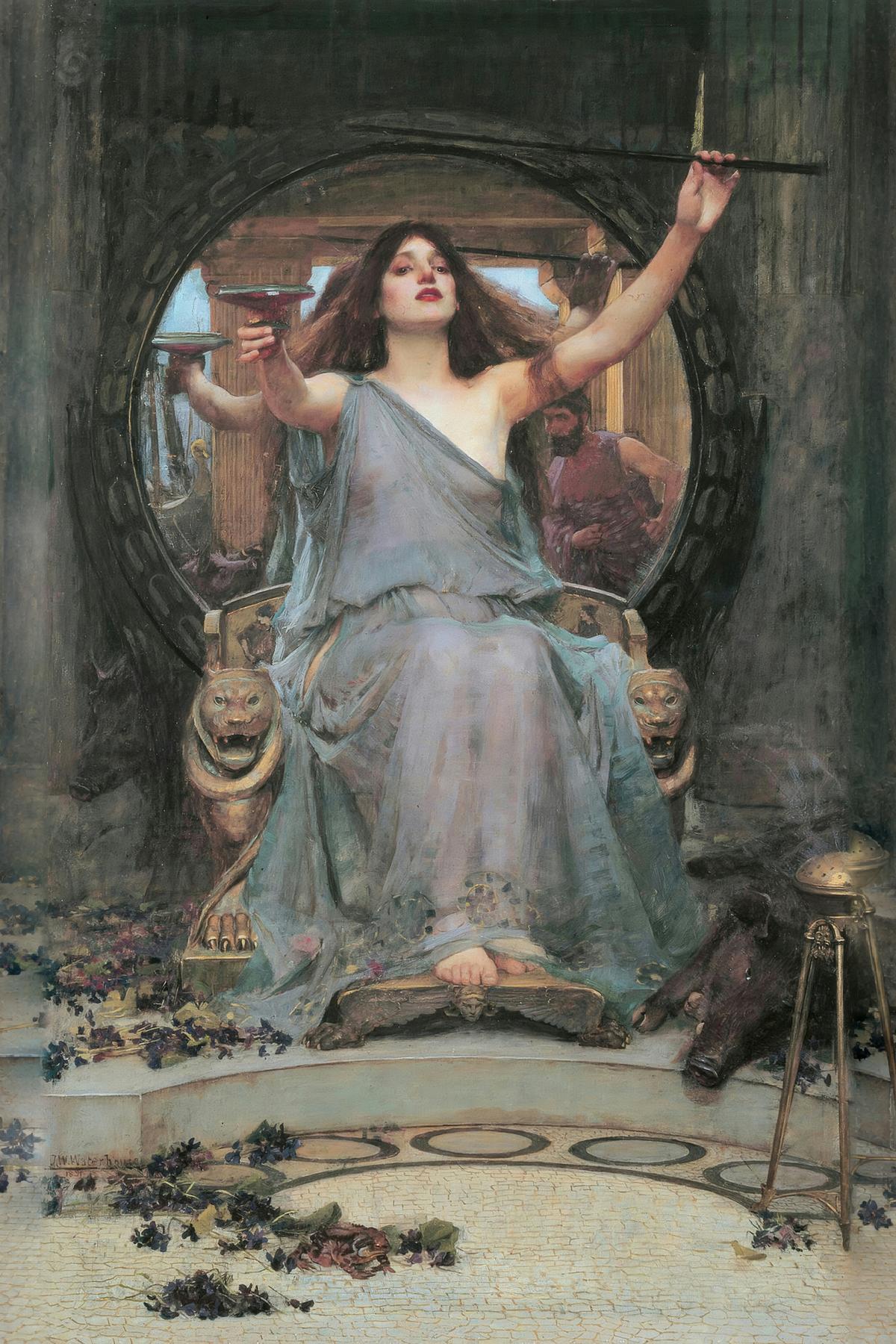
In this mythological scene, a sorceress commands the center of a tessellated marble floor. Seated on a carved throne flanked by lion heads, Circe holds forth a potion-filled chalice in one hand and a raised wand in the other. Her sheer, pale blue gown drapes across her figure, contrasting with her flowing auburn hair. A large, circular mirror dominates the background, cleverly reflecting the approaching figure of Ulysses and the columns of a sunlit temple, while a transformed sailor, now a dark swine, lies quietly near a smoking bronze brazier at her feet.
The palette balances deep, shadowy tones with deliberate moments of luminosity. The translucent blues and soft lavenders of Circe's drapery contrast sharply with the dark, heavy bronze of the mirror frame and the rich mahogany tones of her hair. Scattered violet blooms on the pale stone steps soften the severity of the architecture. Together, these colors create a mood of quiet, magnetic tension and mythical weight, bringing an atmosphere of classical mystery to a space.
This vertical composition makes a natural focal point in spaces that invite contemplation. As a large gallery canvas, it draws the eye above a dark wood console, in a formal dining room, or anchoring a library wall. Its blend of romantic storytelling and classical architecture complements vintage, maximalist, and dark academia interiors, while serving as a strong anchor piece in a thoughtfully curated eclectic gallery wall.
Painted by British artist John William Waterhouse in 1891, the work reflects the romantic intensity of the late nineteenth century, blending classical myth with Victorian aestheticism. Now housed at Gallery Oldham, this piece is reproduced as an archival fine-art print on matte museum-grade paper using archival pigment inks. It is meticulously prepared for print by Surrealium at Vaxholm Fortress, Sweden, from the museum's scan, ensuring the subtle shifts in light, sheer fabric, and rich shadow endure as a lasting piece of wall art.