Annunciation painting: three rooms, one encounter
Compare three Annunciation paintings by Memling and Joos van Cleve through gesture, domestic space, light and carefully qualified symbols.
An Annunciation painting turns a spoken encounter into a visible arrangement. In the Christian narrative, Gabriel announces to Mary that she will bear Jesus. Painters must give that exchange a place, a distance between bodies and a way for the viewer to follow attention. A book, a doorway or a lifted hand can matter as much to the composition as an angel's wings.
Three works in Fable's catalogue make a close comparison possible: two by Hans Memling and one by Joos van Cleve, all held by the Metropolitan Museum of Art. Each places the encounter in a furnished room, but the figures occupy those rooms differently. Look first at what is actually visible. Then use the museum's account to distinguish a supported symbolic reading from a tempting guess about every object in the picture.
Memling makes the central body the event
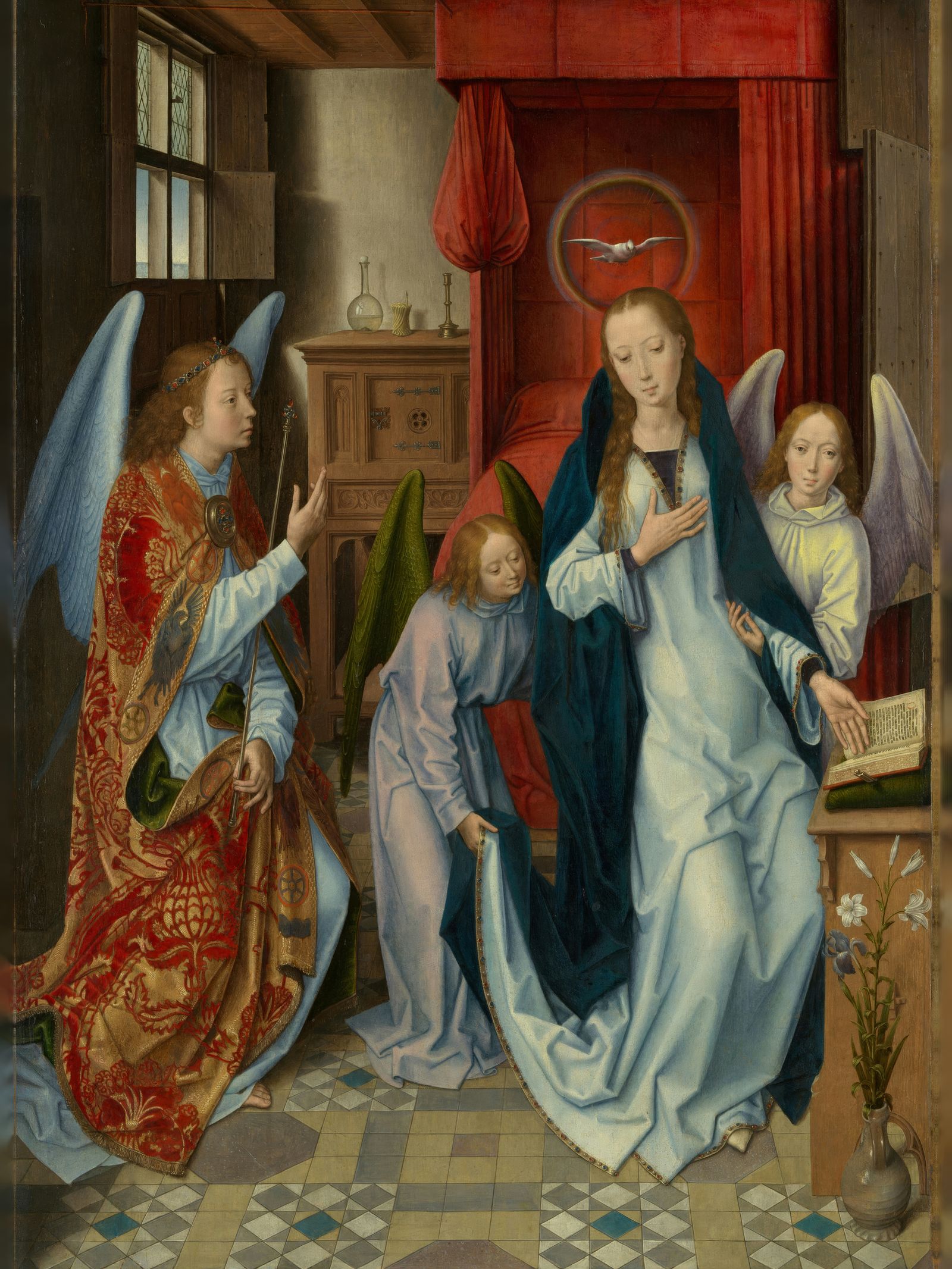
The Annunciation · Hans Memling · 1480–89 · The Metropolitan Museum of Art. Prepared for print by Surrealium at Vaxholm Fortress, Sweden.
In Memling's Annunciation of 1480–89, Mary stands near the centre with two smaller angels supporting her. Gabriel occupies the left, his richly patterned garment contrasting with the quieter blue and pale folds around her. The Met describes Mary as swooning; that action makes her body's position central to the encounter rather than presenting the moment as a calm exchange between two equal standing figures.
Follow the hands and supporting arms before looking at the objects. They explain the movement within the group and connect the otherwise separate figures. The tiled floor and furniture give the event a measured domestic setting, while the bodies interrupt that order. The painting is especially useful for comparison because the angelic support changes the familiar two-person arrangement. A viewer who expects every Annunciation to follow the same pose would miss one of this work's defining choices.
Read the room, then qualify the symbols
The red bed, shelving, window and small vessels make the room specific enough to examine as a space. Lines in the floor lead towards the figures, and the vertical furnishings help hold them upright within the narrow composition. Those visible relationships are available before any symbolic interpretation is supplied.
The Met connects the water-filled vessel and lilies with purity, and the empty candleholder with Christ as the light of the world. These are readings of this painting within a religious tradition, not a rule that every vase or unlit candle in every picture has the same meaning. Notice where the objects are placed and how clearly they are shown. The museum's explanation adds a layer to the looking; it does not require us to turn the whole room into a puzzle with one mandatory answer for every item.
An earlier Memling keeps the exchange more direct
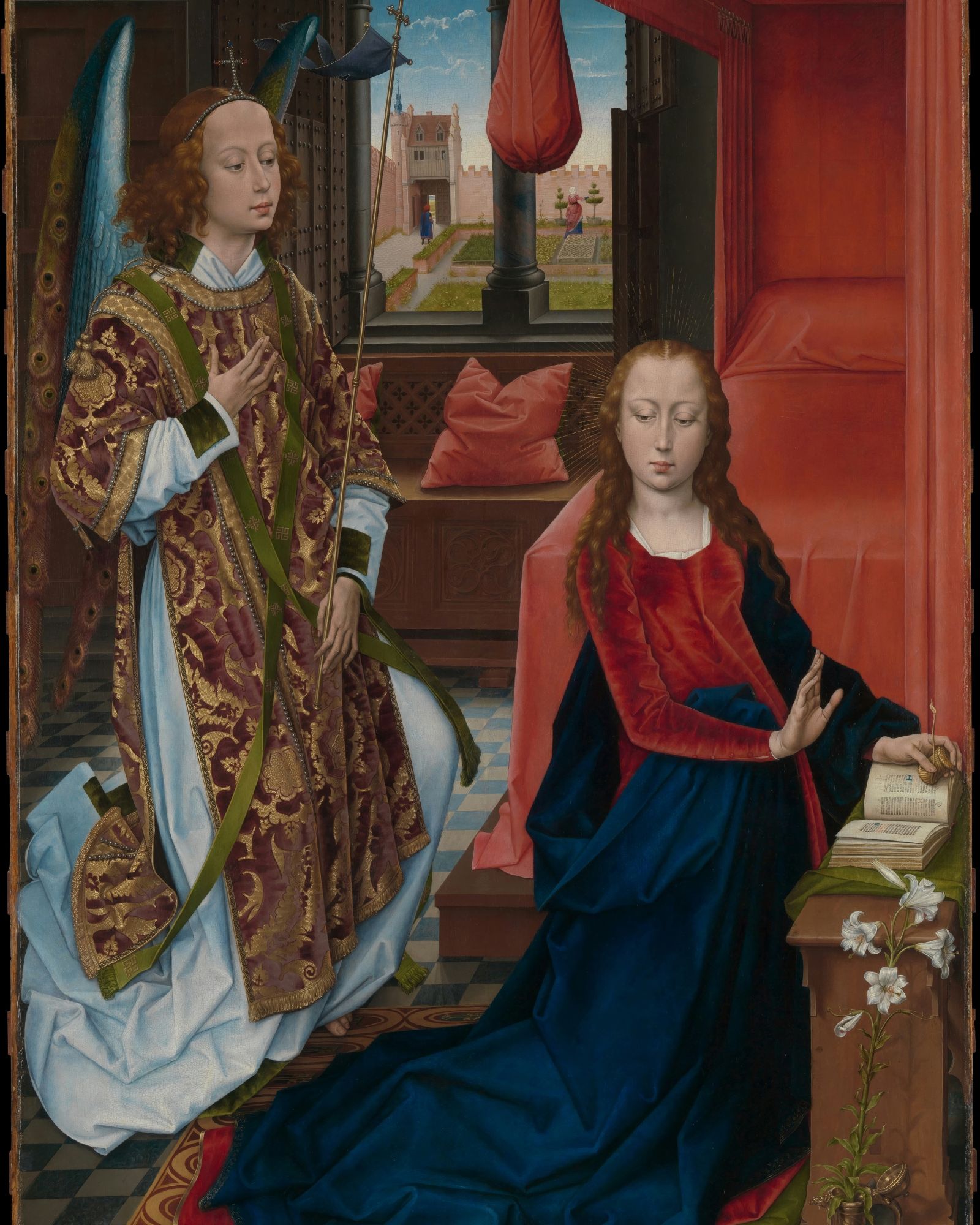
The Annunciation · Hans Memling · ca. 1465–70 · The Metropolitan Museum of Art. Restored by Surrealium at Vaxholm Fortress, Sweden.
Memling's earlier Annunciation, dated about 1465–70, places Gabriel at the left and Mary at the right, with the open book and the turn of her body helping to organise the encounter. The red bed and the view through the window create a setting that is both enclosed and connected to a world beyond the room. Unlike the later picture, this arrangement does not gather supporting angels around a standing central figure.
Compare the space between Gabriel and Mary in the two works. Here their gestures cross an interval that remains easy to follow, while the rich garments and broad folds give each figure a distinct area. The difference is not simply that one painting contains fewer people. It changes the pace of looking, making the exchange between the two principal figures clearer and allowing the surrounding objects to be read in relation to that distance.
A possible commission is not a certain biography
The Met connects the earlier painting with a probable commission from Ferry de Clugny, noting heraldic evidence in the carpet and stained glass and relating it to his chapel at Autun. The museum also discusses the design's relationship to Rogier van der Weyden. These are valuable historical connections, but the language of probability belongs with them.
For a viewer, this is a useful example of how an artwork's history differs from a story invented around its appearance. A coat of arms can support a scholarly identification when it is examined in context; it does not license a confident biography based only on a decorative detail. We can appreciate the painted room, gestures and fabrics while keeping the commission qualified. That approach preserves what the evidence offers without pretending it fills every gap between the object, its maker and its first setting.
Joos van Cleve gives the room another rhythm
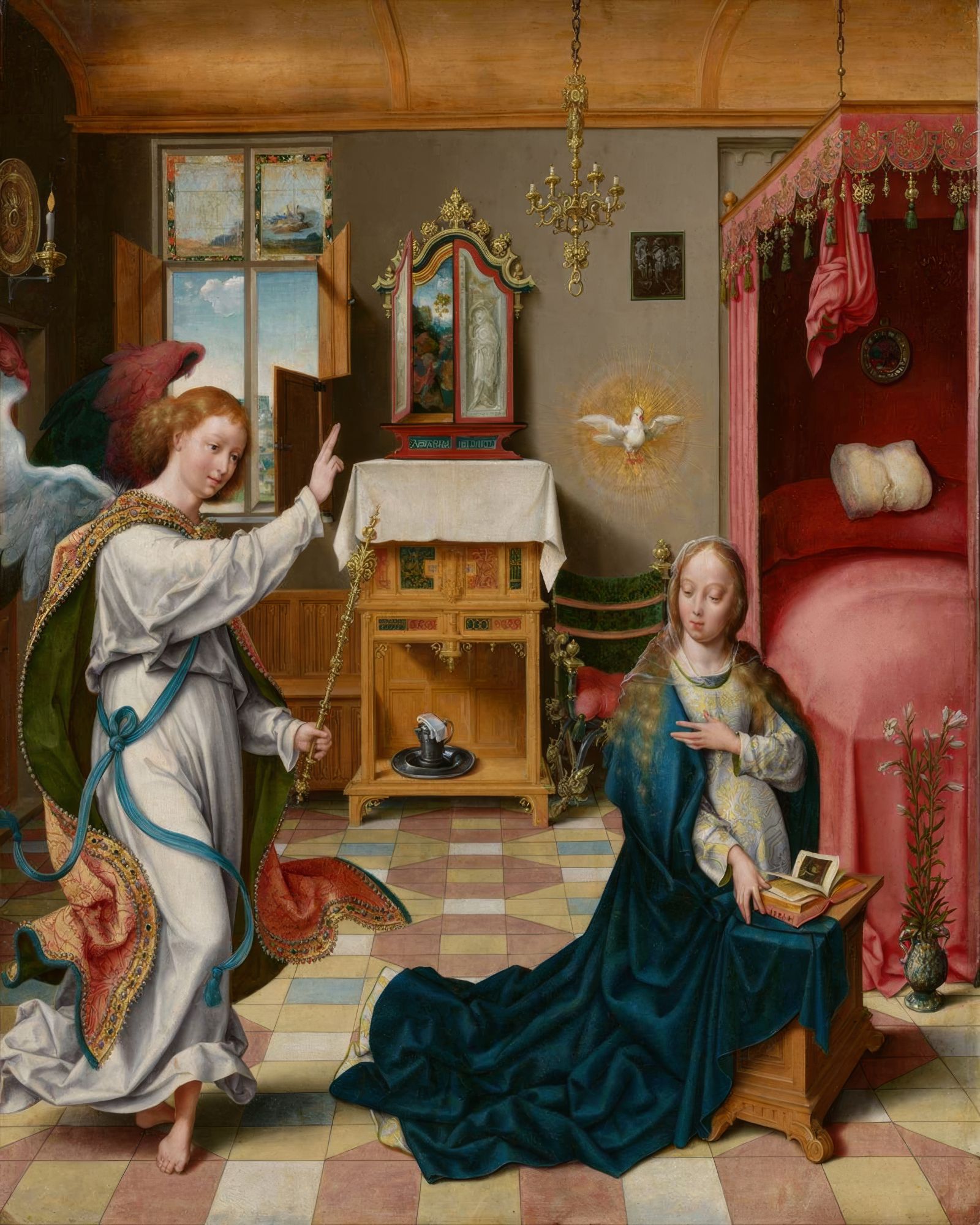
The Annunciation · Joos van Cleve · ca. 1525 · The Metropolitan Museum of Art. Restored by Surrealium at Vaxholm Fortress, Sweden.
Joos van Cleve's Annunciation of about 1525 sets Gabriel in motion at the left, with a raised hand reaching towards Mary at the right. Her open book remains close, while the red bed, architectural recesses and patterned floor divide the room into recognisable areas. The light near the small dove gives the upper middle of the composition another point of attention.
The Met notes how the room's religious images connect Old Testament figures with New Testament themes, and discusses Italian influence in the gestures. Those observations help explain why the setting contains more than ordinary furniture. Still, begin by tracing the visible arrangement: the angel's inclined body, Mary's answering turn and the space between them. The picture makes the encounter active through movement and direction, while the room's verticals and receding floor keep that movement within a stable structure.
Compare whole compositions, not isolated emblems
Place the three works side by side in your mind and ask the same questions of each. Where does the principal movement begin? Is Mary standing, kneeling or supported? How much space separates her from Gabriel? Which line in the room carries the eye towards the encounter, and which object becomes visible only after you have followed the figures?
These questions make the differences concrete without asking you to choose the most correct version of the subject. They also help when choosing a print. A tall, narrow group needs its full height; a room with several receding spaces needs the architecture around the figures. Cropping to a wing, a face or a vase may preserve an attractive detail while removing the way the story is organised. Let the whole composition lead, then return to the smaller objects with the museum's account and the limits of that account in view.
An Annunciation can reward both historical reading and slow visual attention. The three paintings share a narrative, yet their gestures, supporting figures and rooms give it different forms. Choose the work whose arrangement you want to return to, and keep its complete proportions when exploring a Masterworks print. The small details become more meaningful when they remain part of the encounter around them.
The angel paintings guide broadens the subject. Compare light and gesture in Caravaggio and the figure arrangements in Manet, then the different mythic arrival in The Birth of Venus. Browse the Renaissance collection and Memling's works for the individual pictures.
Explore the Annunciation pictures
- What does an Annunciation painting depict?
- It depicts Gabriel’s announcement to Mary, within the Christian narrative, that she will bear Jesus. Artists give the encounter different settings and gestures. The three works here use furnished rooms, but their arrangements of Mary, Gabriel and accompanying figures are not identical.
- Why do lilies appear in Annunciation paintings?
- Lilies are traditionally associated with Mary’s purity, and the Met uses that reading for the later Memling shown here. Apply the explanation to a documented work rather than assuming every flower in any religious painting carries exactly the same meaning.
- Are all the objects symbolic?
- Some objects have supported symbolic readings, while others also establish the room and organise the composition. Start with the visible placement and consult the holding museum’s account. It is better to leave an uncertain object unexplained than invent a confident meaning for every detail.
- Which version should I choose as a print?
- Compare the whole arrangement: the supporting angels in the later Memling, the direct interval in the earlier work and the moving gesture in Joos van Cleve. Choose according to the picture you want to look at, preserving its own proportions rather than selecting only an isolated emblem.