Angel paintings: 14 angels from Blake to the Renaissance
Gabriel at the Annunciation, Raphael guiding Tobias, Dürer’s musician angels and Blake’s good and evil angels: fourteen pictures of angels, what each one means, and where they look best.
Angels are messengers: the word comes from the Greek angelos. In Christian art they announce, guard, guide, sing and fight, and painters have spent two thousand years working out how to show a being that is not quite a person. Wings came from the Victory figures of ancient Greece; haloes, harps and cherubs’ chubby faces came later.
The fourteen works below follow angels from the Annunciations of fifteenth-century Flanders to William Blake’s visions and Gustave Moreau’s Jacob wrestling the angel. Each can be ordered as a print prepared from the museum’s scan. Four of them are Fable atelier colour editions of famous black and white engravings and drawings, coloured by hand from the originals.
1. The Annunciation
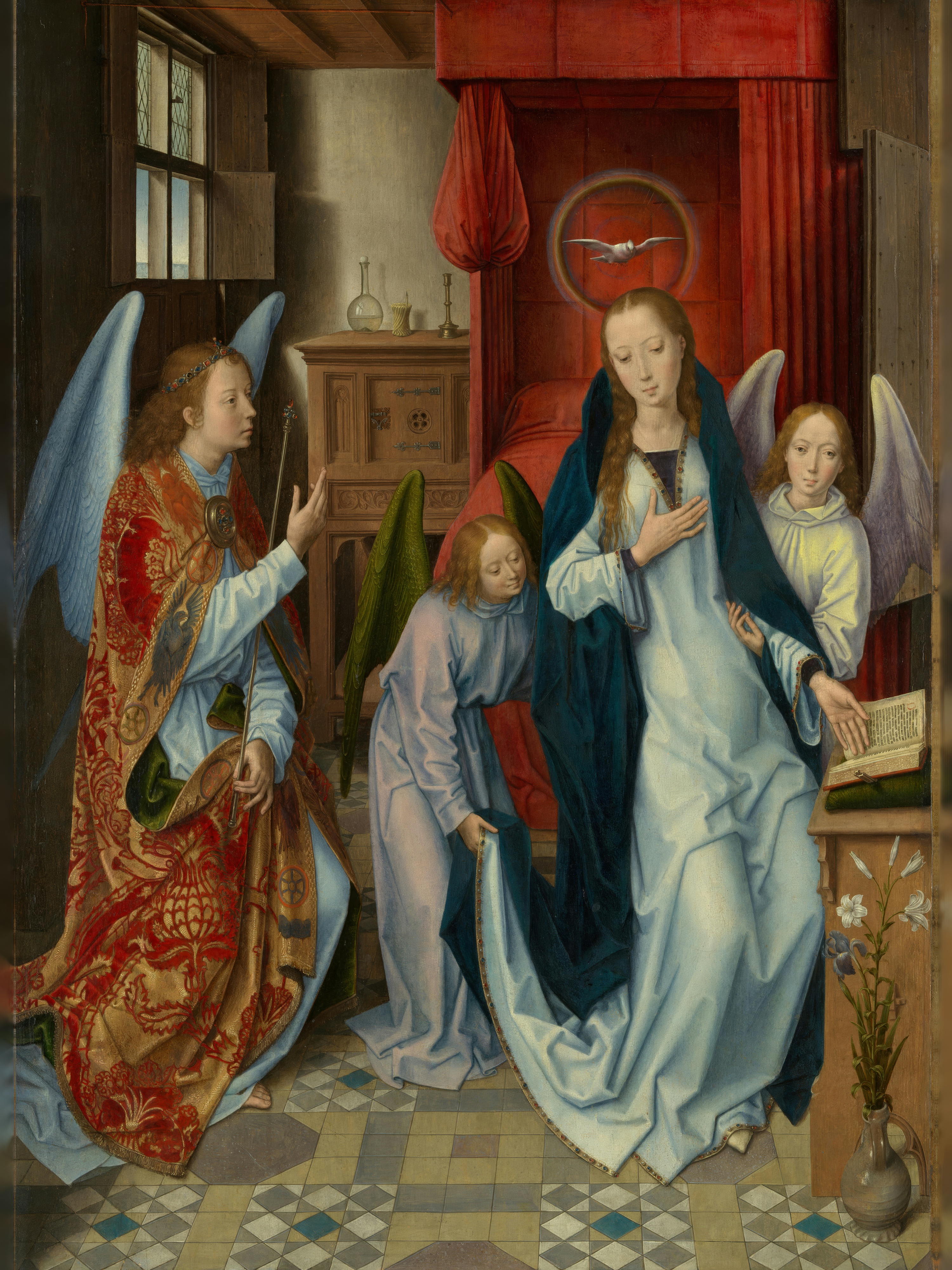
Hans Memling, The Annunciation, 1480–89. Oil on panel, transferred to canvas. The Metropolitan Museum of Art, New York.
Memling sets the Annunciation in a comfortable Flemish bedroom. Gabriel, in a brocade cope, kneels before Mary as she rises from her prayers, and every object in the room, from the lily to the bed curtains, carries a quiet meaning.
2. The Annunciation
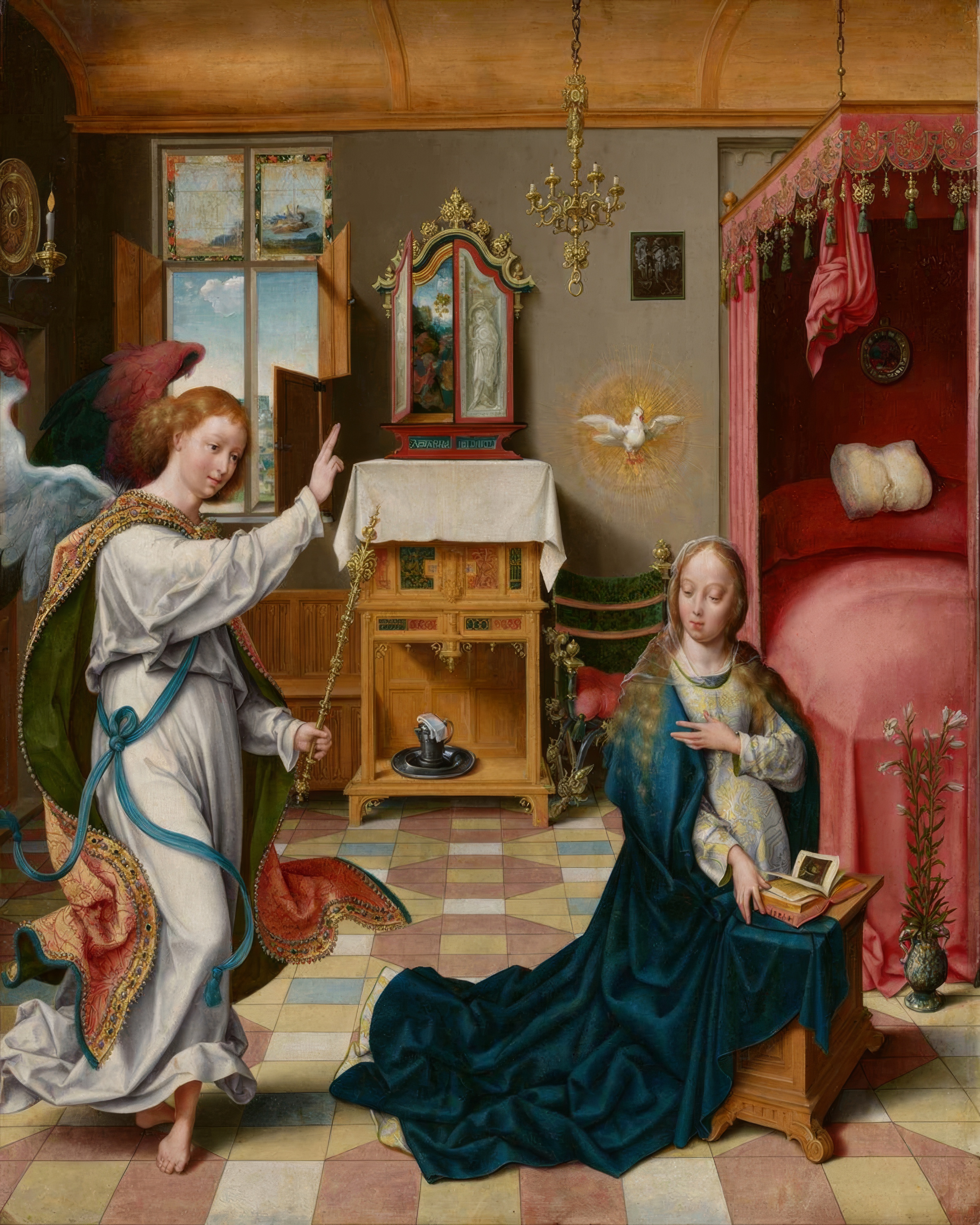
Joos van Cleve, The Annunciation, ca. 1525. Oil on wood. The Metropolitan Museum of Art, New York.
Joos van Cleve, working in Antwerp around 1525, painted the moment the angel enters Mary’s room. The polished floor, the brass chandelier and the open book are all painted with Flemish precision.
3. The Angel of the Annunciation
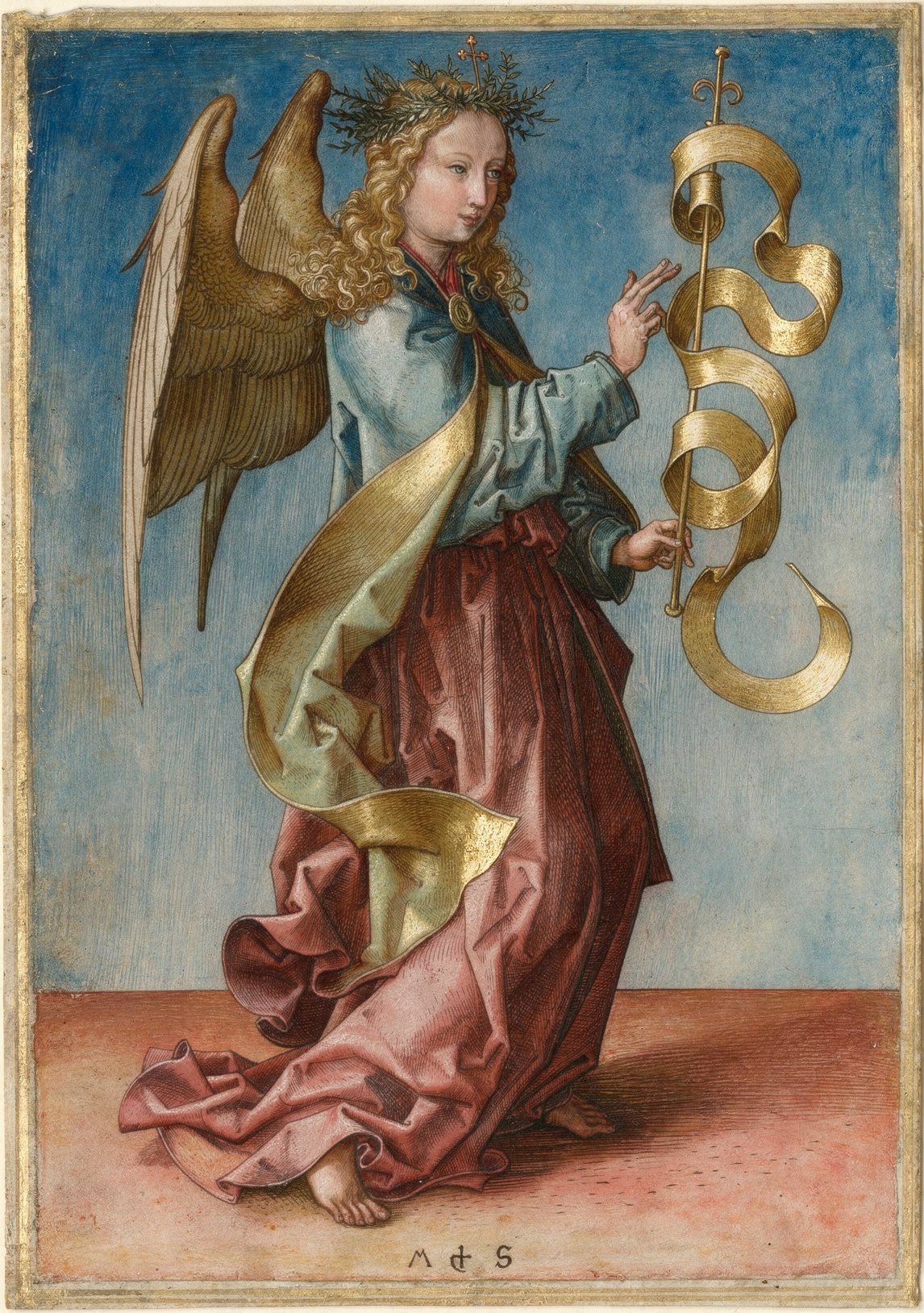
Martin Schongauer, The Angel of the Annunciation, c. 1470–75. Atelier colour edition of the engraving. Cleveland Museum of Art.
Martin Schongauer was the greatest engraver before Dürer, and his Gabriel, kneeling with a sceptre and a scroll, is one of the most elegant angels of the fifteenth century. This atelier edition adds colour by hand to his black and white engraving.
4. Music-Making Angels
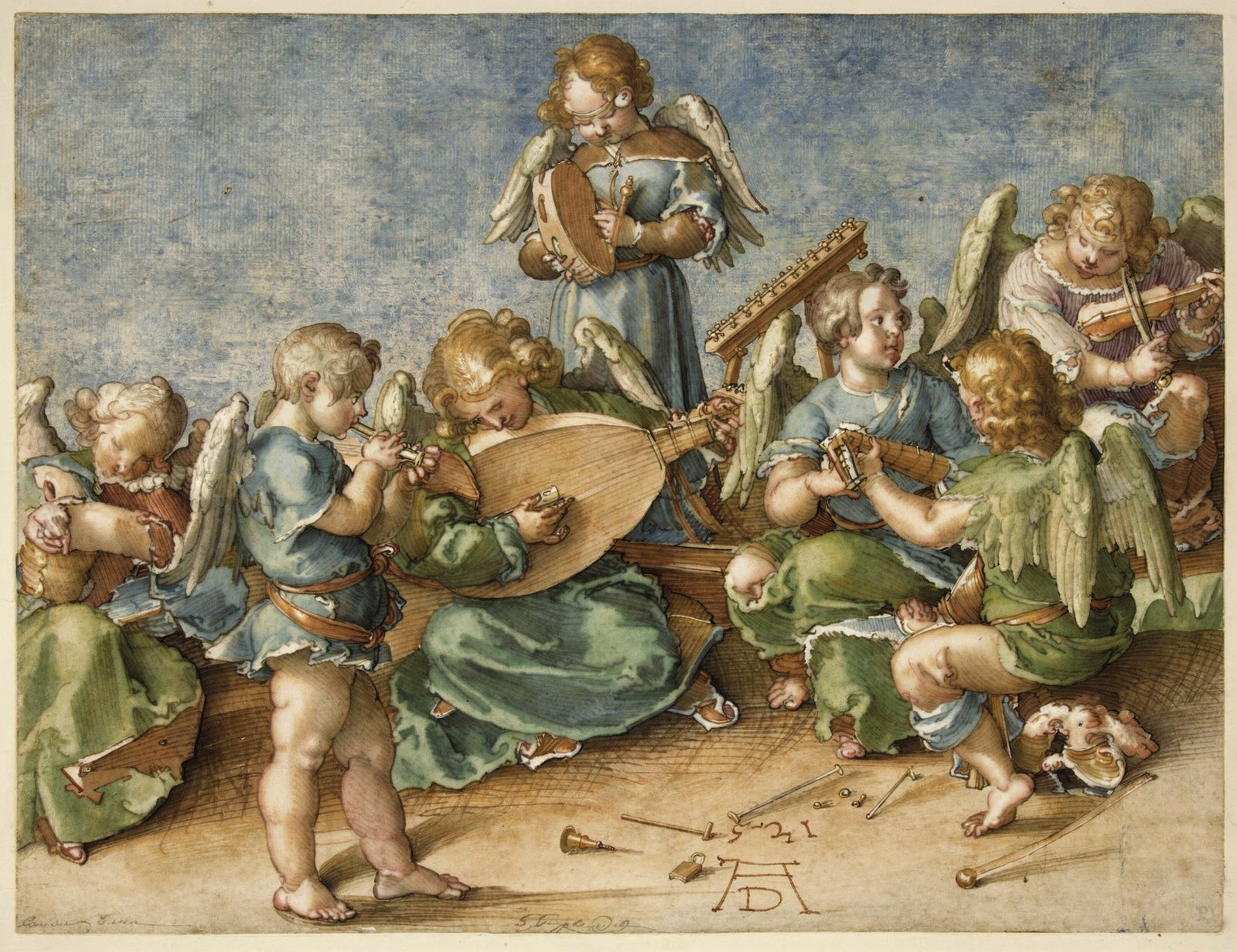
Albrecht Dürer, Music-Making Angels, 1521. Atelier colour edition of the pen drawing. The Metropolitan Museum of Art, New York.
Dürer drew these angels playing music in 1521, during his journey to the Netherlands. The atelier edition gives colour to his quick pen lines, and the angels look like a small heavenly band in rehearsal.
5. The Virgin Crowned by Two Angels
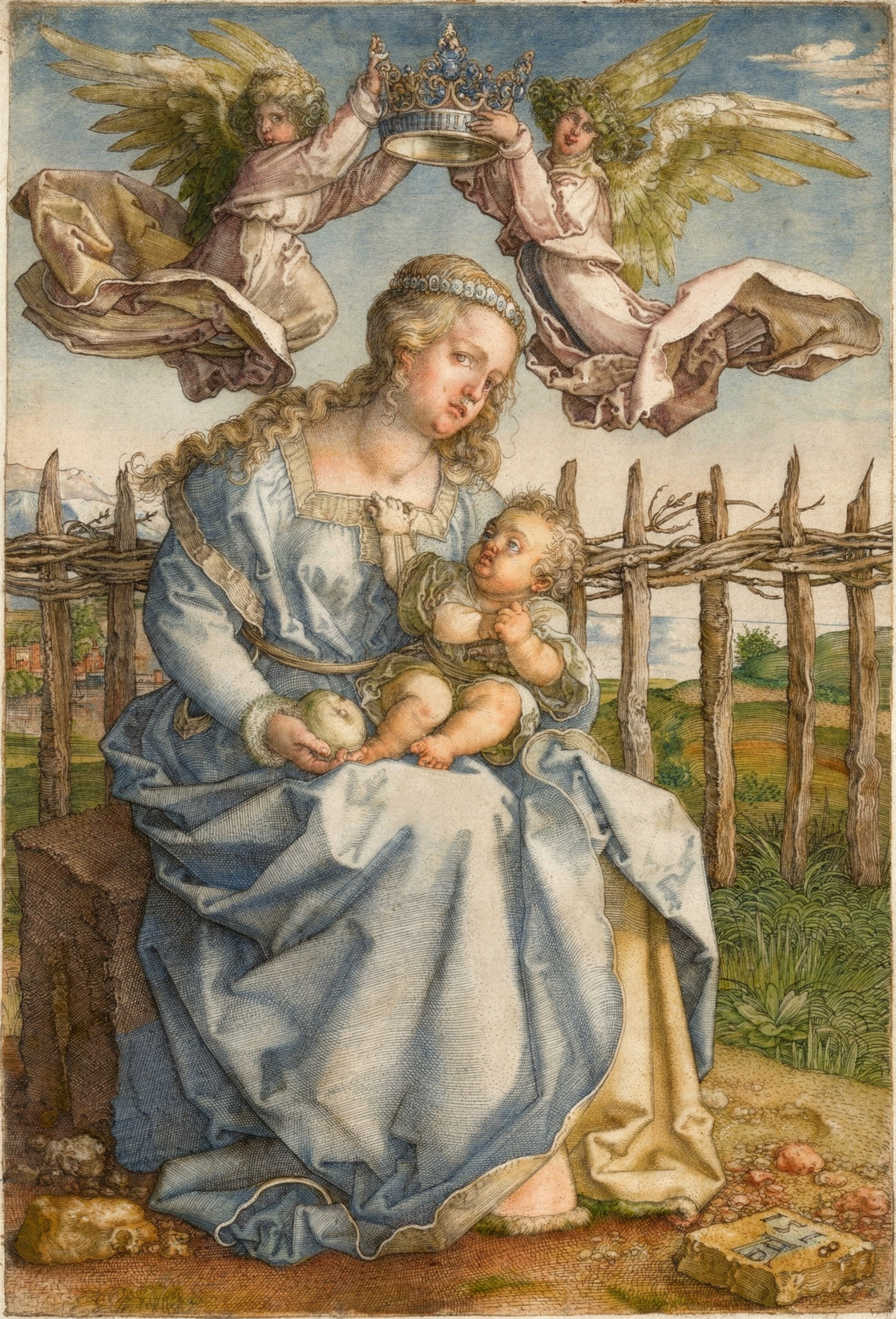
Albrecht Dürer, The Virgin Crowned by Two Angels, 1518. Atelier colour edition of the engraving. Cleveland Museum of Art.
Two angels fly down to hold a crown above the Virgin and Child in Dürer’s engraving of 1518. The atelier edition colours it in soft blues and golds.
6. Saint Matthew and the Angel
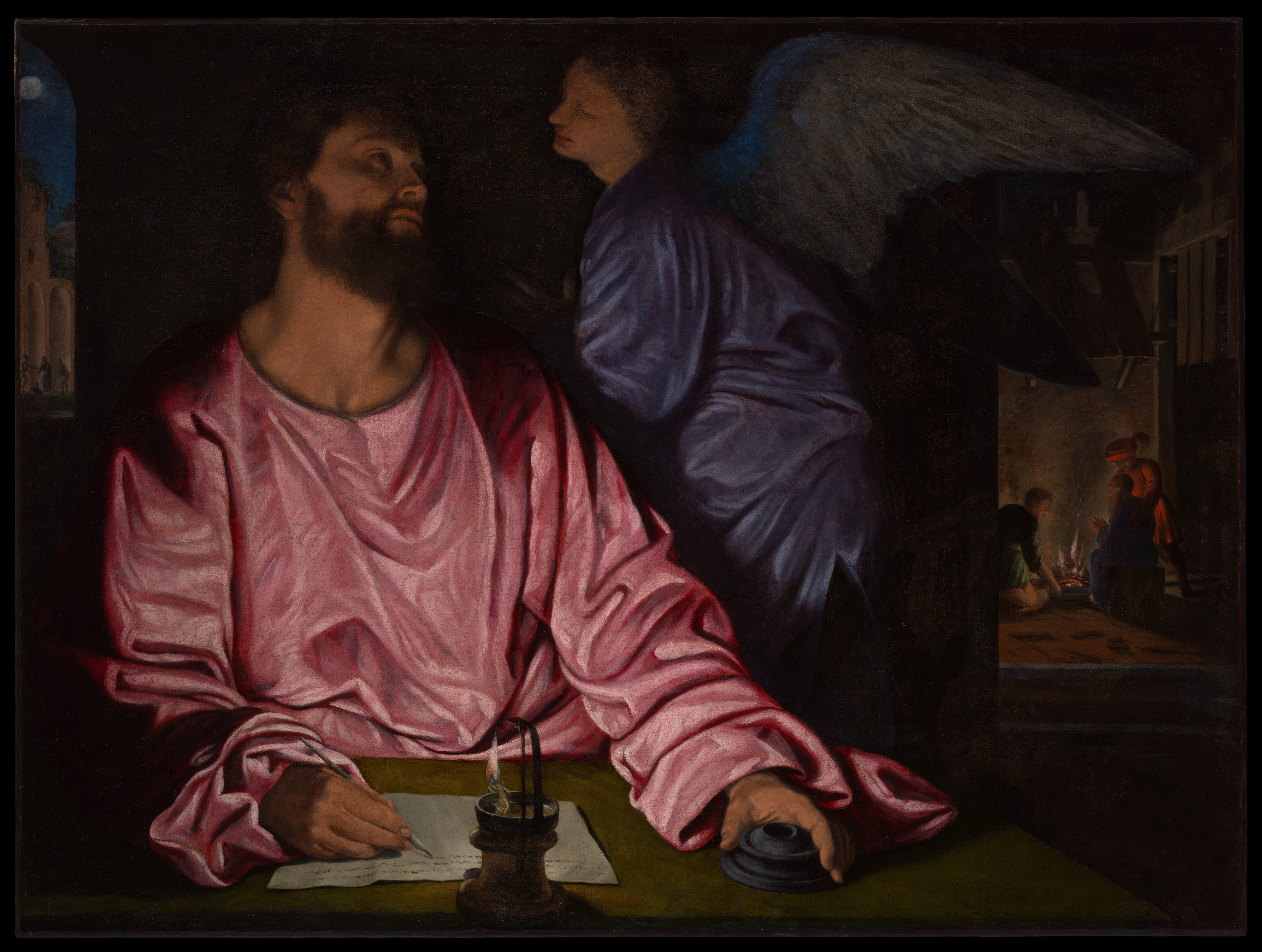
Giovanni Gerolamo Savoldo, Saint Matthew and the Angel, c. 1534. Oil on canvas. The Metropolitan Museum of Art, New York.
Matthew is writing his gospel at night when an angel appears at his elbow to guide his pen. Savoldo, a Venetian painter of light and shadow, lights the scene with a single lamp, and in the dark background small figures go about their evening.
7. Tobias and the Angel Raphael
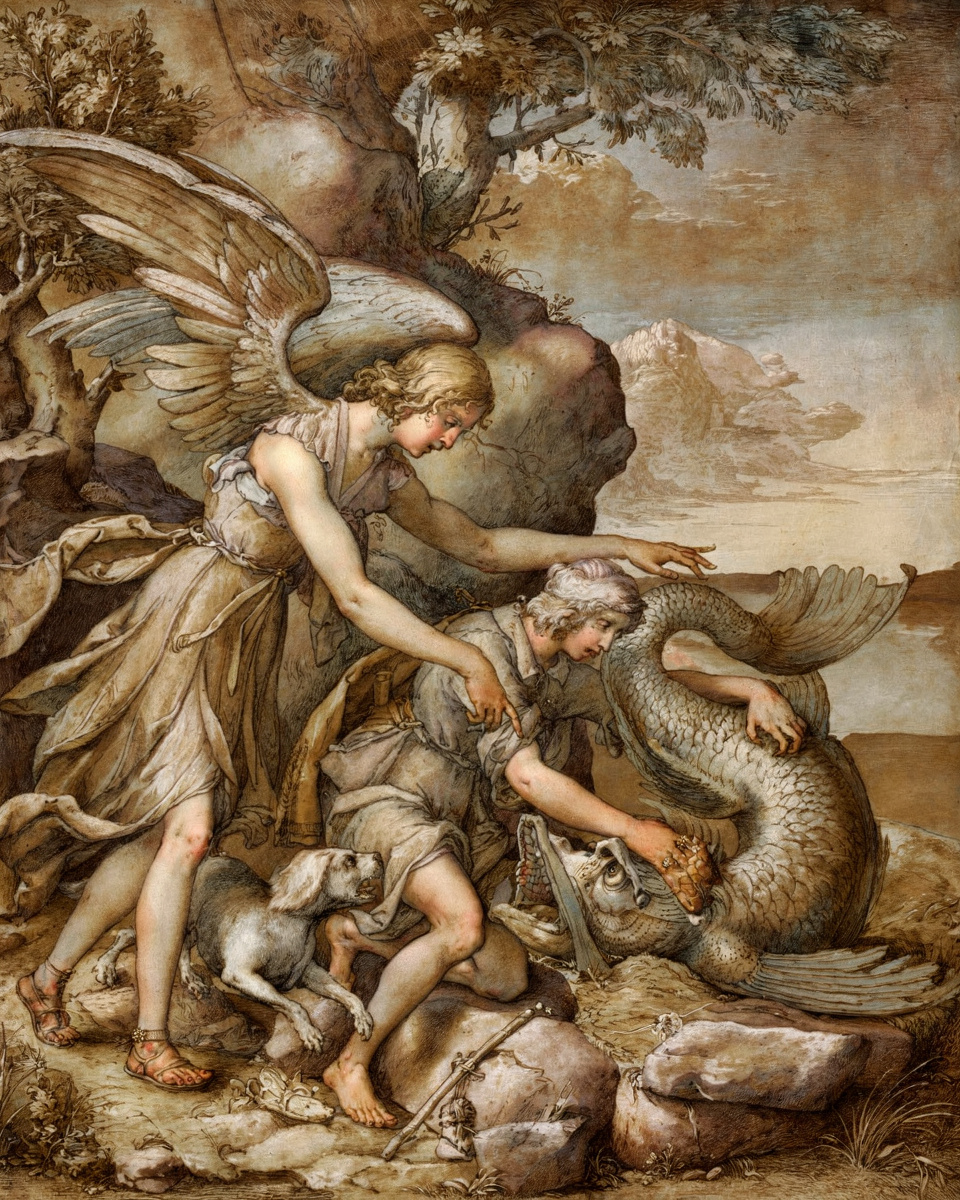
Jacopo Ligozzi, Tobias and the Angel Raphael, c. 1605. Pen and brown ink with brush and brown wash, heightened with lead white (oxidized), over black chalk, with gray overpaint, (added by a later hand) on head and right hand of Tobias, on cream laid paper, laid down on gray laid paper. Art Institute of Chicago.
In the Book of Tobit, the archangel Raphael travels with young Tobias, disguised as a companion, and teaches him to use a fish to heal his father’s blindness. Jacopo Ligozzi, court artist to the Medici, draws them walking together, the angel’s huge wings spread behind.
8. Tobias and the Angel
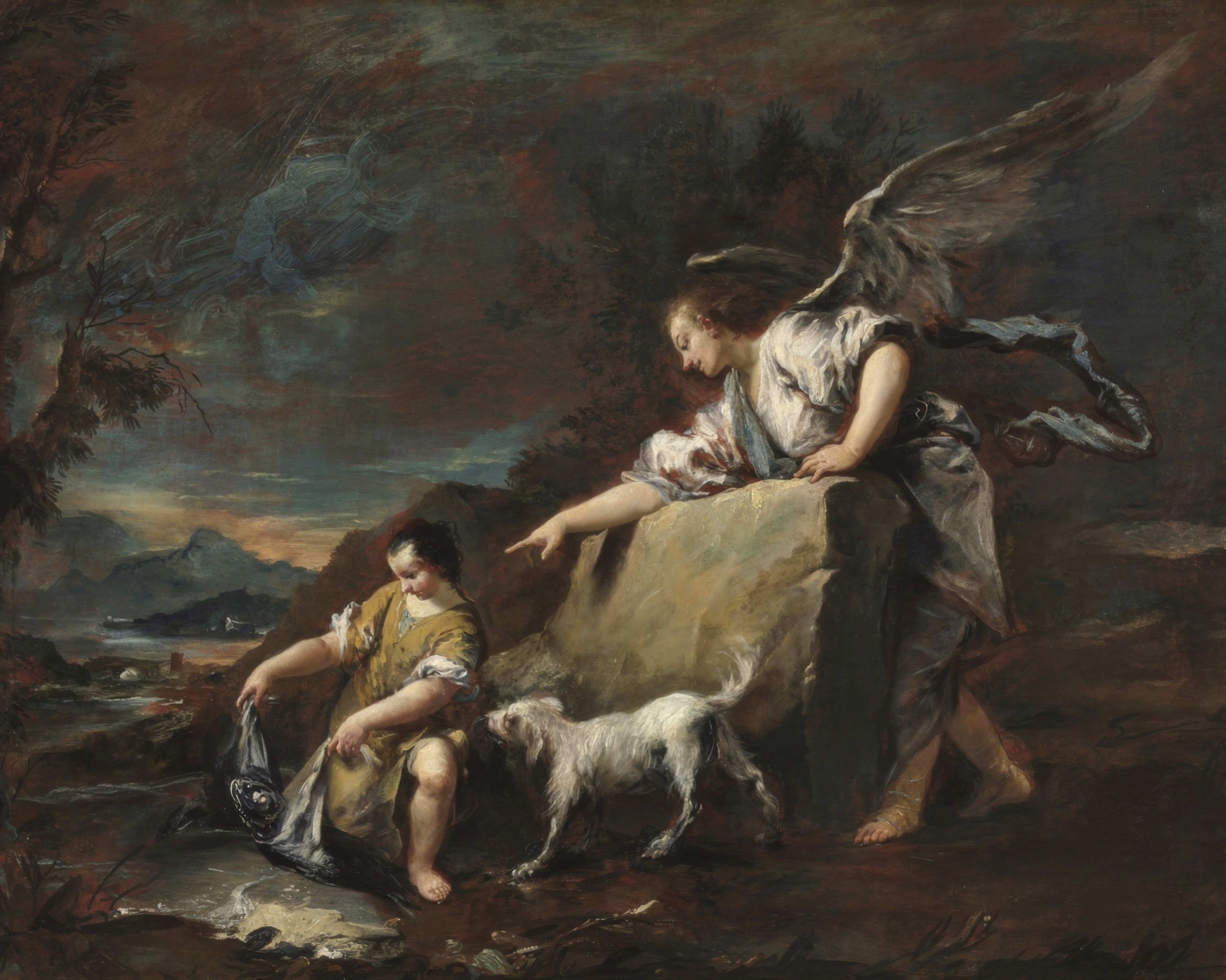
Francesco Guardi, Tobias and the Angel, 1750s. Oil on canvas. Cleveland Museum of Art.
Francesco Guardi painted Tobias and the Angel as part of a series of Old Testament scenes, with flickering Venetian brushwork that makes the angel seem made of light. Tobias and Raphael became the model for every guardian angel picture that followed.
A traditional gift for a christening, a new parent or someone setting off on a journey.
9. The Vision of Saint Francis
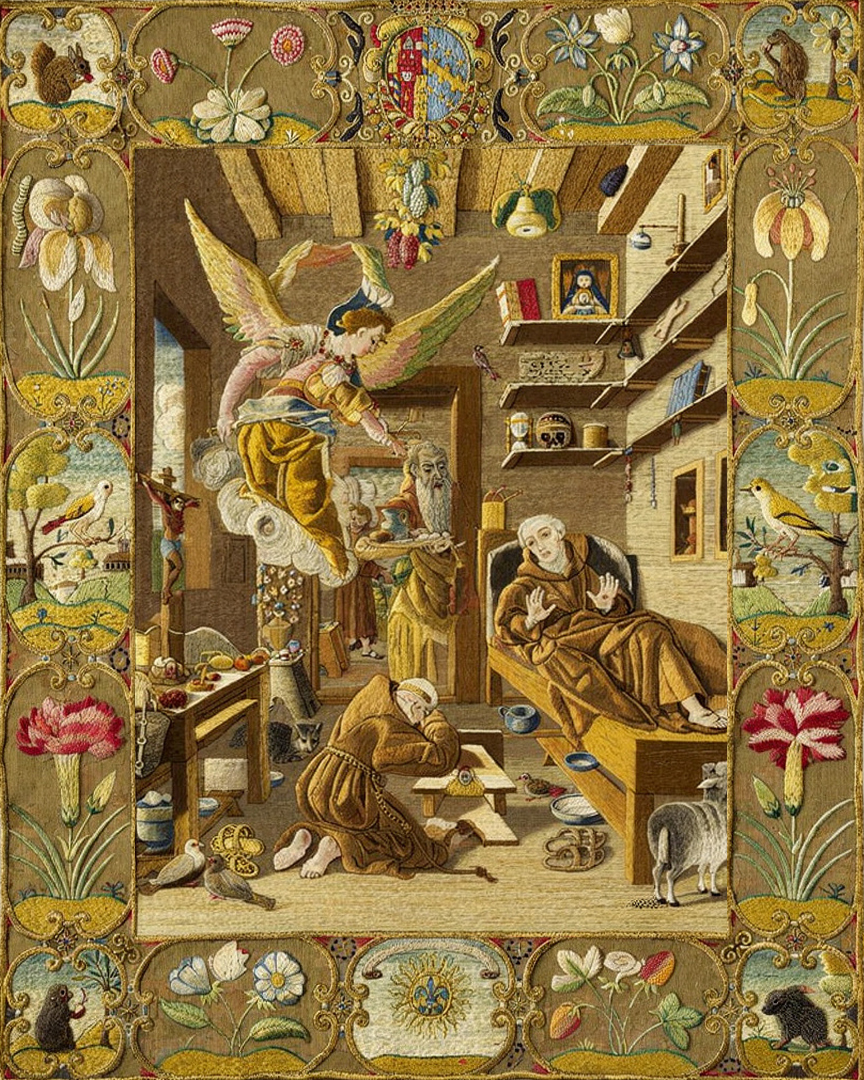
The Vision of Saint Francis, 1600-1622. Victoria and Albert Museum, London.
Saint Francis, ill and in pain, is visited by an angel who plays the violin so sweetly that he forgets his suffering. Painters of the early 1600s loved this gentle story of music as consolation.
10. Putto and Butterfly
Arnold Böcklin, Putto and Butterfly, 1895.
Late in life Böcklin painted this little winged child reaching for a butterfly in a meadow. The butterfly was an old symbol of the soul, so the picture is both a cherub and a quiet thought about what we try to catch.
Shown in a room, it brings a gentle warmth to a nursery or a child’s bedroom.
11. The Angel
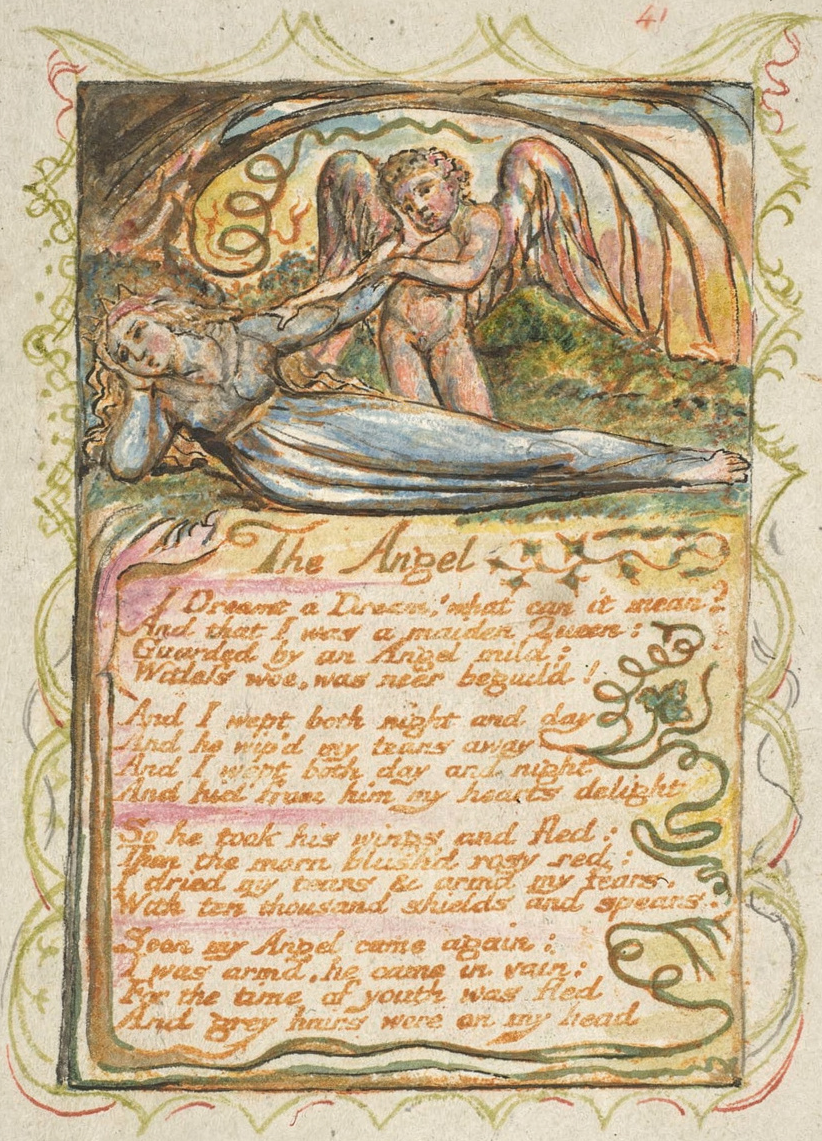
William Blake, The Angel, [1794] printed ca. 1825. Atelier colour edition of the relief etching. The Metropolitan Museum of Art, New York.
Blake wrote, etched and coloured his own books. The Angel, from Songs of Experience, is a poem about a maiden queen who wept, guarded by a winged boy, until her chance at love had gone. This atelier edition follows the Met’s copy.
12. The Good and Evil Angels
William Blake, The Good and Evil Angels, 1795-c. 1805.
One of Blake’s great colour prints. A good angel carries a child away from a dark, chained angel reaching out of fire, a picture of the struggle between innocence and energy that ran through all his work.
Shown in a room, its drama suits a study or a hallway.
13. Christ in the Sepulchre, Guarded by Angels
William Blake, Christ in the Sepulchre, Guarded by Angels, c. 1805.
Two angels kneel above Christ’s body in the tomb, their wings meeting in a pointed arch like a Gothic window. Blake painted it for his patron Thomas Butts, and its symmetry and calm make it one of his most serene works.
14. Jacob and the Angel
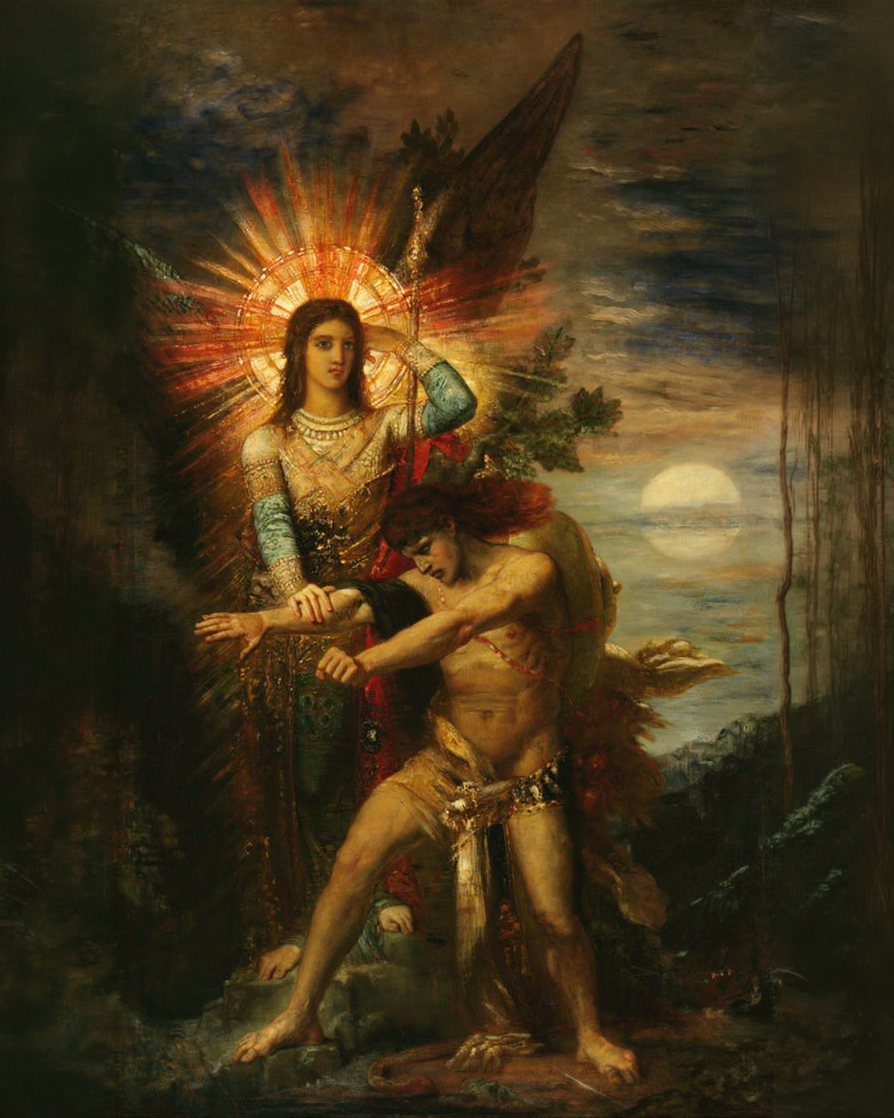
Gustave Moreau, Jacob and the Angel, 1874-1878. Oil on canvas. Harvard Art Museums.
In Genesis, Jacob wrestles all night with a stranger who turns out to be an angel. Moreau shows Jacob straining with all his strength while the angel stands perfectly calm, barely touching him: the human struggle and the divine composure side by side.
Angel pictures are often given as gifts: for a christening, a new home, a wedding, or in memory of someone. A guardian angel such as Raphael with Tobias suits a child’s room or a hallway; a quiet Annunciation suits a bedroom or a reading corner; Blake’s dramatic angels belong in a study. For more, see our guides to Renaissance art masterpieces and symbolism art.
Questions
What do angels symbolise in paintings?
Angels carry messages and protection from God. Gabriel announces, Raphael guides and heals, Michael fights evil, and music-making angels show the harmony of heaven. Cherubs, small winged children, stand for divine love.
Who is the angel in Tobias and the Angel?
The archangel Raphael, who in the Book of Tobit guides the young Tobias on a journey, protects him and shows him how to heal his father’s blindness. He became the model for the guardian angel in art.
What is the difference between a cherub and a putto?
A cherub is a kind of angel; a putto is a chubby winged child in art, borrowed from the cupids of ancient Rome. In practice painters used the same little winged boys for both.
Is an angel picture a good gift?
Yes. Angels are a traditional gift for christenings, new homes and memorials. A print of Tobias and the Angel is a classic present for a new parent or a traveller.