Symbolism art: 16 paintings of dreams and visions
Unicorns, chimeras, prophetic birds and the angel of light: sixteen symbolist works by Moreau, Redon, Böcklin, Stuck, Hodler, Vrubel and more, and what their visions mean.
In 1886 the poet Jean Moréas published a manifesto in Le Figaro and gave a name to a mood that had been spreading across Europe: symbolism. Against the realists who painted what they saw and the impressionists who painted light, the symbolists painted what they felt and dreamed. Myths, gods, sphinxes, death, desire and the soul were their subjects, and they treated them less as stories than as visions.
The sixteen works below come from Paris, Basel, Munich, Bern, Moscow, Helsinki and beyond. They range from Gustave Moreau’s jewelled myths to Hugo Simberg’s peasant devils. Each can be ordered as a print.
1. The Unicorns
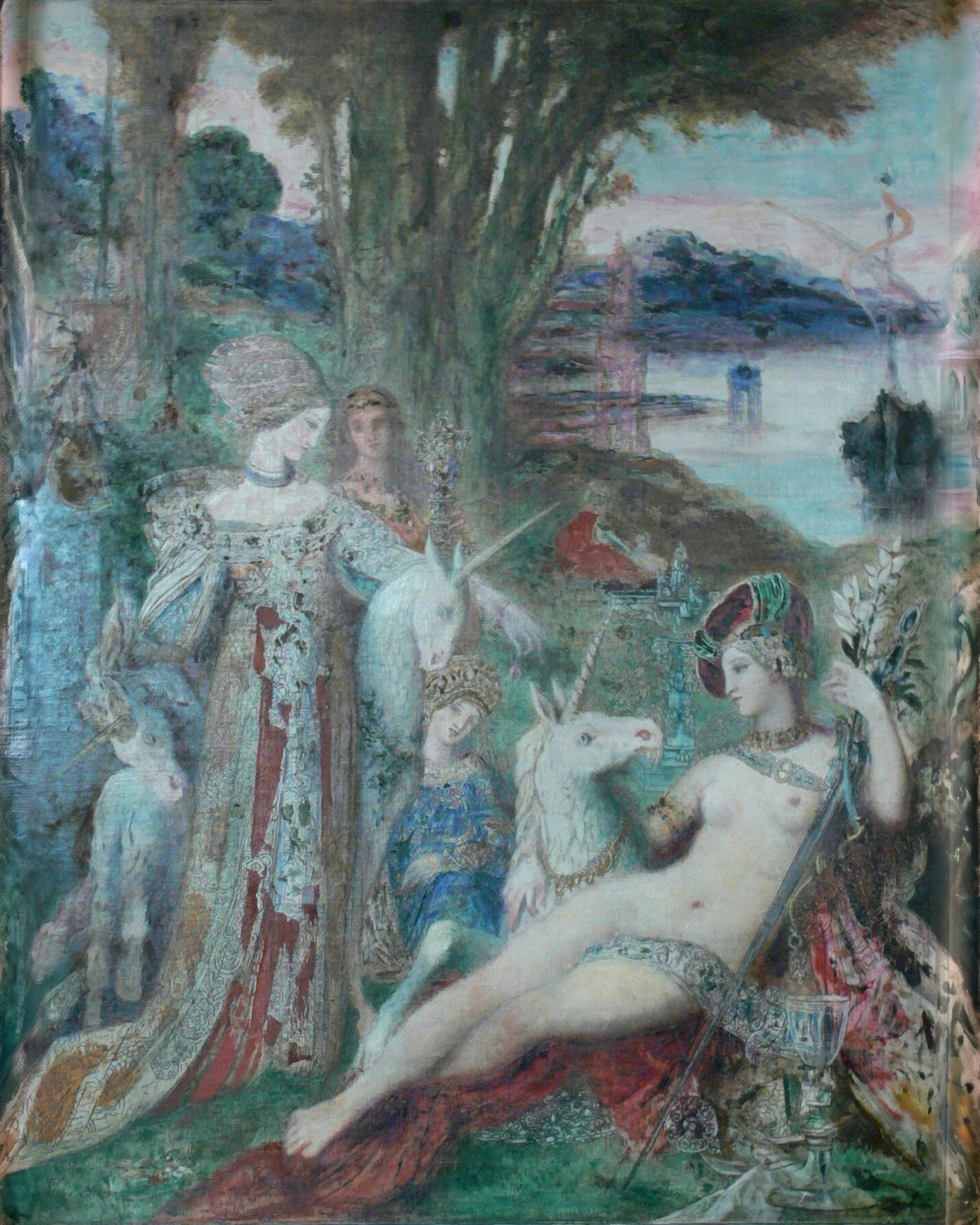
Gustave Moreau, The Unicorns, c. 1885–88. Oil on canvas. Musée Gustave Moreau, Paris.
In the medieval legend only a pure maiden could tame a unicorn. Moreau turns the story into a vision: women in jewelled robes rest among white unicorns in an enchanted landscape that seems half forest, half dream. It hangs in his own house in Paris, now his museum.
2. Jupiter and Semele
Gustave Moreau, Jupiter and Semele, 1895. Oil on canvas. Musée Gustave Moreau, Paris.
Semele, a mortal loved by Jupiter, asked to see him in his true form, and the sight killed her. Moreau’s last great painting shows the god enthroned in a vast, jewelled palace while Semele collapses, overwhelmed by divine glory.
3. Salome Dancing
Gustave Moreau, Salome Dancing, ca 1886. Oil on canvas. Musée Gustave Moreau, Paris.
Salome dances before King Herod to win the head of John the Baptist. Moreau painted her again and again, covering her body and the palace around her with fine ornament drawn like tattoos. The novelist Huysmans made his Salome famous across Europe.
Shown in a room, the gold and ochre fill a wall like a Byzantine icon.
4. The Chimera
Gustave Moreau, The Chimera, 1867. Oil on panel. Harvard Art Museums.
Moreau painted this small panel in 1867: a winged chimera springs from a cliff carrying a woman who has given herself up to him. It is about desire as something that carries you off, and it is now at Harvard.
5. A Singular Being
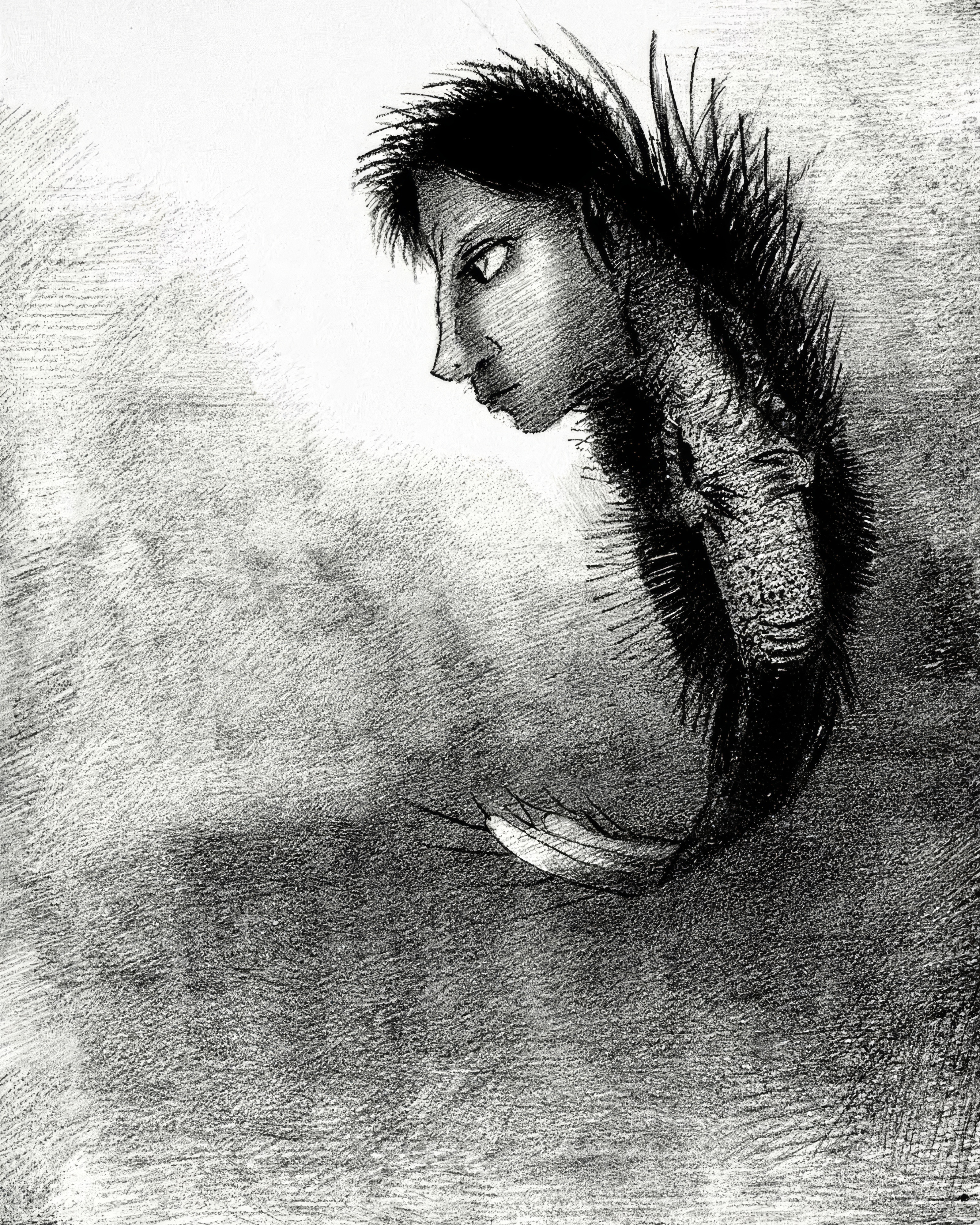
Odilon Redon, A Singular Being, 1888. Lithograph in black on ivory China paper, laid down on ivory wove paper (chine collé). Art Institute of Chicago.
Odilon Redon worked for years in black and white, which he called his noirs. This lithograph illustrates Flaubert’s Temptation of Saint Anthony, in which a creature with a man’s head and a fish’s body rises from the dark.
6. The island of life
Arnold Böcklin, The island of life, 1888. Kunstmuseum Basel.
Böcklin painted this bright island as a counterpart to his famous Isle of the Dead: here people dance, swans glide and the sky is blue. Together the two pictures are about the two ends of the same journey.
7. Lucifer
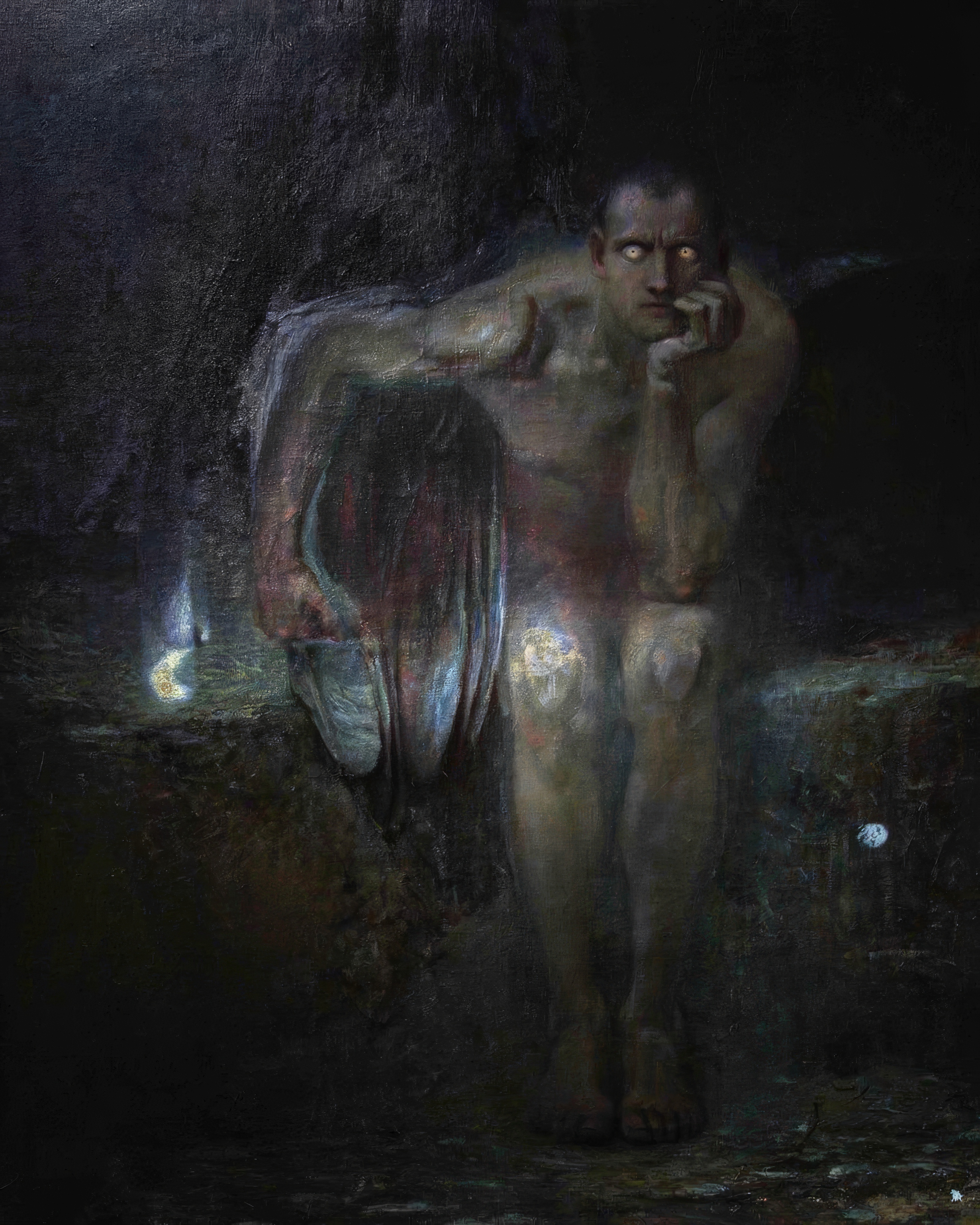
Franz von Stuck, Lucifer, c. 1890. Oil on canvas. National Gallery, Sofia.
Franz von Stuck was the prince of the Munich Secession, and his Lucifer is the fallen angel of light crouched in darkness, staring straight at us with burning eyes. When it was shown, viewers reportedly crossed themselves; Ferdinand of Bulgaria bought it, and it remains in Sofia.
8. Night
Ferdinand Hodler, Night, 1889–90. Oil on canvas. Kunstmuseum Bern.
Hodler’s breakthrough picture. Seven figures sleep, but in the centre a man wakes in terror as a black-shrouded shape crouches on him: death, or the fear of it. The city of Geneva banned it from an exhibition in 1891, and it made him famous in Paris.
9. The Minotaur
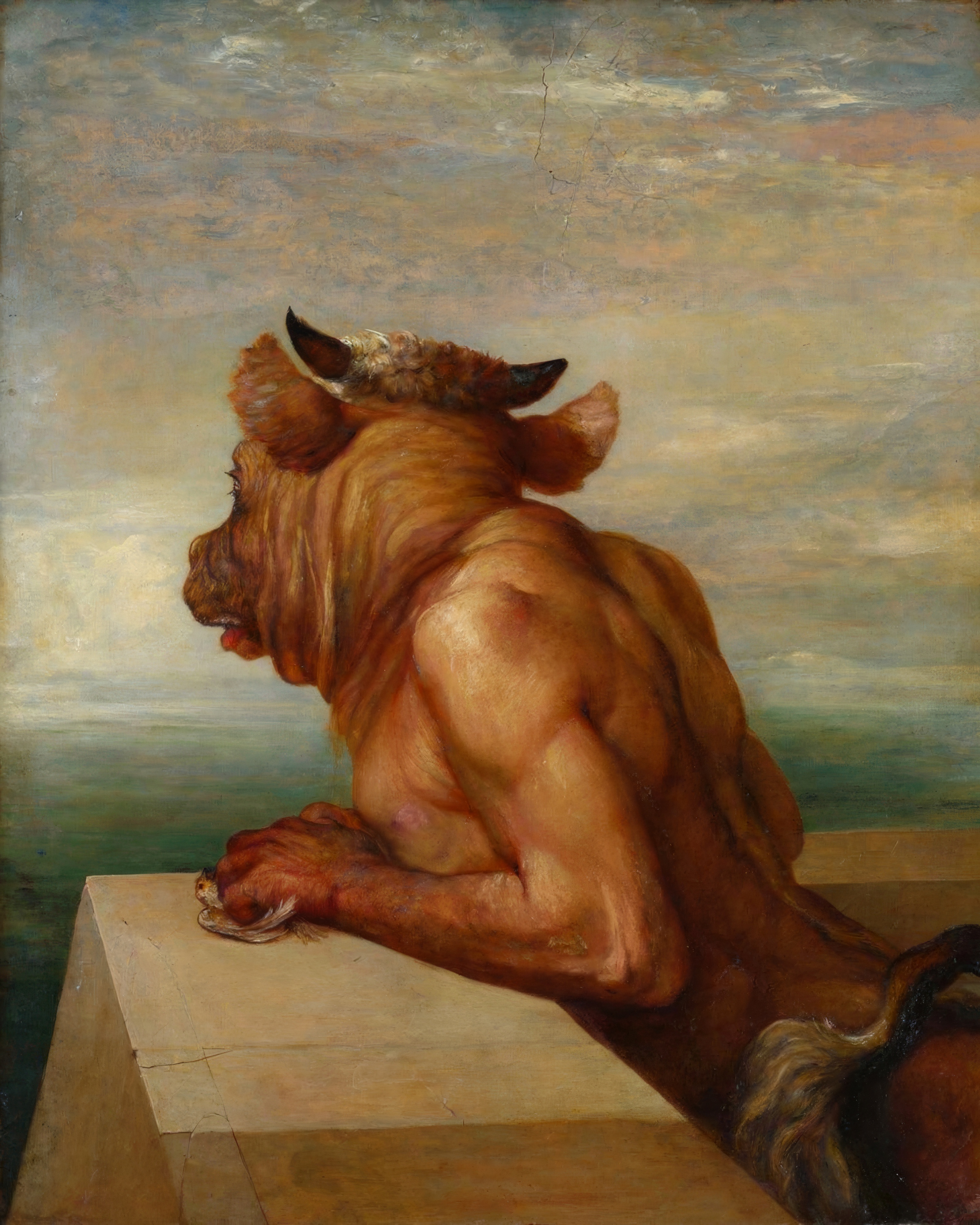
George Frederic Watts, The Minotaur, 1885. Oil on canvas. Tate, London.
G. F. Watts painted this in a single morning in 1885, in anger at the child abuse exposed by a newspaper campaign. The monster gazes out to sea waiting for his victims, and under his hand lies a crushed bird.
10. Frost
Hugo Simberg, Frost, 1895.
Hugo Simberg, Finland’s great symbolist, painted kindly devils and peasant spirits. Here Frost himself, a grinning sprite, crouches over the fields and breathes the cold that kills the crop. It is folklore and fear in one image.
11. Pan
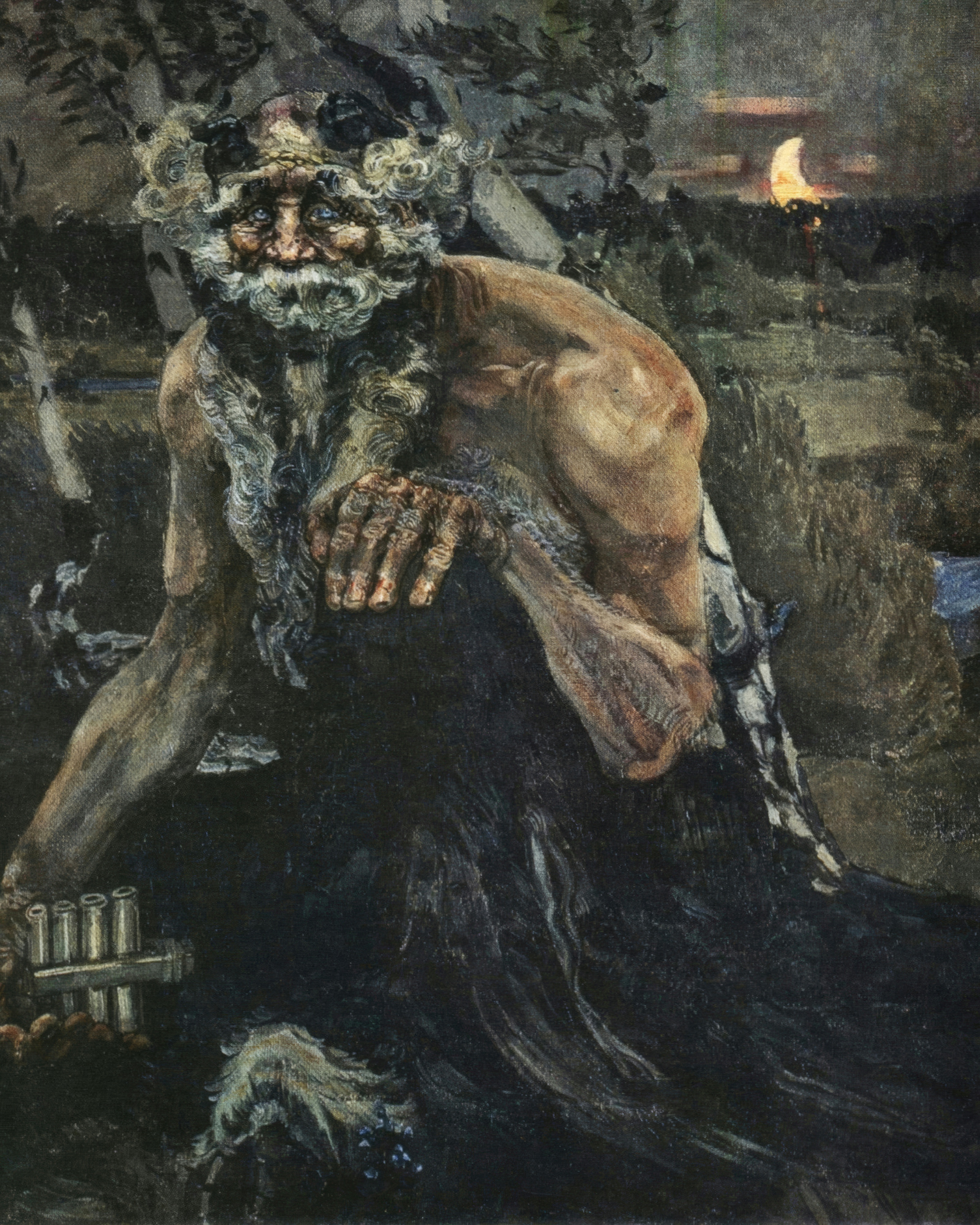
Mikhail Vrubel, Pan, 1899. Oil on canvas. State Tretyakov Gallery, Moscow.
Mikhail Vrubel painted Pan in 1899 not as a goat-legged satyr but as an old forest spirit, mossy and gnarled like a stump, with eyes the colour of the evening lake. He painted it in two days.
12. Gamayun, the Prophetic Bird
Viktor Vasnetsov, Gamayun, the Prophetic Bird, 1897.
In Russian folklore Gamayun is a prophetic bird with a woman’s face who knows the fate of the world. Vasnetsov, the great painter of Russian fairy tales, shows her singing her prophecy against a burning sky, her wings spread darkly.
13. Astarte Syriaca
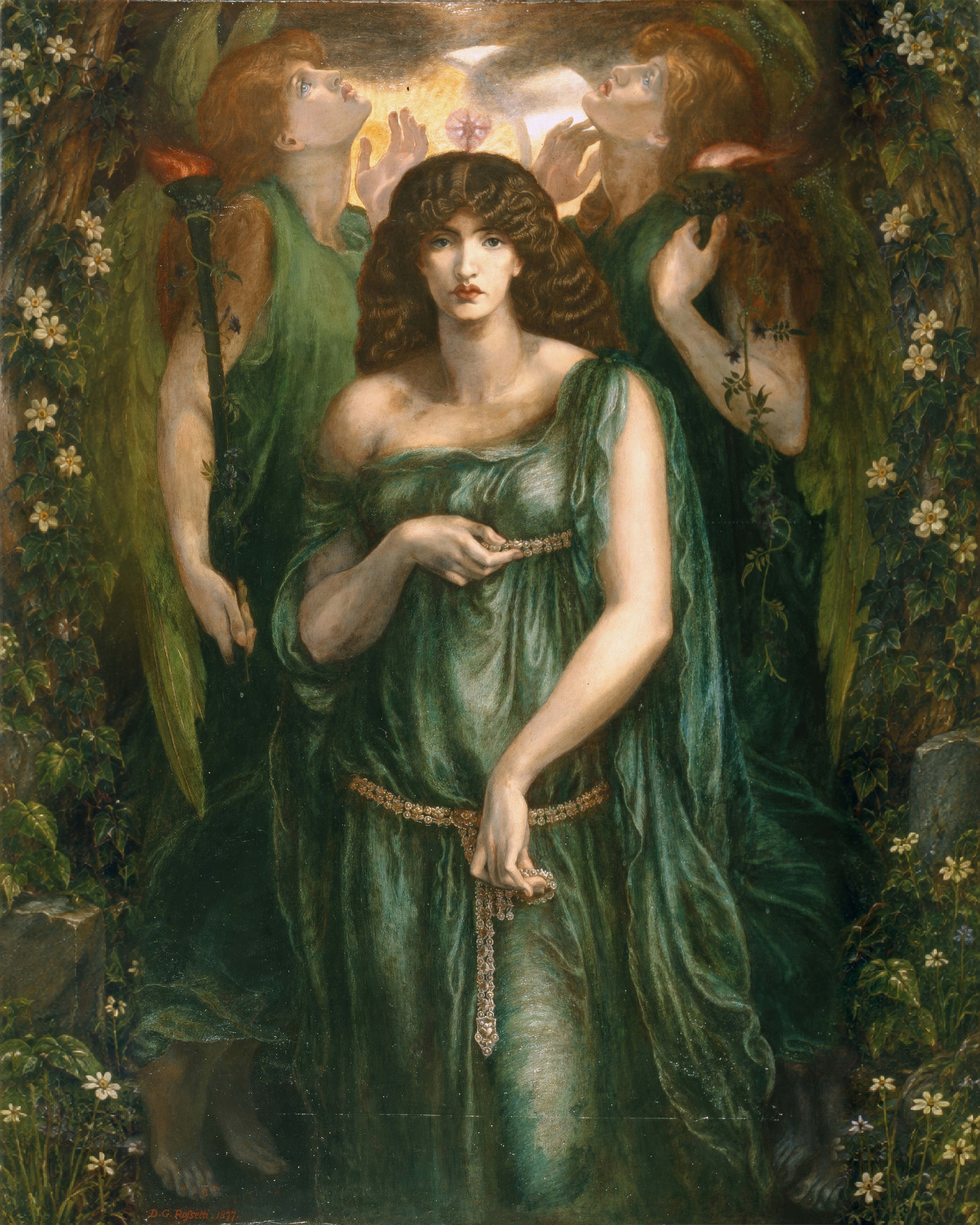
Dante Gabriel Rossetti, Astarte Syriaca, 1877. Oil on canvas. Manchester Art Gallery.
Rossetti’s largest late painting, of the Syrian goddess of love, with Jane Morris as model. Two attendants hold torches and the moon hangs behind her. It is the point where the Pre-Raphaelites turn into the symbolists.
14. The Questioner of the Sphinx
Elihu Vedder, The Questioner of the Sphinx, 1863. Oil on canvas. Museum of Fine Arts, Boston.
The American painter Elihu Vedder shows a wanderer in the desert pressing his ear to the mouth of a half-buried sphinx, hoping for the secret of life. Around him lie the bones of those who asked before. It made Vedder’s name in 1863.
15. The Water Sprite (Strömkarlen)
Ernst Josephson, The Water Sprite (Strömkarlen), 1884.
In Scandinavian folklore the Strömkarl is a water spirit who plays the fiddle so beautifully that anyone who hears him is lost. The Swedish painter Ernst Josephson made him his obsession, and the painting was refused by the Nationalmuseum when it was new; today it is a national treasure.
16. Siegfried and the Rhine Maidens
Albert Pinkham Ryder, Siegfried and the Rhine Maidens, 1888–91. Oil on canvas. National Gallery of Art, Washington.
Albert Pinkham Ryder painted this after hearing Wagner’s Götterdämmerung, working on it for days without sleep. Siegfried rides through a twisting, moonlit forest while the Rhine maidens warn him of his fate.
Symbolist art is not for every wall. It is for the walls you choose deliberately: a study, a library, a dark hallway, a bedroom you want to dream in. A single strong image, one unicorn or one sphinx, works better than a crowd. For the movement it grew out of, see Pre-Raphaelite paintings, and for more night and moonlight, moon art.
Questions
What is symbolism in art?
A movement of the 1880s and 1890s in which painters and poets expressed ideas, dreams and emotions through myth, allegory and strange, suggestive images instead of describing the visible world.
Who are the most famous symbolist painters?
Gustave Moreau, Odilon Redon and Pierre Puvis de Chavannes in France, Arnold Böcklin in Switzerland, Franz von Stuck in Germany, Ferdinand Hodler, Fernand Khnopff, Gustav Klimt and Edvard Munch, and Mikhail Vrubel in Russia.
Is Gustav Klimt a symbolist?
Yes. Klimt’s early work and the Vienna Secession grew directly out of symbolism, and his golden period is its most famous late flowering.
Where can I see Gustave Moreau’s paintings?
Above all at the Musée Gustave Moreau in Paris, his own house and studio, which he left to the French state with thousands of his works.