Pre-Raphaelite paintings: 12 works of myth and colour
Rossetti’s dreaming women, Burne-Jones’s enchantments, Sandys’s sorceresses and Waterhouse’s Circe: twelve Pre-Raphaelite works, the stories behind them and how to hang them.
In 1848 three young students at the Royal Academy in London, Dante Gabriel Rossetti, John Everett Millais and William Holman Hunt, formed a secret society. They called themselves the Pre-Raphaelite Brotherhood, because they believed art had gone wrong after Raphael and wanted to go back to the bright colour, sharp detail and sincerity of the painters before him.
The movement grew into something richer and stranger: medieval legends, Shakespeare, Greek myth and beautiful, brooding women with long hair. The twelve works below follow it from the 1850s to Waterhouse in the 1890s. Each can be ordered as a print prepared from the museum’s scan.
1. The Day Dream
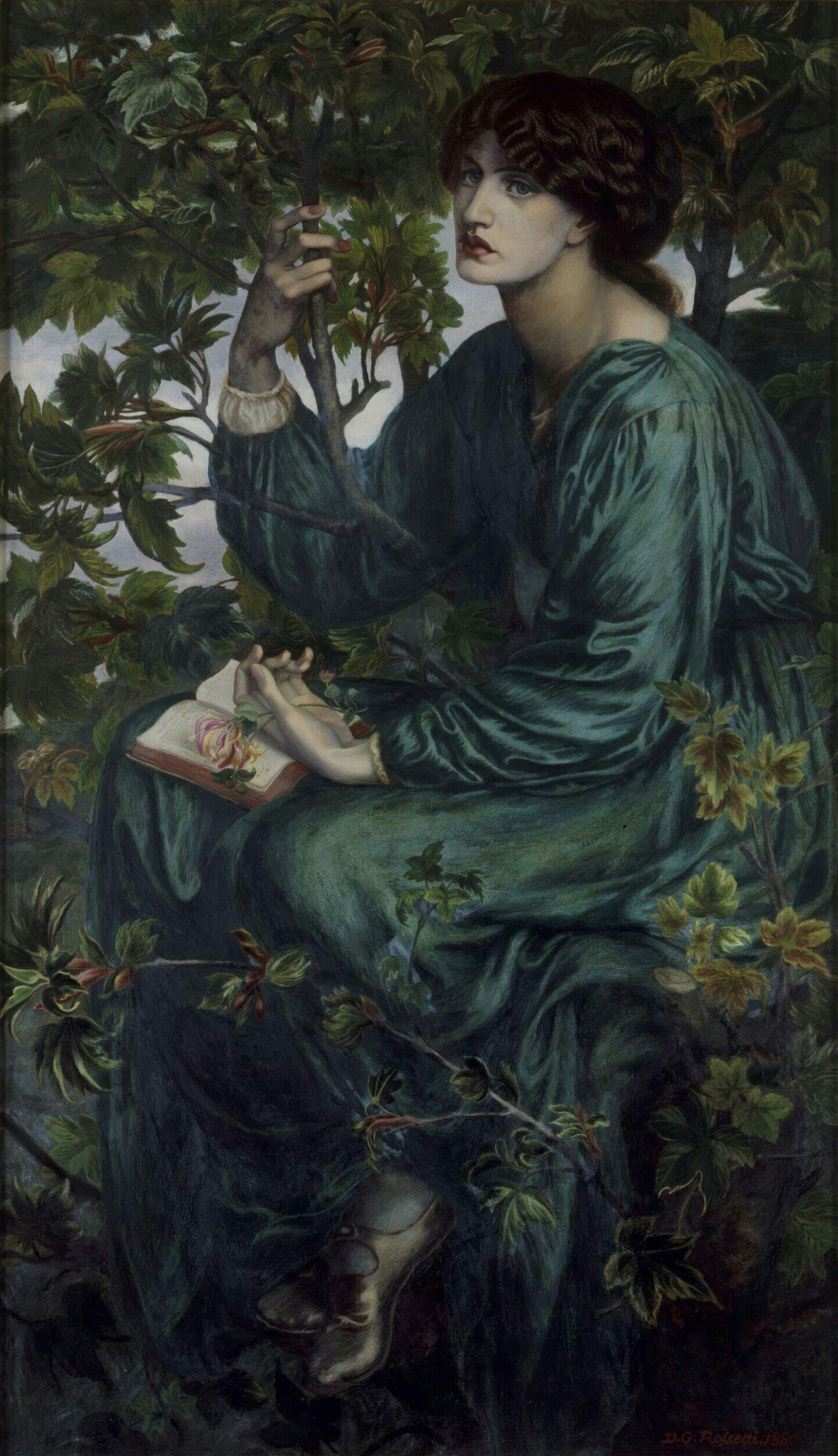
Dante Gabriel Rossetti, The Day Dream, 1880. Victoria and Albert Museum, London.
Rossetti’s last great painting. Jane Morris, the wife of his friend William Morris and the love of his later life, sits in a sycamore tree with a book forgotten in her lap and a sprig of honeysuckle in her hand. It is in the V&A, and it is everything the Pre-Raphaelites became: green, dreamy and full of longing.
2. A Sea-Spell
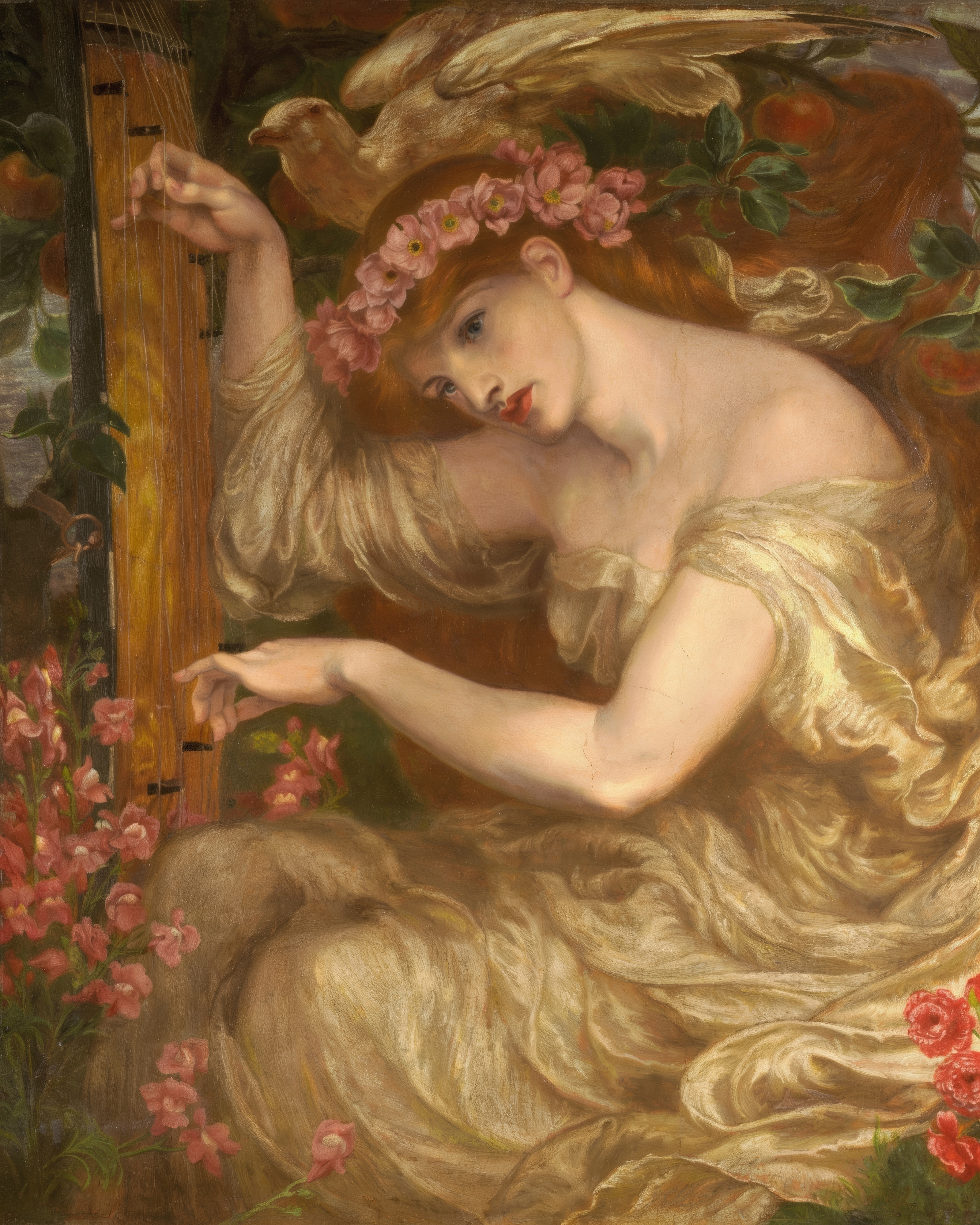
Dante Gabriel Rossetti, A Sea-Spell, 1875-1877. Oil on canvas. Harvard Art Museums.
A siren plays a lute hung in an apple tree, and a seabird comes to listen, spellbound. Rossetti’s model was Alexa Wilding, and the painting accompanies one of his own sonnets about music that lures sailors to their doom.
3. My Lady Greensleeves
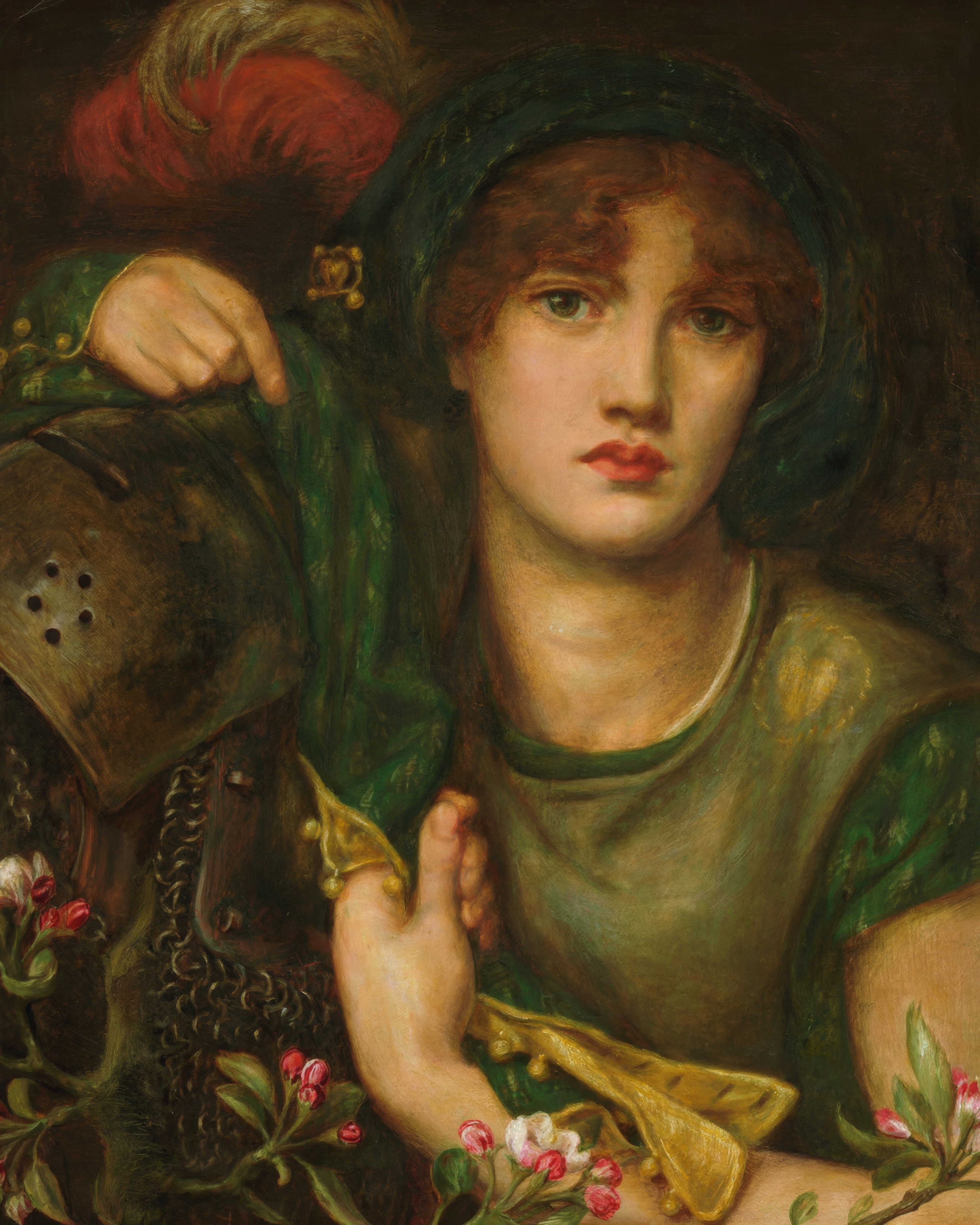
Dante Gabriel Rossetti, My Lady Greensleeves, 1863. Oil on panel. Harvard Art Museums.
A small panel of a woman in a green velvet dress, named after the Tudor song. It is from the moment, in the early 1860s, when Rossetti turned from medieval stories to close-up images of women in rich colour, the pictures for which he is now best known.
4. The Proscribed Royalist
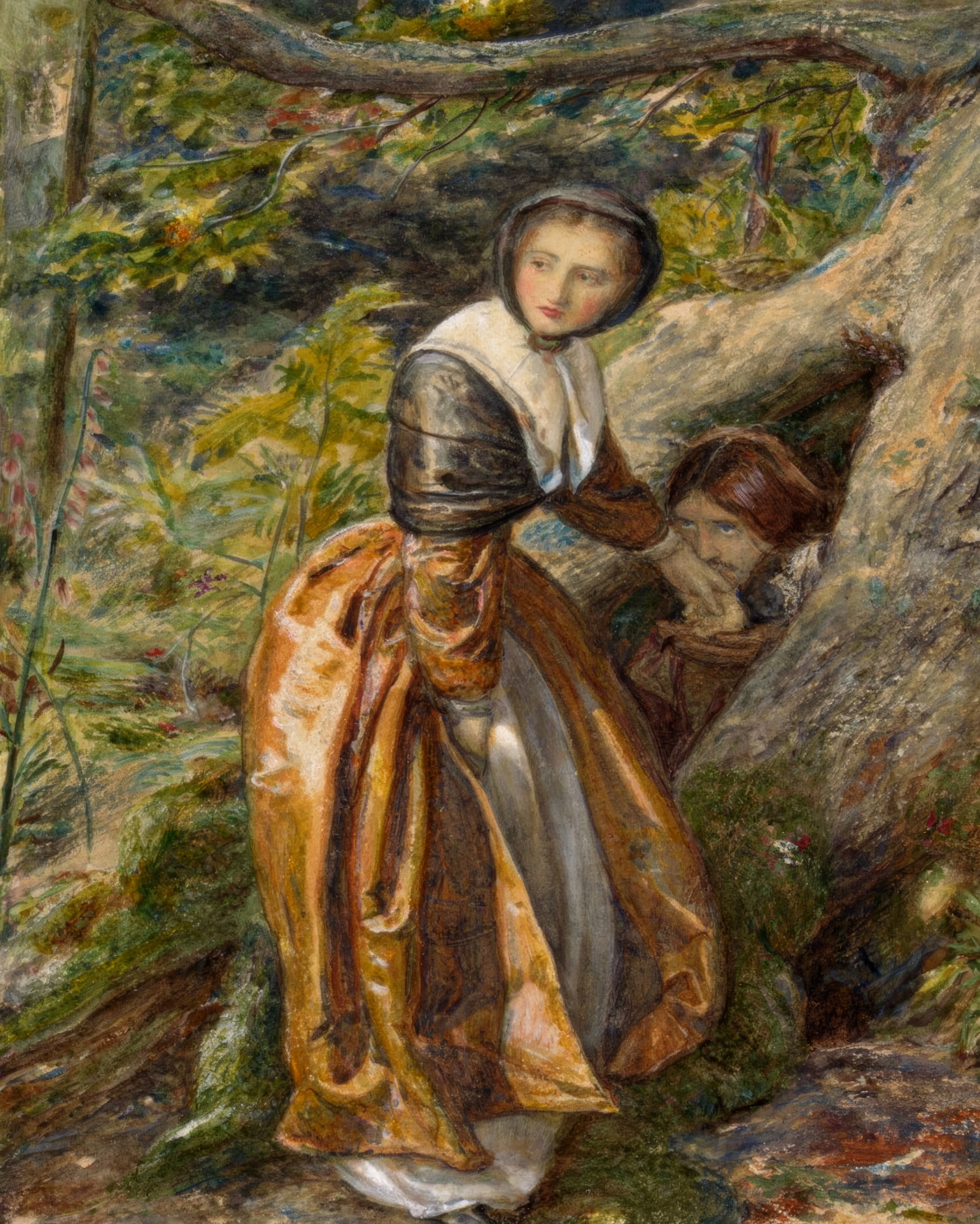
John Everett Millais, The Proscribed Royalist, 1864. Watercolor and white gouache on off-white wove paper. Harvard Art Museums.
Millais painted the story of a Puritan girl who secretly feeds a Royalist fugitive hiding in an oak tree during the English Civil War. This later watercolour repeats his famous oil of 1853, with every leaf and bramble drawn with Pre-Raphaelite precision.
5. Cordelia Parting from her Sisters
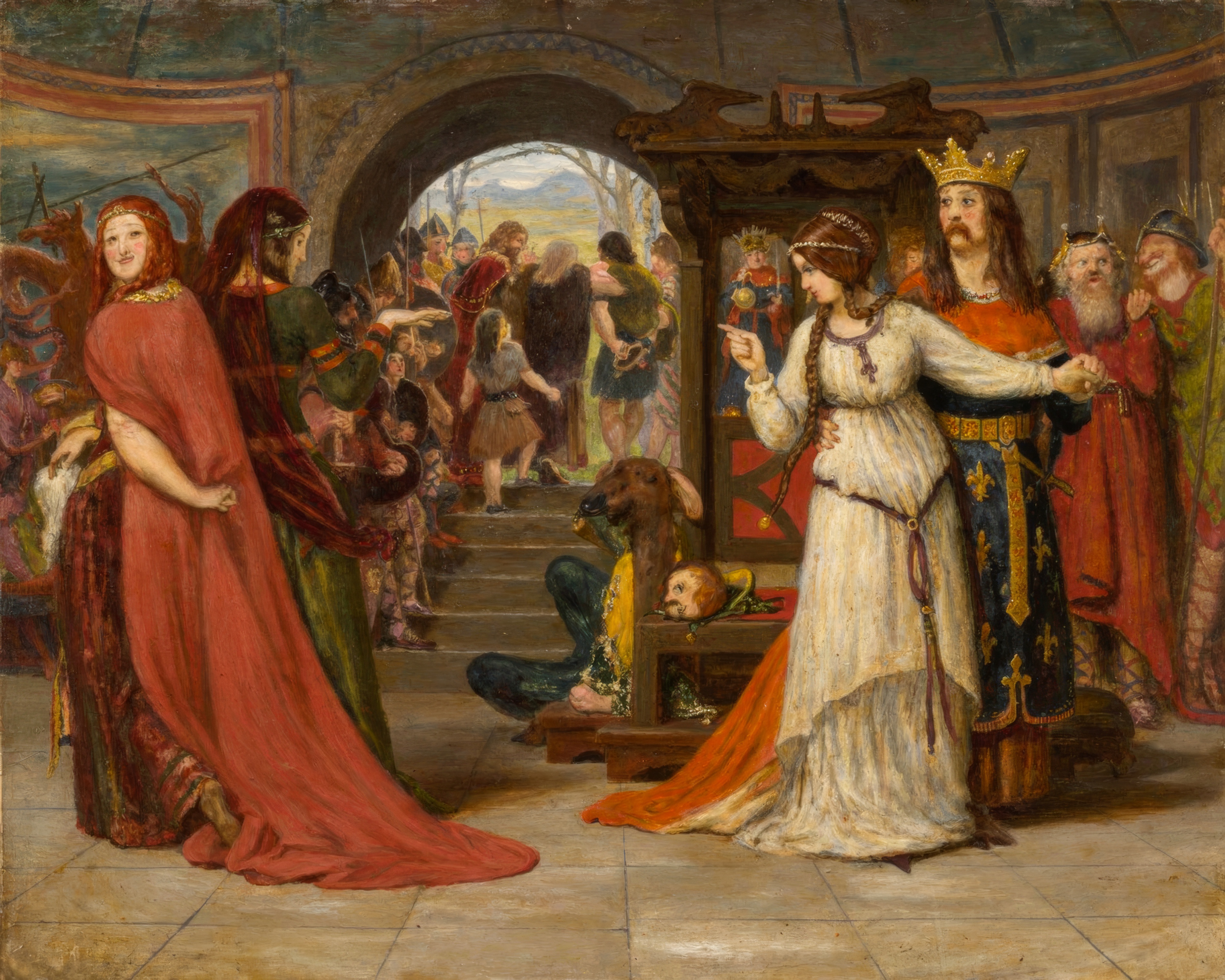
Ford Madox Brown, Cordelia Parting from her Sisters, 1854. Pen and oil on paper on panel. Cleveland Museum of Art.
Ford Madox Brown was the Brotherhood’s older mentor. From King Lear, he shows the moment Cordelia, disinherited for her honesty, leaves her two flattering sisters. The colour is jewel-bright and the faces are full of feeling.
6. The Beguiling of Merlin
Edward Burne-Jones, The Beguiling of Merlin, 1872–77. Oil on canvas. Lady Lever Art Gallery, Port Sunlight.
From the Arthurian legend: the enchantress Nimue reads a spell from Merlin’s own book, and the great wizard sinks helpless into a hawthorn bush. Burne-Jones worked on it for five years, and the swirling blue-grey drapery is one of the most beautiful passages in Victorian painting.
Shown in a room, it holds a large wall the way a tapestry would.
7. The Doom Fulfilled
Edward Burne-Jones, The Doom Fulfilled, 1888. Gouache on paper. Southampton City Art Gallery.
One of Burne-Jones’s Perseus series, painted for the future prime minister Arthur Balfour. The hero fights the serpent in coils so tight that knight and monster become a single pattern of steel and scale, while Andromeda waits, pale, on the rocks.
8. Morgan-le-Fay
Frederick Sandys, Morgan-le-Fay, 1864. Oil on panel. Birmingham Museum and Art Gallery.
Frederick Sandys painted women of dangerous power. Morgan le Fay, King Arthur’s half-sister, weaves a poisoned cloak at her loom, wrapped in a leopard skin, among the props of her magic.
Create your portrait in this style
9. Medea
Frederick Sandys, Medea, 1866–68. Oil on wood panel. Birmingham Museum and Art Gallery.
The Royal Academy refused this painting in 1868, and the Pre-Raphaelites protested. Medea, the sorceress of Greek myth, prepares her poison against a gold background painted with Jason’s ship, with toads and charms at her feet.
Shown in a room, the gold background glows even across a large wall.
10. The Sea Maidens
Evelyn De Morgan, The Sea Maidens, 1885–86. Oil on canvas. De Morgan Foundation.
Evelyn De Morgan was one of the most original painters of the later movement, and a committed suffragist. Her sea maidens rise through turquoise waves in a rhythm like music. It belongs to the De Morgan Foundation, set up by her sister to keep her work together.
11. The Magic Circle
John William Waterhouse, The Magic Circle, 1886. Oil on canvas. Tate, London.
Waterhouse painted this for the Royal Academy in 1886, and Tate bought it at once. A sorceress draws a magic circle in the dust with her wand; inside it, smoke rises from a cauldron, and outside, ravens and a frog keep their distance.
12. Circe Invidiosa
John William Waterhouse, Circe Invidiosa, 1892. Oil on canvas. Art Gallery of South Australia, Adelaide.
Circe, in jealousy, poisons the water where her rival Scylla bathes, turning her into a monster. Waterhouse makes the poison a pool of luminous green spreading through the sea around her feet.
Create your portrait in this style
Pre-Raphaelite pictures are jewel-toned and full of detail, so they reward a close look. Hang them where you pass slowly: a bedroom, a reading room, a staircase. A pair of Rossetti women either side of a bed or a fireplace is a classic arrangement. For the movement that grew out of theirs, see symbolism art, and for more myths, romanticism paintings.
Questions
What is Pre-Raphaelite art?
Art made by the Pre-Raphaelite Brotherhood, founded in London in 1848 by Rossetti, Millais and Holman Hunt, and by the painters who followed them. It is known for brilliant colour, close detail, medieval and literary subjects, and romantic images of women.
Who are the most famous Pre-Raphaelite painters?
Dante Gabriel Rossetti, John Everett Millais, William Holman Hunt, Edward Burne-Jones, Ford Madox Brown, Frederick Sandys, Evelyn De Morgan and, in the next generation, John William Waterhouse.
Who were the Pre-Raphaelite models?
Elizabeth Siddal, Jane Morris, Fanny Cornforth and Alexa Wilding were the most famous. Jane Morris, wife of William Morris, sat for Rossetti’s The Day Dream.
Is Waterhouse a Pre-Raphaelite?
Not a member of the Brotherhood, but its most famous heir. He painted Pre-Raphaelite subjects from the 1880s to the 1910s, and is often called the modern Pre-Raphaelite.