Berthe Morisot and the space around a person
Berthe Morisot makes a mirror, a garden and a dining room feel inhabited. Look closely at three paintings and their shifting edges.
Berthe Morisot gives the space around a person almost as much life as the person herself. In Woman at Her Toilette, a bare shoulder turns towards a mirror while pale marks flicker across the room. The figure is recognisable, yet the painting never settles into a collection of neatly enclosed objects. Looking moves between skin, fabric, reflection and paint.
Morisot participated in the first Impressionist exhibition in 1874. That places her inside the movement’s founding history, not at its margins. The Impressionist paintings story introduces the broader company; these three pictures offer a closer encounter with her particular handling of a room, a garden and the people who occupy them.
A figure who does not turn to meet us
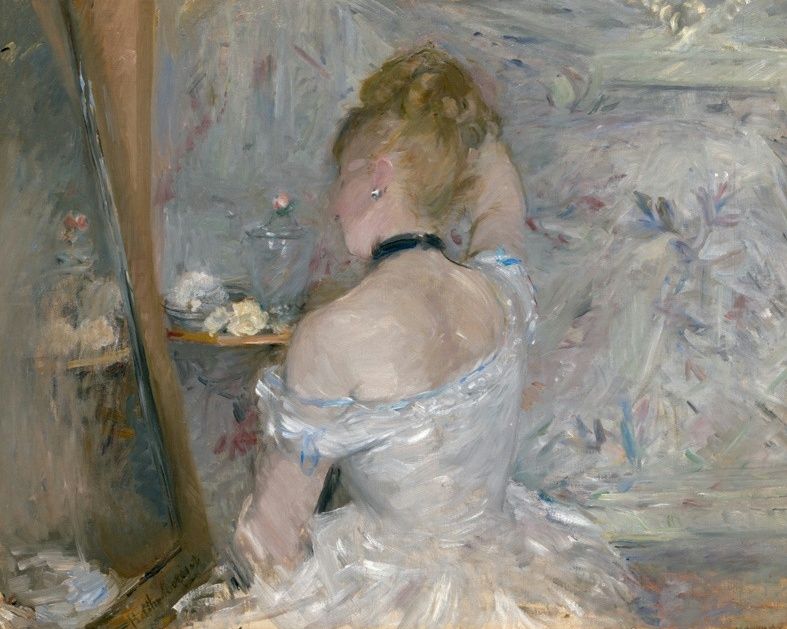
Woman at Her Toilette · Berthe Morisot, 1875–80 · Art Institute of Chicago. Restored by Surrealium at Vaxholm Fortress, Sweden.
The woman in Woman at Her Toilette, dated 1875–80, sits with her back partly towards the viewer. Her dark neck ribbon gives the eye a small, decisive point of contrast. Around it, the shoulder and pale dress are more broadly described. She belongs to an activity already underway; she has not arranged herself to greet someone entering the picture.
The mirror does something less straightforward than supply a second portrait. Its angled edge makes a firm boundary at the left, but the reflected space remains broken and uncertain. We can understand the room without accounting for every object in it. The painting gives enough information for recognition and leaves the rest open to looking.
Try following the outer edge of the dress. In some places it stands apart from its surroundings; in others, similar pale colours carry across the boundary. That alternation makes the person feel present without making her appear cut out and placed in front of a backdrop. Her body has weight, but the surrounding air has movement.
What the unfinished-looking edges accomplish
Loose handling is often described as a way of catching a fleeting moment. Here it also controls attention. A line strong enough to identify the back of a chair need not have the same strength as a line describing a shoulder. Morisot can make one part clear and allow another to dissolve, keeping the viewer’s eye in motion.
This is different from saying that the picture was casually made. A finished painting can deliberately preserve broken marks and unresolved edges. Nothing in a reproduction tells us exactly how long a passage took, and visible liveliness is not a stopwatch. What we can judge is the result: dark accents are scarce, pale colours have room to spread, and detail is concentrated rather than evenly distributed.
Stand back from the image, then return to it. At a distance the figure holds together. Up close, the room becomes a network of strokes. Both readings remain available, and neither cancels the other. That is part of the painting’s pleasure: it does not require us to choose between seeing a person and noticing a painted surface.
The garden is an active setting
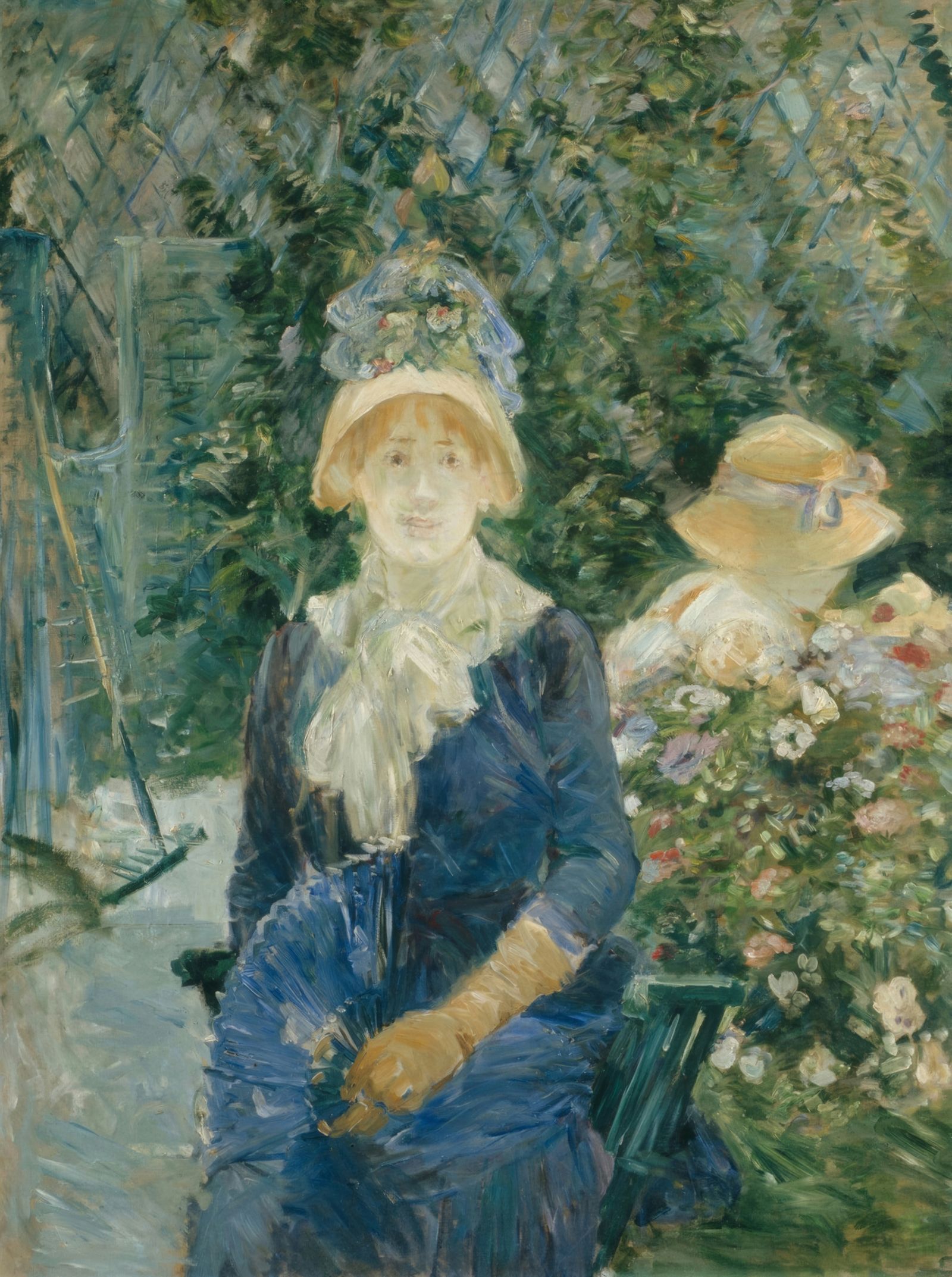
Woman in a Garden · Berthe Morisot, 1882–83 · Art Institute of Chicago. Restored by Surrealium at Vaxholm Fortress, Sweden.
In Woman in a Garden, the blue dress has a much stronger colour presence. The seated figure faces towards us, while another figure, largely hidden by a broad hat, occupies the space behind. Leaves, flowers and the trellis build a dense setting. The garden is not a neutral stage on which a portrait has been placed.
The upright lines behind the woman matter because so much around them is irregular. Against the shifting leaves and patches of light, the trellis gives the composition a loose scaffold. Her hands offer a quieter stopping point near the lower centre. You can move from that pause back into the scattered marks above her head.
There is no need to identify every bloom to enjoy the arrangement. The meaningful contrast is between a sustained human presence and surroundings that appear restless. Compared with the turned figure at the dressing table, this woman seems more directly available to our gaze. Yet the busy space prevents the encounter from becoming a formal presentation against an empty ground.
Private scenes still make public pictures
These settings can tempt us to treat Morisot’s work as a diary opened without permission. A painting, however, is a composition made for other people to see. Domestic subject matter does not guarantee that we are witnessing an unplanned event, nor does an informal pose tell us exactly what the sitter was thinking.
It is more useful to ask how the picture arranges access. The woman at her toilette turns away. The garden figure faces out. One room gives us a mirror that complicates our position; another setting places foliage between distinct human presences. Those choices shape our relationship with the people depicted, without requiring an invented story about their mood.
The Musée d’Orsay’s account of Morisot’s toilette scenes places them within contemporary conventions of private dress and public display. That history helps explain why such an ordinary activity could be a substantial artistic subject. It also sharpens the act of looking: a quiet interior can contain questions about who is seen, how they are seen and what the painter chooses to withhold.
A dining room held together by colour
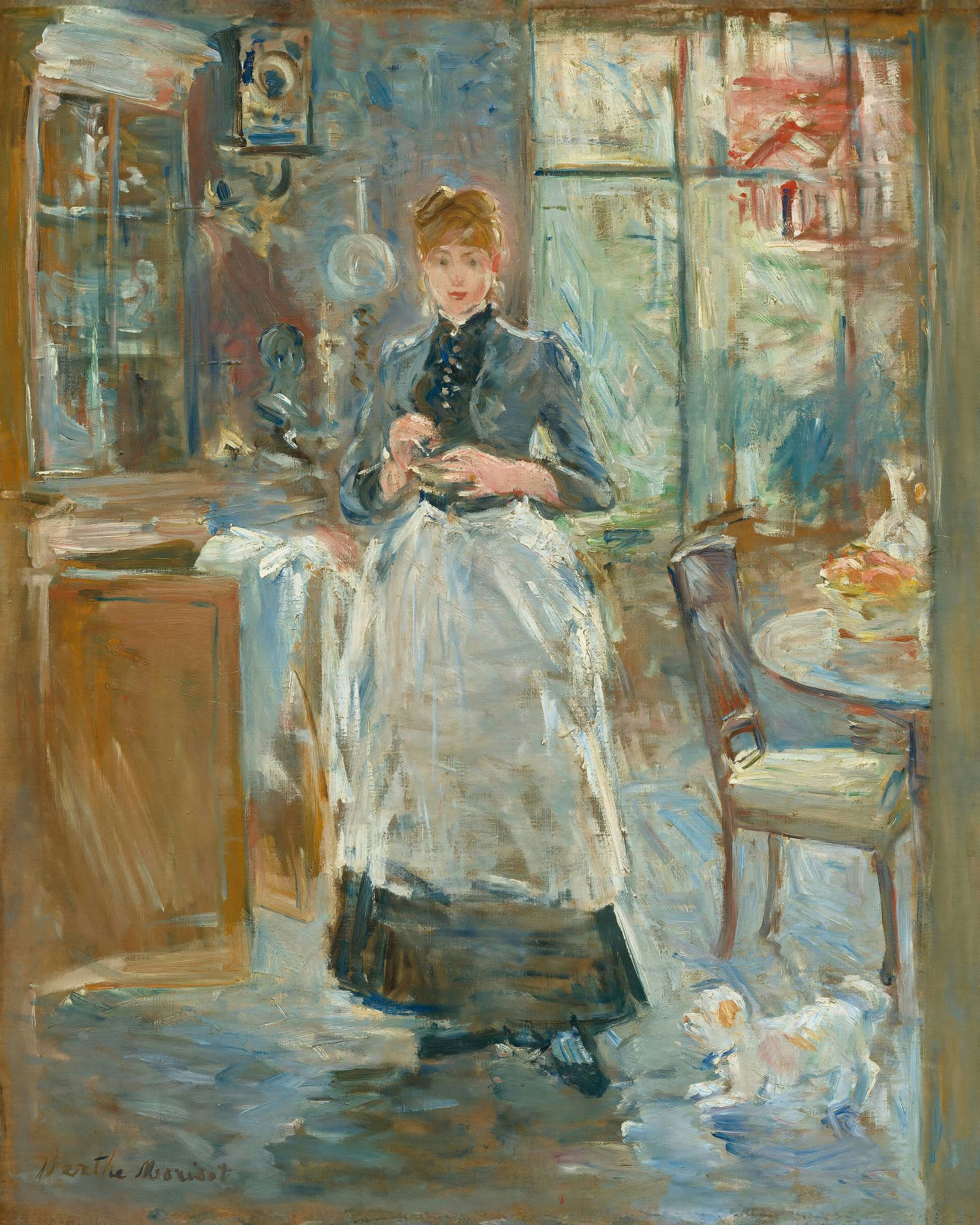
In the Dining Room · Berthe Morisot, 1886 · National Gallery of Art, Washington. Prepared for print by Surrealium at Vaxholm Fortress, Sweden.
In the Dining Room, dated 1886, makes the setting more legible. A woman stands before a glazed cabinet; a table enters from the right, and a small dog occupies the floor. Furniture, dress and room share a range of blue, green and warm brown notes. The upright body is surrounded by other verticals, yet the paint keeps those repeated forms from becoming rigid.
The white apron is a broad area of light near the middle. It helps establish the figure immediately, even when the smaller objects take longer to read. Around it, reflections in the cabinet and marks on the floor keep the room active. No single descriptive passage needs to explain the entire interior.
Compare the dog’s low position with the woman’s face. Their separation stretches our attention through the picture’s height. The space feels inhabited at more than one level, by more than one kind of presence. It is a small observation, but one that distinguishes this scene from a portrait in which the surroundings merely identify the sitter’s possessions.
Three ways of making room for a person
Seen together, these paintings offer three different relationships between a figure and a setting. The toilette scene joins the woman to a pale, wavering interior. The garden sets a strong blue dress against restless growth. The dining room folds an upright figure into the repeated lines and reflections of furniture. Morisot does not need a single formula for intimacy.
A comparison with James Tissot makes those choices clearer. His precisely described clothing can turn a sleeve or hem into an instrument of narrative. Morisot often lets the boundary of a garment become uncertain. Both painters can make an ordinary pose matter, but they distribute emphasis differently. Fantin-Latour’s still lifes offer a further comparison in how objects hold their place against a quieter ground.
For a print, consider which relationship you want to keep returning to: a turned shoulder, a direct encounter in a garden, or a person absorbed into the activity of a room. Look at the whole composition before concentrating on the face. Much of Morisot’s character lives in the spaces that a tight portrait crop would remove.
Return to the Impressionist collection with those edges in mind. Morisot rewards a second look because the person remains clear while the space around her keeps changing its emphasis. Choose the whole painting that holds your attention, including its pauses, its oblique lines and the small areas it leaves unresolved.
- Was Berthe Morisot an Impressionist?
- Yes. Morisot took part in the first Impressionist exhibition in 1874. Her broken brushwork and attention to contemporary life belong to that history, although each painting deserves more than a movement label.
- Which Morisot paintings are shown here?
- Woman at Her Toilette, Woman in a Garden and In the Dining Room. The captions identify their dates and holding collections. They are three distinct works, not variations of one portrait.
- Does loose brushwork mean a painting is unfinished?
- Not necessarily. Broken edges and selective detail can be deliberate features of a completed composition. These images support a discussion of their visible effect, not a claim about how quickly each passage was painted.