James Tissot and the story held in a gesture
James Tissot makes clothing, hands and thresholds carry a story. Compare a farewell at a gate with the suspended afternoon of Seaside.
James Tissot can make two joined hands carry the weight of an entire scene. In Les Adieux, a couple stand on opposite sides of an iron fence. Their clothing is carefully described, but the point of contact is small. The picture holds them close while the setting insists on separation.
That ability to make a gesture matter also appears in a quieter form in Seaside. Fable’s essay on July: Specimen of a Portrait considers that painting individually. Bringing it beside the farewell, and then beside a clearly identified Renoir comparison, reveals how Tissot moves between narrative tension and the more open experience of a person passing an afternoon.
The fence gives the farewell its shape
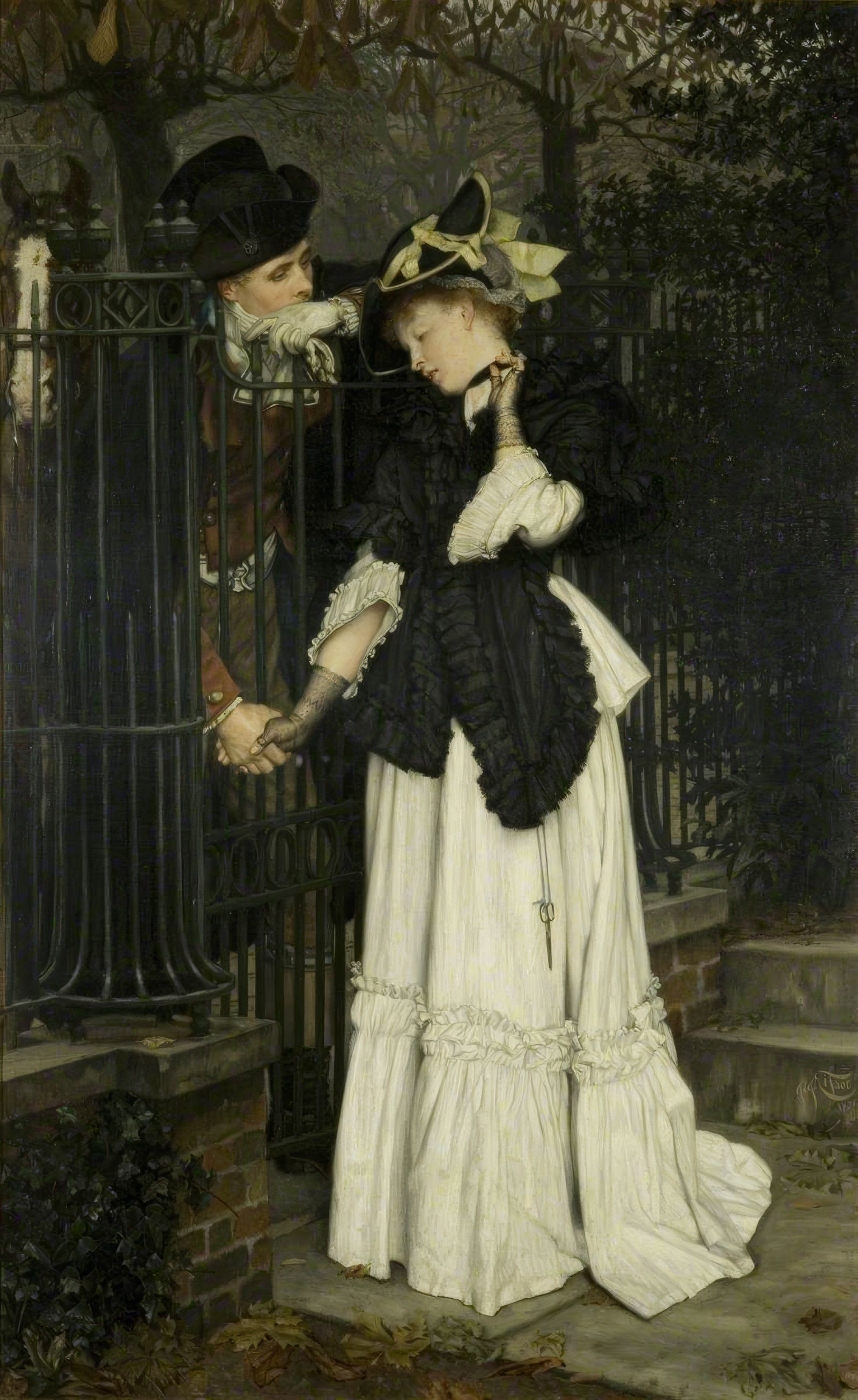
Les Adieux (The Farewells) · James Tissot, 1871 · Bristol Museum and Art Gallery. Prepared for print by Surrealium at Vaxholm Fortress, Sweden.
Les Adieux, or The Farewells, dates from 1871. Bristol Museums identifies it as an early work from Tissot’s time in London, after his move from Paris. The woman occupies most of the foreground, while the man remains behind the fence. Their heads incline towards one another, and their hands meet through an opening lower down.
The ironwork is more than a prop with an easily translated meaning. It creates a series of narrow divisions across the image. We can see through it, but the people cannot simply stand together within the space it occupies. That visible difference between looking and touching gives the scene much of its force.
The woman’s pale skirt extends almost to the lower edge. Against the dark coat, fence and foliage, it establishes a broad area of light. The viewer notices her first, then follows the smaller movements towards the man. A public arrangement of clothing and garden furniture becomes the setting for a private exchange.
Description can make a scene less certain
The precision of a painted dress can encourage us to believe that everything else in the picture is equally knowable. Yet the farewell leaves important questions unanswered. We do not know the words being spoken, how long the separation will last, or what brought the couple to this gate. The title and the gesture give a situation, not a complete biography.
Bristol Museums discusses the fence and the scissors at the woman’s waist as images of separation. That reading offers a useful historical interpretation of the details. It need not turn every fold or leaf into a code. Some parts of the picture establish material richness and rhythm rather than supplying another hidden message.
Look at the difference between the long verticals of the fence and the irregular outlines of the clothing. The people seem momentarily caught within a firmer structure. Their hands cross that division, but their bodies remain apart. Even without deciding what each accessory symbolises, the composition makes the difficulty of parting visible through the placement of ordinary things.
An afternoon without an obvious next event
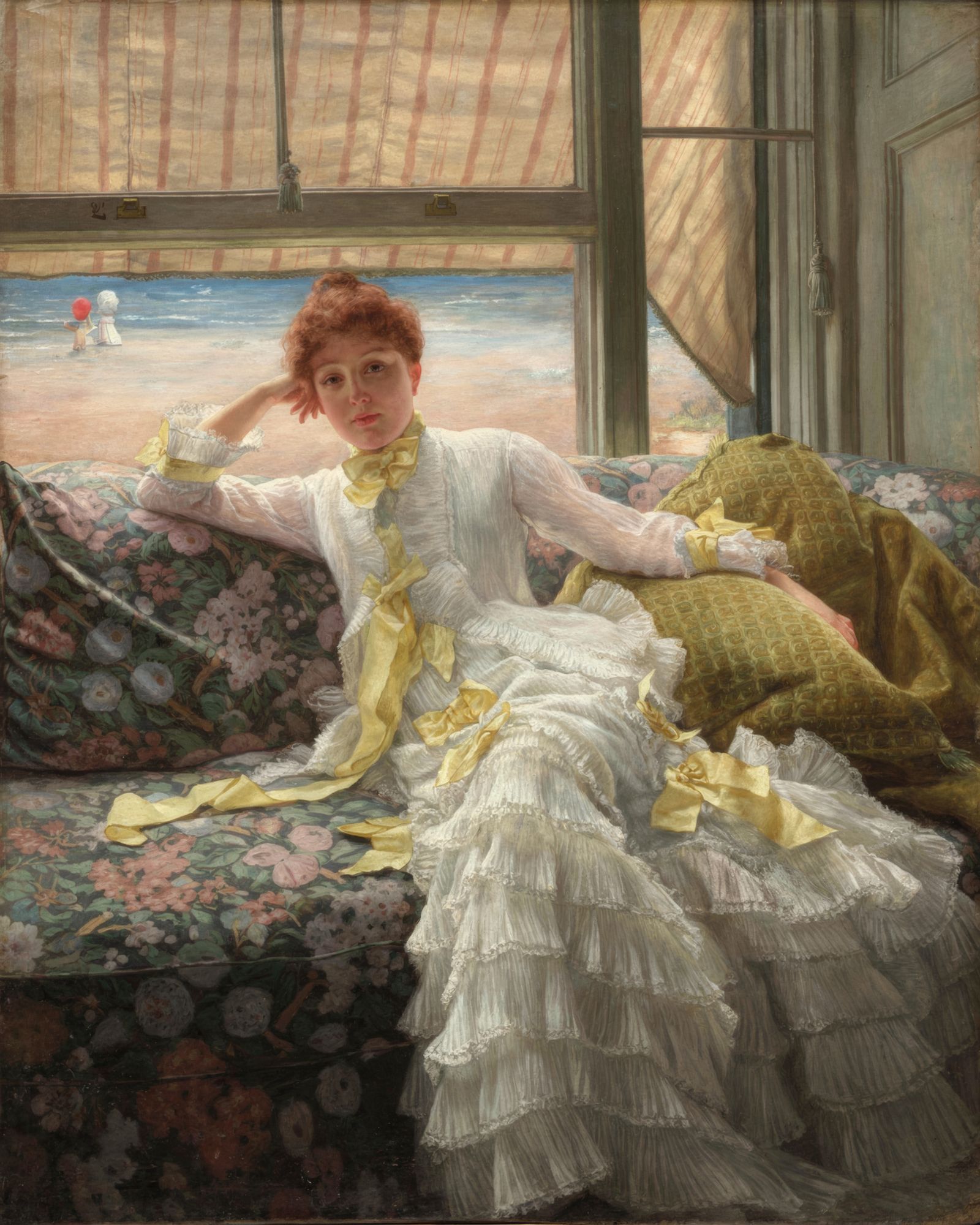
Seaside (July: Specimen of a Portrait) · James Tissot, 1878 · Cleveland Museum of Art. Restored by Surrealium at Vaxholm Fortress, Sweden.
Seaside, also titled July: Specimen of a Portrait, painted in 1878, replaces the gate with an interior beside a window. A woman reclines on a patterned sofa. Her pale dress, yellow ribbons and relaxed arms spread through the lower part of the image, while an awning and a glimpse of shore establish the setting behind her.
The Cleveland Museum of Art identifies the sitter as Kathleen Newton. That identification supplies a historical fact, but it does not tell us exactly what she feels in this painted moment. Her pose can sustain several impressions: ease, waiting, attention directed outwards. The picture is stronger when those possibilities remain available.
The sofa pattern and the dress compete gently for our eye. One offers repeated floral shapes; the other gathers into folds and ribbons. Above them, the more open band of beach and water gives a different scale of space. The room is close and materially dense, while the world beyond the window remains comparatively distant.
Clothing connects a body to its surroundings
Across the two Tissots, clothes occupy a great deal of the visible surface. In Les Adieux, the pale skirt makes a long upright shape beside the fence. In Seaside, the dress spreads into a wider, more relaxed arrangement across the sofa. The garment changes how the body fits the composition.
This is why fashion detail can be central to the painting rather than an ornamental extra. A sleeve helps establish the angle of an arm. A bow adds a bright interruption. A hem carries the figure towards the edge of the canvas. These are visual functions as well as records of clothing.
Compare the spaces immediately around the hands. At the gate, contact between two people gathers the narrative. On the sofa, the arms extend into separate areas of the furniture, helping the figure inhabit the room. Tissot makes different kinds of relationship visible through those placements. We can follow the gestures without assuming that detailed dress makes the scene superficial or that an intimate subject must be loosely painted.
Renoir offers another kind of contact
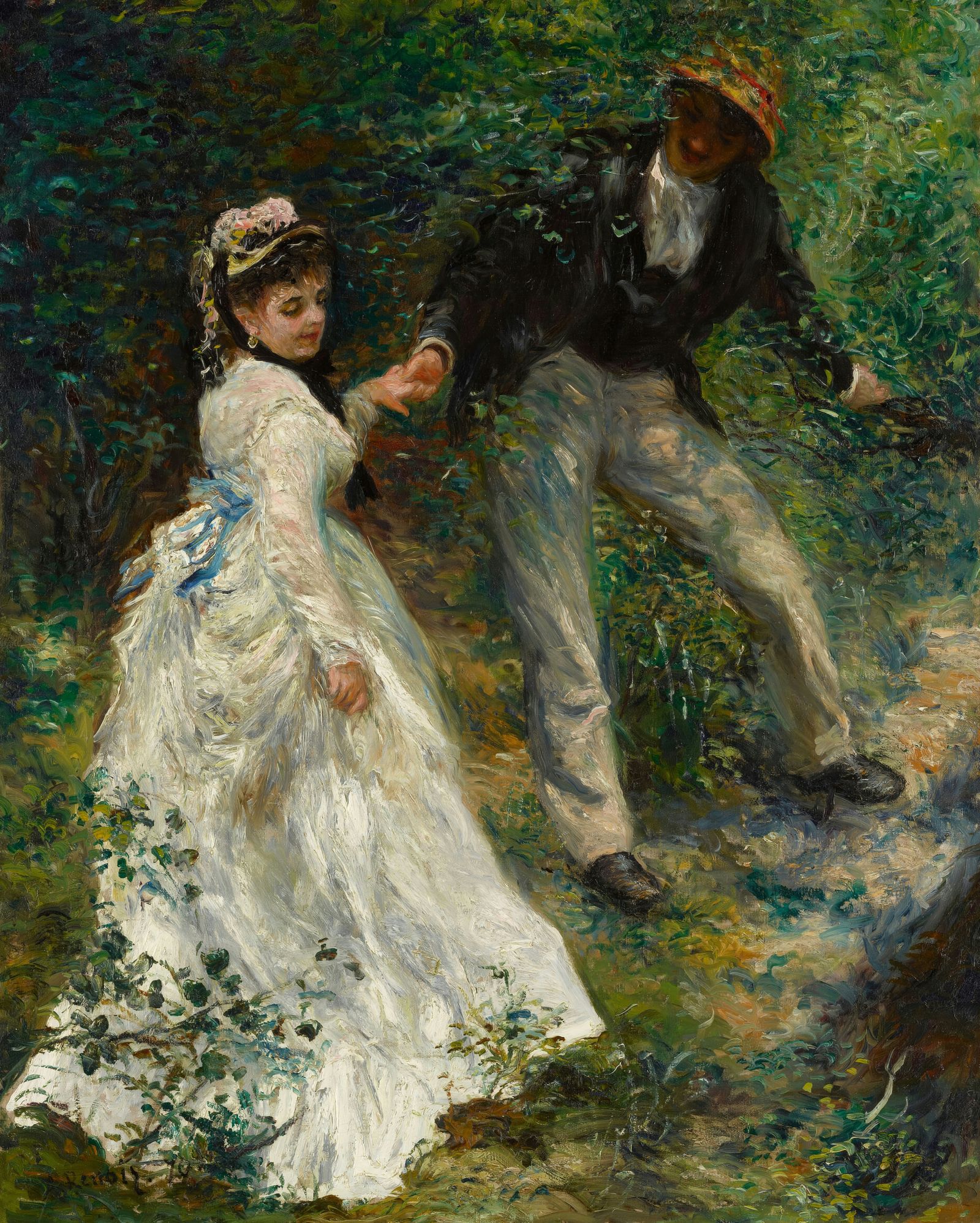
La Promenade · Pierre-Auguste Renoir, 1870 · J. Paul Getty Museum, Los Angeles. Prepared for print by Surrealium at Vaxholm Fortress, Sweden.
The third painting here is La Promenade, by Pierre-Auguste Renoir, not Tissot. A man extends a hand towards a woman on a leafy path. Her pale dress occupies the foreground, while foliage fills the surrounding space. The offered hand suggests movement through the landscape rather than a pause at a boundary.
Putting it beside Les Adieux makes the difference between the gestures clear. Tissot’s couple maintain contact across a barrier. Renoir’s figures appear connected by the possibility of moving together. Neither picture needs a large action to create a relationship; the direction of an arm and the ground beneath the figures do much of the work.
The paint also gives the settings different kinds of activity. Renoir’s leaves and light break into a shifting field around the couple. Tissot’s fence remains a more explicit structure. The Renoir couples story extends that comparison across his encounters. This comparison does not make one painter freer or more truthful than the other. It shows how two artists can organise an encounter around different kinds of space.
A narrative can remain open
The useful question is not always what happens next. Sometimes it is what the painting allows to remain unresolved. The farewell carries the possibility of departure without showing it. The seaside portrait suspends a person within an afternoon. Both have enough visible structure to hold our attention without supplying a final sentence to the story.
Berthe Morisot’s figures and interiors offer another comparison in how a painter arranges access to a person. Her edges often dissolve into their surroundings; Tissot tends to give a sleeve, fence or cushion a more definite presence. These differences change our experience of intimacy as much as the subject itself does.
If choosing a print, look first at the gesture you return to, then at the space that gives it meaning. The clasped hands need the gate. The reclining figure needs the sofa, window and narrow view outside. A whole painting preserves those relationships and lets the scene remain more than an isolated face or a beautiful piece of clothing.
Explore the nineteenth-century works in the Impressionist collection, keeping each painter’s method distinct. Tissot’s strength here lies in the relation between precise things and incomplete stories. A dress, a gate and a pair of hands can be clearly visible while the human situation continues to invite another look.
- Who painted Les Adieux?
- James Tissot painted Les Adieux, also called The Farewells, in 1871. The work is held by Bristol Museum and Art Gallery. The painting shown here is that farewell scene.
- Who is the woman in Seaside?
- The Cleveland Museum of Art identifies her as Kathleen Newton. That identification does not establish a single emotion or private thought for the moment represented in the painting.
- Is La Promenade also by Tissot?
- No. The comparison image is Pierre-Auguste Renoir’s La Promenade. It is included to compare an offered hand on a path with Tissot’s contact across a fence, and is labelled accordingly.