Paintings of farewell: eight lovers parting, from Verona to the railway
A soldier at the door, a knight's shadow on a wall, two hands through a garden railing. Eight farewells in art, and the stories behind them.
Painters have always known that a parting tells a love story better than a wedding does. The farewell shows what is at stake: the war, the voyage, the family, the law that stands between two people. In these eight paintings the lovers are about to be separated, and the painter has caught the last second before they are.
1. Les Adieux (The Farewells)
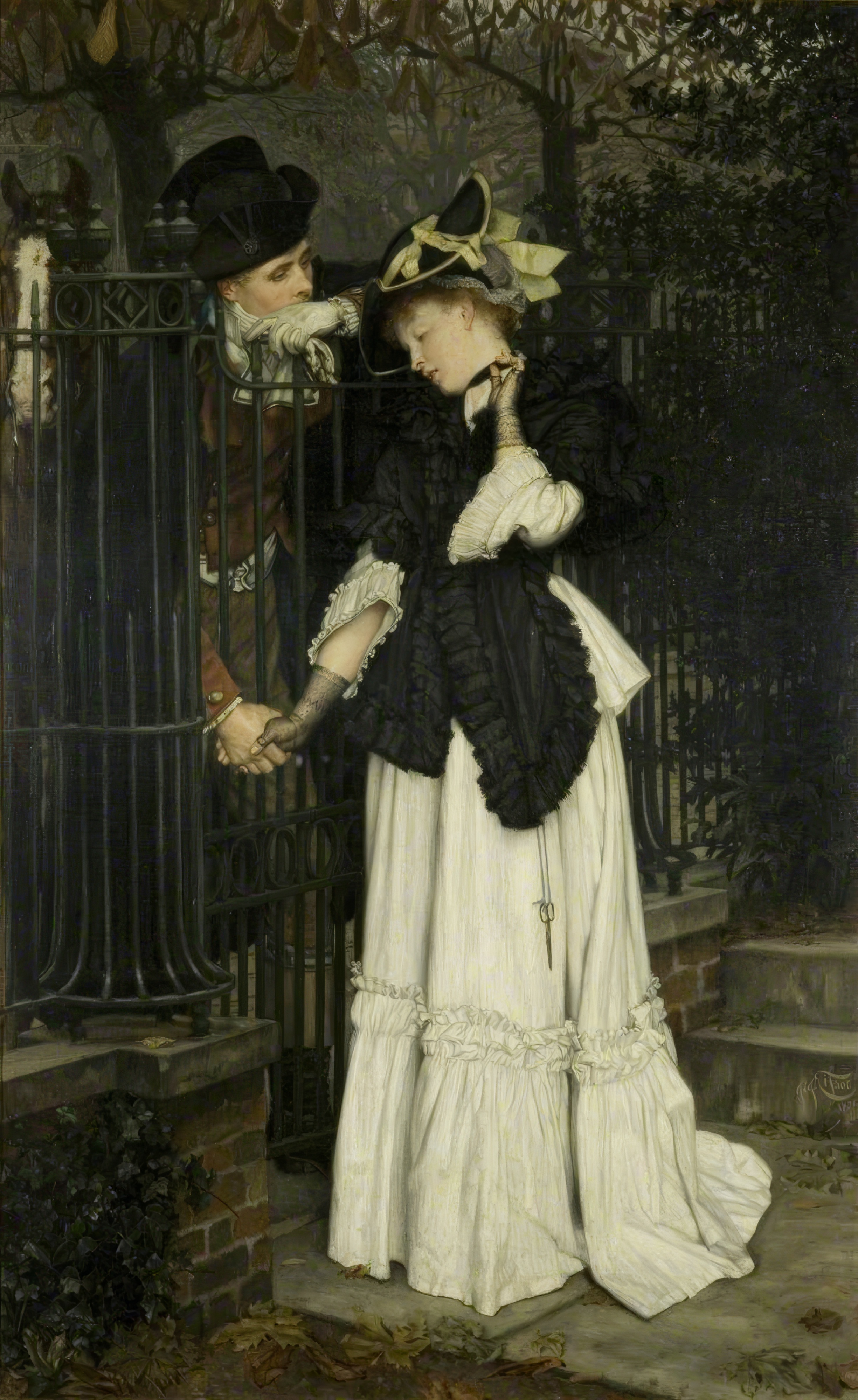
James Tissot — Les Adieux (The Farewells), 1871. Bristol Museum and Art Gallery. Complete composition.
James Tissot's young woman in a black jacket and white skirt stands inside a garden railing, her head bowed; outside it, a young man in a top hat leans over to say goodbye. Their hands meet through the iron bars. Autumn leaves lie on the path. Tissot painted it in London in 1871.
Black, white and autumn gold: Victorian melancholy at its most elegant.
2. The Departure of the Conscript
Gerolamo Induno — The Departure of the Conscript, 1862. Complete composition.
In Gerolamo Induno's painting a young conscript in a blue army greatcoat stands in a stone doorway beside a weeping young woman, who hides her face in her shawl. His bag is on his back. Induno fought in Italy's wars of unification himself and painted their human cost with great sympathy.
A small, honest picture with real feeling: for anyone who has waited for someone to come home.
3. Romeo and Juliet
Francesco Hayez — Romeo and Juliet, before 1881. Complete composition.
Hayez paints the dawn after Romeo and Juliet's wedding night. Romeo, banished from Verona, has to go, and Juliet clings to him on the threshold.
Gold silk and Venetian light: the most romantic farewell ever written, painted with full theatre.
4. The Shadow
Edmund Blair Leighton — The Shadow, 1909. Complete composition.
A knight about to leave for the Crusades stands against the castle wall, and his lady traces the outline of his shadow on the stone so that she will have his likeness while he is gone. Blair Leighton took the idea from the ancient legend of a Corinthian girl who drew her lover's shadow before he went to war.
Bright and tender: a parting with hope in it.
5. Arminius Bids Farewell to Thusnelda
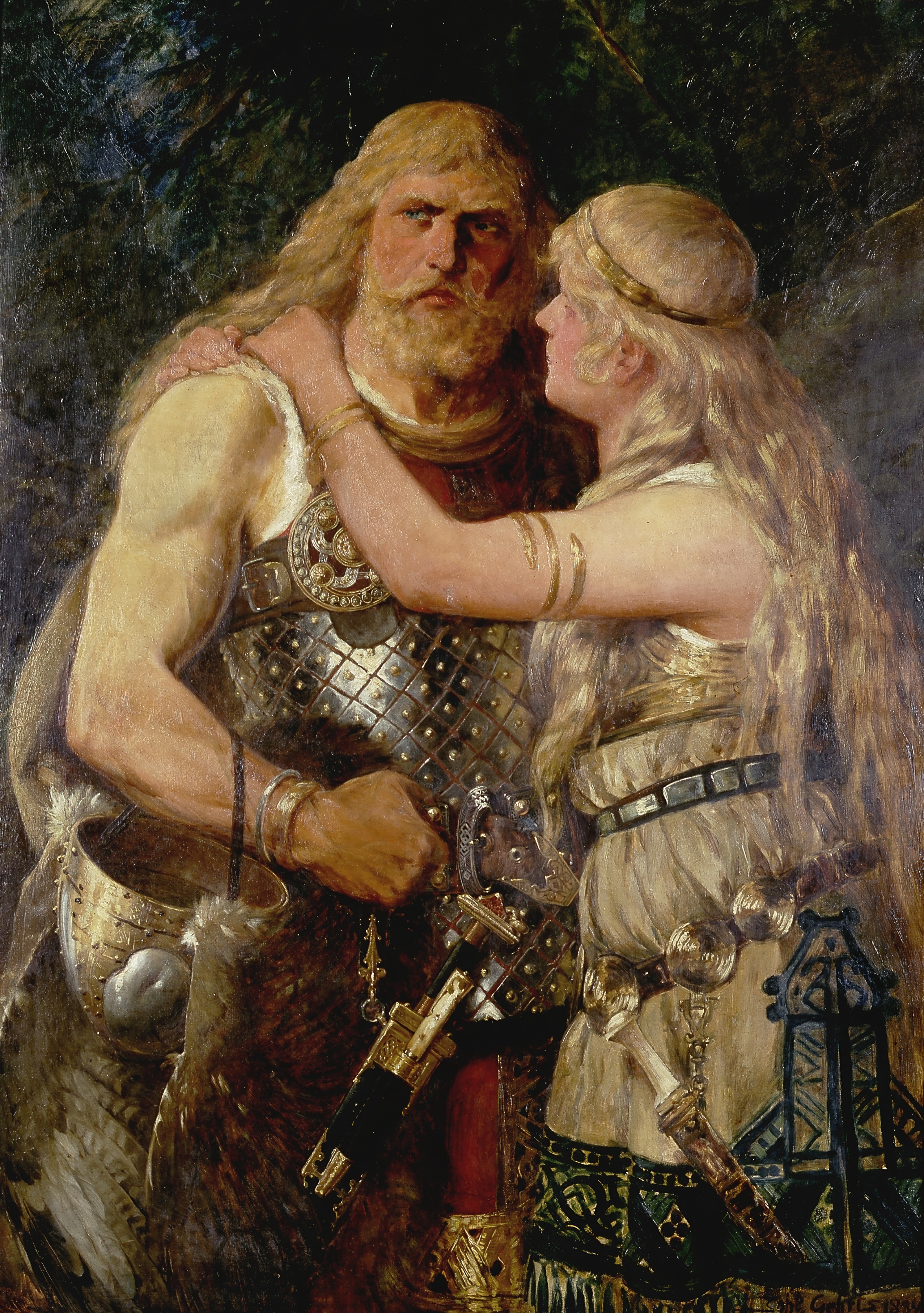
Johannes Gehrts — Arminius Bids Farewell to Thusnelda, 1884. Complete composition.
Arminius, chief of the Cherusci, is leaving for war against Rome and holds his wife Thusnelda close. Johannes Gehrts gives them the grandeur of an opera: mail, gold and long fair hair.
Heroic and northern: a strong picture for a study or library.
6. One More Kiss
Italo Nunes Vais — One More Kiss, c. 1885. Complete composition.
The farewell of the railway age: a young woman in a rose-coloured dress steps up on to a carriage to kiss the man leaning out of its window, her parasol dangling from her wrist. Italo Nunes Vais calls it One More Kiss.
Elegant and modern: perfect for a couple who spend too much time on trains.
7. Farewell!
Alfred Guillou — Farewell!, 1892. Musée des Beaux-Arts de Quimper. Complete composition.
Alfred Guillou, a painter of the fishermen of Concarneau in Brittany, called this Adieu!: a fishing boat is swamped by a huge grey-green wave, and a young fisherman holds the woman he loves above the water for the last time. It is the most dramatic painting in the collection.
Wild sea and great feeling: a powerful picture for those who love the sea in all its moods.
8. The False Knight
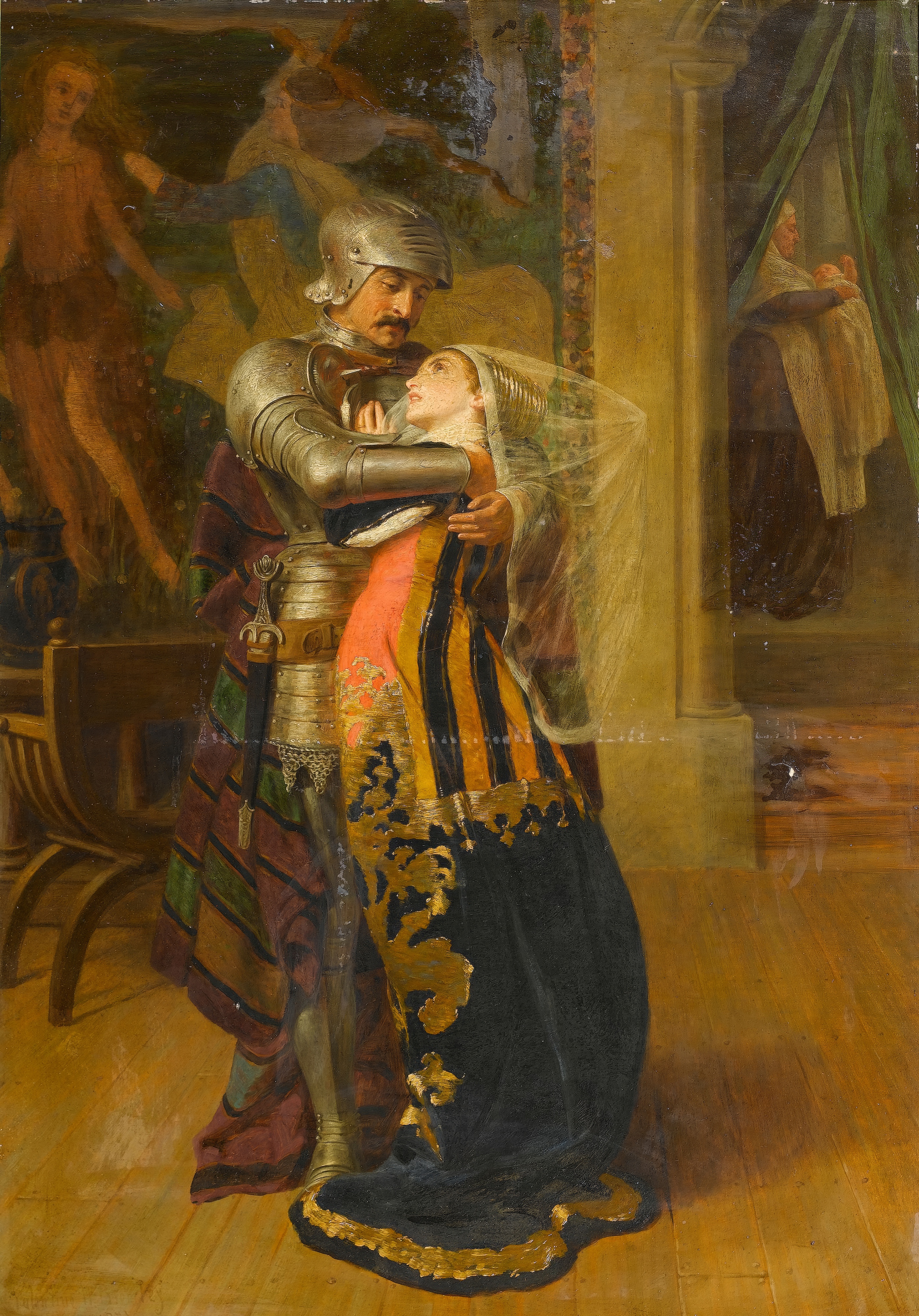
Valentine Walter Bromley — The False Knight, 1871. Complete composition.
Not every farewell is honest. Valentine Walter Bromley's armoured knight holds a veiled lady at the door of a hall, and the title, The False Knight, tells us that he will not be coming back for her.
Rich, dark and full of story: a picture that starts conversations.
Some of these couples met again, and some never did. All of them are in the Love Stories collection, printed whole, and every one has its own portrait style, for the couple who have been apart and want to remember being together.
Walk through the Love Stories room · The Love Stories collection