The Garden of Earthly Delights, detail by detail: 11 scenes to find
An owl in a stranger's arms, lovers in a mussel shell, a bird-headed prince on a throne. Eleven scenes from Bosch's great triptych, each one a picture on its own.
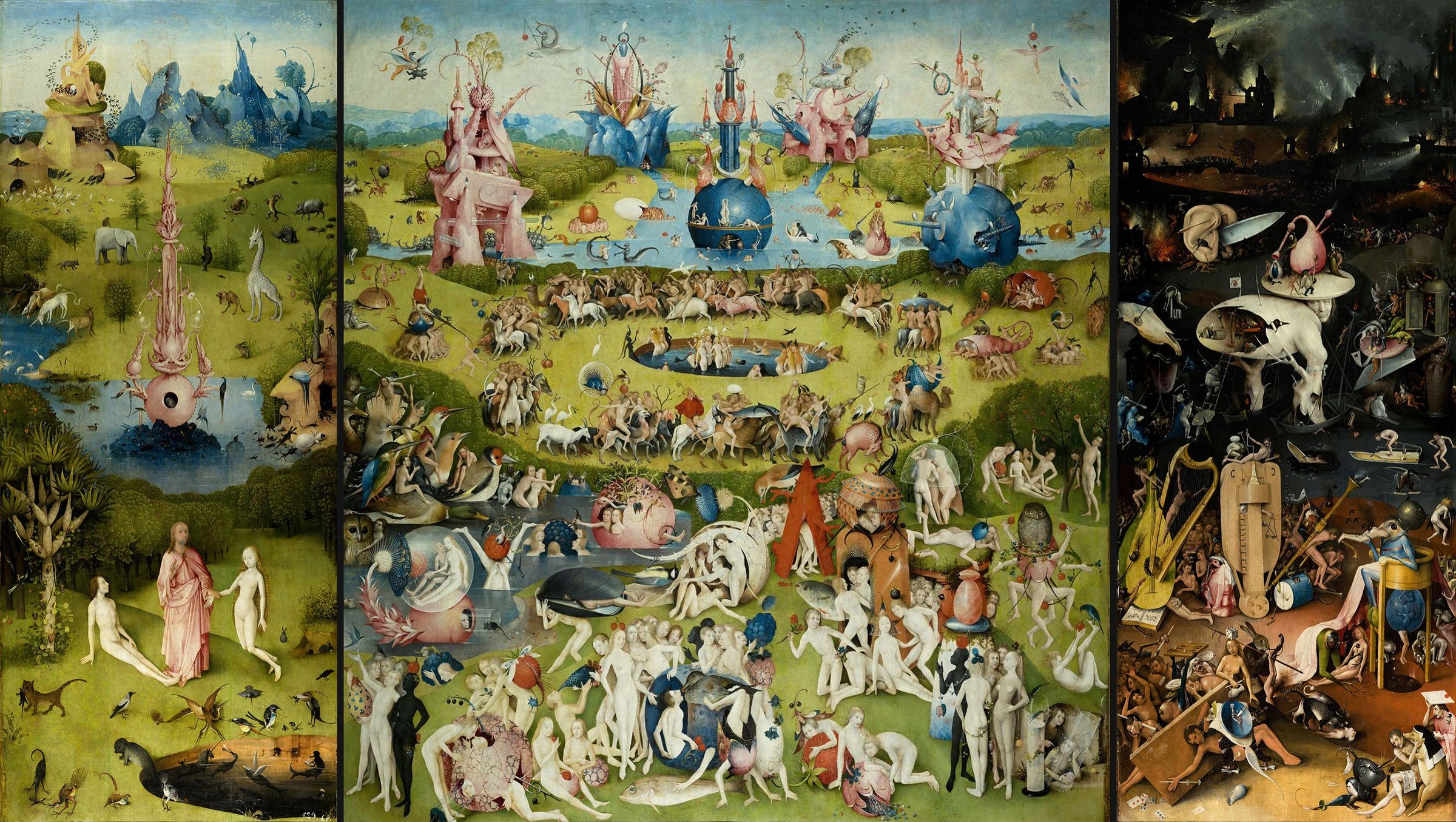
Hieronymus Bosch — The Garden of Earthly Delights, c. 1490–1510. Museo del Prado, Madrid. The whole triptych, open.
Bosch painted The Garden of Earthly Delights as three panels that read from left to right: God bringing Adam and Eve together in paradise, a vast garden where hundreds of naked figures chase fruit, birds and each other, and a hell where musical instruments become machines of punishment. Nobody has ever finished counting its figures, and almost every corner holds a scene that could hang on its own. That is exactly how Surrealium has printed it for years: one detail at a time. Here are eleven of them, in the order you meet them when you read the painting from paradise to hell.
See every print marked on the whole painting
1. God Presents Eve
Hieronymus Bosch — God Presents Eve. Museo del Prado, Madrid. Surrealium print; complete composition.
On the left wing, God takes Eve by the wrist and presents her to Adam, who sits up in the grass to look at her. It is the calmest scene in the whole triptych: three figures, a quiet meadow and animals going about their business around them. Bosch makes the first marriage look almost tender, which is what gives the rest of the painting its weight.
A gentle, luminous picture for anyone who loves the painting but wants its quietest moment on the wall.
2. The Fountain of Life
Hieronymus Bosch — The Fountain of Life. Museo del Prado, Madrid. Surrealium print; complete composition.
Above them rises the Fountain of Life: a tall pink structure, half plant and half goldsmith's work, standing in a blue lake. Look into the round opening at its base and an owl looks back. Around it, an elephant and a giraffe walk through paradise, animals Bosch knew only from travellers' descriptions and prints.
Choose it for a tall wall: the fountain's slender shape suits a portrait frame and its pinks and greens are unusually soft for Bosch.
3. The Tower of Birds
Hieronymus Bosch — The Tower of Birds. Museo del Prado, Madrid. Surrealium print; complete composition.
In the top corner of paradise a pale rock rises from the water, and around it flocks of birds wheel out into the sky. It is a reminder of how much of the painting is simply landscape, painted with the same care as the figures.
A light, airy detail with very little drama: good beside more crowded scenes.
4. The Garden of Earthly Delights: Center Panel
Hieronymus Bosch — The Garden of Earthly Delights: Center Panel. Museo del Prado, Madrid. Surrealium print; complete composition.
The centre panel is the garden itself. In the background, fantastical towers of pink stone and blue spheres stand in a lake; in the middle ground, riders on horses, camels and boars circle a pool full of bathers; in the foreground, couples and groups play among giant fruit and birds. Nothing here is violent, yet nothing lasts: the fruit is overripe and the pleasures are fleeting.
The whole garden in one print: the piece to choose if you want the painting's full sweep rather than one scene.
5. The Strawberry Butterfly
Hieronymus Bosch — The Strawberry Butterfly. Museo del Prado, Madrid. Surrealium print; complete composition.
Bosch's fruit is enormous. In this corner of the garden, figures wrap their arms around a giant strawberry as if it were a lover. Strawberries were a familiar symbol of sweet pleasure that does not last, which is exactly what the whole garden is about.
Bright red against pale skin and green grass: one of the most graphic, modern-looking details in the painting.
6. The Shell of Temptation
Hieronymus Bosch — The Shell of Temptation. Museo del Prado, Madrid. Surrealium print; complete composition.
A huge mussel shell is carried on a man's back, and inside it a pair of lovers hide from the world, only their legs showing. Nearby, figures float and play in the water. The shell, closed around the couple, is one of the painting's most quoted images.
Witty and strange: a detail that starts conversations.
7. The Owl
Hieronymus Bosch — The Owl. Museo del Prado, Madrid. Surrealium print; complete composition.
On the right of the garden, a great owl perches on a pale figure wrapped in a pink flower bud, whose arms reach out holding red berries. Owls appear again and again in Bosch, often read as birds of night, of folly or of watchfulness. Here the bird simply stares straight out of the picture, the only creature in the crowd looking at us.
A small, haunting close-up with one clear subject: it holds a narrow wall or a stair beautifully.
8. Infernal Symphony
Hieronymus Bosch — Infernal Symphony. Museo del Prado, Madrid. Surrealium print; complete composition.
The right wing is hell, and much of it is music. A harp has become a rack, a lute pins a sinner to its neck, and a choir sings from a score written on a man's backside. Above, a city burns against a black sky. Bosch turns the pleasures of the garden into their punishment, one instrument at a time.
The darkest panel, and the one to choose for a dramatic room: deep blacks lit by fire.
9. The Knife
Hieronymus Bosch — The Knife. Museo del Prado, Madrid. Surrealium print; complete composition.
Hell is full of ordinary things grown monstrous. Here a huge kitchen knife lies across the dark among the punished, beside a glowing lantern and a tall jar, as if the whole of hell were a kitchen and its guests the meal.
Dark, strange and graphic: for anyone who loves Bosch's oddest inventions.
10. Grotesque Haven
Hieronymus Bosch — Grotesque Haven. Museo del Prado, Madrid. Surrealium print; complete composition.
At the heart of hell stands the Tree Man: a hollow egg-shaped body resting on two tree trunks, with a face turned back over his shoulder and a tavern inside him. Many have seen a self-portrait in that face. Above him, two enormous ears pierced by an arrow push a knife blade forward like a war machine.
The most famous figure in the hell panel, and a striking pale shape against the dark.
11. The Prince of Hell
Hieronymus Bosch — The Prince of Hell. Museo del Prado, Madrid. Surrealium print; complete composition.
In the lower corner of hell, a bird-headed creature sits on a high chair, devouring sinners and passing them out again into a pit below. He wears a cauldron as a crown. It is the painting's grimmest joke, and one of its most precisely painted scenes.
For collectors who want hell's sharpest moment: a strong close-up with a single, unforgettable figure.
Seen together, the details tell the triptych's story: a perfect beginning, a world given over to pleasure, and its price. Seen alone, each one is a painting in its own right, with Bosch's clear colour and impossible creatures filling the frame. Every detail here is a museum-quality print, and the page Bosch's triptychs, detail by detail shows exactly where each one sits in the whole.
Bosch's triptychs, detail by detail · The Surrealium Collection