Young Girl with a Dog: Greuze’s close encounter
Young Girl with a Dog brings a child and an animal into one compact portrait. Look at Greuze’s hands, pale clothing and outward glances.
Young Girl with a Dog, painted by Jean-Baptiste Greuze in 1767, makes a small encounter fill the frame. The child leans around a dark dog held close against her pale clothing. Both faces turn outwards, but they do not merge into a single expression. The arms connect them while their separate presences remain visible.
The title appears in several forms, including A Young Child Playing with a Dog. The Petit Palais’s Greuze exhibition material identifies the child as his daughter Louise-Gabrielle, following a contemporary identification. The broader famous dog paintings selection shows animals in many settings; this essay stays with the particular relationship built by Greuze’s compact portrait, then tests it against two clearly labelled later comparisons.
Two faces within one close frame
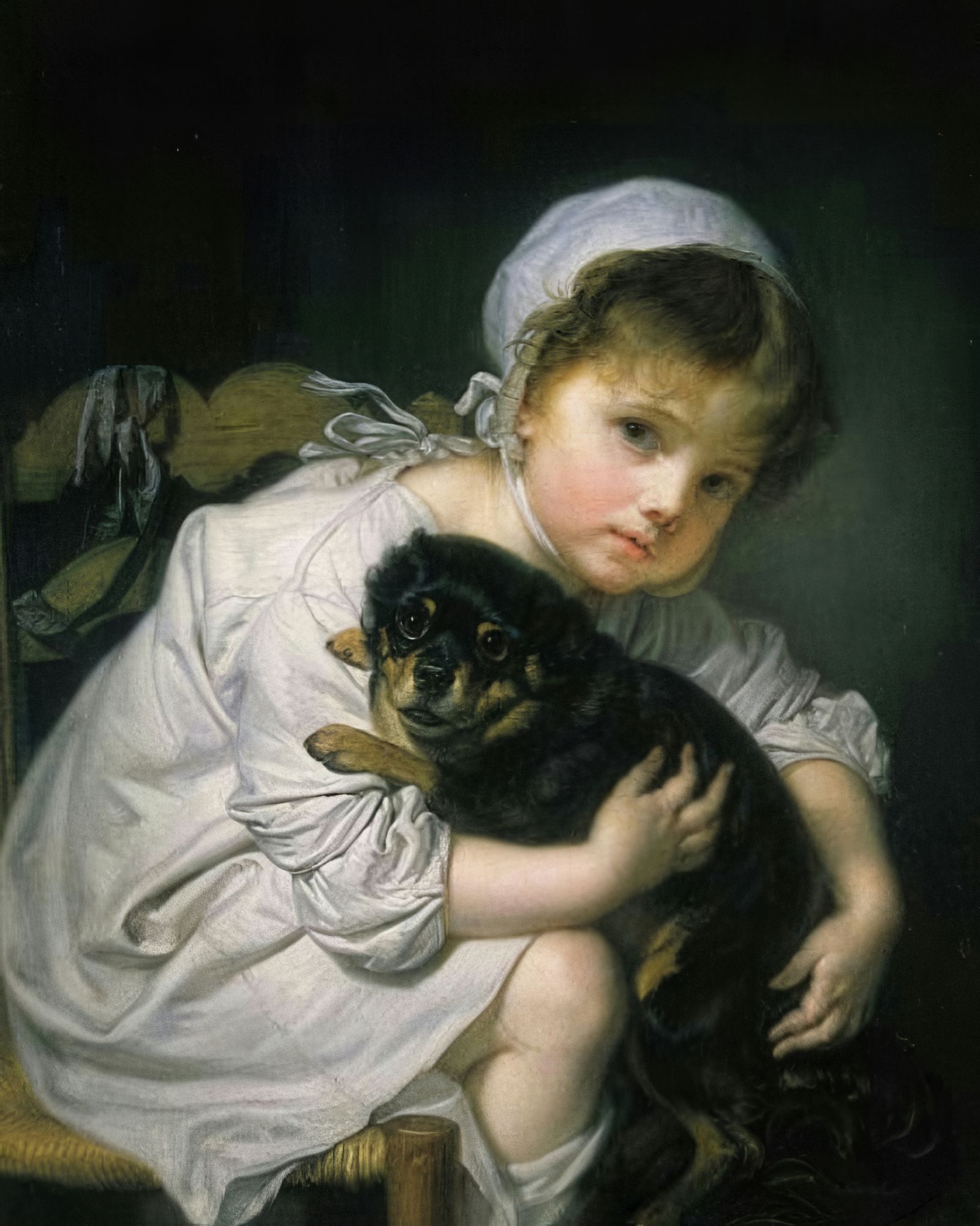
Young girl with a dog · Jean-Baptiste Greuze, 1767 · Private collection. Prepared for print by Surrealium at Vaxholm Fortress, Sweden.
In Greuze’s painting, the child’s head tilts above the dog’s. The pale cap and loose shirt establish a broad light shape around her face and arms. The animal’s dark coat creates a second mass inside that shape, with small highlights allowing its features to register. The background stays comparatively subdued.
The arms are essential to the arrangement. One crosses in front of the animal; the other curves around its body. Together they connect the two figures without hiding the dog’s head. The child’s body leans into the action, so the encounter feels like something being sustained rather than a pair of subjects placed independently beside one another.
Look at the gap between their faces. It is small, but it keeps the dog from becoming merely an attribute of the child. Each face has its own orientation and distinct relation to the viewer. The painting brings them close while preserving that difference. Its affection is carried through a physical arrangement, not through identical expressions.
The title is not the whole history
The Petit Palais dates the work to 1767 and records its appearance at the Salon of 1769. Those are different events: the making of the painting and its public exhibition. Confusing them would make a short caption simpler but less accurate. The collection is identified as private, rather than being assigned to a museum without evidence.
The museum’s identification of Louise-Gabrielle gives the picture a family connection. Even so, the composition should not be treated as an unmediated glimpse of a private instant. Greuze made a painting that other people could encounter, and its closeness is part of its public effect. The large light area, compact grouping and outward faces all help produce that effect.
The child’s loose clothing also contributes to the sense of informality. It provides room for folds and movement around the arms instead of presenting a stiff, ceremonial silhouette. We can observe that visual difference without inventing words for the child or claiming to know how long the pose lasted. The historical record and the image each tell us different things.
Courbet changes the direction of attention
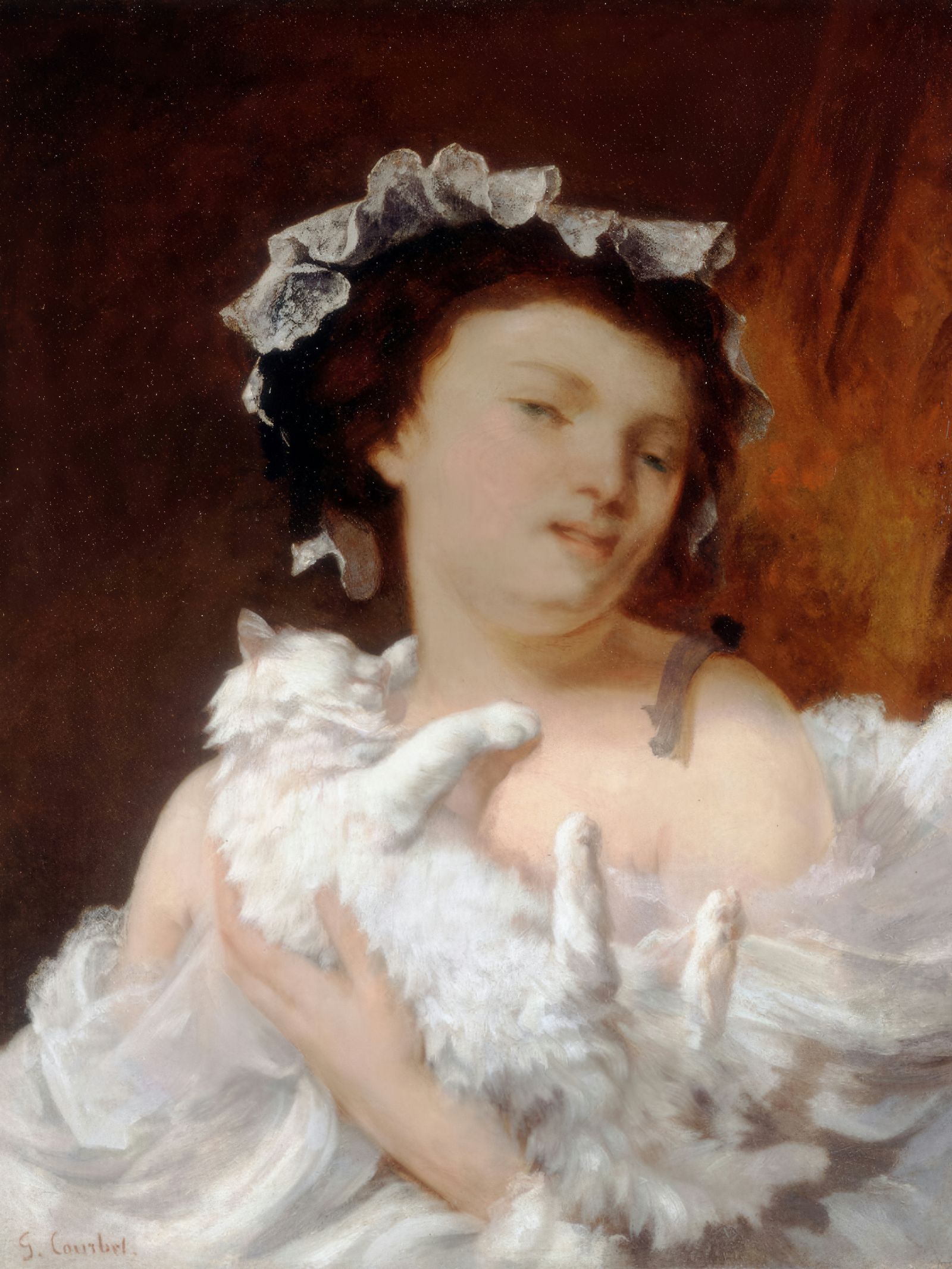
Woman with a Cat · Gustave Courbet, 1864 · Worcester Art Museum. Prepared for print by Surrealium at Vaxholm Fortress, Sweden.
The next image is Woman with a Cat, by Gustave Courbet, not Greuze. A woman holds a pale cat against her chest. Its body reaches upwards, while her head turns to the side. Light fabric, exposed skin and pale fur gather into a broad bright area against a darker setting.
This is a useful comparison because the physical closeness remains, but the relationship with the viewer changes. Greuze’s child and dog present two distinct faces towards us. Courbet’s woman appears more absorbed in the contact with the animal. The cat’s raised body directs attention through the embrace, rather than simply supplying another face beside hers.
The comparison does not establish that one encounter is more sincere than the other. It shows how different arrangements can suggest different forms of intimacy. A body turning outwards can acknowledge the viewer; a body turning towards an animal can concentrate the scene internally. The painter makes that difference available through posture, light and the space between heads.
A dark coat is not an empty shape
Return to Greuze and look at the dog before the child. Its dark body could easily disappear into a simplified patch against the shirt. Instead, small changes in tone establish the muzzle, eyes and contours. The animal remains a distinct presence within the larger embrace.
The light clothing helps because it gives the dark form an immediate boundary. Yet the boundary is not equally clear everywhere. Where a hand crosses the body, the viewer can follow the contact. Where the lower coat approaches the background, the distinction is quieter. Greuze varies the degree of separation rather than outlining the animal uniformly.
That is one reason the whole painting matters. A tightly cropped image of the two faces would preserve their appeal but remove much of the work done by arms, sleeves and surrounding darkness. The contact has a shape and a weight. Looking at that structure makes the picture more specific than a general image of a child who likes a dog.
Chaplin makes room for a quieter animal
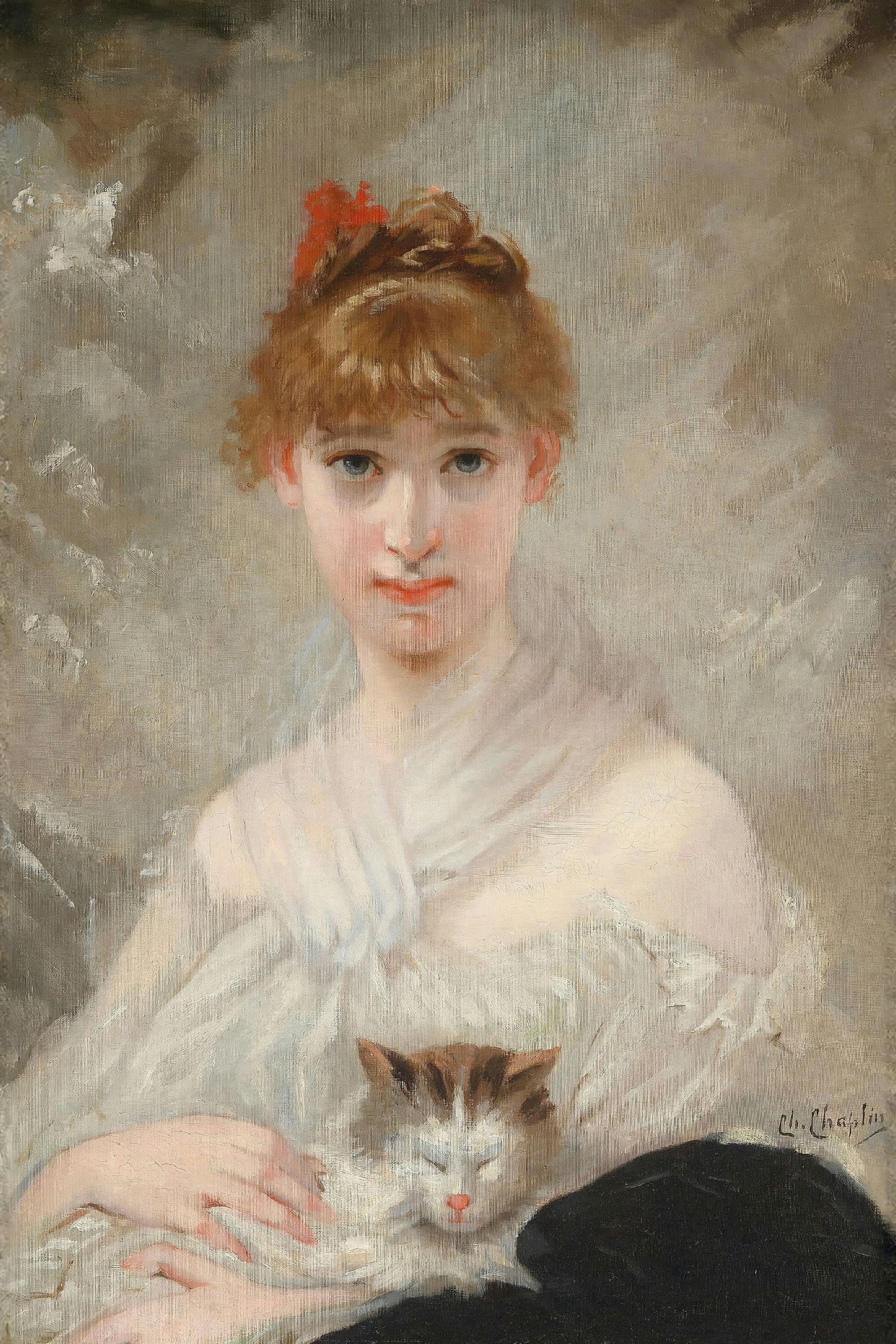
Girl with a White Shawl and a Cat · Charles Joshua Chaplin, by 1891 · Private collection. Prepared for print by Surrealium at Vaxholm Fortress, Sweden.
Girl with a White Shawl and a Cat, by Charles Joshua Chaplin, supplies a second later comparison. The girl faces outwards, with a cat settled low in front of her. Pale clothing spreads around the animal, and a hand rests nearby. The composition is more upright and less visibly wrapped around its animal companion than Greuze’s.
Notice how low the cat sits in relation to the girl’s face. The space between them creates a different rhythm. We move down through the pale garment to find the animal, rather than meeting two heads close together near the upper part of the picture. That difference changes the scale of the encounter even though both works place a young person beside a pet.
Chaplin’s picture is not a second Greuze or a record of the same child. Its value here is comparative. It makes Greuze’s leaning body, close-set heads and encircling arms more apparent. An image can teach us about another image precisely because its choices are different.
Affection is visible; a complete story is not
The painting’s closeness invites a sympathetic response, but a response is not the same thing as a documented account of the sitters’ feelings. We can see that the child holds the dog, that their bodies are close and that their faces remain distinct. We cannot recover an entire relationship from this single composition.
Henriette Ronner-Knip’s cats offer another way to think about that limit. Animals can command attention through posture and surroundings even when no human figure is present. Greuze brings a person into the arrangement, but the dog still needs to be seen as an animal with its own body and direction of attention. The individual dogs in Rosa Bonheur’s portraits of animals make that separate presence especially clear.
When selecting a print, start with the parts that made you pause. It might be the child’s tilted head, the dog’s dark face or the hand against the coat. Then step back to see how the rest of the picture supports that detail. The encounter remains compelling because the composition gives affection a particular form, while leaving room for the viewer’s own experience of company.
The Neoclassical-era collection provides a broader setting for this eighteenth-century work, without making every painting in the group follow the same style. Greuze’s small scene asks for close attention. Keep the complete embrace, the quiet background and the difference between the two faces in view; together they make this encounter its own.
- Who painted Young Girl with a Dog?
- The work discussed here is Jean-Baptiste Greuze’s 1767 painting. Its title also appears as A Young Child Playing with a Dog. The later Courbet and Chaplin images are explicitly identified comparisons.
- Who is the child in Greuze’s painting?
- The Petit Palais exhibition material identifies her as Louise-Gabrielle Greuze, the artist’s daughter, following a contemporary identification. The essay attributes that information rather than inferring identity from appearance.
- Why do some accounts mention 1769?
- The painting is dated 1767 in the Petit Palais material and was exhibited at the Salon of 1769. The exhibition year and the painting’s date should be kept distinct.