Rosa Bonheur: the individual animal
Rosa Bonheur is famous for horses, but her dogs reveal the same close attention. Four animal portraits show how a particular creature becomes a subject.
Rosa Bonheur is often introduced through The Horse Fair, the great scene of a Paris horse market held by the Metropolitan Museum of Art. That painting matters, but the four works shown here take us closer to individual dogs. A shaggy face, a white blaze, a raised head and two bodies resting together let us see how carefully an animal can be distinguished without being turned into a person in costume.
The Horse Fair is discussed as context and is not reproduced on this page. The available pictures are identified in their own captions. They offer a useful route into Bonheur's attention to animals, whether you are interested in famous horse paintings, considering a horse portrait from a photograph, or simply looking at how a painter gives a living creature a specific presence.
Brizo: a face without a human role
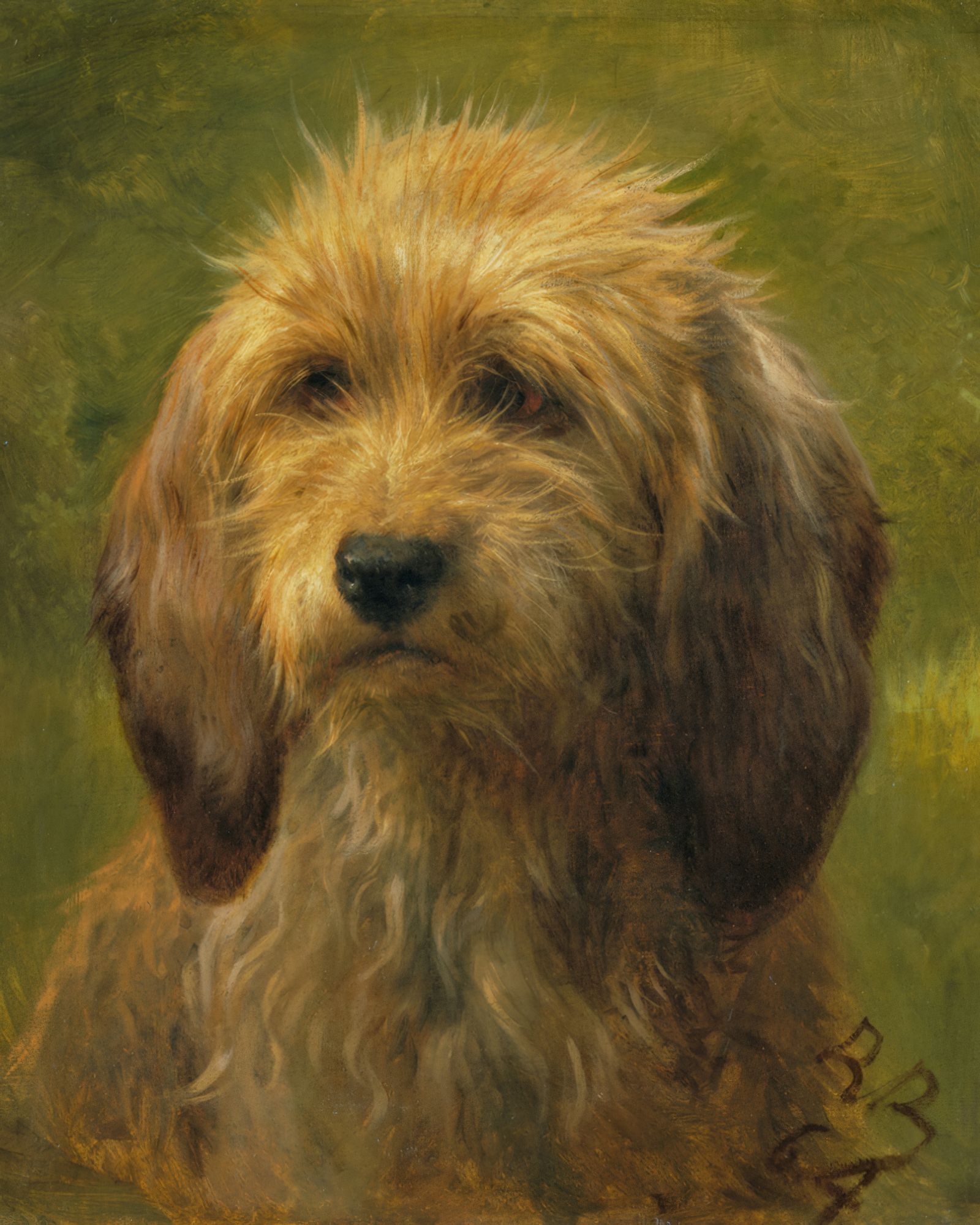
Brizo the dog · Rosa Bonheur, 1864 · Wallace Collection, London. Prepared for print by Surrealium at Vaxholm Fortress, Sweden.
Brizo's head fills much of the picture, with long ears, a dark nose and irregular pale hairs breaking the outline of the face. The warm background supports the animal without providing a story about what it is doing. The eyes matter, but so do the differences between the loose hair above them and the heavier fur below. Recognition is built from those unequal textures.
The Wallace Collection holds this 1864 work. Its close view has the concentration we associate with a portrait, yet the dog remains a dog. There is no need for a uniform, a crown or a borrowed human expression to make the subject important. The painting asks for attention to the animal's own face, and that is a stronger form of particularity than an elaborate invented role could provide.
Why the edges matter
Animal likeness is easy to reduce to eyes, but Bonheur's pictures show how much information lives elsewhere. The shape of an ear, the fall of hair over a brow and the angle at which the muzzle projects can distinguish one animal from another. A soft or broken edge is not necessarily a failure to describe; it can describe fur more convincingly than a uniformly hard outline.
When looking at Brizo, follow the silhouette before returning to the face. Some hairs reach into the background while others disappear into similar tones. That movement keeps the head from feeling cut out and pasted onto a surface. The painting's closeness is therefore not just a matter of filling the frame. It depends on making the transition between animal and surrounding space feel observed.
Martin: a different kind of roughness
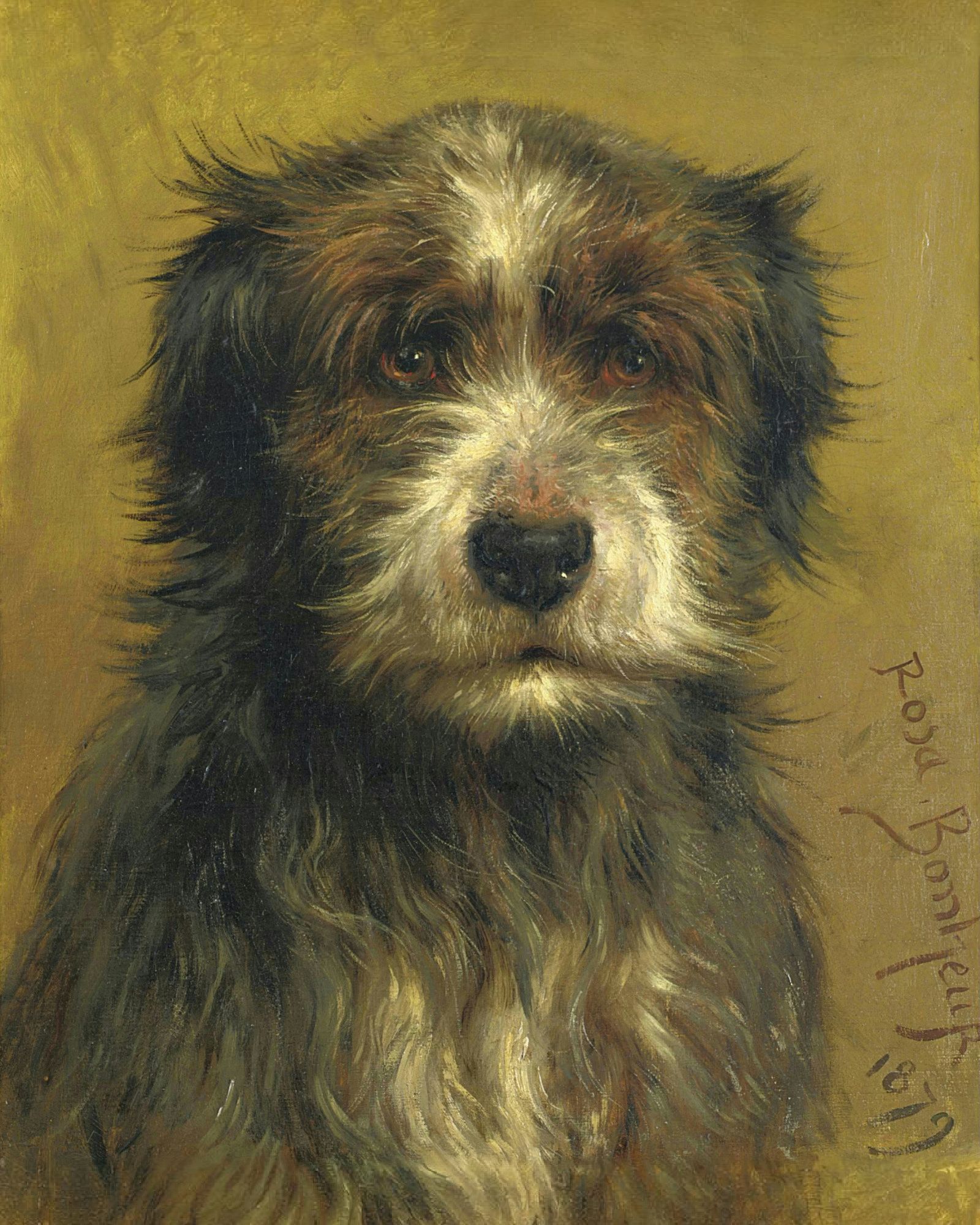
Martin, a terrier · Rosa Bonheur, 1879 · Private collection. Prepared for print by Surrealium at Vaxholm Fortress, Sweden.
Martin, a terrier, gives the face a darker frame, interrupted by a pale stripe and light hair around the muzzle. The ears, brow and coat create a different pattern from Brizo even though both pictures centre a shaggy head. Comparing them makes it difficult to treat “dog portrait” as one repeated formula. The individual distribution of dark and light is doing much of the work.
The picture is dated 1879 and is recorded in a private collection. Its directness can tempt a viewer to assign a mood with confidence, but a painted look does not provide a transcript of an animal's feelings. It is enough to say that the head faces us closely and that the eyes hold attention within the textured coat. Interpretation can follow without pretending to be evidence.
From the horse market to the single animal
The Met dates The Horse Fair to 1852–55 and identifies its setting as the horse market on the Boulevard de l'Hôpital in Paris. Its account describes Bonheur's repeated visits to sketch there and the painting's appearance at the Salon of 1853. Those facts establish a practice of sustained observation rather than an image invented from a generic idea of animal grandeur.
The smaller dog pictures operate at a different scale, but they invite a related kind of looking. Instead of following a group moving through a public space, we attend to one head or one stance. The comparison should not erase differences of purpose and composition. It simply reminds us that Bonheur's reputation for large, energetic animal scenes sits beside a capacity for concentrated studies of an individual creature.
A Limier Briquet Hound: the body has a direction
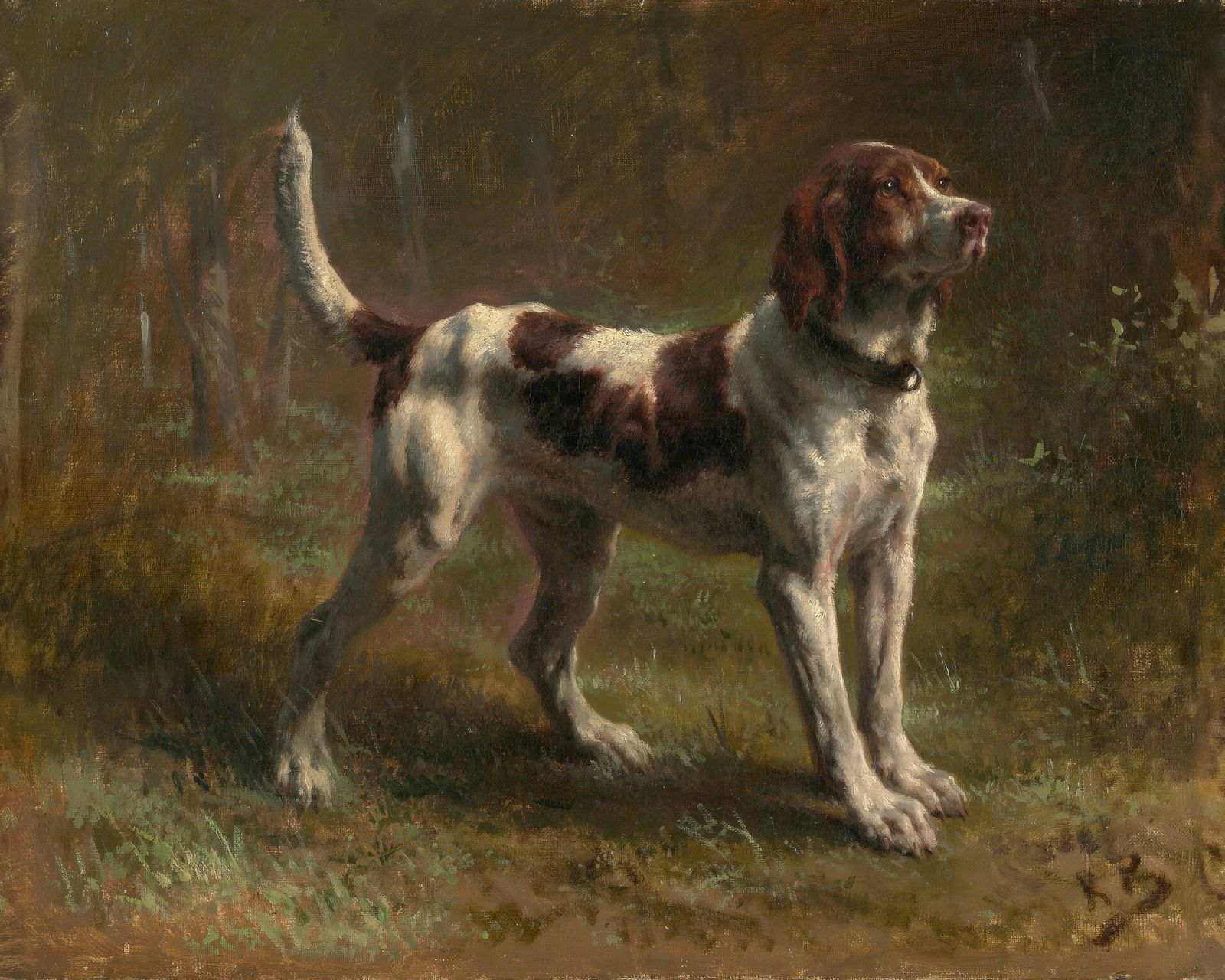
A Limier Briquet Hound · Rosa Bonheur, 1856 · Metropolitan Museum of Art, New York. Prepared for print by Surrealium at Vaxholm Fortress, Sweden.
The standing hound is shown in profile within a wooded setting, its head lifted and its tail extending the body's line. The mottled coat breaks the surface into distinct patches while the legs carry the weight clearly. Here the animal's identity is not confined to the face. Stance, proportions and the relation between head and back contribute to the sense of a particular body occupying the ground.
Compare the space around this dog with the close framing of Brizo and Martin. A whole-body portrait needs room for feet, tail and the direction of attention. Cropping those away would change the work into a different kind of image. The full composition also keeps the dog within a setting, allowing posture and environment to work together without inventing a human task for the animal.
Sultan and Rosette: two animals, unequal scales
Sultan and Rosette places a large black-and-white dog beside a much smaller pale one, with architecture and sky behind them. The difference in scale is immediate, but the smaller animal is not merely an accessory: its presence changes how we read the larger dog's body and the space around it. The pairing creates a relationship through proximity without requiring the painter to stage a human conversation.
The work is a watercolour on paper dated 1852, held by the National Museum in Warsaw. That medium belongs in the caption because these animals should not automatically become another example of Bonheur's oil painting. Look at the pair before deciding which figure holds your attention: the larger body establishes one scale, while the smaller companion asks the eye to adjust. Their difference gives the grouping its particular character.
What these pictures teach a portrait viewer
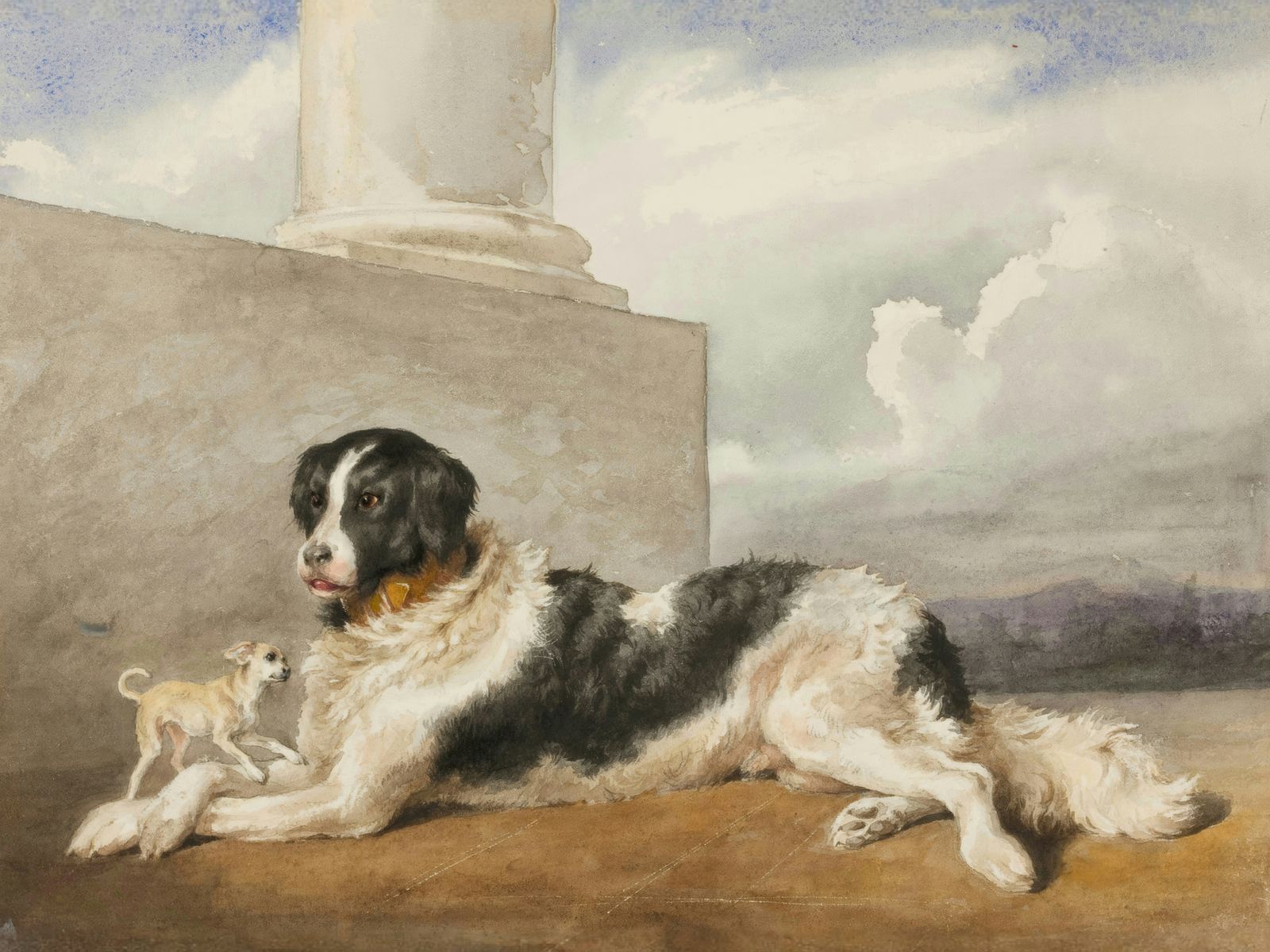
Sultan and Rosette – the dogs of the Czartoryskis · Rosa Bonheur, 1852 · National Museum in Warsaw. Prepared for print by Surrealium at Vaxholm Fortress, Sweden.
If you are choosing a photograph for a pet portrait, use the same attention to particulars. Check the shape of the head, the markings that must remain, the position of ears and the amount of body you want included. A photograph with an appealing mood but hidden facial detail may be a poor reference for the likeness you hope to preserve.
The pet portrait styles guide helps with the available choices, while George Stubbs's animal paintings offers a different approach to anatomy and setting. These are comparisons between artists and practical observations about looking, not promises that every historical work can become a selectable portrait style. The animal's recognisable features should lead the decision, especially when the result is intended as a gift.
Choosing a Bonheur work for its own subject
A historical animal portrait can be meaningful without representing your own dog. You may admire the texture of Brizo's coat, the hound's stance or the different scales of Sultan and Rosette. Those are sufficient reasons to choose a work. The picture does not need a claim that all dogs of a breed share a personality or that an old painting somehow depicts your family's particular companion.
Start with Brizo in the Realist collection and compare the full compositions. Notice how much room each animal has, where its attention goes and whether you prefer a face or a body in a landscape. Bonheur's care is visible in those differences. A thoughtful selection preserves them instead of gathering every animal image under the same sentimental description.
Bonheur gives animals importance through observation. A dog can remain absorbed, alert, resting or simply present without becoming a symbol of human virtue. The closer we look at the differences between these four works, the more individual their subjects become.
- What is Rosa Bonheur’s most famous painting?
- The Horse Fair is her best-known large animal scene and is held by the Metropolitan Museum of Art. It is discussed here for context; the four reproduced works show dogs.
- Did Rosa Bonheur paint pets as well as horses?
- Yes. The dog portraits selected here demonstrate her attention to individual animals, from closely framed heads to a full body and a pair of dogs.
- Why keep a pet natural in a portrait?
- Natural posture, markings and proportions are what make the animal recognisable. Bonheur’s work shows how much character can be conveyed through those features without adding human clothes or roles.