Henriette Ronner-Knip: cats with room to move
Henriette Ronner-Knip paints the weight, watchfulness and small disruptions of cats. Three works show how affection becomes a composition.
Henriette Ronner-Knip makes a cat’s position in a room worth noticing. A paw approaches a loose object. A kitten lies low against a soft ground. A mother cat occupies a barn window while her young gather on the blanket below. The subjects are appealing, but their interest comes from more than a recognisable face.
Often written Henriëtte Ronner-Knip, the artist painted animals with close attention to posture and setting. The famous cat paintings selection places her among other painters of feline company. Here, three works allow a longer look at her own methods: how she distributes a group, builds a small incident and lets a single resting animal fill the picture.
The tabletop is one move away from disorder
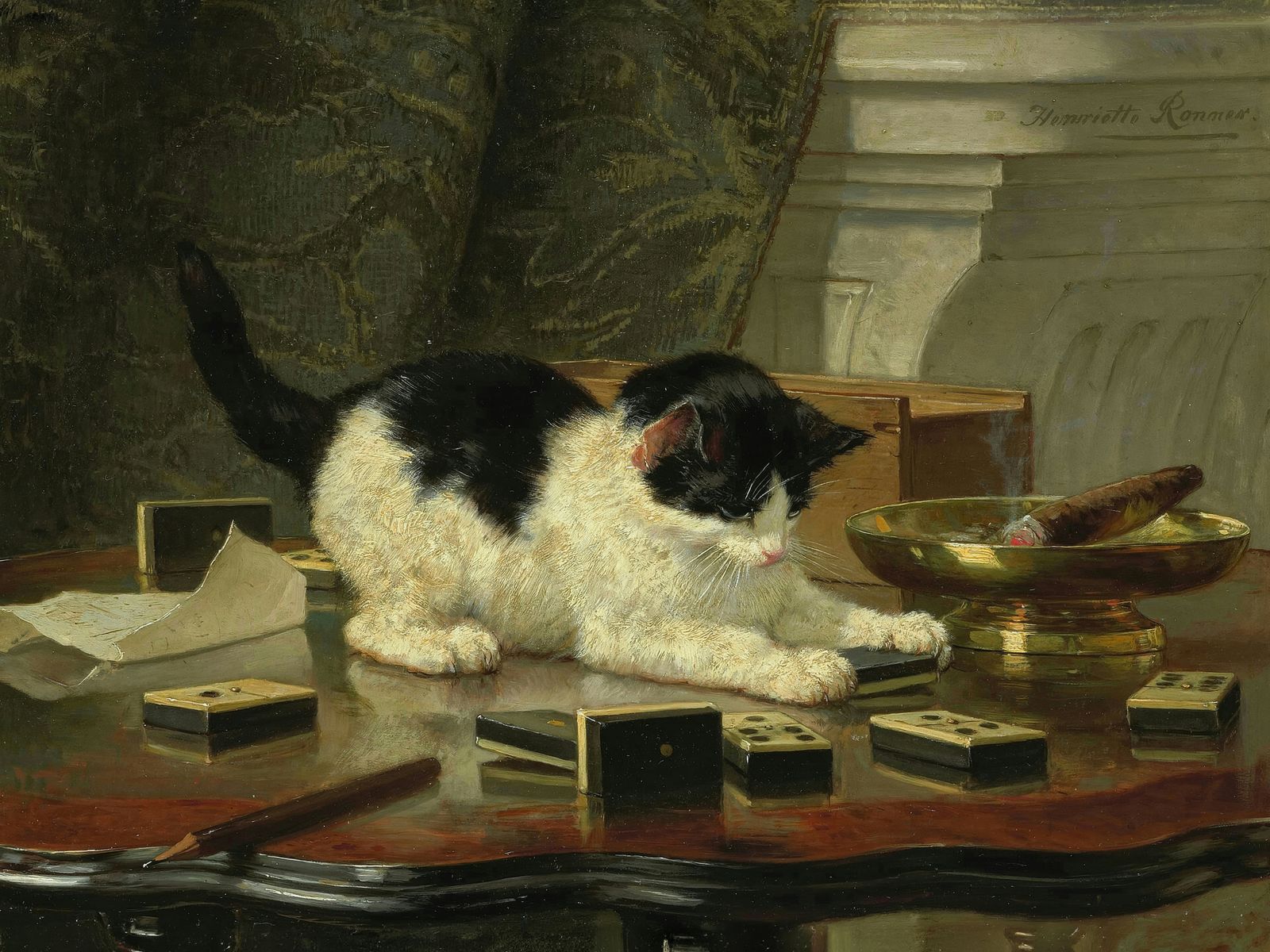
The cat at play · Henriëtte Ronner-Knip, c. 1860–1878 · Rijksmuseum, Amsterdam. Prepared for print by Surrealium at Vaxholm Fortress, Sweden.
The Cat at Play, dated by the Rijksmuseum to about 1860–78, places a black-and-white kitten among dominoes on a table. Nearby is a dish holding a cigar. The objects belong to a human activity, but the kitten has begun to give them a different use. One small movement could change the arrangement.
The low viewpoint makes the table feel like a substantial stage. The animal’s body stretches horizontally, while its lowered head directs attention towards the scattered pieces. Rectangular dominoes contrast with the rounded body and soft coat. Their dark faces and pale edges also repeat some of the cat’s own colouring.
The scene contains an implied next moment, but the painting does not show that moment arriving. We remain just before a possible tumble or interruption. That held interval gives the picture its humour. It is enough to watch the relation between paw, object and edge; no exaggerated expression is needed to tell us why the situation might become troublesome.
Affection does not require a fixed expression
Calling a painted animal happy, guilty or mischievous can close down observation too quickly. In the tabletop scene, it is more useful to begin with what is visible. The kitten leans forward. Its attention is directed downwards. Small objects lie within reach, and the table gives them only a limited surface on which to remain.
The surrounding objects help us understand the animal’s size and possible movement. A domino can be displaced by a paw; the larger dish has a different weight and position. Those relationships make the scene readable even if we cannot assign a precise intention to the cat. It is a composition built around physical possibilities.
Tees Valley Museums describes Ronner-Knip’s attention to animal behaviour and her use of posed paper models in developing paintings. That account is a useful reminder that observation and arrangement can coexist. A convincing animal picture need not be a single instant copied without alteration. It can combine studied behaviour with deliberate choices about where each form belongs.
One resting kitten can be enough
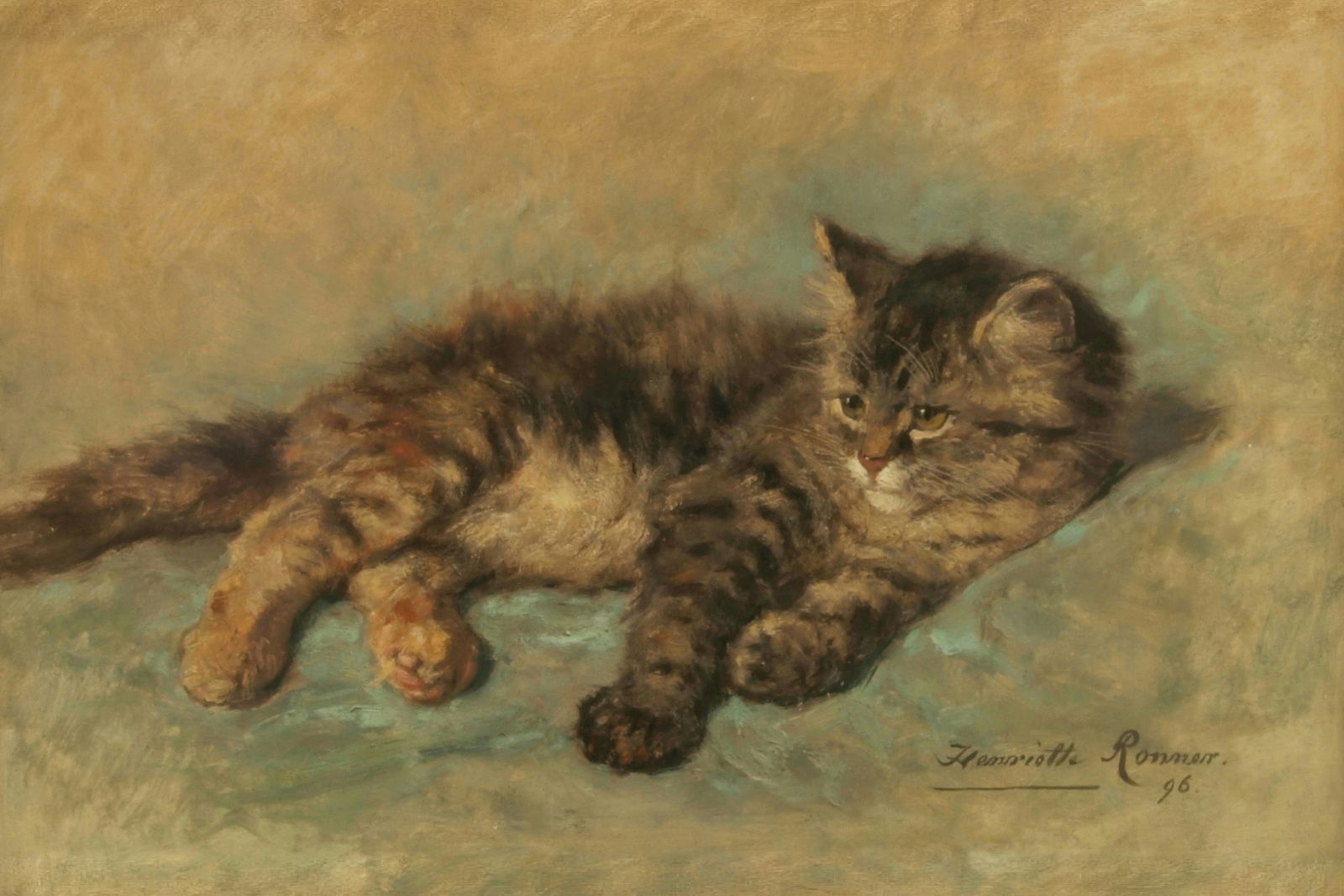
Kitten Lying Down · Henriëtte Ronner-Knip, 1896 · Teylers Museum, Haarlem. Prepared for print by Surrealium at Vaxholm Fortress, Sweden.
Kitten Lying Down removes most of the household. The small animal stretches along a lightly described surface, its head turned towards the viewer and its body extended across the image. There is no basket to organise a group and no elaborate furniture to establish a room. The posture carries the composition.
Look at the difference between the face and the body. The face needs enough definition for the direction of the gaze to register. Along the body, softer edges and irregular marks suggest fur without describing every hair. The animal has a distinct weight against the ground even though the surrounding space remains open.
That openness changes the pace of looking. In the tabletop picture, attention moves between the cat and nearby objects. Here it can follow a continuous shape, from the head along the back and towards the hind legs. The painting asks less of narrative curiosity and more of simple recognition: this is a particular way for a small animal to occupy a resting place.
Fur is a matter of edges as well as texture
A convincing painted coat depends on more than adding many fine lines. Some edges must be clear enough to establish the animal’s shape; others can break into the surrounding colour. The lying kitten shows how those two kinds of edge can coexist. Its softness is visible because the outline is not equally firm everywhere.
The same principle operates in the window group shown below, where dark patches, pale fur and patterned cloth meet. A light area can become legible through contrast with the material beside it. A darker head needs different surrounding tones. The painter adjusts relationships across the picture rather than treating each animal as an isolated cut-out.
This gives a useful way to look beyond the first appeal of a kitten’s face. Follow the places where fur meets cloth or floor. Ask which parts appear to carry weight and which seem airy. Those transitions help explain why the animal feels present. They also reward viewing the complete image at a comfortable scale instead of inspecting only a heavily enlarged facial detail.
A window holds a family group
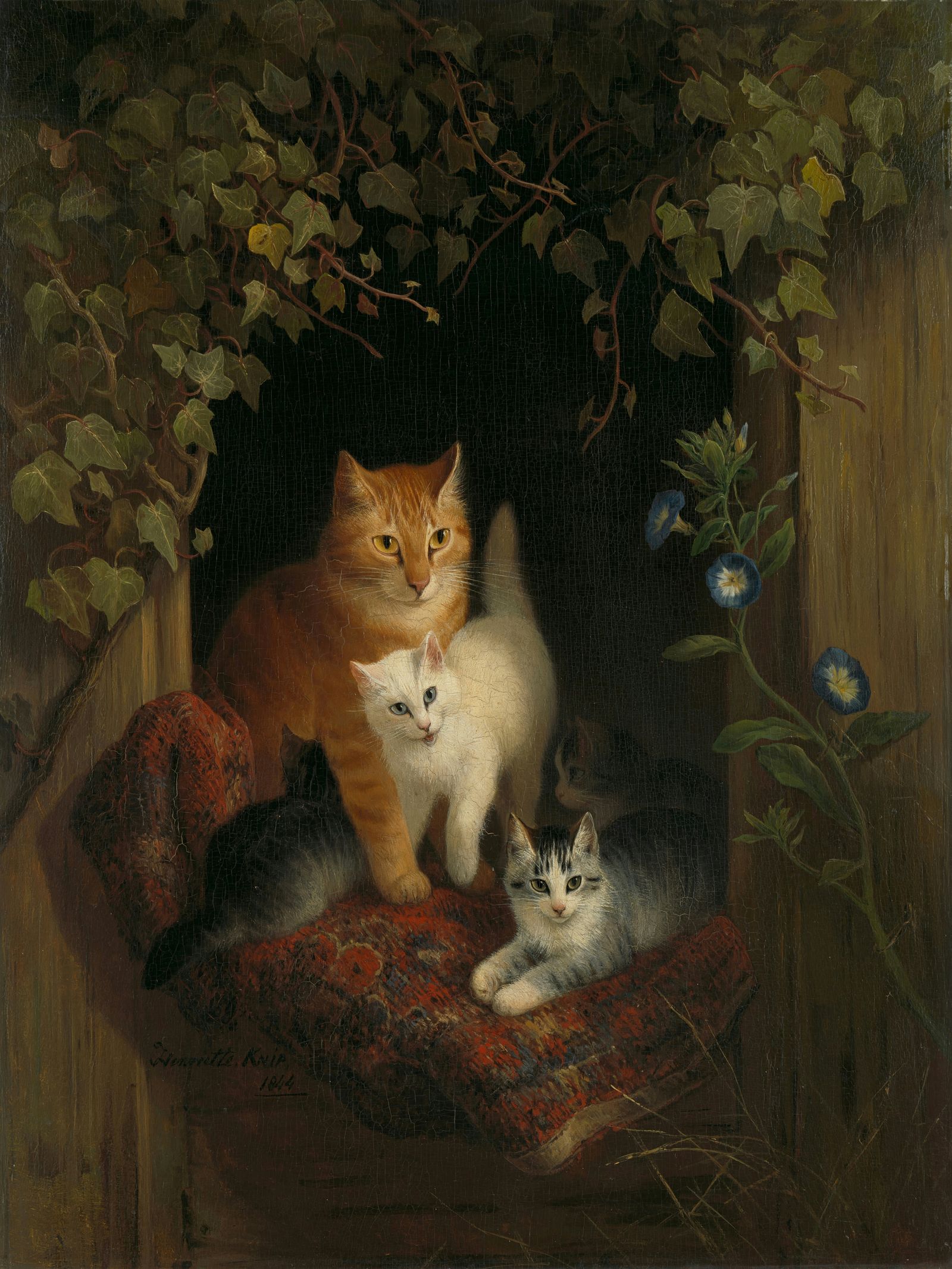
Cat with Kittens · Henriëtte Ronner-Knip, 1844 · Rijksmuseum, Amsterdam. Prepared for print by Surrealium at Vaxholm Fortress, Sweden.
Cat with Kittens, dated 1844 in the Rijksmuseum record, sets an adult cat and four young in a wooden barn window. A patterned blanket covers the sill, and climbing plants frame the opening. The adult’s orange coat registers strongly against the dark interior; the kittens occupy a lower, more varied arrangement around her.
The white kitten near the centre stands upright, while the grey-and-white animal at the front lies along the blanket. Other small bodies emerge less clearly from the surrounding darkness. Their different levels give the group depth without requiring an elaborate view into the building. We see enough of the window to understand its shelter and its edge.
Follow the leaves around the opening, then return to the animals. The foliage forms an outer frame, while the blanket supplies a shared surface below. The cats have individual postures, but the setting holds them together. It is a different kind of anticipation from the domino picture: the interest lies in several alert presences occupying a protected place.
A painter of animals, not a single mood
These three works differ in structure as much as in subject. The window makes a vertical group. The lying kitten stretches into a quieter horizontal shape. The tabletop picture gathers attention around objects that may soon move. Ronner-Knip can offer company, repose or anticipation by changing the surroundings and the animal’s position within them.
Compare her approach with Rosa Bonheur’s dogs. Different animals and different settings call for different kinds of emphasis, but both discussions begin with the visible body: its weight, orientation and relation to the ground. Affection becomes more persuasive when it rests on particular observation.
For a print, consider whether you want several points of attention or one sustained form. A group of kittens gives the eye routes through the image; a solitary animal can make a stronger pause. Preserve the surrounding window, tabletop or open ground. Those spaces explain what the cat is doing and how the composition asks us to look.
Continue with Greuze’s Young Girl with a Dog for a different arrangement of animal and human company. Ronner-Knip’s cats need no human figure beside them to hold a picture. Their ordinary positions, carefully observed and deliberately arranged, are sufficient subjects in themselves. The Romantic-era collection includes the earlier window group among other nineteenth-century works.
- Is Henriëtte Ronner-Knip the same artist as Henriette Ronner?
- Yes. Her name appears in several forms, including Henriëtte Ronner-Knip and Henriette Ronner. The captions here preserve the identification attached to each selected work.
- Are all three pictures scenes of kittens playing?
- No. One shows an adult cat with four kittens, one concentrates on a resting kitten, and one presents a kitten among dominoes. Their different arrangements are the focus of the essay.
- What should I look for beyond the cats’ faces?
- Follow the paws, backs and points of contact with cloth or furniture. The gaps between animals, the edges of the table and the surrounding colours all contribute to the painting’s character.