Medieval constellation drawings: the zodiac of a Prague star book
Thirteen constellation drawings from a star book made in northern Italy around 1370 to 1400 and now in Prague: the twelve signs of the zodiac, every star numbered, and a sea-lion for Cetus.
Somewhere in northern Italy, probably in Milan or Pavia, between about 1370 and 1400, a scribe and a painter made a large book of the stars. It shows all forty-eight constellations of the ancient sky, each drawn as a figure, with every star set into the body and numbered. The book is now in the Strahov Library in Prague, catalogued as Cod. DA II 13. Here are its constellation drawings of the twelve signs of the zodiac, in order, and the sea-lion it draws for Cetus.
The book is a copy of what scholars call the Sufi latinus. Its stars come from Ptolemy, who listed 1,025 of them in forty-eight constellations around 150 CE. Its pictures come from the Persian astronomer al-Sufi, whose Book of the Fixed Stars (around 964) drew every constellation twice: as seen in the sky, and as seen on a globe. In the thirteenth century, probably in Sicily, his figures were joined to Gerard of Cremona's Latin version of Ptolemy's star list. Only a handful of illustrated copies survive.
The numbers are the key. Each star has a number beside it, and each number points to a line in the star tables, where a reader could find that star's place in the sky and its brightness. In the manuscript the stars inside a figure are red discs holding a small gold or silver star, and the stars outside are black with a yellow star. The pictures here come from black-and-white photographs that the Wellcome Collection made in 1940, cleaned of stains and specks, so they keep the drawing but not the colour.
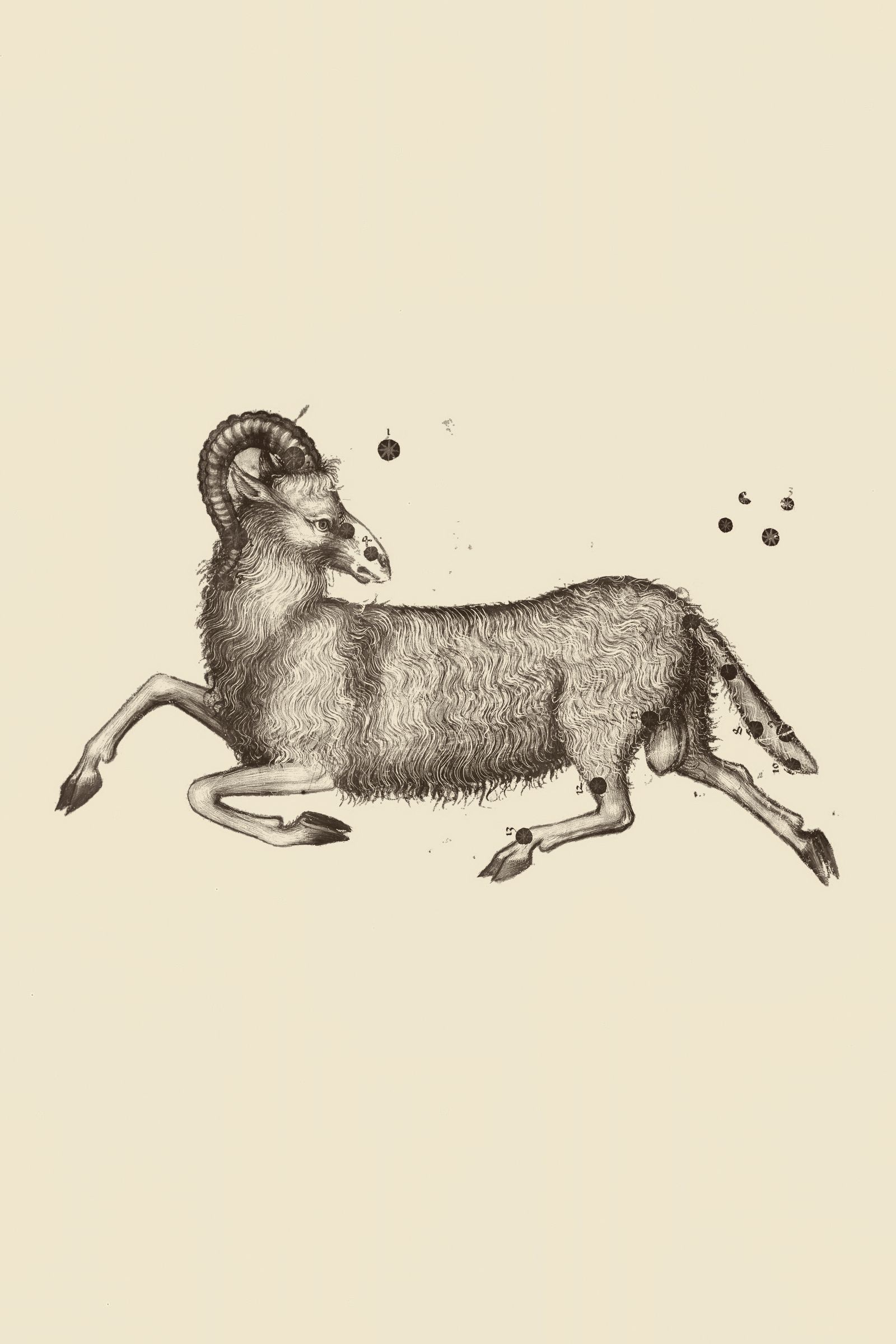
1. Aries, constellation figure
An unknown painter, Aries, constellation figure, northern Italy, c. 1370–1400. Strahov Library, Prague (Cod. DA II 13, fol. 20r), from a Wellcome Collection photograph of 1940. Complete composition. Restored by Surrealium at Vaxholm Fortress, Sweden.
The book opens its zodiac with the ram. He stretches out with his legs reaching forward and back and his head turned back over his shoulder, the way Aries had been drawn since antiquity. The painter built the fleece from short, curling strokes and set only a few stars into the body. The others sit beside him, numbered, as the stars "outside the figure".
One small animal on a mostly empty sheet: it works where a room needs calm.
See the print of Aries, constellation figure
2. Taurus, constellation figure
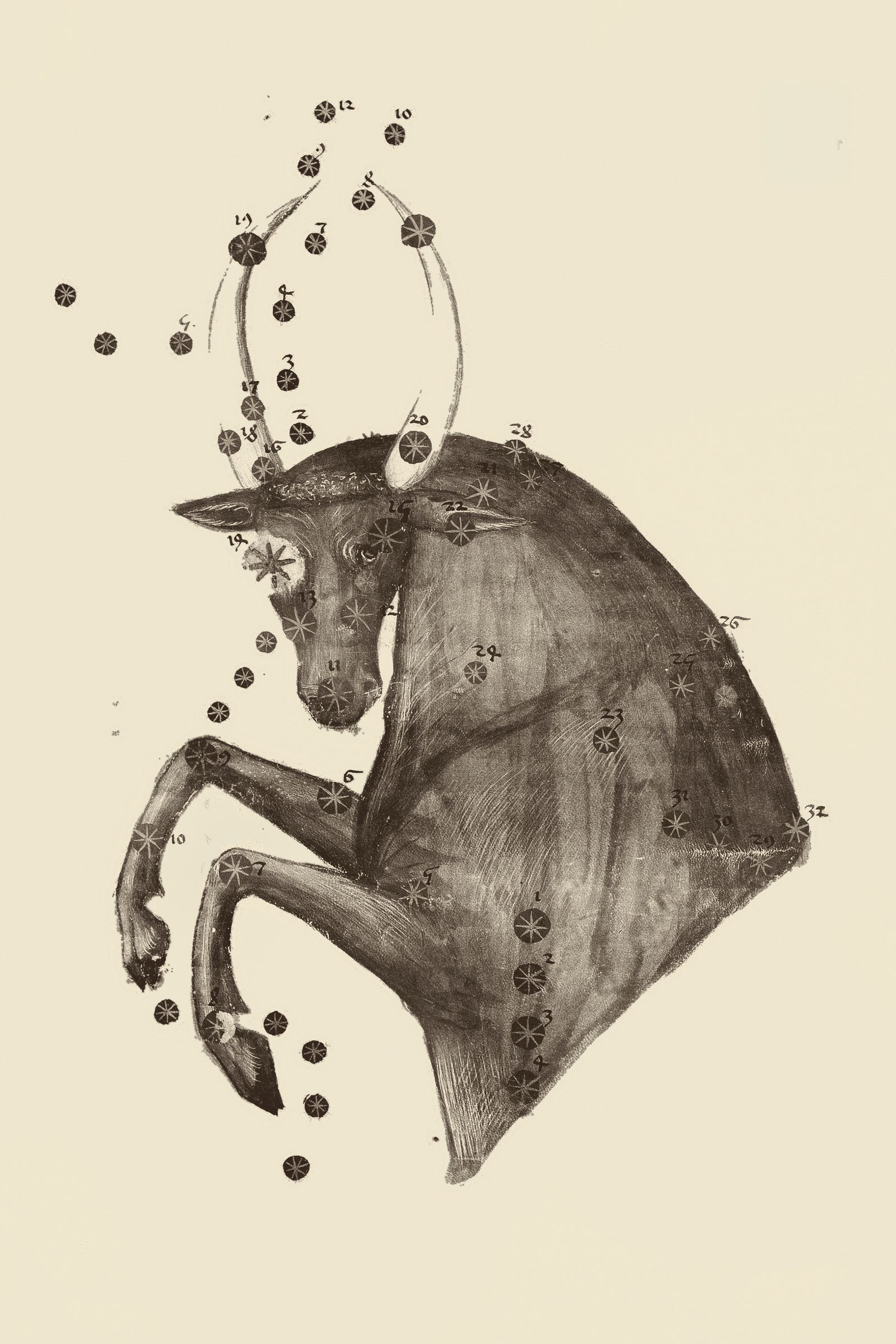
An unknown painter, Taurus, constellation figure, northern Italy, c. 1370–1400. Strahov Library, Prague (Cod. DA II 13, fol. 21v), from a Wellcome Collection photograph of 1940. Complete composition. Restored by Surrealium at Vaxholm Fortress, Sweden.
Taurus is only half a bull. Since Ptolemy the constellation has been the animal's front half, and this painter ends the body with one clean diagonal line. The bull rears with his forelegs bent and his head lowered, and a chain of small numbered stars climbs past his horns.
Dark and heavy, with a strong diagonal: it holds a wall on its own.
See the print of Taurus, constellation figure
3. Gemini, constellation figure
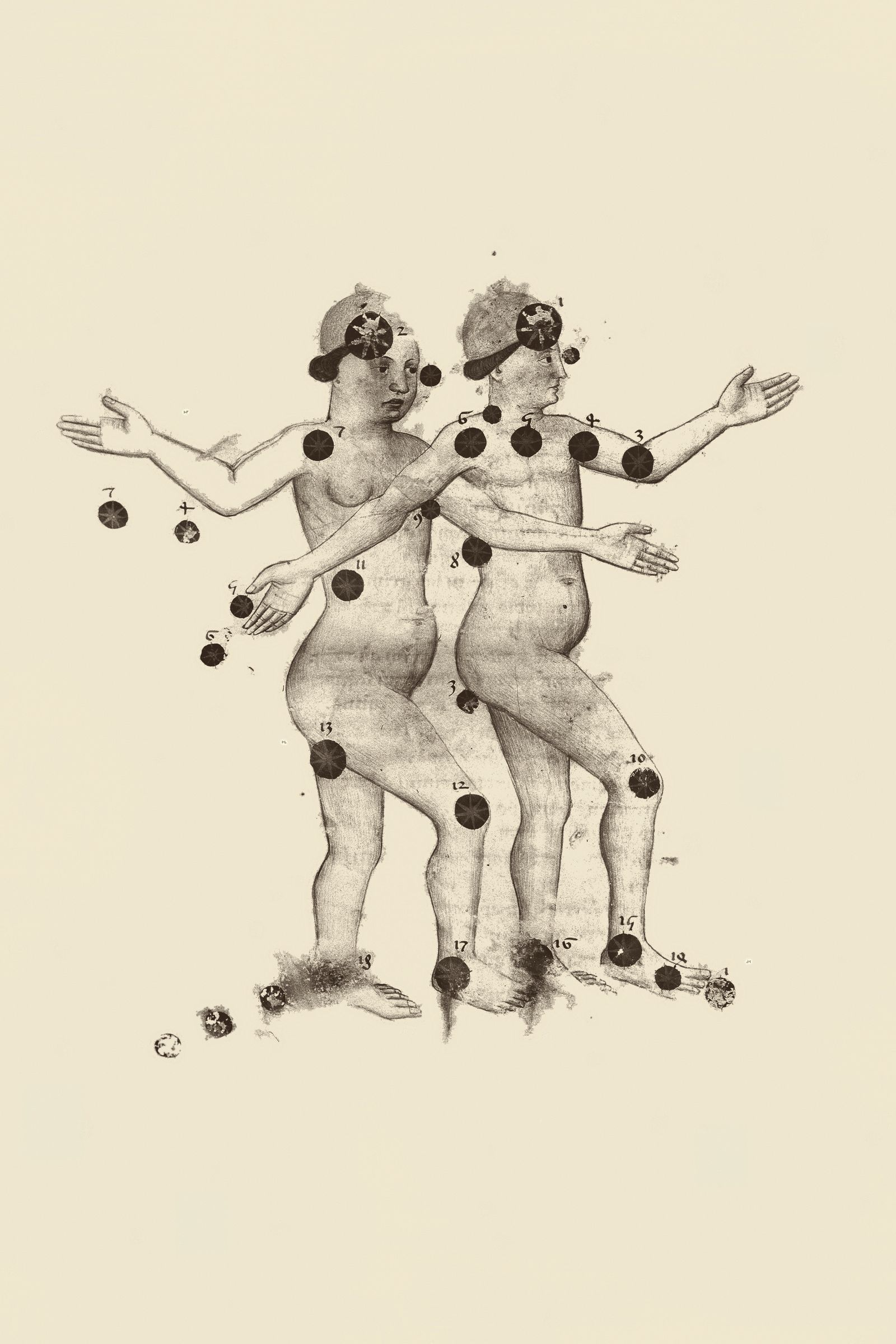
An unknown painter, Gemini, constellation figure, northern Italy, c. 1370–1400. Strahov Library, Prague (Cod. DA II 13, fol. 22v), from a Wellcome Collection photograph of 1940. Complete composition. Restored by Surrealium at Vaxholm Fortress, Sweden.
The twins stand naked, side by side, each with an arm around the other and the free arm thrown wide. The two largest star wheels sit on their heads. These are Castor and Pollux, the brightest stars of the constellation, which still carry the twins' names. A small number beside each star ties it to its line in the star tables.
Two pale figures and very little else: tender, and light on a wall.
See the print of Gemini, constellation figure
4. Cancer, constellation figure
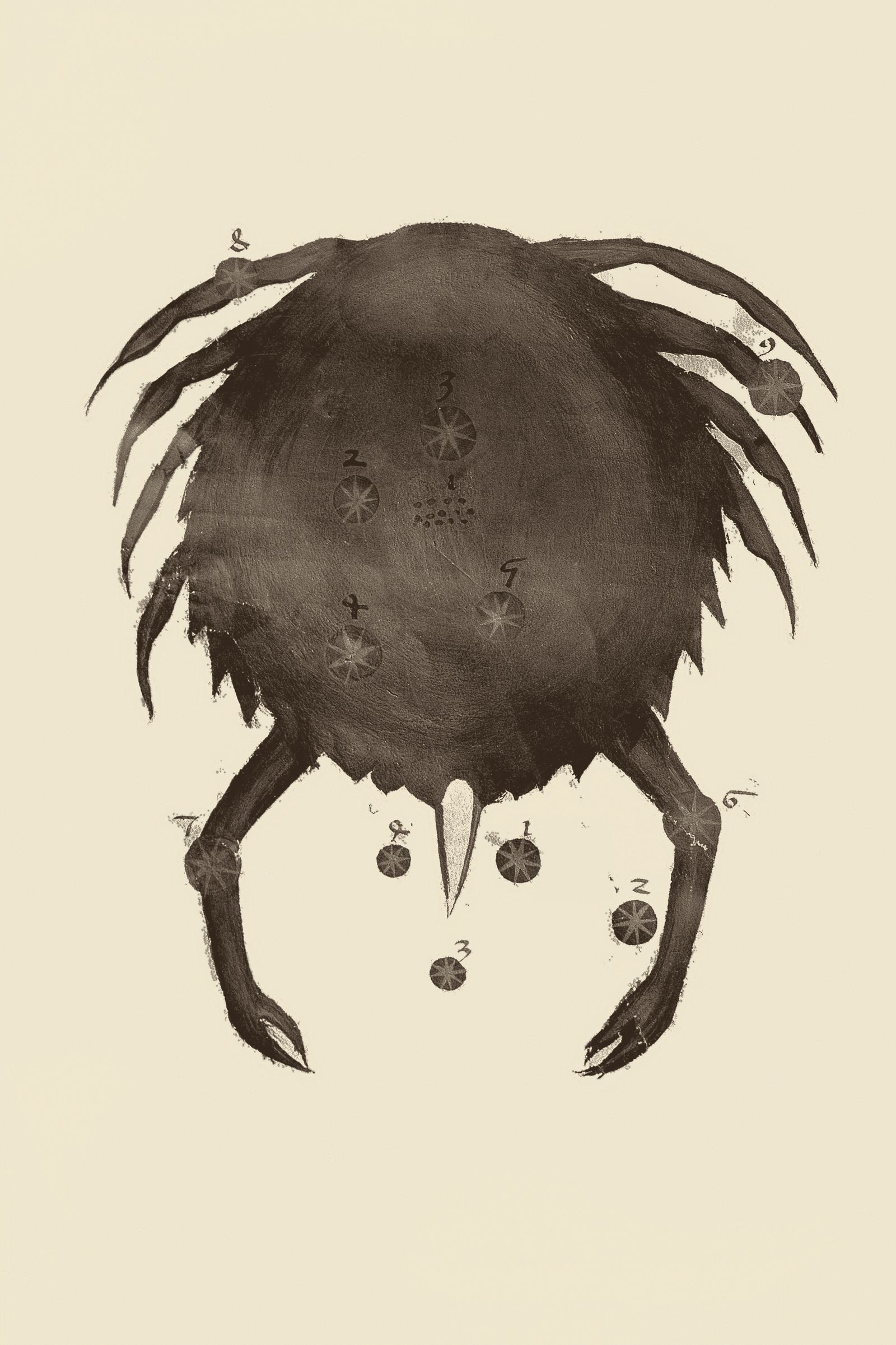
An unknown painter, Cancer, constellation figure, northern Italy, c. 1370–1400. Strahov Library, Prague (Cod. DA II 13, fol. 23v), from a Wellcome Collection photograph of 1940. Complete composition. Restored by Surrealium at Vaxholm Fortress, Sweden.
Cancer is seen from above, as you would see a crab on the shore: a round dark shell, a fringe of spiny legs and two claws reaching down. Its stars are set into the shell like rivets. Cancer is one of the faintest constellations in the real sky, and here it has the darkest, densest body in the book.
A single dark shape on pale ground: graphic enough for a modern room.
See the print of Cancer, constellation figure
5. Leo, constellation figure
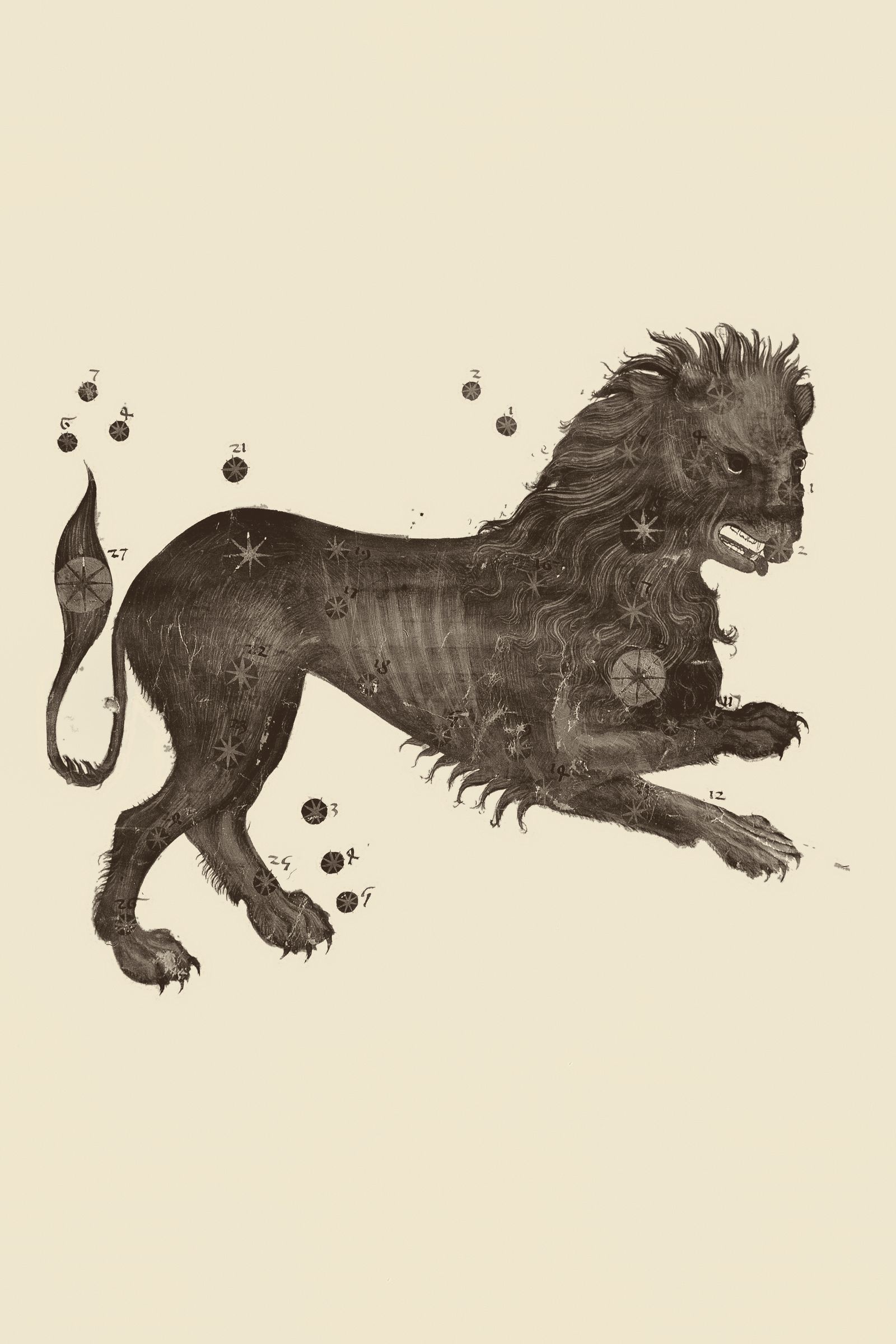
An unknown painter, Leo, constellation figure, northern Italy, c. 1370–1400. Strahov Library, Prague (Cod. DA II 13, fol. 25r), from a Wellcome Collection photograph of 1940. Complete composition. Restored by Surrealium at Vaxholm Fortress, Sweden.
The lion strides to the right with his mouth open, his mane shaggy and his tail raised behind him. A star sits in the tuft of the tail, where astronomers still place Denebola, whose Arabic name means "the lion's tail". The rest of his body is studded with numbered stars, each one keyed to Ptolemy's list.
The strongest animal of the twelve: it suits a hall or the wall above a desk.
See the print of Leo, constellation figure
6. Virgo, constellation figure
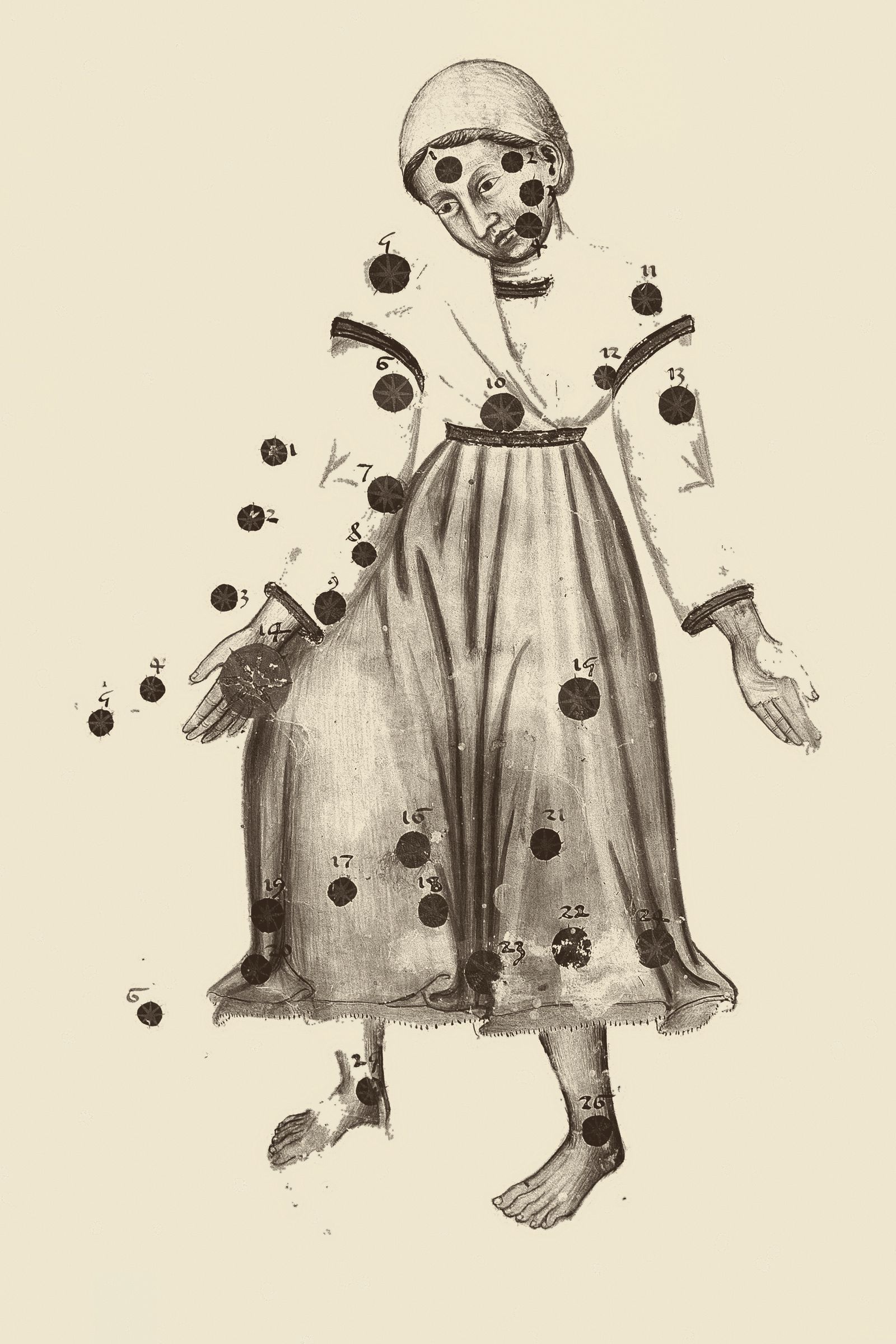
An unknown painter, Virgo, constellation figure, northern Italy, c. 1370–1400. Strahov Library, Prague (Cod. DA II 13, fol. 26v), from a Wellcome Collection photograph of 1940. Complete composition. Restored by Surrealium at Vaxholm Fortress, Sweden.
Virgo is a young woman in a long, belted gown and a close cap, standing barefoot with her hands open at her sides. Her stars run down her body from head to hem like a row of buttons. She looks less like a classical goddess than like someone from the painter's own world.
A standing figure with a calm face: it fits a bedroom or a narrow wall.
See the print of Virgo, constellation figure
7. Libra, constellation figure
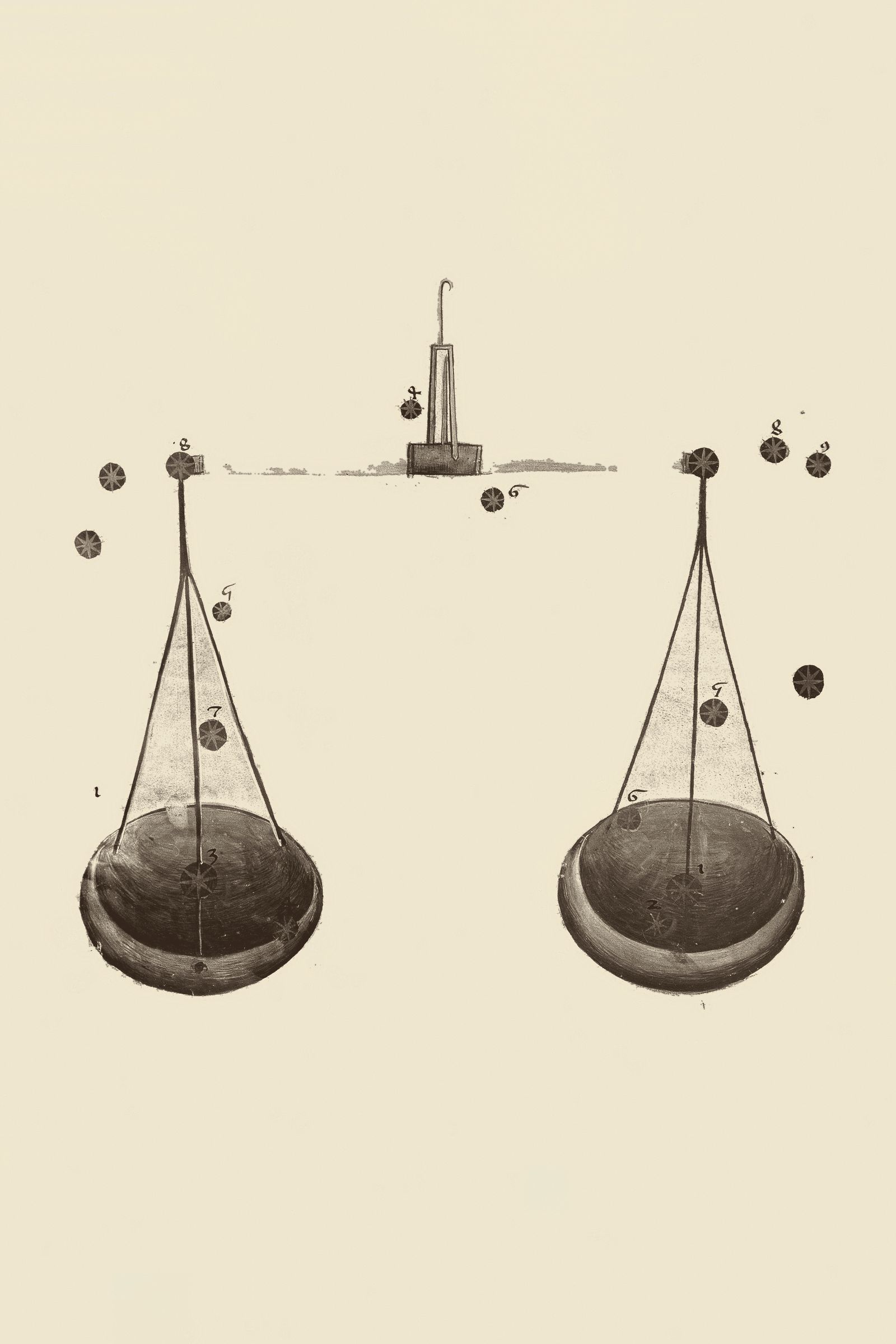
An unknown painter, Libra, constellation figure, northern Italy, c. 1370–1400. Strahov Library, Prague (Cod. DA II 13, fol. 27v), from a Wellcome Collection photograph of 1940. Complete composition. Restored by Surrealium at Vaxholm Fortress, Sweden.
Libra is the only sign of the twelve that is not a living thing. Ptolemy's catalogue still lists its stars as the scorpion's claws, but the Romans already saw a balance there, and this book follows them. The two pans hang on fine threads from a beam, with a small post rising at the centre. The faint beam is drawn that way in the manuscript.
Almost abstract, all line and space: it pairs well with modern furniture.
See the print of Libra, constellation figure
8. Scorpio, constellation figure
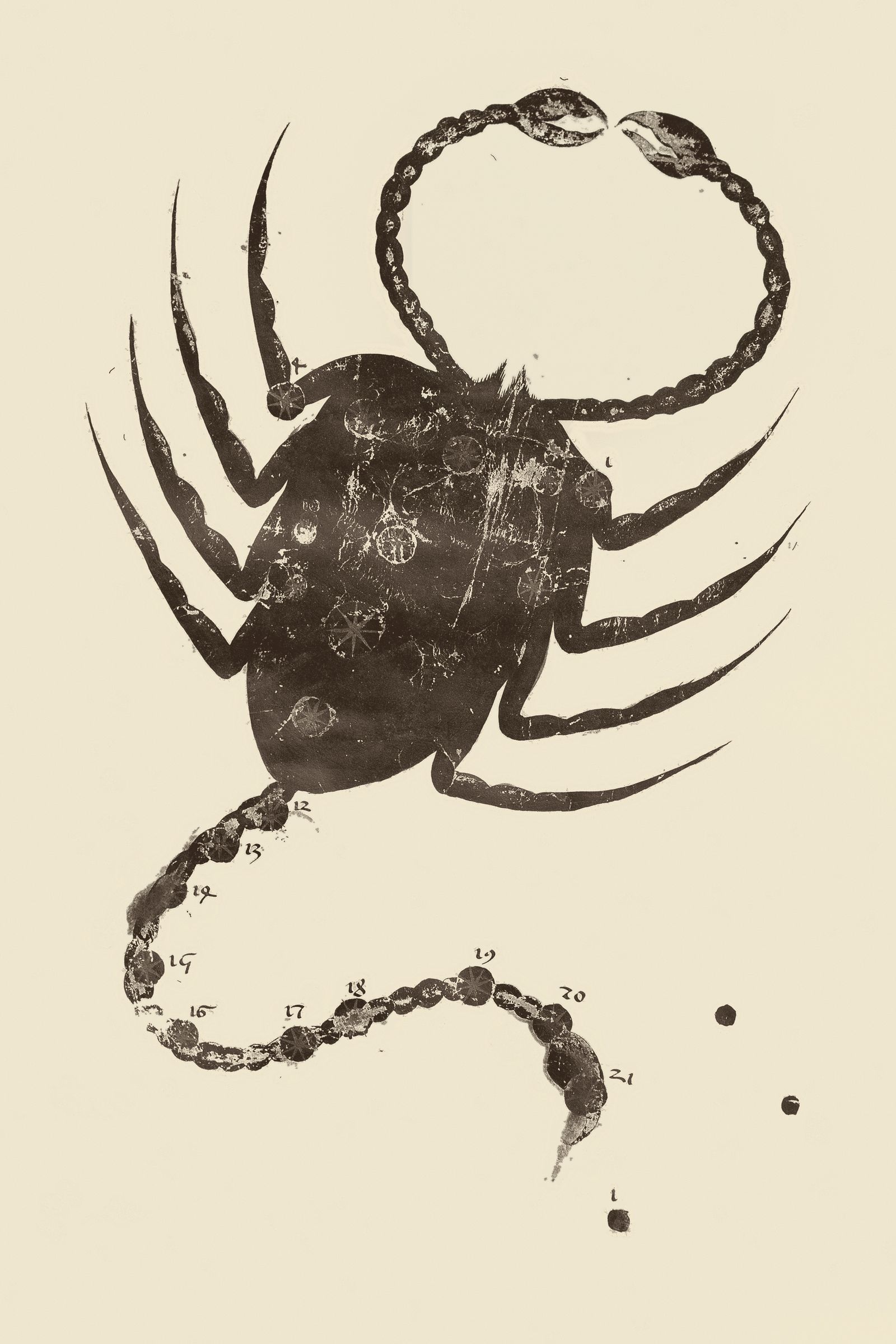
An unknown painter, Scorpio, constellation figure, northern Italy, c. 1370–1400. Strahov Library, Prague (Cod. DA II 13, fol. 28v), from a Wellcome Collection photograph of 1940. Complete composition. Restored by Surrealium at Vaxholm Fortress, Sweden.
The scorpion's claws curl up and meet over its head in a loop. Its tail runs down the page as a chain of beads, each bead a numbered star, and ends in the sting. Wellcome catalogued its photograph of this page as Cancer by mistake.
The most dramatic shape in the book, from top to bottom: made for a tall wall.
See the print of Scorpio, constellation figure
9. Sagittarius, constellation figure
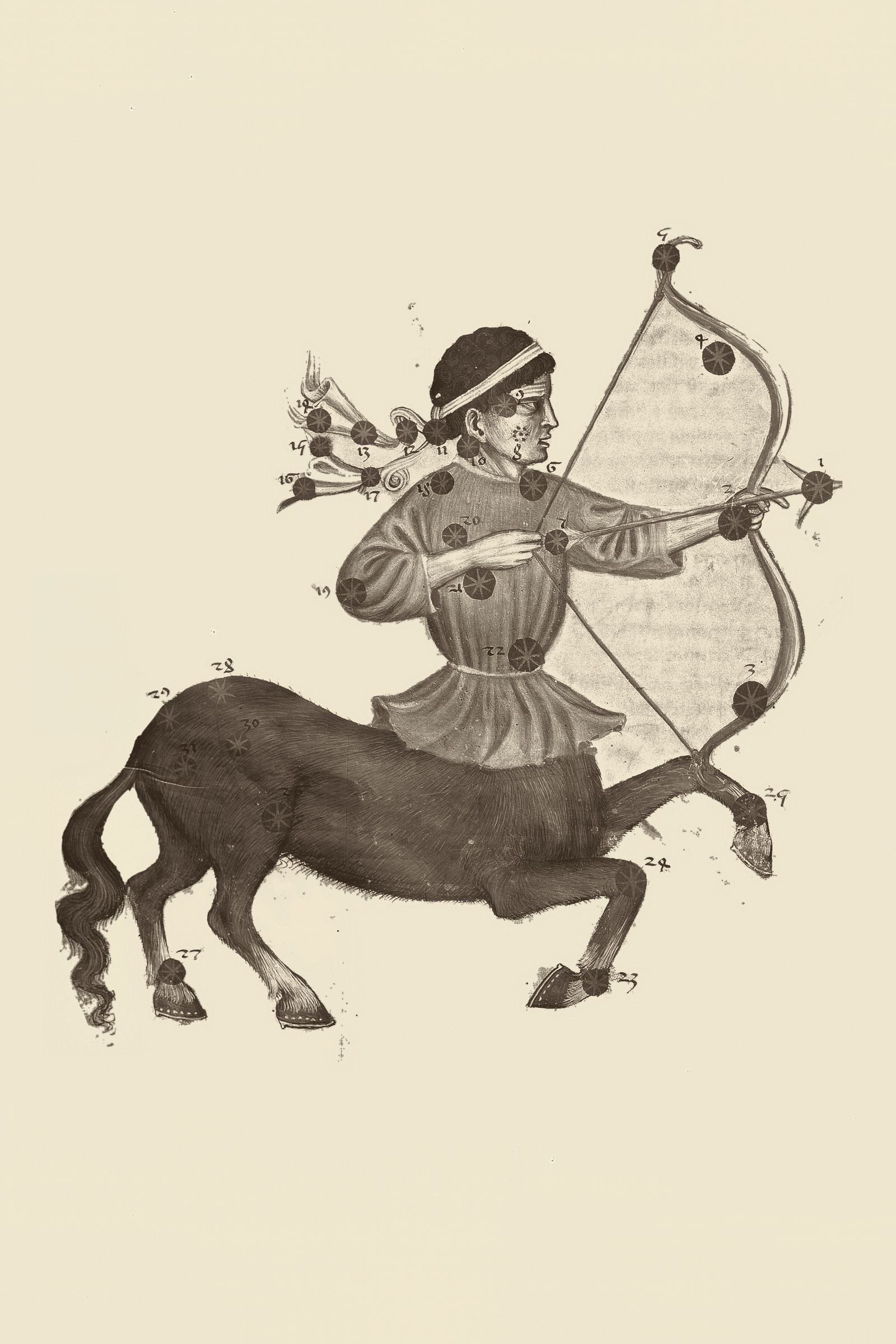
An unknown painter, Sagittarius, constellation figure, northern Italy, c. 1370–1400. Strahov Library, Prague (Cod. DA II 13, fol. 29v), from a Wellcome Collection photograph of 1940. As photographed in 1940; the photograph trims the edge of the drawing. Restored by Surrealium at Vaxholm Fortress, Sweden.
Sagittarius is a centaur in a belted tunic and a headband. He draws a bow with an arrow on the string and carries a quiver of feathered arrows on his back. The 1940 photograph cuts the page close to the horse's haunch on the left, and nothing has been painted in.
Movement and tension in one figure: it brings energy to a quiet room.
See the print of Sagittarius, constellation figure
10. Capricorn, constellation figure
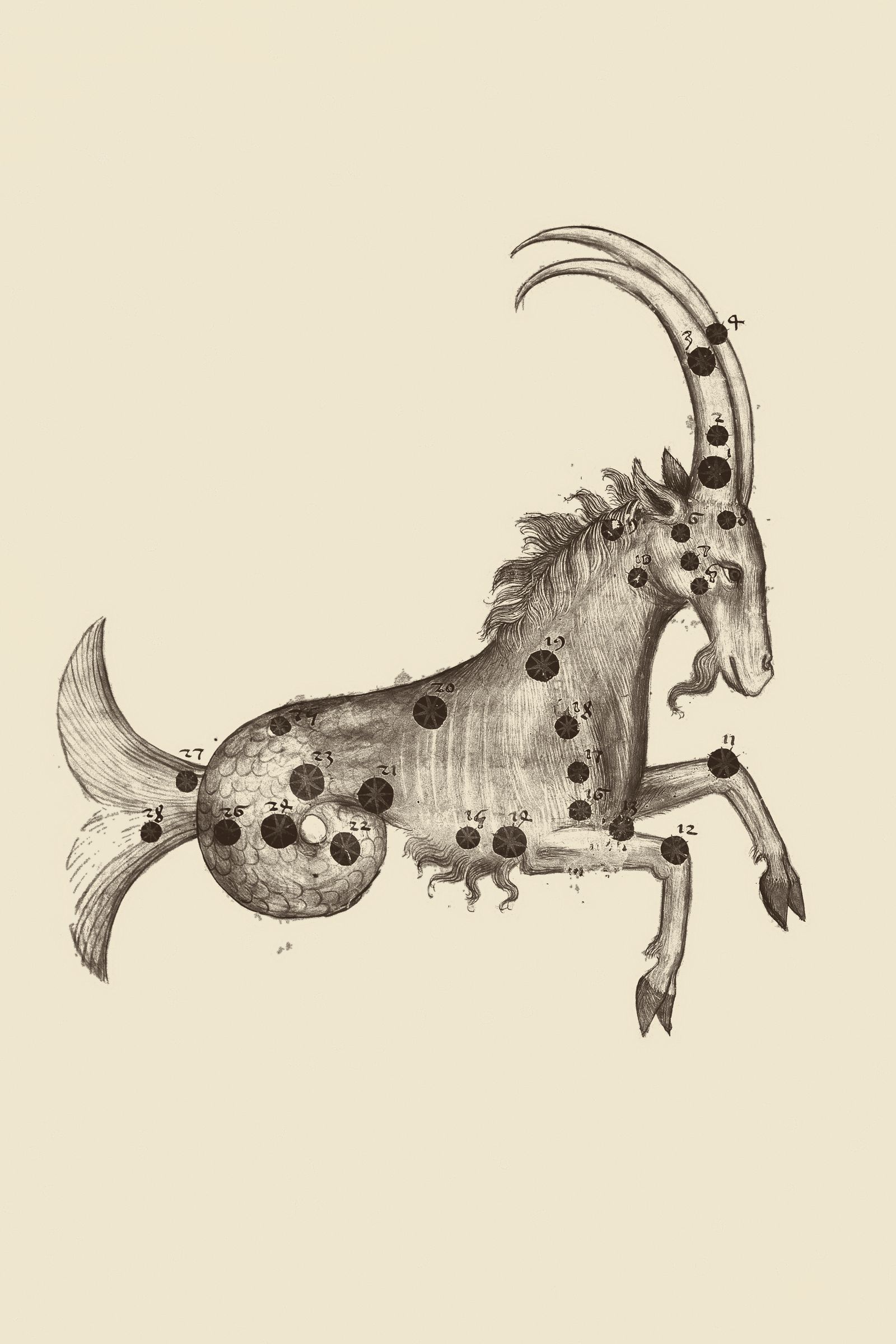
An unknown painter, Capricorn, constellation figure, northern Italy, c. 1370–1400. Strahov Library, Prague (Cod. DA II 13, fol. 30v), from a Wellcome Collection photograph of 1940. As photographed in 1940; the photograph trims the edge of the drawing. Restored by Surrealium at Vaxholm Fortress, Sweden.
Capricorn is the sea-goat: a goat's front half, with long swept-back horns and a beard, ending in a curled fish's tail. The creature is older than Greek astronomy and goes back to Mesopotamia. This painter gives the goat a hatched coat and the tail a fringe of fins. The 1940 photograph just trims the tip of one fin.
Strange and elegant at once: a good choice for a study.
See the print of Capricorn, constellation figure
11. Aquarius, constellation figure
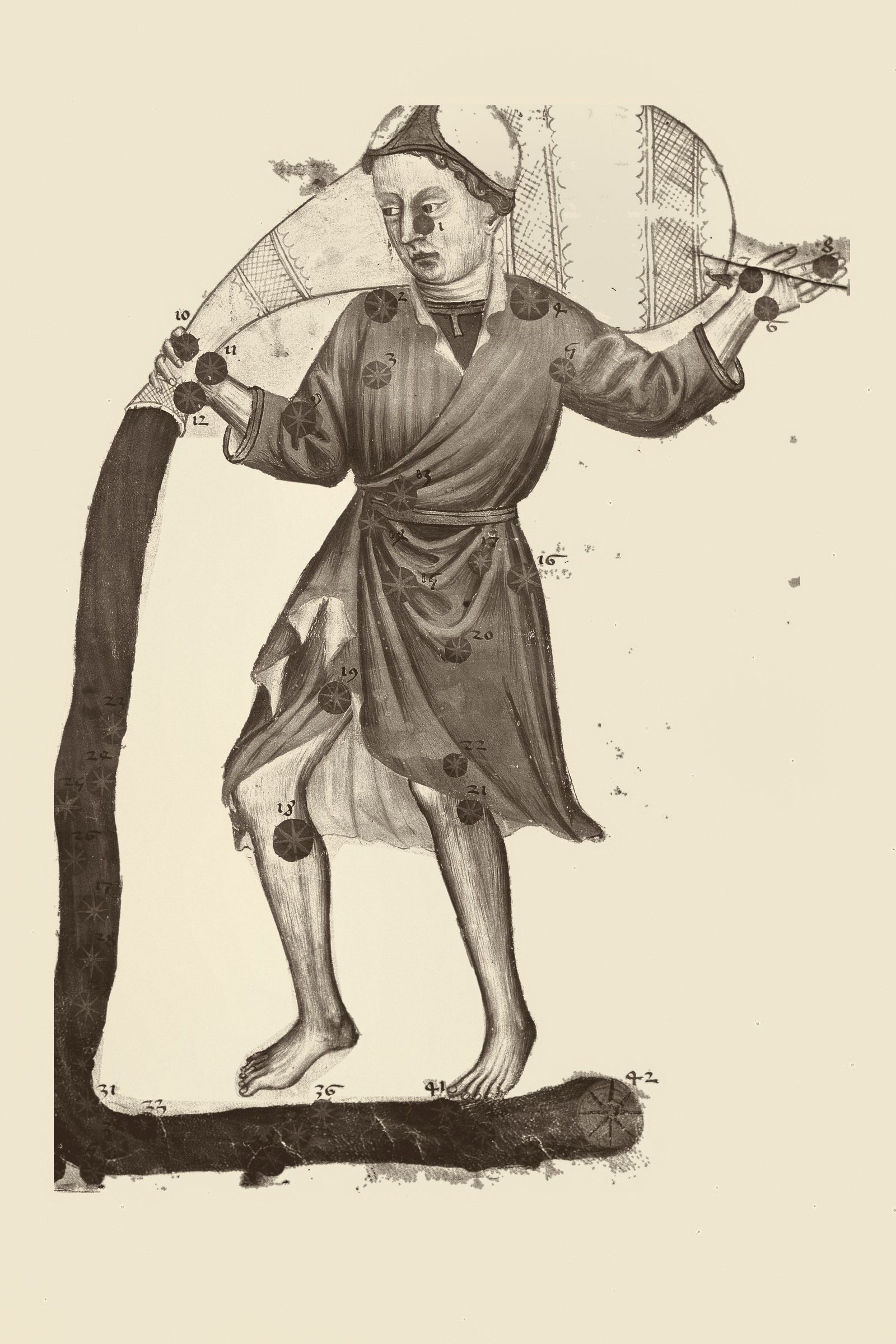
An unknown painter, Aquarius, constellation figure, northern Italy, c. 1370–1400. Strahov Library, Prague (Cod. DA II 13, fol. 33r), from a Wellcome Collection photograph of 1940. As photographed in 1940; the photograph trims the edge of the drawing. Restored by Surrealium at Vaxholm Fortress, Sweden.
Aquarius is a barefoot young man in a knee-length robe and a cap, carrying a great jar across his shoulders. The water pours from its mouth on the left, falls down the page and turns at his feet in an L. In the manuscript the stream is painted green. The 1940 photograph cuts it close at the left and the bottom.
A tall figure framed by its own stream: it fits a narrow hall.
See the print of Aquarius, constellation figure
12. Pisces, constellation figure
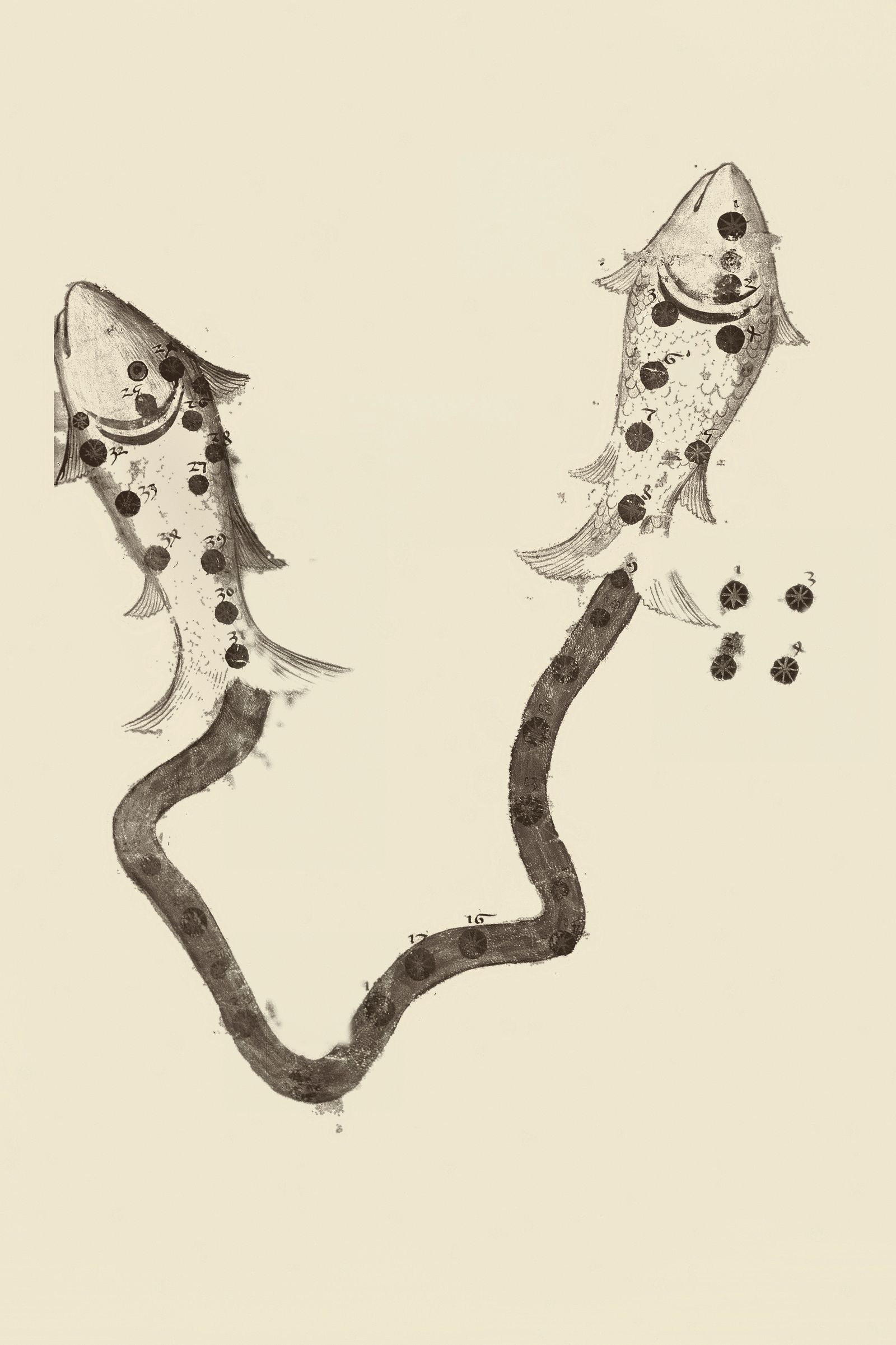
An unknown painter, Pisces, constellation figure, northern Italy, c. 1370–1400. Strahov Library, Prague (Cod. DA II 13, fol. 32v), from a Wellcome Collection photograph of 1940. Complete composition. Restored by Surrealium at Vaxholm Fortress, Sweden.
The two fish rise side by side, heading up and away from each other, joined tail to tail by a long winding band. Classical writers called that band a cord tying the fish together. This book paints it as a green stream with a kink in the middle, and scatters stars along both fish and down the stream.
Light and lively, with one long line running through it: lovely over a bed.
See the print of Pisces, constellation figure
13. Sea-lion (Cetus), constellation figure
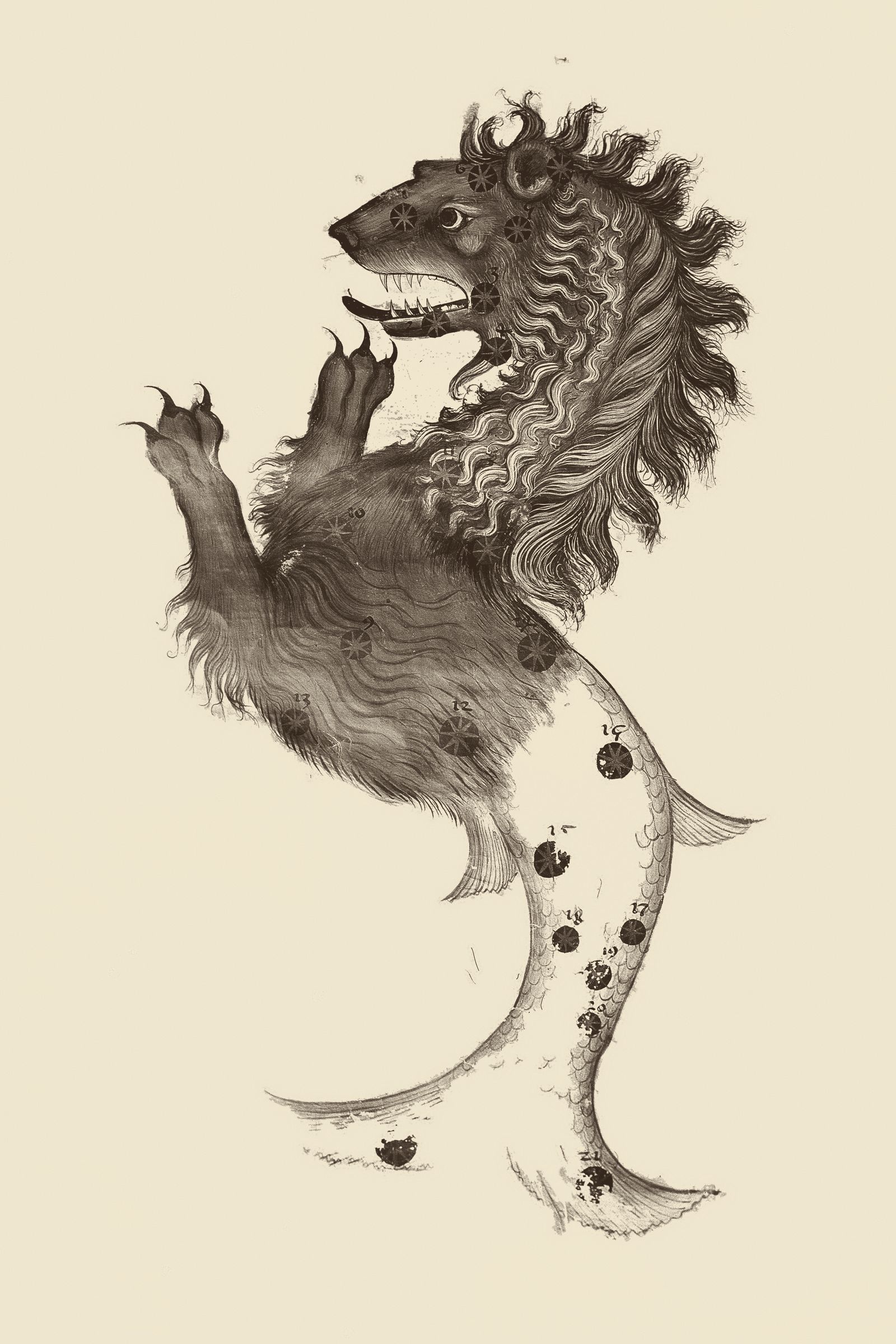
An unknown painter, Sea-lion (Cetus), constellation figure, northern Italy, c. 1370–1400. Strahov Library, Prague (Cod. DA II 13, fol. 34v), from a Wellcome Collection photograph of 1940. Complete composition. Restored by Surrealium at Vaxholm Fortress, Sweden.
Ptolemy's Cetus is a sea monster. This book makes it a lion of the sea, rearing upright on the page with its jaws open: a lion's head, mane and raised claws on a scaled fish's body. In the manuscript the head is brown, the chest and paws green and the fish's body silver. The oldest surviving Latin copy of the book, made in Bologna around 1265, already has a sea-lion here, so the idea was more than a century old when this page was painted.
The strangest creature in the book, and a conversation piece anywhere.
See the print of Sea-lion (Cetus), constellation figure
The book has had a long life. Its scribe signed himself Petrus de Guioldis, and the arms of two families, da Casteliono and de Martignoni, are painted on its first page. By the middle of the seventeenth century it was in the library of the Clementinum, the Jesuit college in Prague, and in 1754 Joseph Stepling, who ran the Clementinum's observatory, wrote his own notes into it. It was restored at the Strahov Monastery in 1990. After the stars come shorter texts on precious stones, on the powers of herbs and on engraved seals.
Copies of the Wellcome photographs still circulate with an old caption: an unidentified thirteenth-century manuscript in Vienna. The drawings match the Prague book page for page, as the Saxl Project's description and a digitised copy show, and Wellcome's own record now points to the Strahov Library.
All thirteen hang in the Astrology through the ages series in Masterworks, in zodiac order, beside Baghdad's Book of Wonders, Cellarius's atlas and Mucha's Zodiac. The story of that series follows the zodiac across five centuries. Every print is made to order from the restored file.