Urania's Mirror: the constellation cards you held up to a candle
In 1824 a London bookseller sold the night sky in a box: thirty-two hand-coloured cards by the engraver Sidney Hall, each star punched through so it shone when held to the light. Here are twenty-nine of them, from the dragon at the pole to a ship, an owl and a cat in the southern sky.
In November 1824 Samuel Leigh, a bookseller at 18 Strand in London, began selling a small box called Urania's Mirror, or a View of the Heavens. Inside were thirty-two cards, each eight inches by five and a half, and a little book by Jehoshaphat Aspin, A Familiar Treatise on Astronomy. Every card is an etching by the engraver Sidney Hall of one patch of the night sky: its constellations drawn as figures, its stars named, the borders between constellations traced in dotted lines. The lid showed Urania, the muse of astronomy. A plain set cost £1 8s; a fully coloured one, like these, £1 14s.
The cards had one trick. Every star is punched right through the card, and the holes are cut larger for brighter stars. Hold a card up to a window or a candle and the figure fades back while its stars shine through in their true pattern, which is how you were meant to learn to find them in the real sky. The astronomy historian Ian Ridpath has pointed out that the light of 1824 was mostly candlelight, so many cards must have been scorched or burned by readers who held them too close.
The drawings were copied, closely, from Alexander Jamieson's Celestial Atlas of 1822. Together the cards show seventy-nine constellations, and beside the ones we still use are some the sky has since lost: a reindeer, a harvest-keeper, a hot-air balloon, an electrical machine, the harp of King George III and a cat. Our pictures come from the coloured set in the Library of Congress. Here are twenty-nine of the thirty-two cards, in the set's own order, from the dragon coiled around the pole to the crowded southern card that closes it.
1. Draco and Ursa Minor
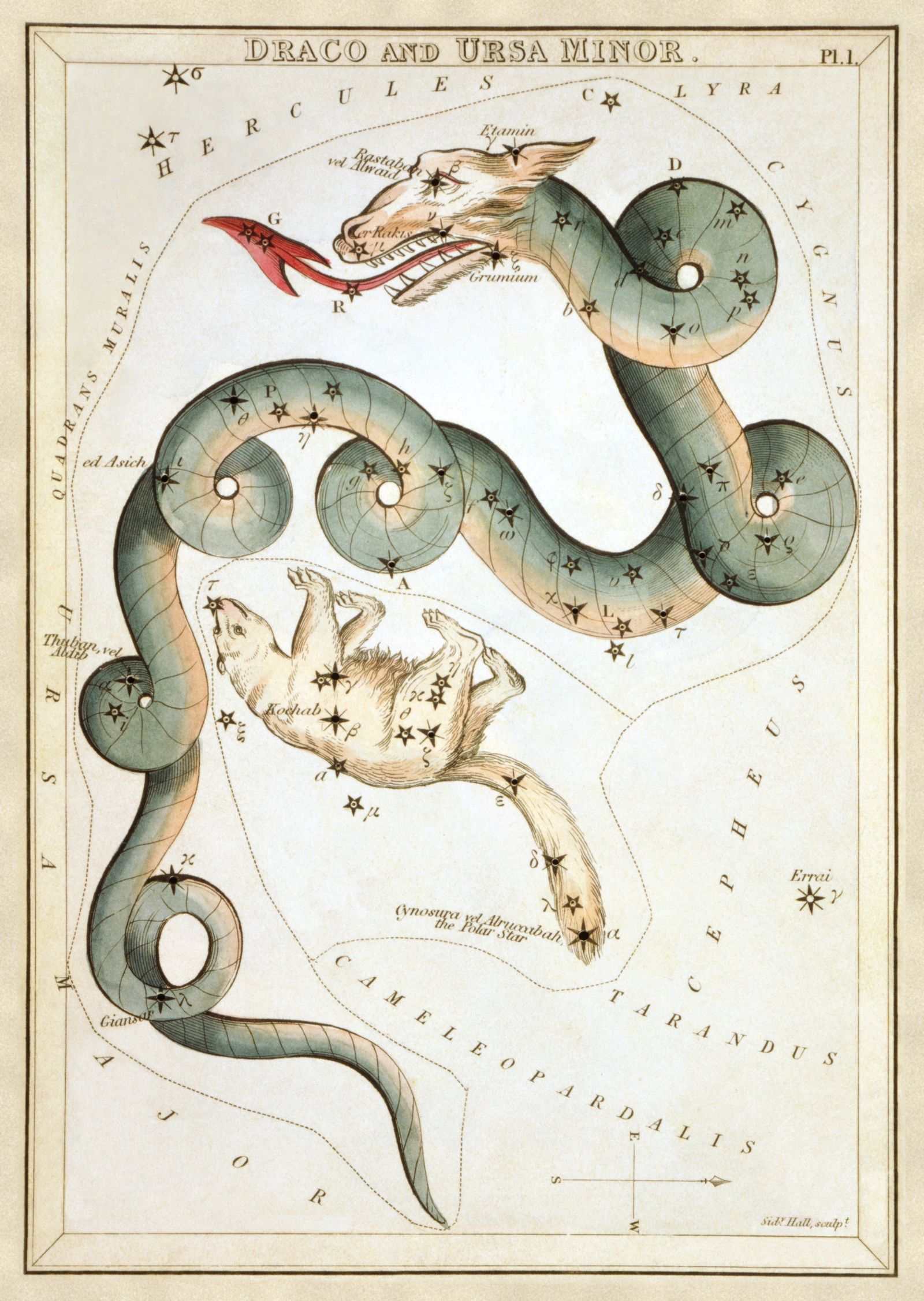
Sidney Hall, Draco and Ursa Minor, card 1 of Urania's Mirror, 1824. Library of Congress, Washington (Prints and Photographs, cph.3g10050). Complete card. Prepared for print by Surrealium at Vaxholm Fortress, Sweden.
The set opens at the top of the sky. Draco, the dragon, winds in green-grey coils between the two bears, with a red forked tongue and a wolfish head. Inside his loops sits the Little Bear, and the last star of its tail is Polaris, the pole star. Five thousand years ago the pole star was Thuban, one of the dragon's own stars.
One long, looping line on a pale ground: it suits a tall, narrow wall.
See the print of Draco and Ursa Minor
2. Camelopardalis, Tarandus and Custos Messium
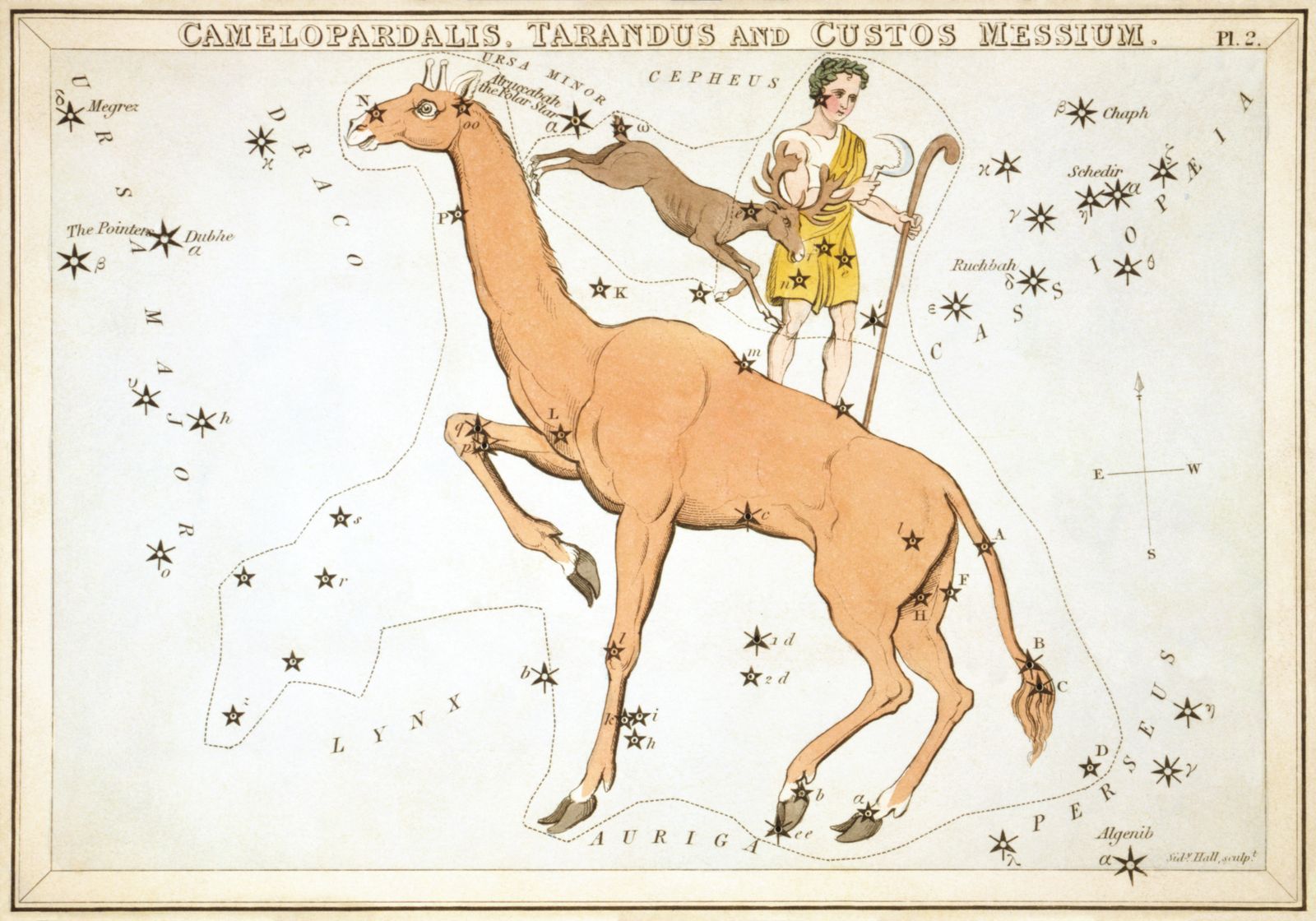
Sidney Hall, Camelopardalis, Tarandus and Custos Messium, card 2 of Urania's Mirror, 1824. Library of Congress, Washington. Complete card. Prepared for print by Surrealium at Vaxholm Fortress, Sweden.
A giraffe strides across the far north, which is where the Dutch mapmaker Petrus Plancius put one around 1612. Above it leaps Tarandus, a reindeer, and behind stands Custos Messium, the keeper of the harvest, a young man with a sickle and a crook. Lalande invented him in 1775 as a pun on Messier, the comet-hunter. Neither the reindeer nor the boy survives on modern star maps.
Gentle, funny and pale: a lovely card for a child's room.
See the print of Camelopardalis
3. Cassiopeia
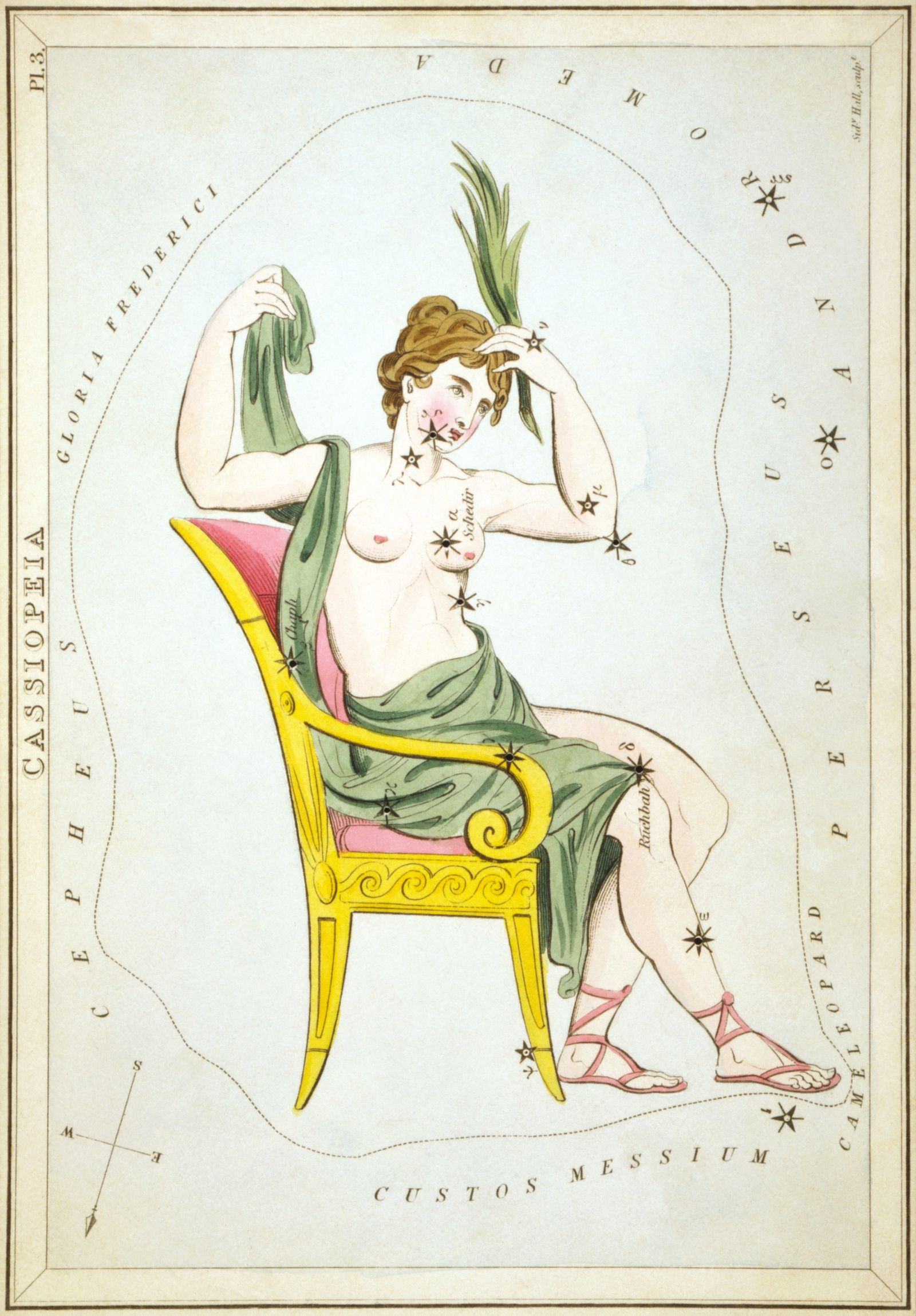
Sidney Hall, Cassiopeia, card 3 of Urania's Mirror, 1824. Library of Congress, Washington. Complete card. Prepared for print by Surrealium at Vaxholm Fortress, Sweden.
The queen of Ethiopia sits on a gilded throne, half wrapped in green, holding up a palm branch. In the myth she boasted that her daughter was more beautiful than the sea nymphs, and was set in the sky on her chair as a punishment, so that for part of every night she hangs upside down. Her five brightest stars make the W that is easy to find on any clear night. The card itself is printed sideways, with its title along the long edge, so the print hangs her upright on her throne.
A single seated figure with a golden chair: elegant in a bedroom or a dressing room.
4. Cepheus
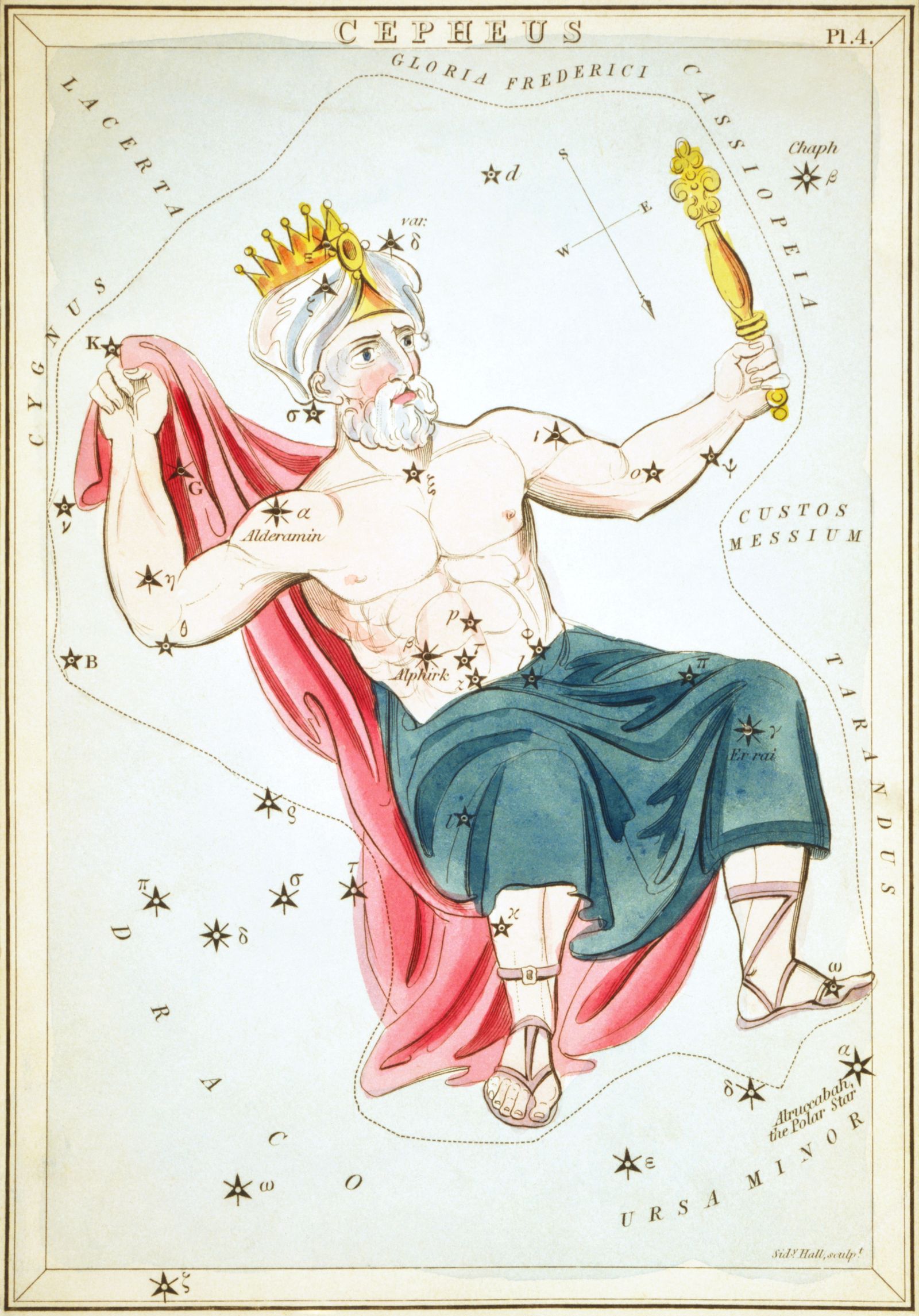
Sidney Hall, Cepheus, card 4 of Urania's Mirror, 1824. Library of Congress, Washington. Complete card. Prepared for print by Surrealium at Vaxholm Fortress, Sweden.
Cassiopeia's husband, King Cepheus, sits beside her in the sky, white-bearded, with a crown set over a white turban, a red cloak billowing behind him and a sceptre raised in his right hand. Hall gives him a heavy blue robe and sandals. The king is a faint constellation, but one of his stars, Delta Cephei, gave its name to the Cepheid variables that later let astronomers measure the distances to other galaxies.
Rich reds and blues on a pale ground: it gives weight to a study or a hall.
5. Gloria Frederici, Andromeda and Triangula
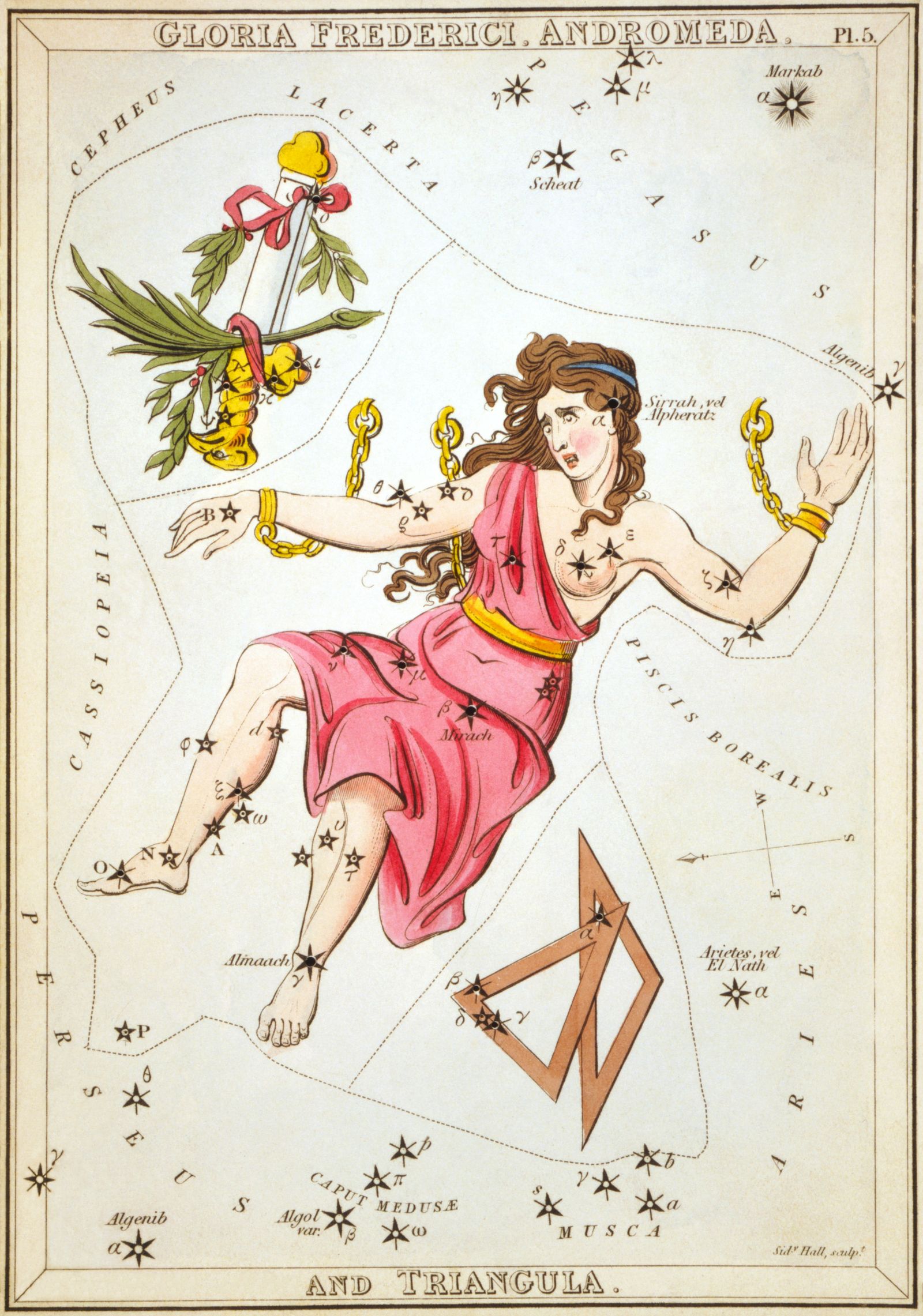
Sidney Hall, Gloria Frederici, Andromeda and Triangula, card 5 of Urania's Mirror, 1824. Library of Congress, Washington. Complete card. Prepared for print by Surrealium at Vaxholm Fortress, Sweden.
Andromeda, the daughter of Cepheus and Cassiopeia, floats in a pink robe with her wrists still in broken chains, the way she was left for the sea monster. Above her hangs a strange trophy: a sword and a pen, with sprays of laurel and olive tied in ribbons. This is Gloria Frederici, Frederick's Glory, which the German astronomer Johann Bode made in 1787 to honour Frederick the Great. Below her lie the two triangles, Triangulum and a smaller one that has since gone.
A dancing figure and a scatter of emblems: it brings movement to a quiet wall.
See the print of Gloria Frederici
6. Auriga
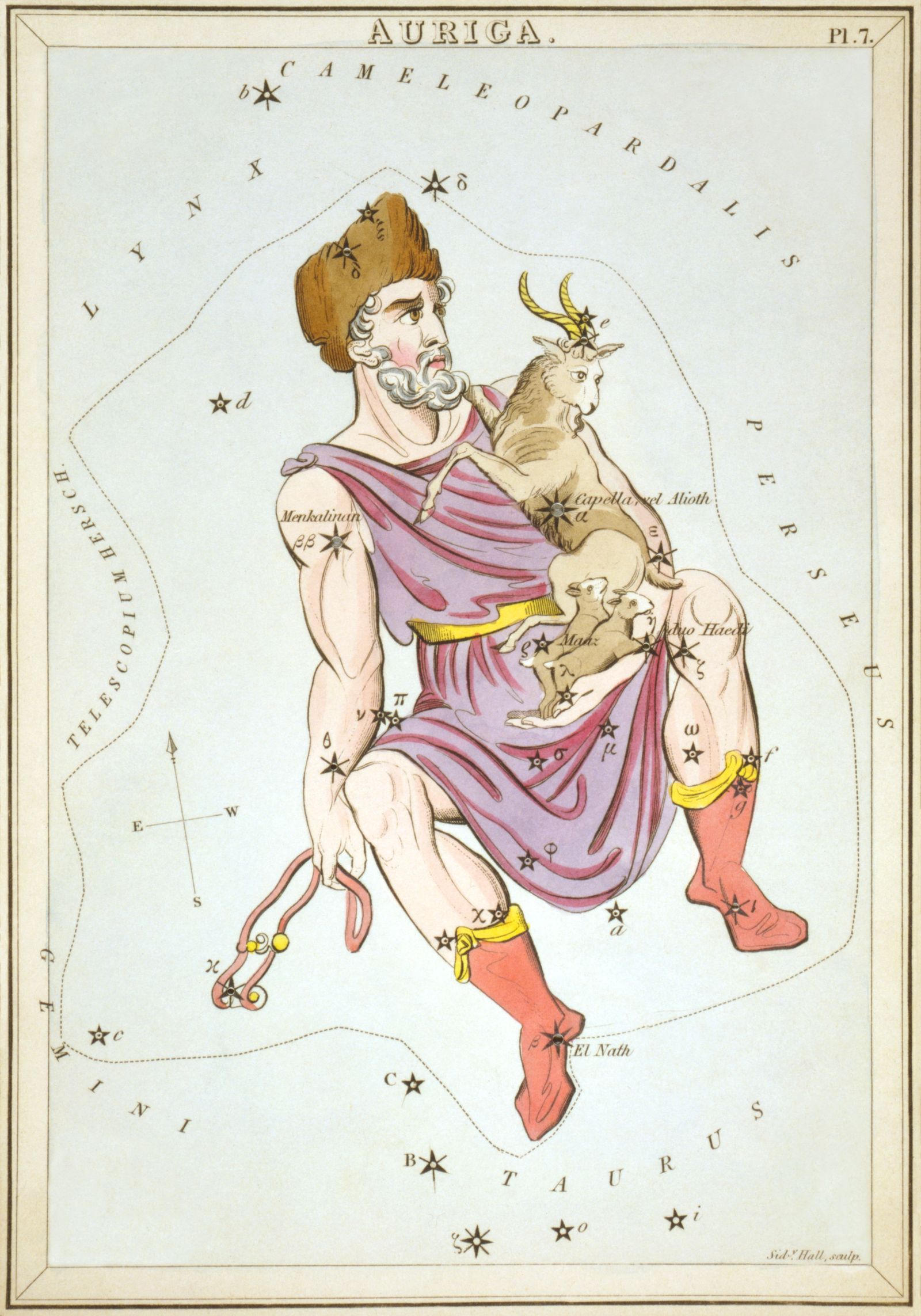
Sidney Hall, Auriga, card 7 of Urania's Mirror, 1824. Library of Congress, Washington. Complete card. Prepared for print by Surrealium at Vaxholm Fortress, Sweden.
The charioteer is an old man in a fur cap, a purple cloak and red boots, with the reins in one hand and a goat held against his chest, and her two kids, the Haedi, are with him too. The goat is Capella, whose name means the little she-goat, and it is the sixth-brightest star in the night sky. Ancient star-gazers already saw a man carrying goats here, so Hall's charioteer has no chariot at all.
A warm, homely figure in strong colour: good beside a fireplace or a reading chair.
7. Ursa Major
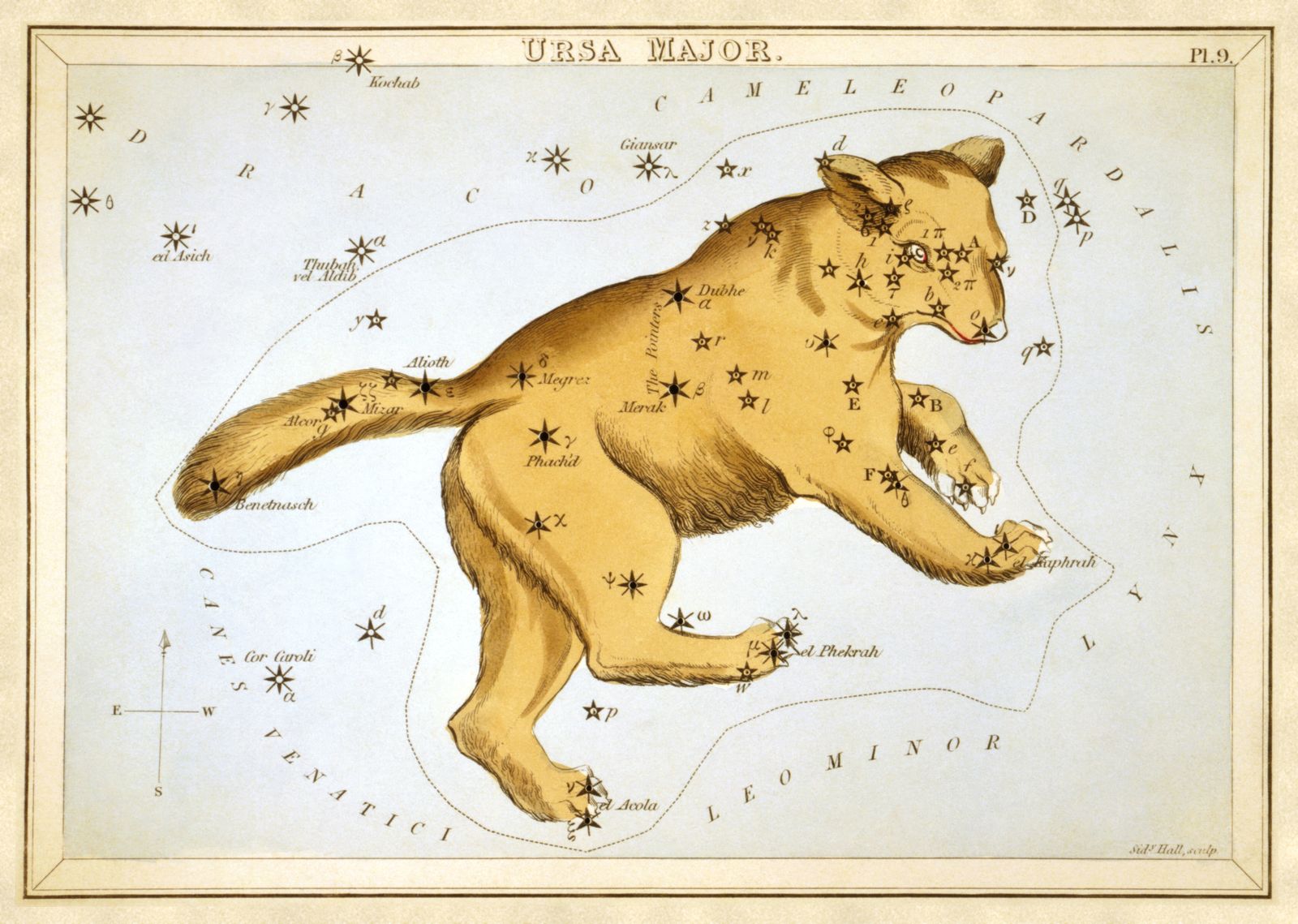
Sidney Hall, Ursa Major, card 9 of Urania's Mirror, 1824. Library of Congress, Washington (Prints and Photographs, Urania’s Mirror plate 9). Complete card. Prepared for print by Surrealium at Vaxholm Fortress, Sweden.
The Great Bear walks across a pale blue sky in honey-gold, with a long tail that no real bear has. Seven of its stars make the Plough, or the Big Dipper: four in the body and three along the tail. The two stars at the front of the bowl, Dubhe and Merak, point the way to the pole star on the first card.
The best-known stars in the northern sky, in warm gold: a natural first print.
8. Boötes, Canes Venatici, Coma Berenices and Quadrans Muralis
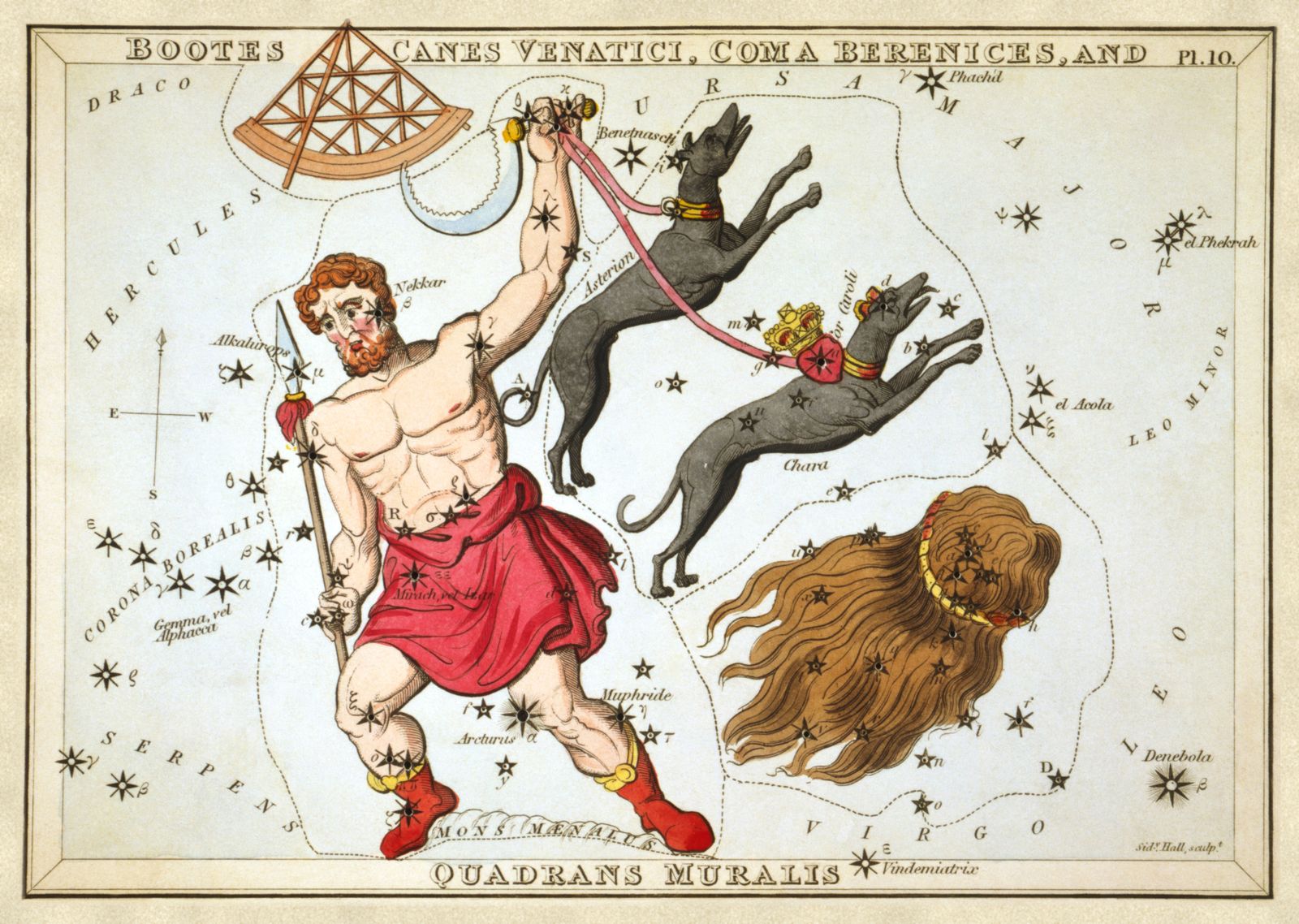
Sidney Hall, Boötes, Canes Venatici, Coma Berenices and Quadrans Muralis, card 10 of Urania's Mirror, 1824. Library of Congress, Washington (Prints and Photographs, cph.3g10076). Complete card. Prepared for print by Surrealium at Vaxholm Fortress, Sweden.
Boötes, the herdsman, strides forward in a red kilt and red boots with his two hunting dogs, Asterion and Chara, straining on a leash. Beside them hangs a lock of hair: Coma Berenices, the hair that Queen Berenice cut off as an offering for her husband's safe return. Over his head stands the mural quadrant, an astronomer's instrument that Lalande put in the sky in 1795. It has gone from star maps, but the January meteor shower that streams from that spot is still called the Quadrantids.
Four stories on one card: a conversation piece for a hall or a study.
9. Hercules and Corona Borealis
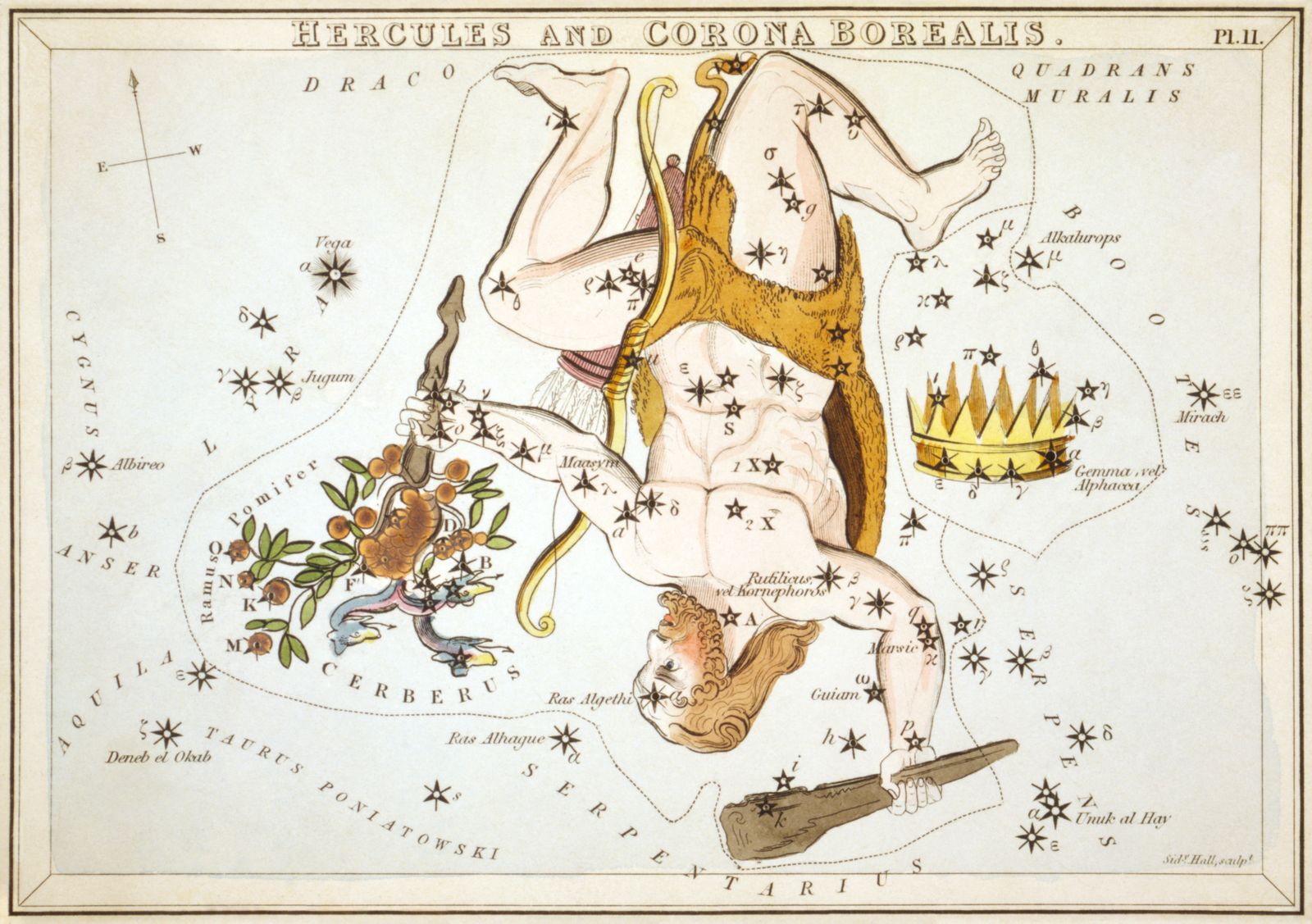
Sidney Hall, Hercules and Corona Borealis, card 11 of Urania's Mirror, 1824. Library of Congress, Washington. Complete card. Prepared for print by Surrealium at Vaxholm Fortress, Sweden.
Hercules hangs upside down, because that is how he stands in the sky as seen from the north: his foot rests on the dragon's head and his own head points south. He wears the lion's skin, swings a club and holds out an apple branch, the Ramus Pomifer, wound with three snakes for Cerberus. A bow hangs at his side. Beside him floats the Northern Crown, drawn as a small golden coronet.
A hero turned on his head: the card that makes guests look twice.
See the print of Hercules and Corona Borealis
10. Taurus Poniatowski, Serpentarius, Scutum Sobiesky and Serpens
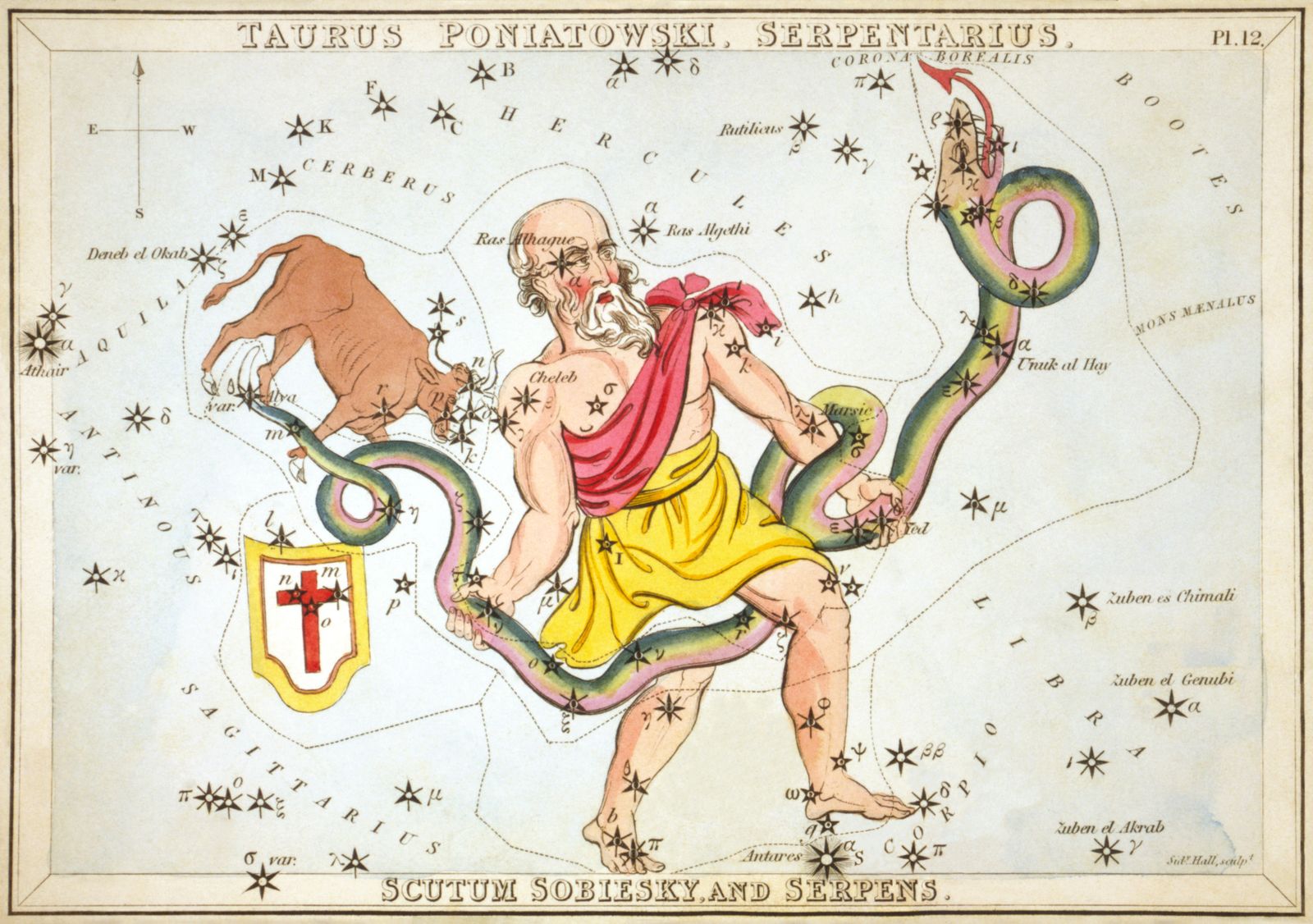
Sidney Hall, Taurus Poniatowski, Serpentarius, Scutum Sobiesky and Serpens, card 12 of Urania's Mirror, 1824. Library of Congress, Washington. Complete card. Prepared for print by Surrealium at Vaxholm Fortress, Sweden.
An old man in a yellow wrap and red sash wrestles a huge serpent that coils around his body: Serpentarius, the serpent-bearer, now called Ophiuchus. Two kings hang beside him. The little bull is Taurus Poniatovii, made in 1777 for Stanisław August Poniatowski, the last king of Poland. The shield with the red cross is Scutum Sobiescianum, made in 1684 for King John III Sobieski after he broke the siege of Vienna. The bull is gone; the shield is still in the sky as Scutum.
A wrestler and a snake, all coils and colour: strong in a hall or a staircase.
See the print of Taurus Poniatowski
11. Delphinus, Sagitta, Aquila and Antinous
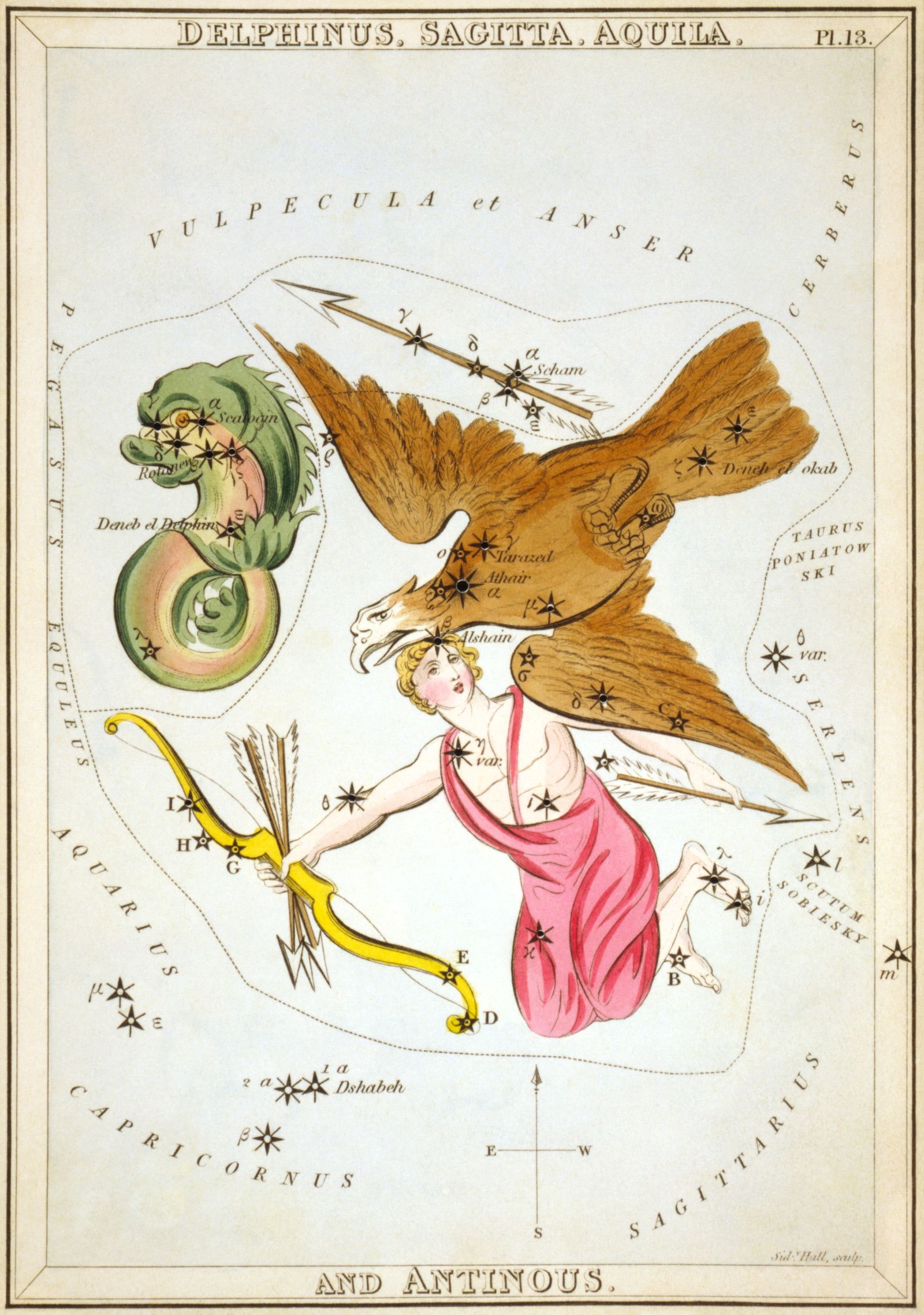
Sidney Hall, Delphinus, Sagitta, Aquila and Antinous, card 13 of Urania's Mirror, 1824. Library of Congress, Washington. Complete card. Prepared for print by Surrealium at Vaxholm Fortress, Sweden.
A great brown eagle spreads its wings over a young man in a pink cloak who holds a bow and arrows. The eagle is Aquila, the bird of Zeus, and its brightest star is Altair. The youth is Antinous, the favourite of the emperor Hadrian, who drowned in the Nile in 130 and whom the grieving emperor had placed among the stars. Antinous has since been folded back into Aquila. In the corner a green dolphin curls its tail, and above flies the arrow, Sagitta.
An eagle in full spread: a bold, upright piece for a study.
12. Lacerta, Cygnus, Lyra, Vulpecula and Anser
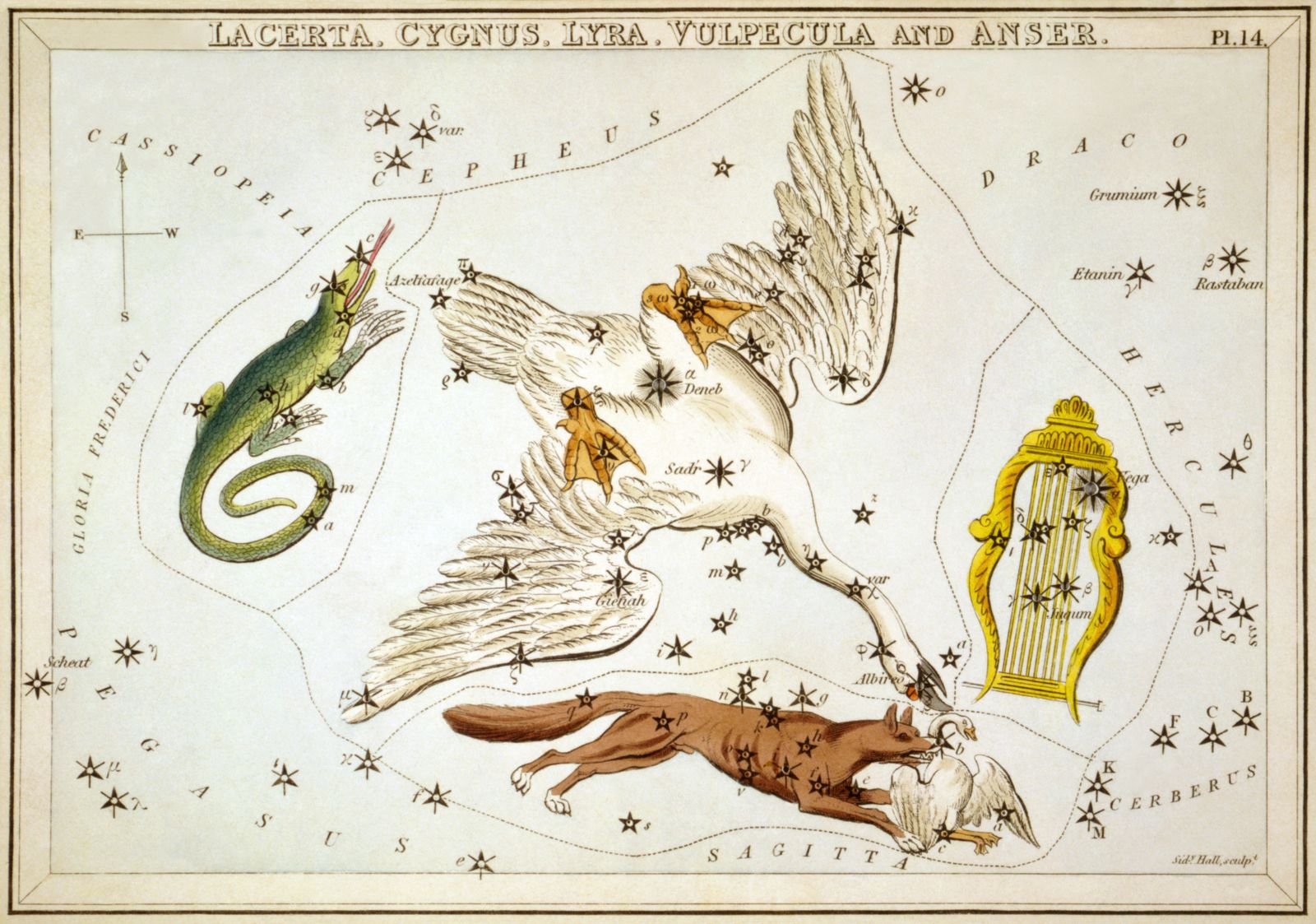
Sidney Hall, Lacerta, Cygnus, Lyra, Vulpecula and Anser, card 14 of Urania's Mirror, 1824. Library of Congress, Washington. Complete card. Prepared for print by Surrealium at Vaxholm Fortress, Sweden.
The swan flies down the Milky Way with its wings wide open, and its brightest stars form the Northern Cross. Around it Hall fits a green lizard, a golden lyre, and a fox running with a goose in its jaws. The fox and goose were one constellation, Vulpecula et Anser, made by Johannes Hevelius in the 1680s; today only the little fox remains. Vega, in the lyre, is one of the brightest stars in the summer sky.
A white swan, a red fox and a golden lyre: a cheerful card for any room.
13. Pegasus and Equuleus
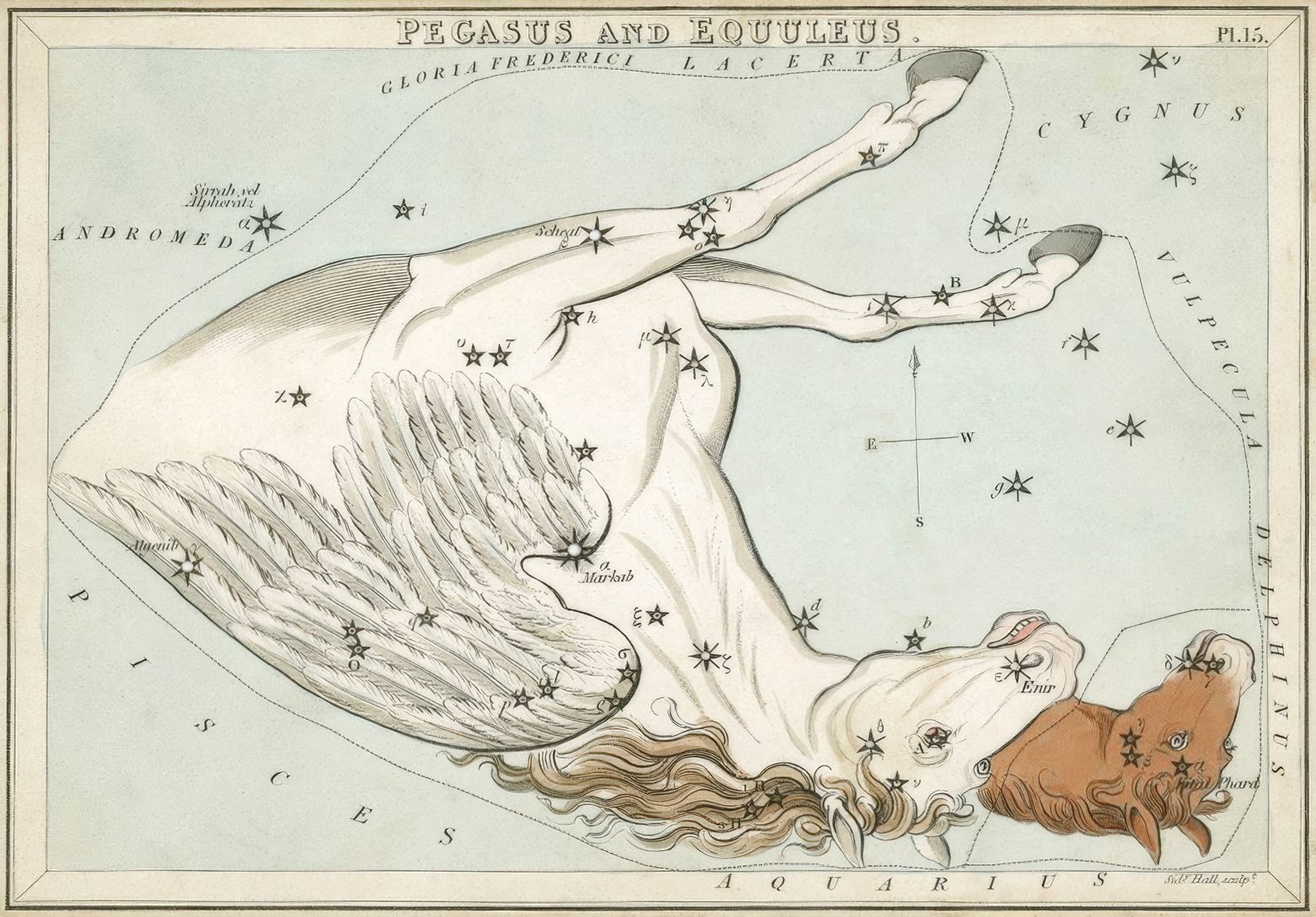
Sidney Hall, Pegasus and Equuleus, card 15 of Urania's Mirror, 1824. Library of Congress, Washington. Complete card. Prepared for print by Surrealium at Vaxholm Fortress, Sweden.
Only the front half of the winged horse is in the sky, and from the northern hemisphere he flies upside down, his hooves kicking up at the top of the card and his head below. Hall paints him white on a pale blue-green ground. Beside his muzzle is the head of a little brown horse, Equuleus, the second-smallest constellation of all. The Great Square of Pegasus is the landmark of autumn nights.
Quiet and airy, almost all white: made for a light, minimal room.
See the print of Pegasus and Equuleus
14. Aries and Musca Borealis
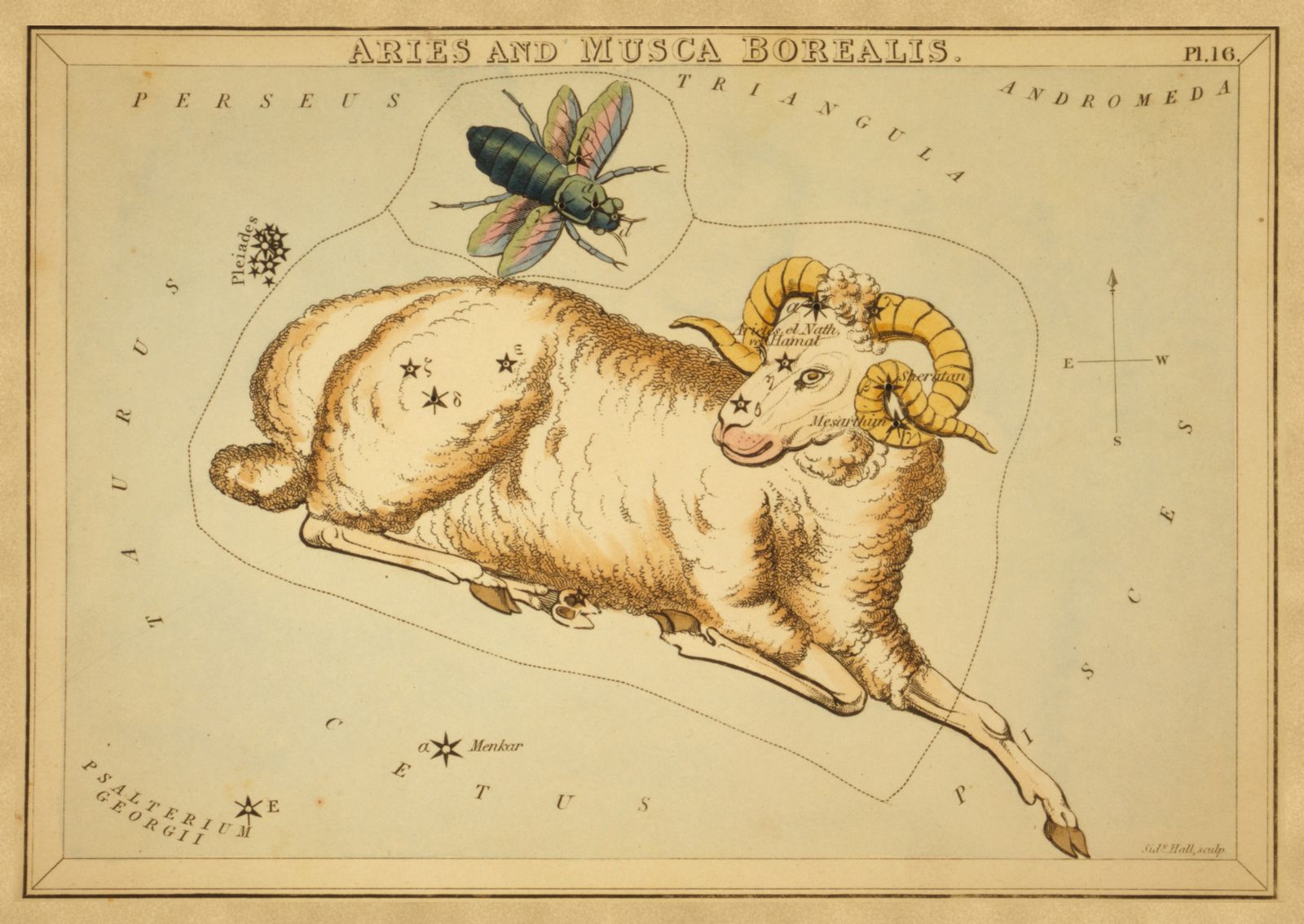
Sidney Hall, Aries and Musca Borealis, card 16 of Urania's Mirror, 1824. Library of Congress, Washington (Prints and Photographs, cph.3g10064). Complete card. Prepared for print by Surrealium at Vaxholm Fortress, Sweden.
The zodiac begins with the ram, lying down with his head turned back and golden curled horns. Above him buzzes a fly: Musca Borealis, the northern fly, one of the small inventions of the seventeenth century that the sky has since let go. Aries was the golden ram whose fleece Jason sailed to find.
A calm, resting animal in soft cream: easy to live with.
See the print of Aries and Musca Borealis
15. Taurus
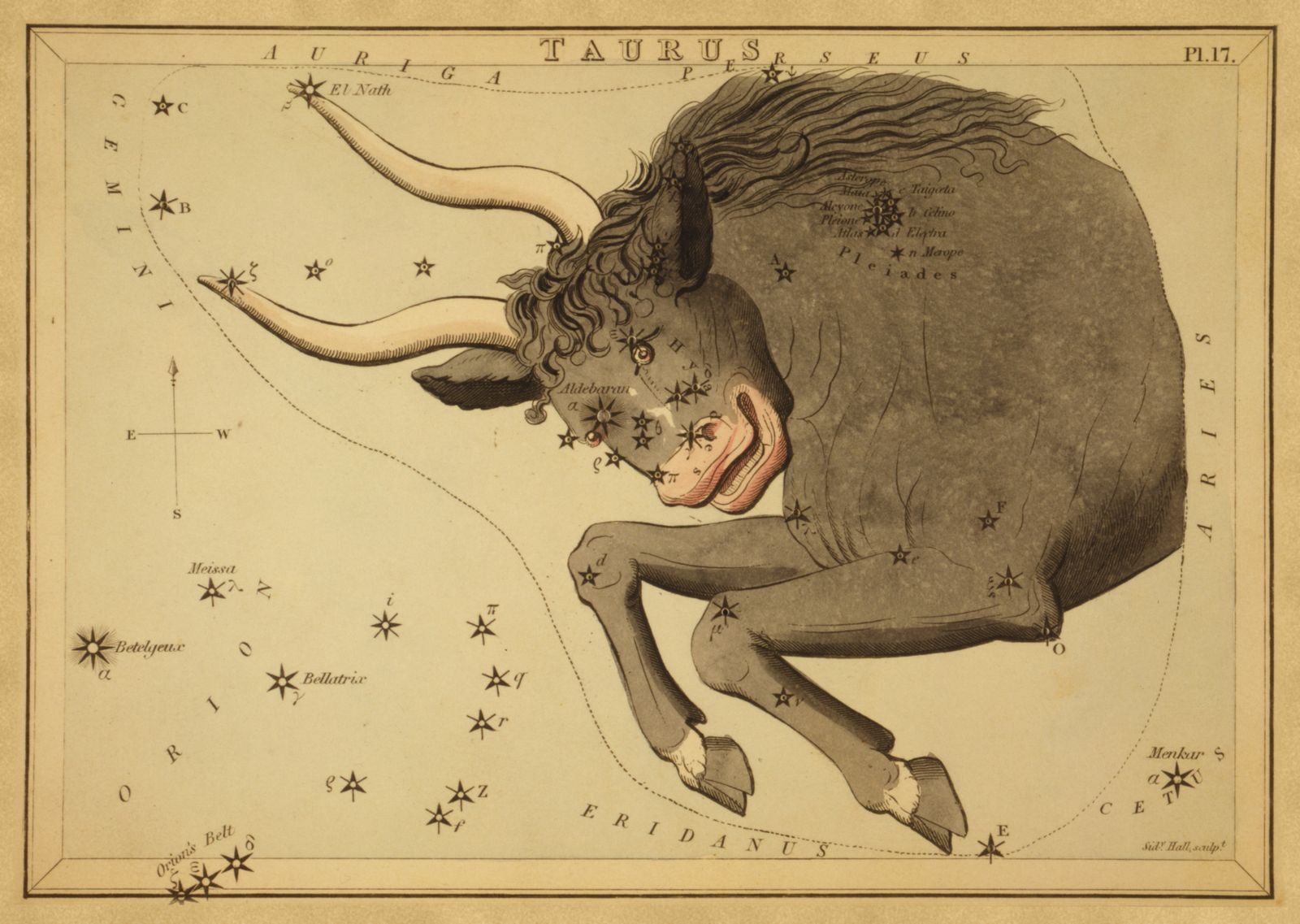
Sidney Hall, Taurus, card 17 of Urania's Mirror, 1824. Library of Congress, Washington (Prints and Photographs, cph.3g10065). Complete card. Prepared for print by Surrealium at Vaxholm Fortress, Sweden.
Like the bull in older star books, Hall's Taurus is only the front half of the animal, charging with his head down and long horns forward. His eye is Aldebaran, the orange giant star that glows in the winter sky. On his shoulder, labelled in tiny letters, sits the Pleiades, the Seven Sisters, a cluster that people have watched since before writing.
Dark and powerful: it holds a large wall on its own.
16. Gemini
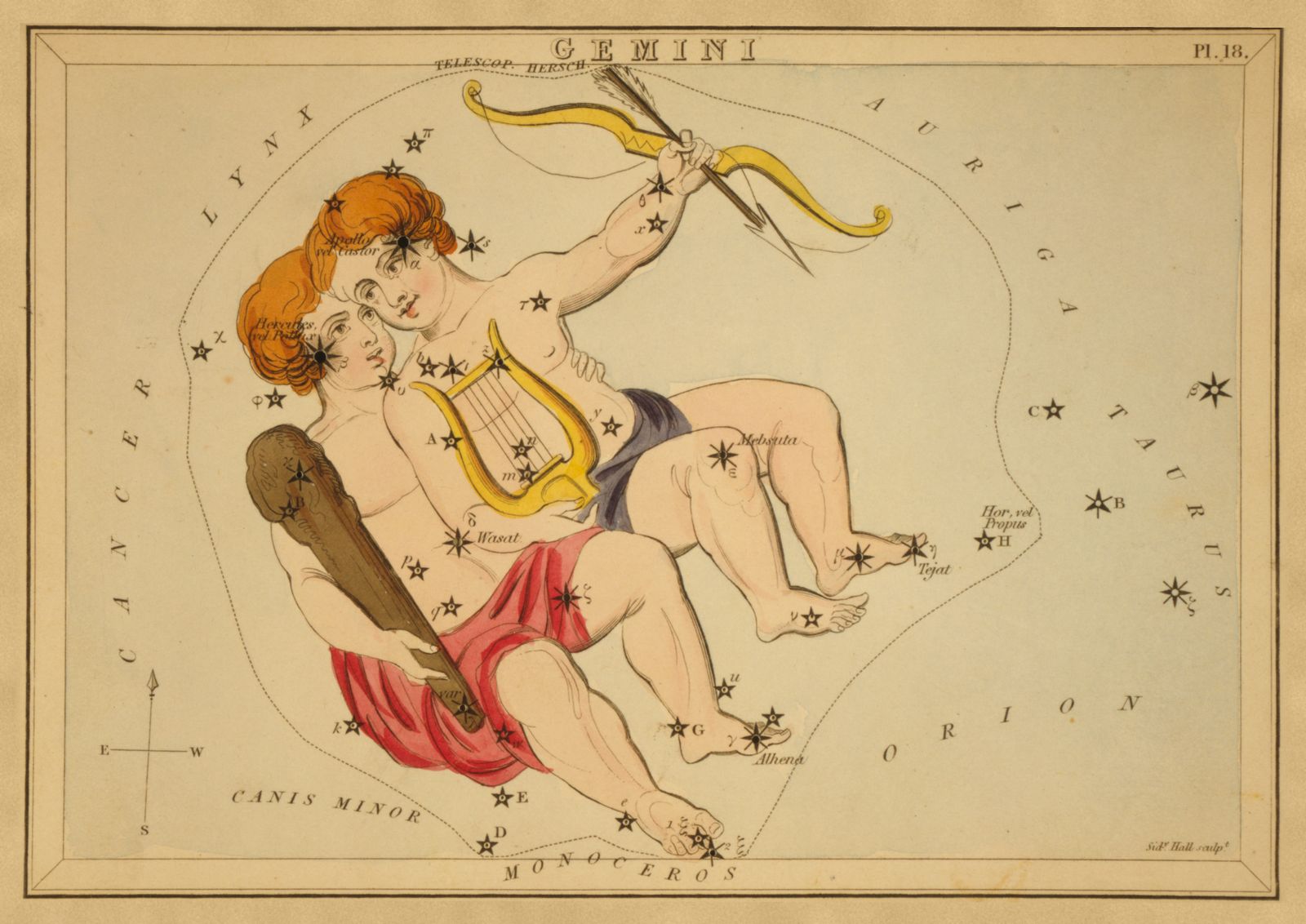
Sidney Hall, Gemini, card 18 of Urania's Mirror, 1824. Library of Congress, Washington (Prints and Photographs, cph.3g10066). Complete card. Prepared for print by Surrealium at Vaxholm Fortress, Sweden.
The twins Castor and Pollux sit close together, one with an arm around the other. One holds a bow and a lyre, the other a club, and each has a bright star on his head that still carries his name. In the myth one twin was mortal and one immortal, and when Castor died Pollux asked to share his immortality, so they spend their time together in the sky.
Tender and warm: a sweet print for siblings or a couple.
17. Cancer
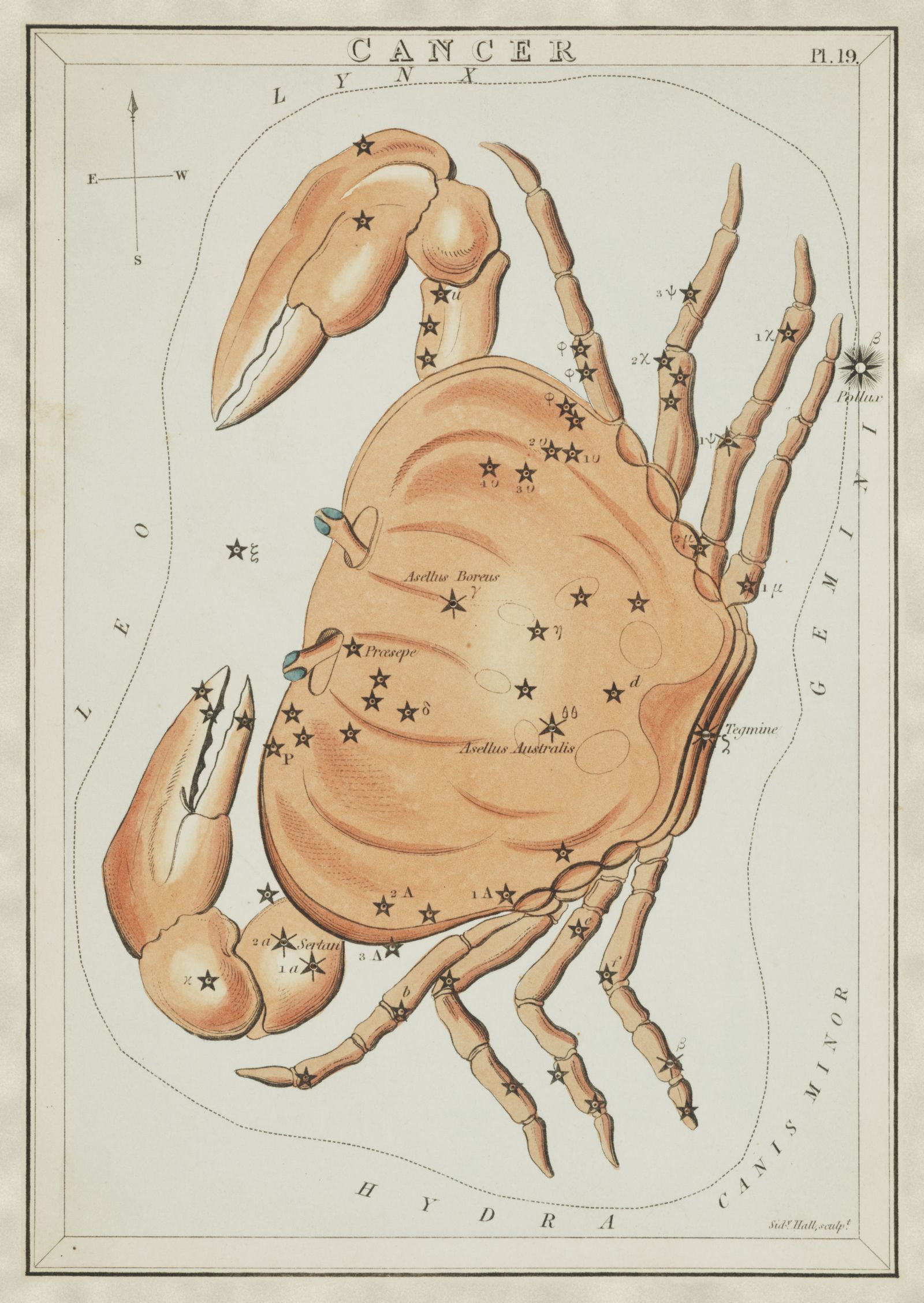
Sidney Hall, Cancer, card 19 of Urania's Mirror, 1824. Library of Congress, Washington (Prints and Photographs, ds.00242). Complete card. Prepared for print by Surrealium at Vaxholm Fortress, Sweden.
A large pink crab fills a tall card, seen from above, with both claws reaching forward. Cancer is the faintest of the zodiac signs, and its treasure is the cluster at its heart that the ancients called Praesepe, the manger. Through a small telescope it is a swarm of stars, which is why it is also called the Beehive.
One strong shape in coral pink: graphic enough for a modern room.
18. Leo Major and Leo Minor
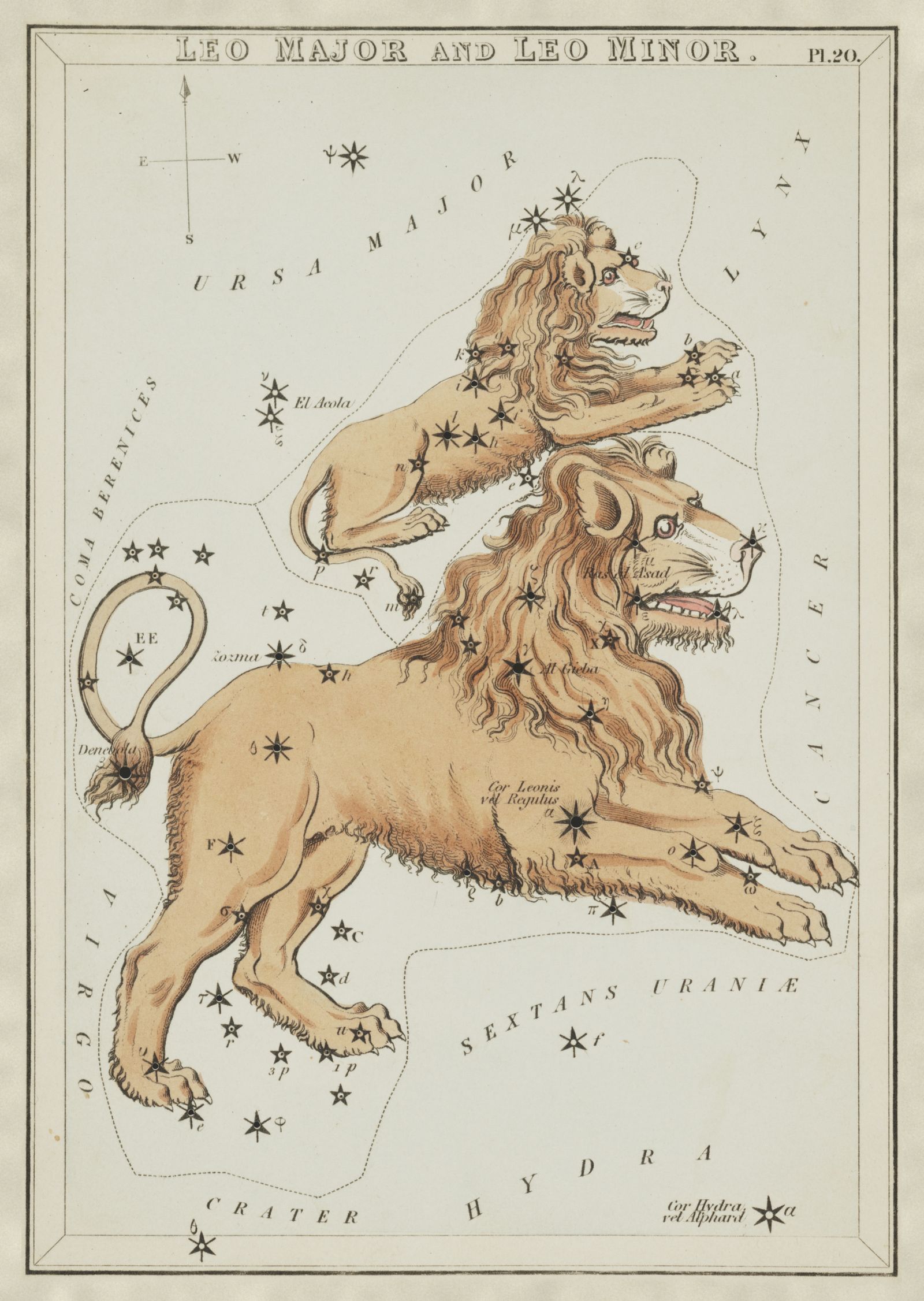
Sidney Hall, Leo Major and Leo Minor, card 20 of Urania's Mirror, 1824. Library of Congress, Washington (Prints and Photographs, ds.00241). Complete card. Prepared for print by Surrealium at Vaxholm Fortress, Sweden.
The great lion leaps down the card, his mane drawn in fine curls, and a smaller lion climbs above him. The little one is Leo Minor, a filler that Hevelius added in the 1680s. The big lion's heart is the bright star Regulus, which the card labels Cor Leonis, and the star in the tuft of his tail is Denebola, the lion's tail.
Two lions on a tall card: a happy choice for a Leo, or a child's room.
See the print of Leo Major and Leo Minor
19. Virgo
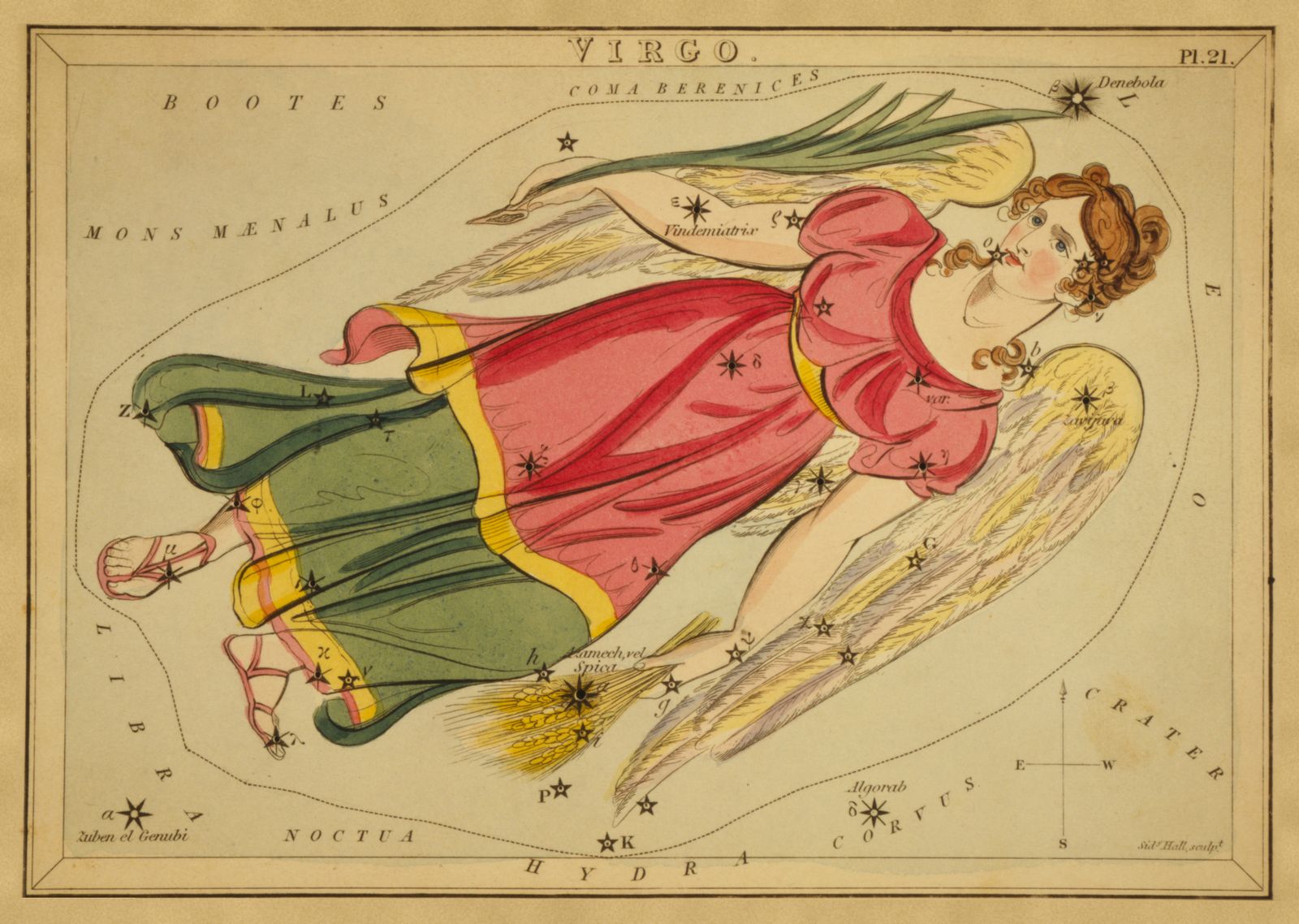
Sidney Hall, Virgo, card 21 of Urania's Mirror, 1824. Library of Congress, Washington (Prints and Photographs, cph.3g10067). Complete card. Prepared for print by Surrealium at Vaxholm Fortress, Sweden.
Virgo flies on pale wings in a pink bodice and a green skirt edged in gold, holding a palm branch in one hand and an ear of wheat in the other. Her brightest star is Spica, which means the ear of grain, and she is the harvest goddess of the late summer sky. Hall lays her along the card, the way she lies along the path of the sun.
The prettiest figure in the set, in pink and green: lovely in a bedroom.
20. Libra
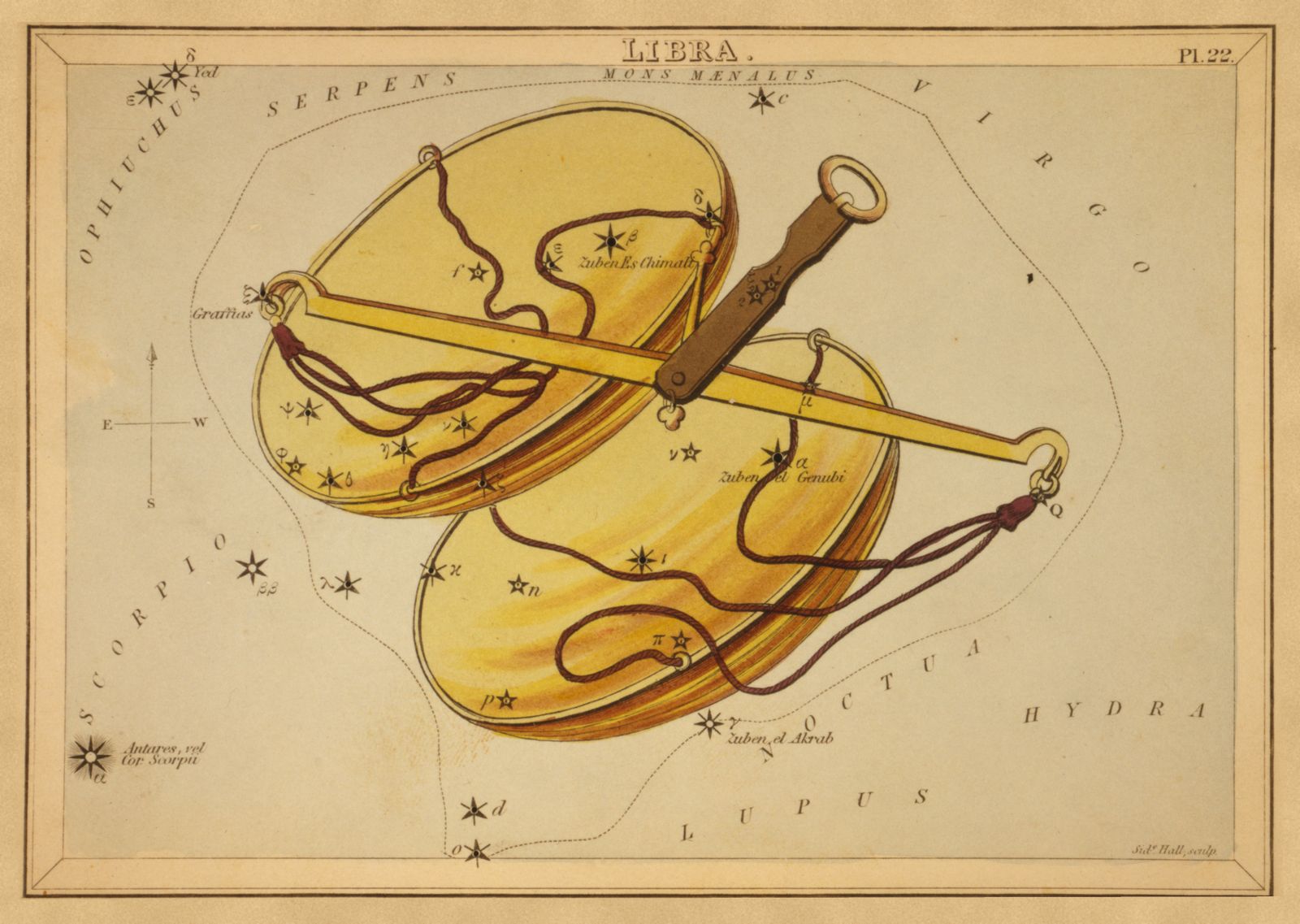
Sidney Hall, Libra, card 22 of Urania's Mirror, 1824. Library of Congress, Washington (Prints and Photographs, cph.3g10068). Complete card. Prepared for print by Surrealium at Vaxholm Fortress, Sweden.
Libra is the only sign of the zodiac that is an object. Hall draws it as a golden balance, its two great pans hanging from a beam on loose brown cords. The Greeks saw the scorpion's claws here, and two of its stars still have Arabic names meaning the southern claw and the northern claw.
All gold and line: it pairs well with modern furniture.
21. Scorpio
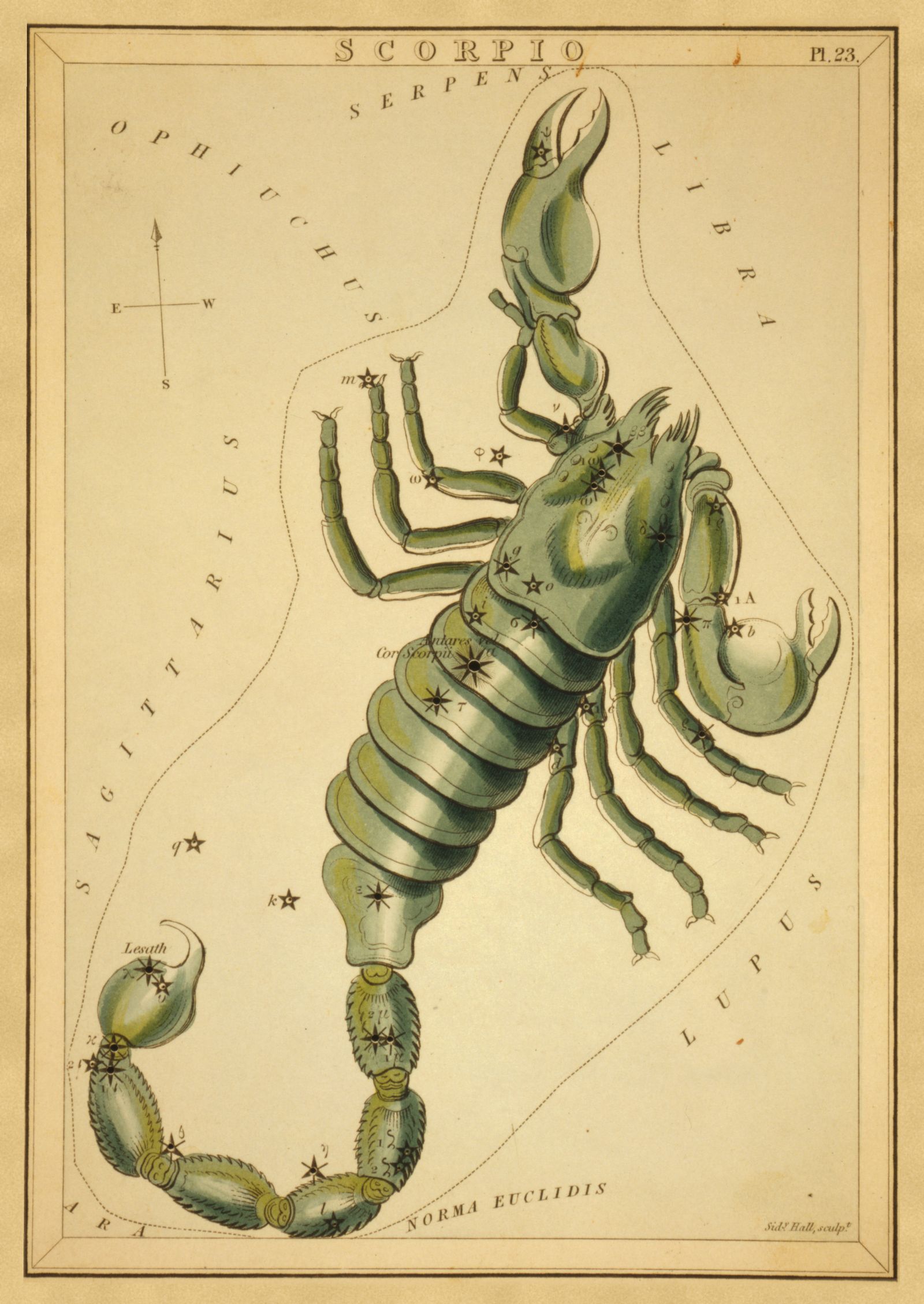
Sidney Hall, Scorpio, card 23 of Urania's Mirror, 1824. Library of Congress, Washington (Prints and Photographs, cph.3g10069). Complete card. Prepared for print by Surrealium at Vaxholm Fortress, Sweden.
A green scorpion climbs the length of a tall card, its claws up and its jointed tail curling round at the bottom to the sting. Its heart is Antares, a red supergiant whose name means the rival of Mars. Scorpio is one of the few constellations that really looks like its creature.
Sharp and vertical in deep green: made for a narrow wall.
22. Sagittarius and Corona Australis, Microscopium and Telescopium
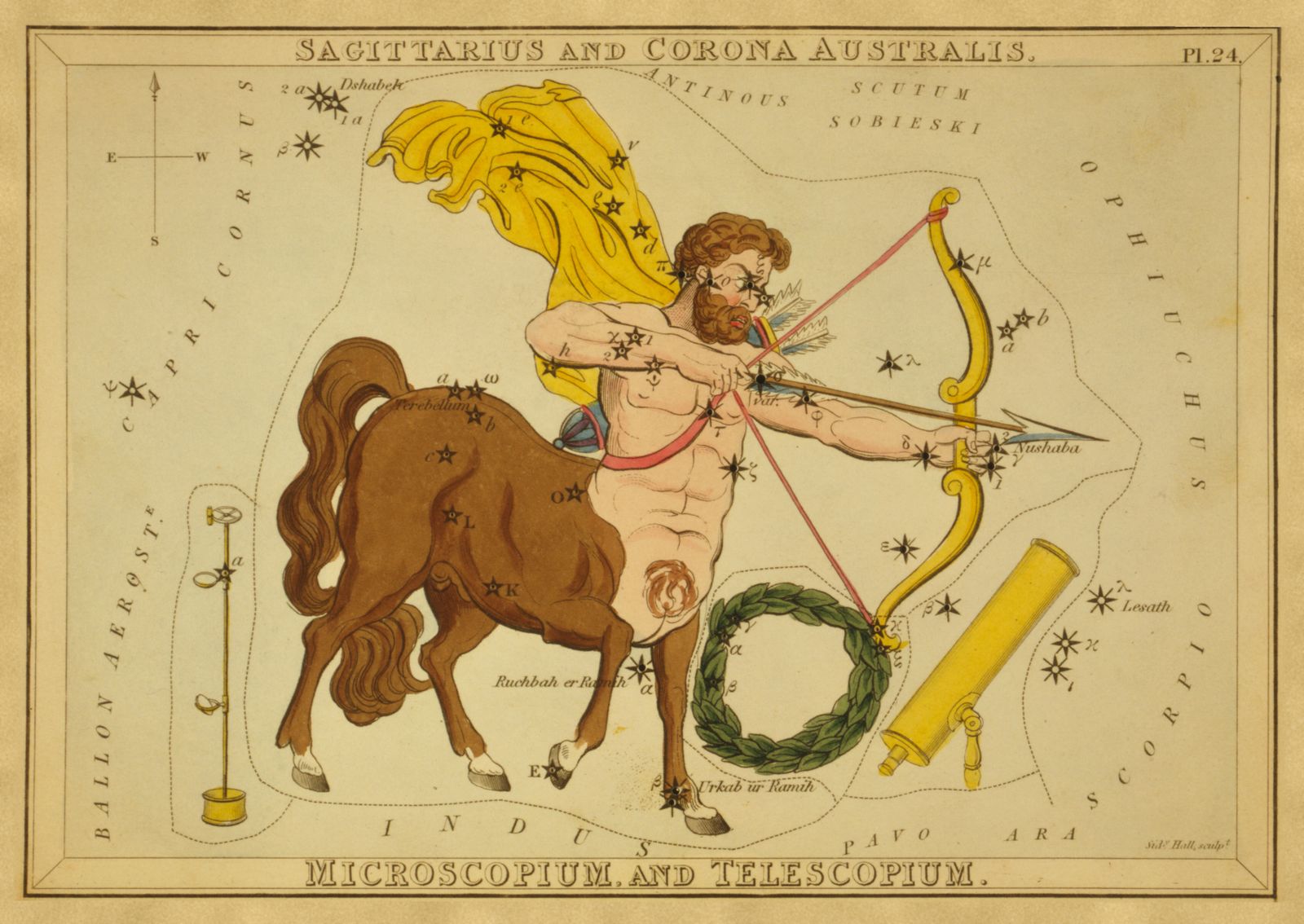
Sidney Hall, Sagittarius and Corona Australis, Microscopium and Telescopium, card 24 of Urania's Mirror, 1824. Library of Congress, Washington (Prints and Photographs, cph.3g10070). Complete card. Prepared for print by Surrealium at Vaxholm Fortress, Sweden.
The archer is a centaur with a yellow cloak blowing out behind him, drawing his bow towards the scorpion on the next card. At his hooves lies the Southern Crown, a wreath of laurel. Beside him Hall adds a microscope and a telescope, two of the instruments that Lacaille set among the southern stars in the 1750s.
Full of movement and colour: it brings energy to a quiet room.
See the print of Sagittarius and Corona Australis
23. Capricornus
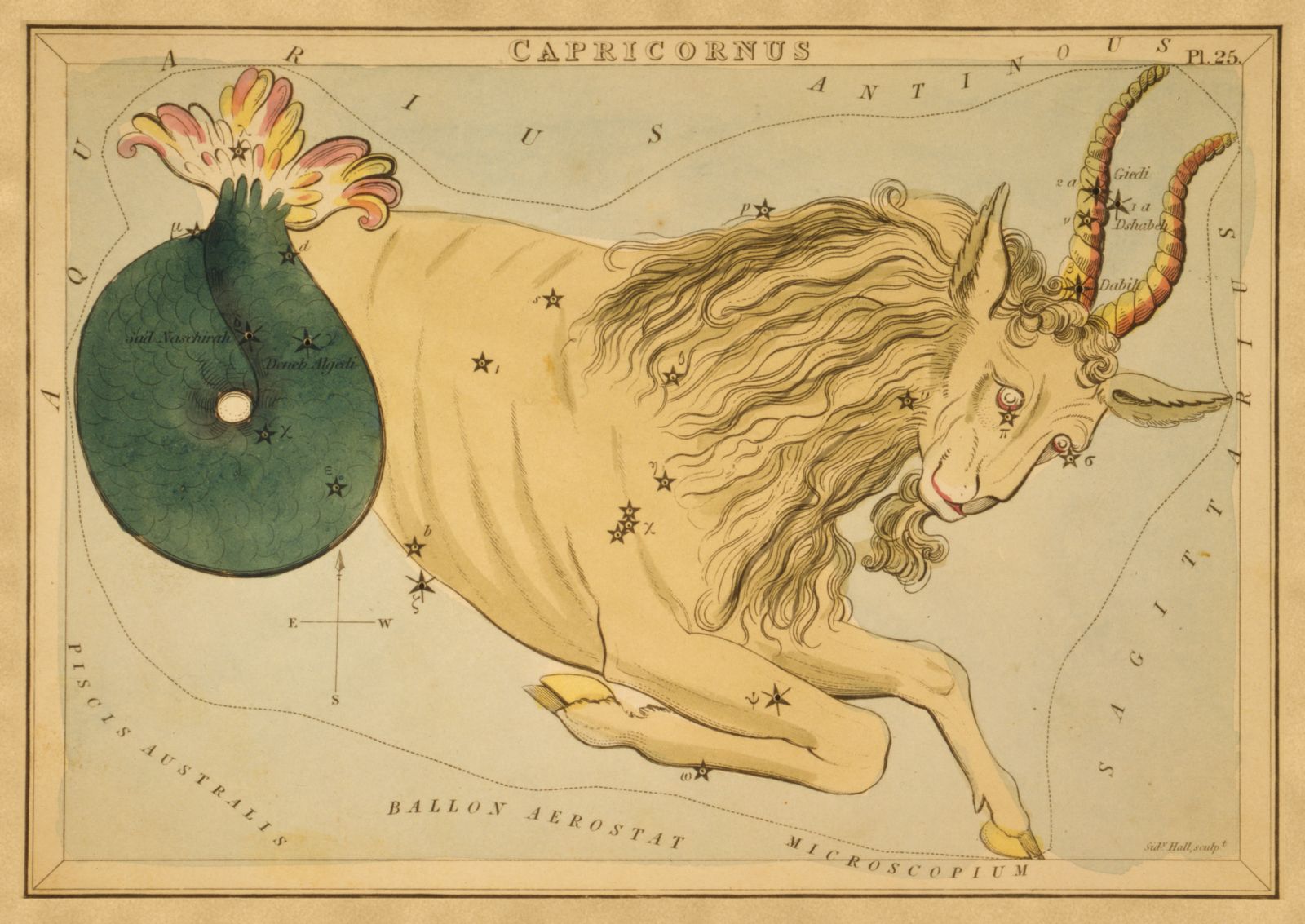
Sidney Hall, Capricornus, card 25 of Urania's Mirror, 1824. Library of Congress, Washington (Prints and Photographs, cph.3g10071). Complete card. Prepared for print by Surrealium at Vaxholm Fortress, Sweden.
The sea-goat has the front of a goat, with a long shaggy mane and swept-back horns, and a curled green fish's tail. It is one of the oldest figures in the sky, already a goat-fish in Babylon three thousand years ago. Hall gives the tail a crest of pink and gold fins.
Strange and handsome at once: a good choice for a study.
24. Aquarius, Piscis Australis and Ballon Aérostatique
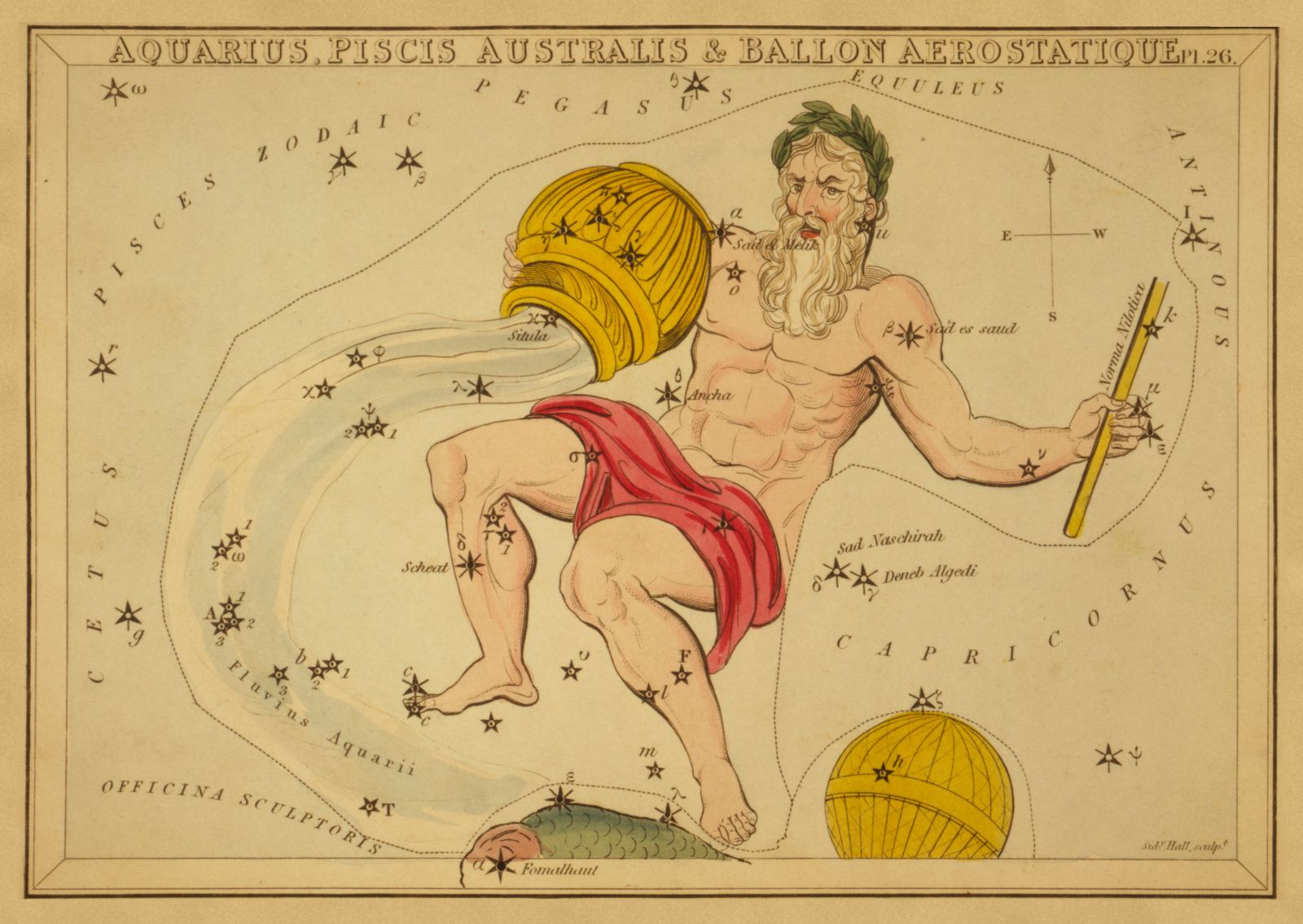
Sidney Hall, Aquarius, Piscis Australis and Ballon Aérostatique, card 26 of Urania's Mirror, 1824. Library of Congress, Washington (Prints and Photographs, cph.3g10072). Complete card. Prepared for print by Surrealium at Vaxholm Fortress, Sweden.
Aquarius is a bearded old man in a red loincloth and a laurel wreath, holding the measuring rod of the Nile, the Norma Nilotica, and pouring a golden urn whose stream curls round and runs down to a fish at the bottom of the card. That fish, Piscis Australis, drinks the water, and its mouth is the bright star Fomalhaut. At the foot of the card floats a golden hot-air balloon, Ballon Aérostatique, which Lalande put in the sky in 1798 for the Montgolfier brothers. It lasted about as long as the craze.
A river of water and a balloon: a playful, generous card.
25. Pisces
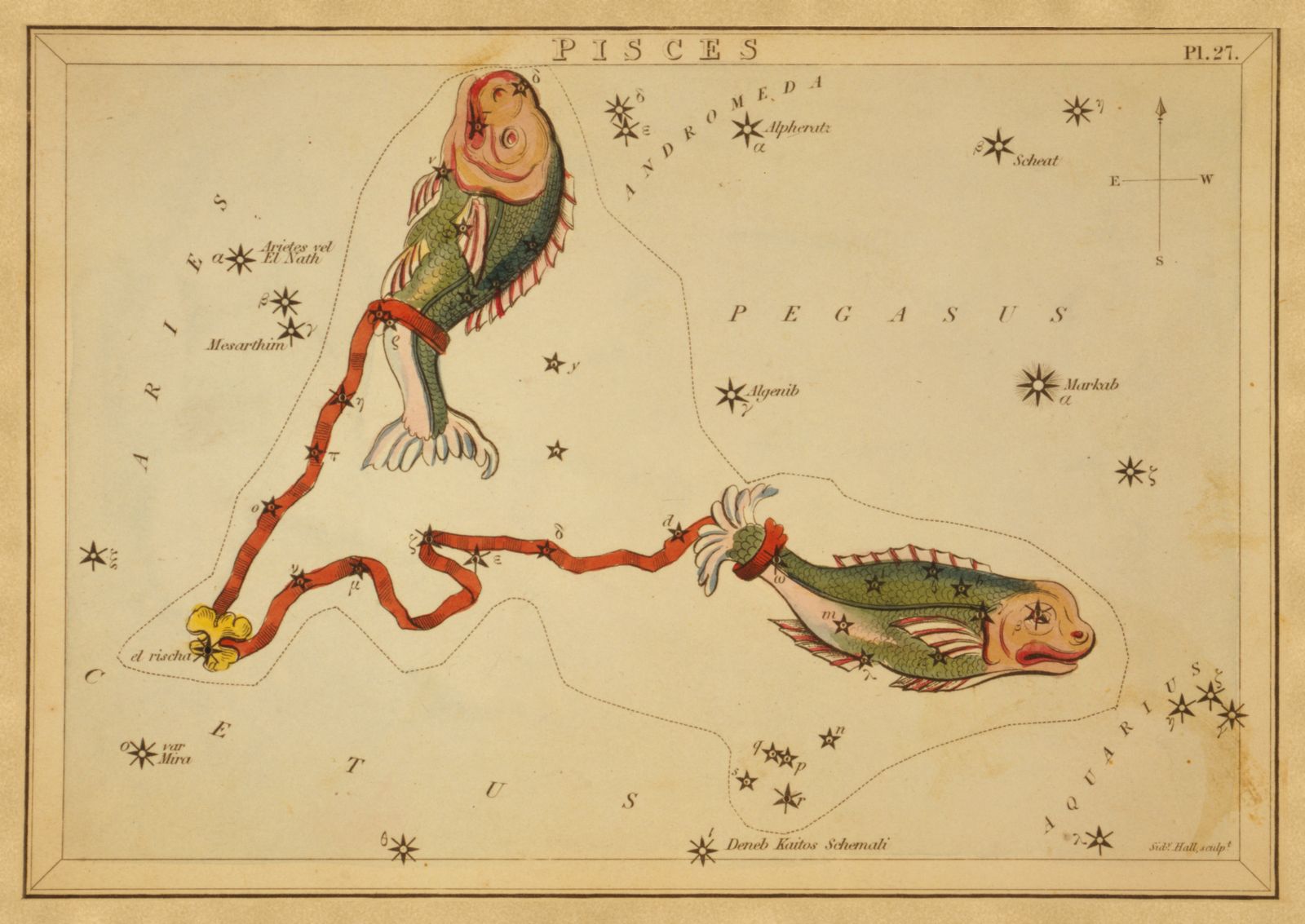
Sidney Hall, Pisces, card 27 of Urania's Mirror, 1824. Library of Congress, Washington (Prints and Photographs, cph.3g10073). Complete card. Prepared for print by Surrealium at Vaxholm Fortress, Sweden.
Two fish swim in opposite directions, one up the card and one along the bottom, tied together by a long red ribbon that meets in a knot. The knot is the star Alrescha, the cord. In the Roman story the fish are Venus and her son Cupid, who tied themselves together and leapt into a river to escape the monster Typhon.
Light and lively, with one red line through it: lovely over a bed.
26. Psalterium Georgii, Fluvius Eridanus, Cetus, Officina Sculptoris, Fornax Chemica and Machina Electrica
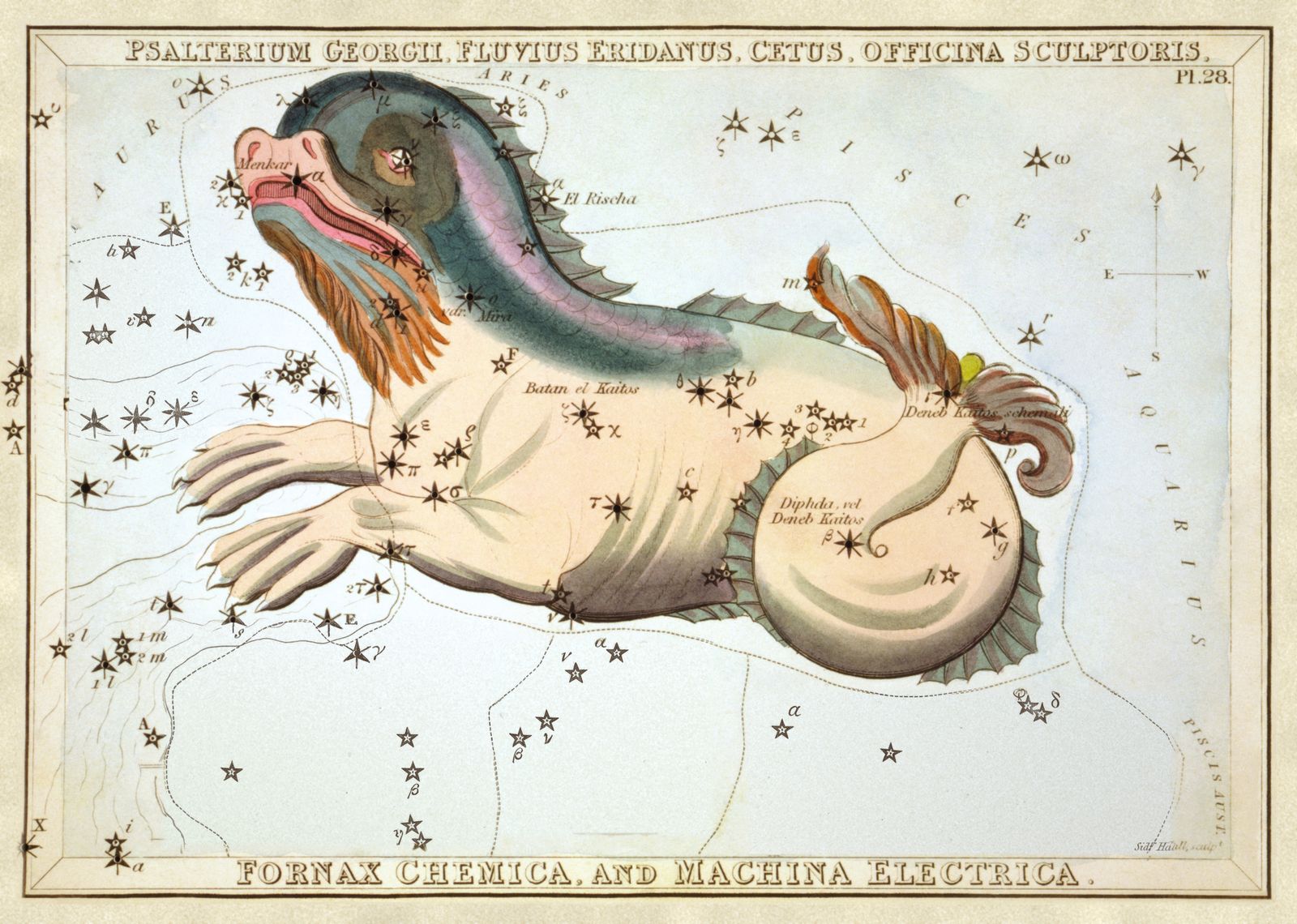
Sidney Hall, Psalterium Georgii, Fluvius Eridanus, Cetus, Officina Sculptoris, Fornax Chemica and Machina Electrica, card 28 of Urania's Mirror, 1824. Library of Congress, Washington (Prints and Photographs, Urania’s Mirror plate 28). Complete card. Prepared for print by Surrealium at Vaxholm Fortress, Sweden.
Cetus, the sea monster sent for Andromeda, is drawn with a beast's head, clawed forelegs and a scaled, coiling tail. Around him stands a gallery of the age's inventions: a golden harp, George's Harp, made in 1789 for George III, a sculptor's workshop, a chemist's furnace, and an electrical machine that Bode set in the sky in 1800. Cetus also holds Mira, the wonderful star, which brightens and fades over about eleven months.
A monster and a laboratory on one card: the most curious print in the set.
See the print of Psalterium Georgii
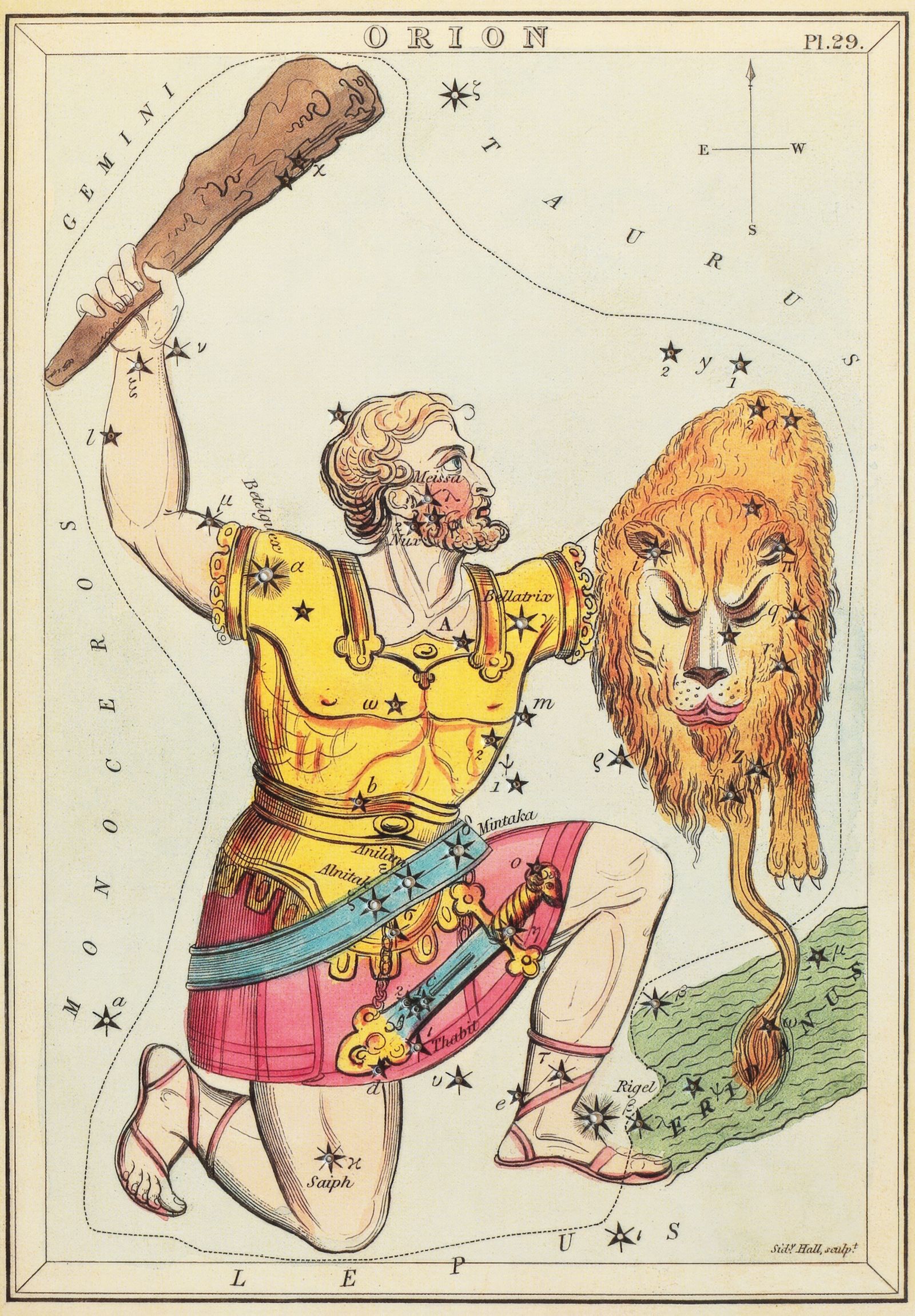
27. Orion
Sidney Hall, Orion, card 29 of Urania's Mirror, 1824. Library of Congress, Washington. Complete card. Prepared for print by Surrealium at Vaxholm Fortress, Sweden.
The hunter kneels with his club raised over his head and a lion's skin held out like a shield. Hall dresses him in a yellow tunic and a pink kilt, with a blue sash and a sword. The three stars across his belt are the easiest pattern in the winter sky to find; Betelgeuse is on his shoulder and Rigel on his foot. He turns his shield towards Taurus, the bull, as he does in the sky.
The great hero of the winter sky, in gold and pink: the strongest single figure in the set.
28. Canis Major, Lepus, Columba Noachi and Cela Sculptoris
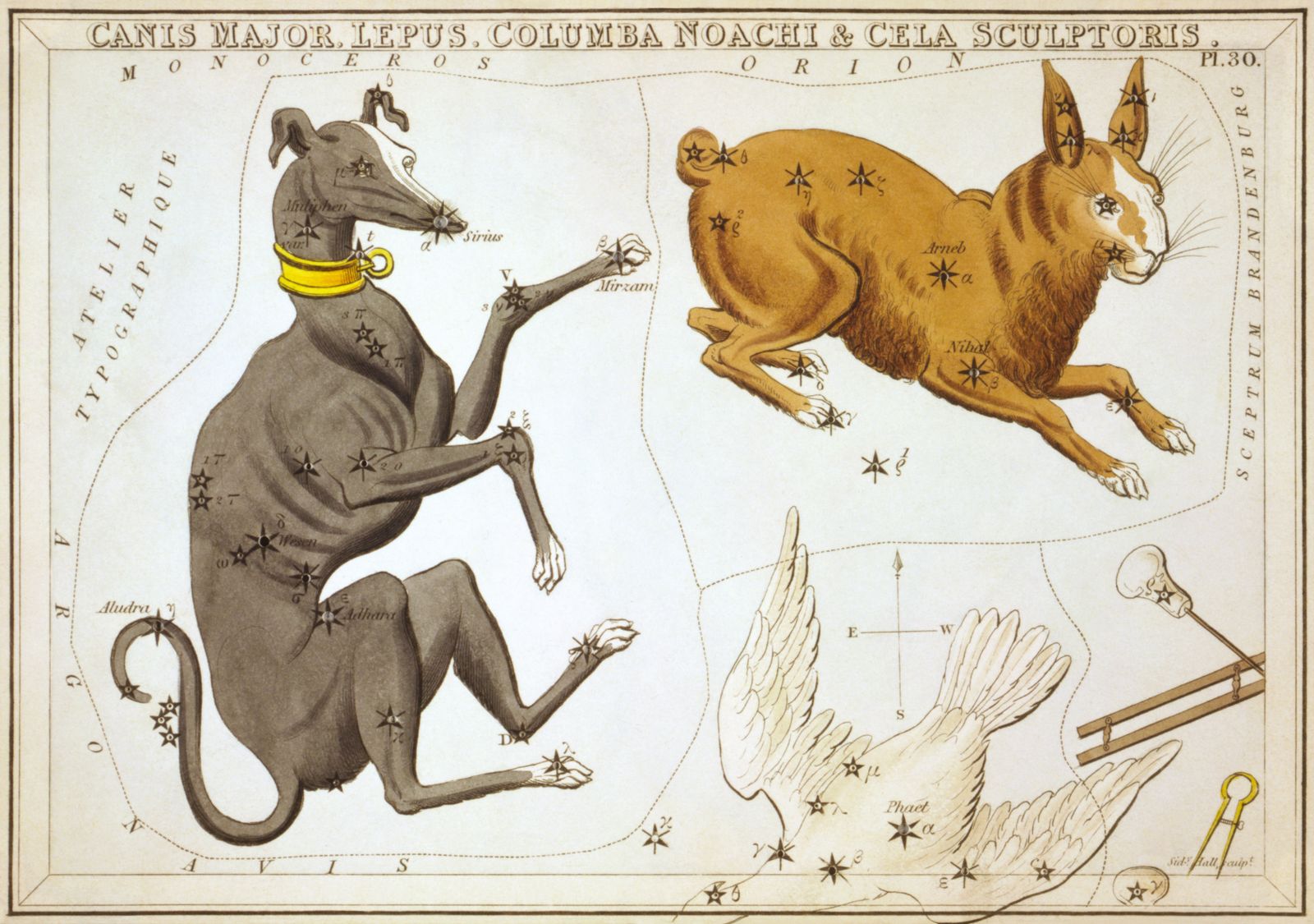
Sidney Hall, Canis Major, Lepus, Columba Noachi and Cela Sculptoris, card 30 of Urania's Mirror, 1824. Library of Congress, Washington. Complete card. Prepared for print by Surrealium at Vaxholm Fortress, Sweden.
Orion's great dog sits up on its haunches in a gold collar, the brown hare beside it. On the dog's nose shines Sirius, the brightest star in the night sky. Below them flies Noah's dove, and on the edge lie a sculptor's chisels. In the margin Hall names the Atelier Typographique, a printing office that Bode put in the sky in 1801.
A dog and a hare under the brightest star: a natural for anyone who loves dogs.
29. Noctua, Corvus, Crater, Sextans Uraniae, Hydra, Felis, Lupus, Centaurus, Antlia Pneumatica, Argo Navis and Pyxis Nautica
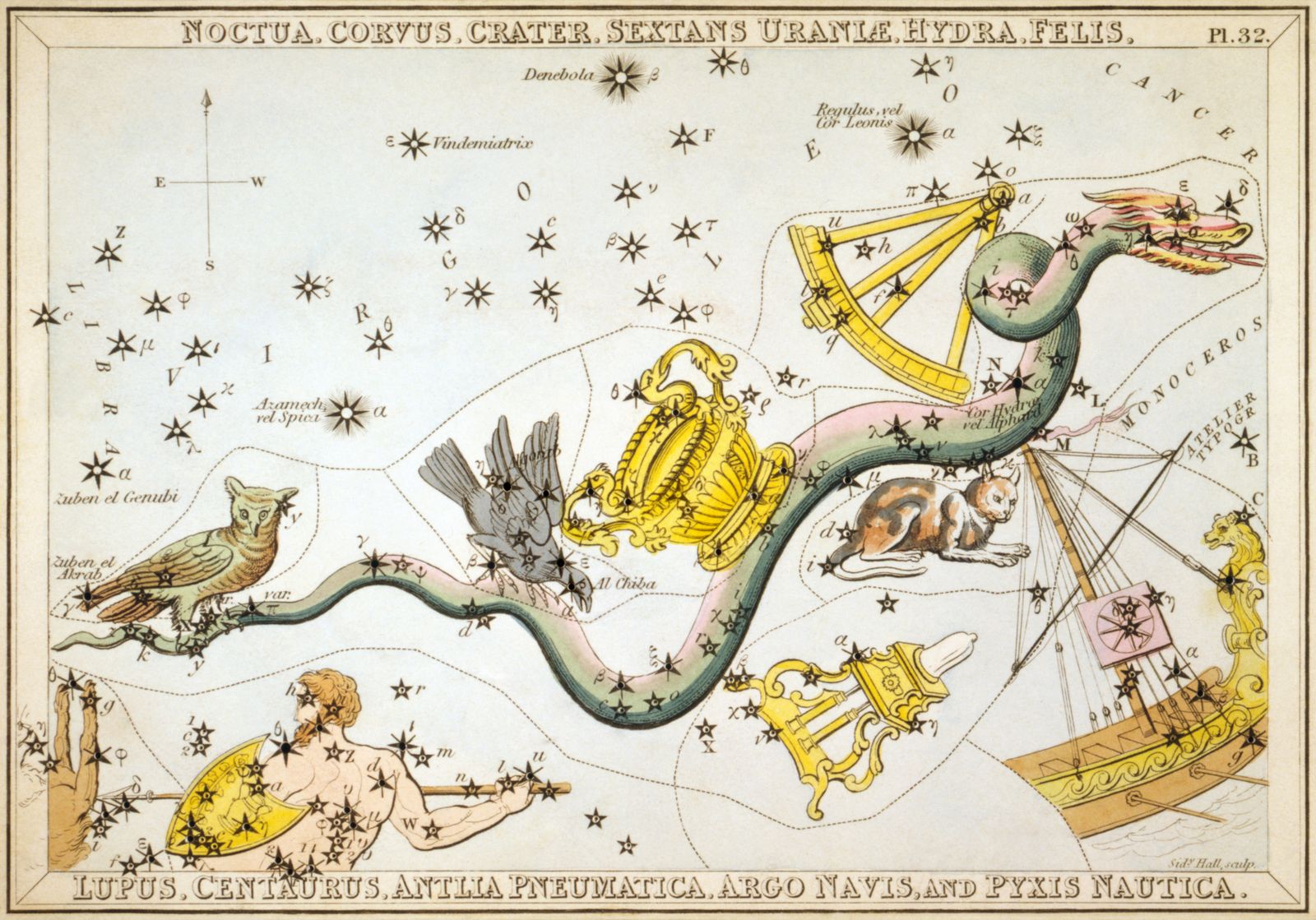
Sidney Hall, Noctua, Corvus, Crater, Sextans Uraniae, Hydra, Felis, Lupus, Centaurus, Antlia Pneumatica, Argo Navis and Pyxis Nautica, card 32 of Urania's Mirror, 1824. Library of Congress, Washington. Complete card. Prepared for print by Surrealium at Vaxholm Fortress, Sweden.
The last card is the most crowded. Hydra, the longest constellation in the sky, crawls the whole width of it. On her back ride a golden cup, a crow, an owl and a sextant, and beside her sits a cat. The cat is Felis, which Lalande added in 1799 because, as he wrote, he was very fond of cats. In the corners are a ship's stern from Argo Navis, an air pump, a compass, a centaur and a wolf.
Eleven constellations and a cat: a card to read slowly over a desk.
The title page said the cards were designed by "a lady", and for 170 years nobody knew who she was. Guesses ran from Caroline Herschel to Mary Somerville. In 1994 Peter Hingley, the librarian of the Royal Astronomical Society, was sorting the society's old election certificates and found one proposing the Reverend Richard Rouse Bloxam, assistant master at Rugby School, and naming him as "Author of Urania's Mirror". Bloxam taught at Rugby for thirty-eight years and published nothing else. Ridpath has noted that Bloxam's wife Ann was the sister of the portrait painter Sir Thomas Lawrence, so the anonymous lady may deserve a share of the credit after all.
The set sold for a decade. Aspin's book grew from 121 pages to 200, a fourth edition appeared in 1834, and an American edition followed in 1832. A promised second part, with the planets and a portable orrery, seems never to have been made.
The cards belong to the Astrology through the ages series in Masterworks, beside Cellarius's atlas, Baghdad's Book of Wonders and a medieval star book from Prague whose constellations were drawn four and a half centuries earlier. The story of that series follows the zodiac across five centuries. Every print is made to order from the scanned card, with its pinholes, its dotted borders and its handwritten colour.