Astrology through the ages: the history of astrology in sixteen pictures
Five centuries of the zodiac as people drew it: constellation beasts from a 14th-century Italian star book, the planets and jinn of Baghdad's Book of Wonders, Cellarius's golden atlas, Urania's Mirror, Trouvelot's night sky and Mucha's Zodiac.
For as long as people have looked up, they have tried to read the sky. The history of astrology is written in books, but it was also drawn: on vellum and paper, in wool and silk, on cloth and copper plates. The sixteen pictures here run from a fourteenth-century Italian star book to a Paris calendar of 1896. On the way they pass through Baghdad, Nepal, Amsterdam and London, and through the slow change from a sky that meant something to a sky that could be measured. The same twelve signs come back again and again, drawn by people who never met. Every picture is in a public collection, and every one is a Fable print.
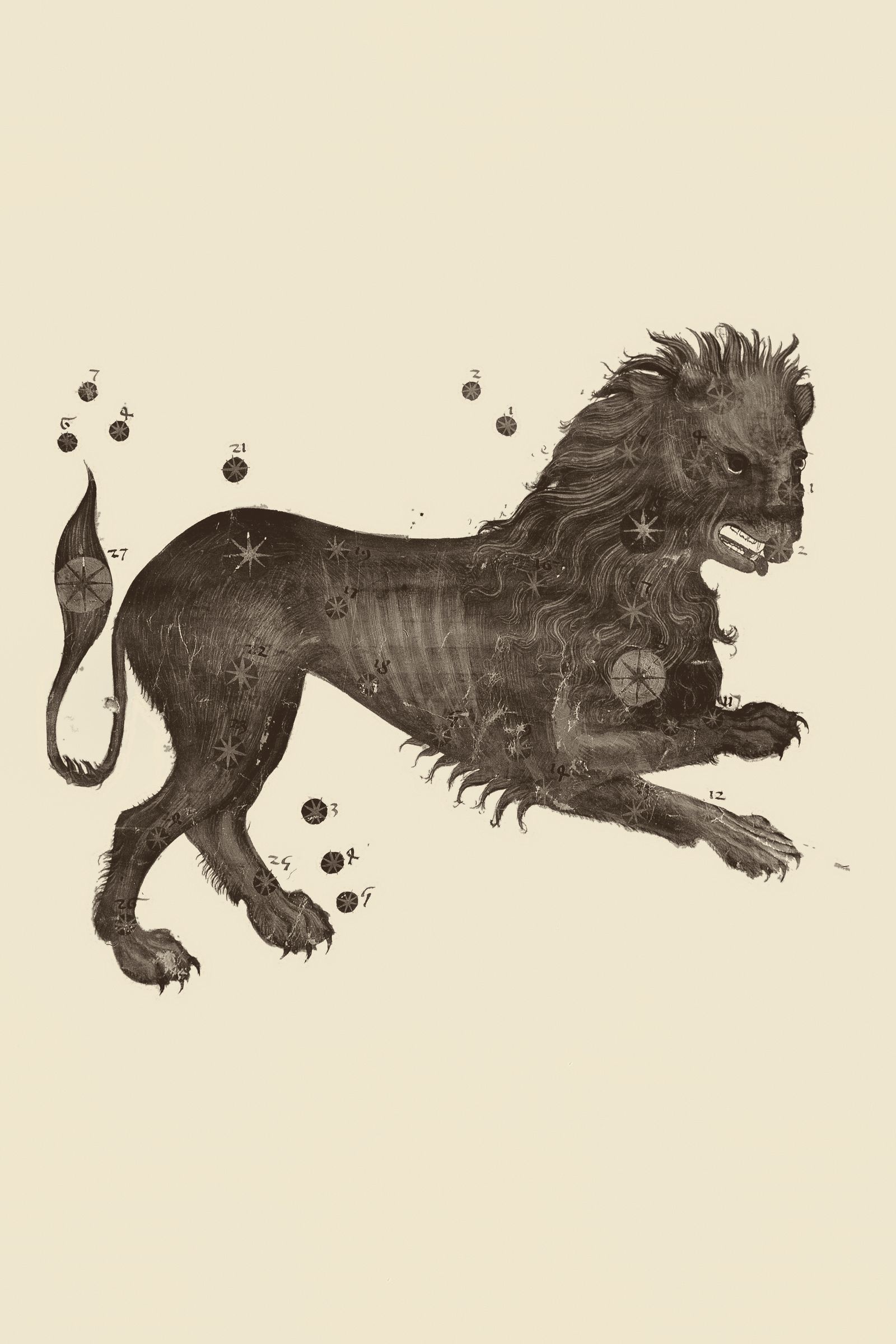
1. Leo, constellation figure
An unknown painter, Leo, constellation figure, northern Italy, c. 1370–1400. Strahov Library, Prague (Cod. DA II 13, fol. 25r), from a Wellcome Collection photograph of 1940. Complete composition. Restored by Surrealium at Vaxholm Fortress, Sweden.
A painter in northern Italy, around 1370 to 1400, drew the constellations as living animals and numbered the stars on their bodies. Leo strides across the bare vellum with his mouth open and his tail curled, each star a small wheel set into the fur, with its number written beside it. The same book drew Cancer as a crab, Capricorn as a sea-goat and Cetus as a sea-lion rearing on a fish's tail.
Ink on pale vellum, almost nothing else: it suits a study or a reading corner.
See the print of Leo, constellation figure
2. Sagittarius, from the Kitāb al-Bulhān
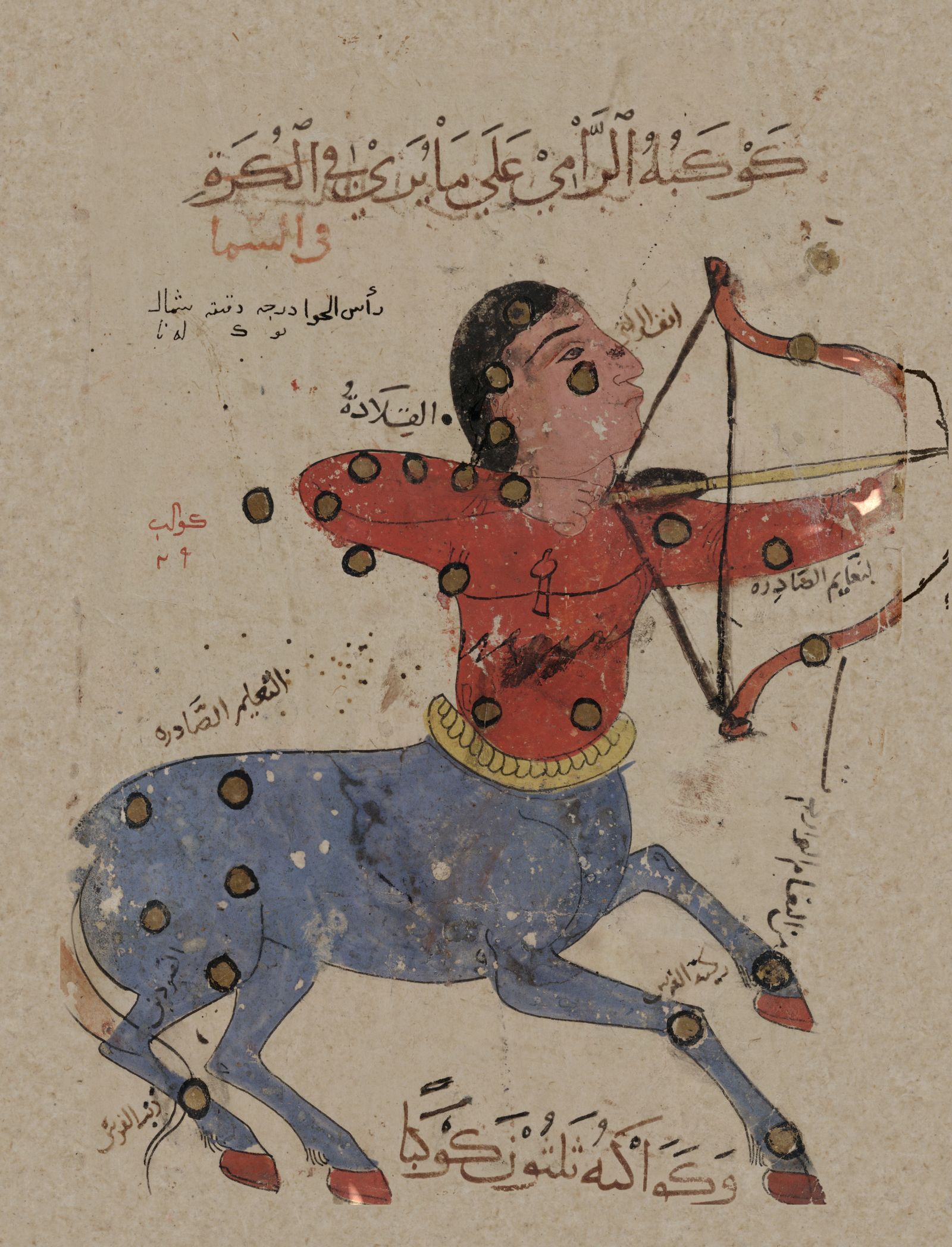
A Jalayirid painter in Baghdad, Sagittarius, from the Kitāb al-Bulhān, late 14th century. Bodleian Library, Oxford (MS. Bodl. Or. 133). Complete composition. Restored by Surrealium at Vaxholm Fortress, Sweden.
In late fourteenth-century Baghdad a painter filled the Book of Wonders with the creatures of the sky and the spirit world. Sagittarius is a centaur in a red tunic drawing his bow, his blue horse's body ringed with stars. The Arabic above names the sign and its stars, as an astrologer would have read them.
Strong red and blue on warm paper, and a figure you can read from across a room.
See the print of Sagittarius, from the Kitāb al-Bulhān
3. Libra with Venus, from the Kitāb al-Bulhān
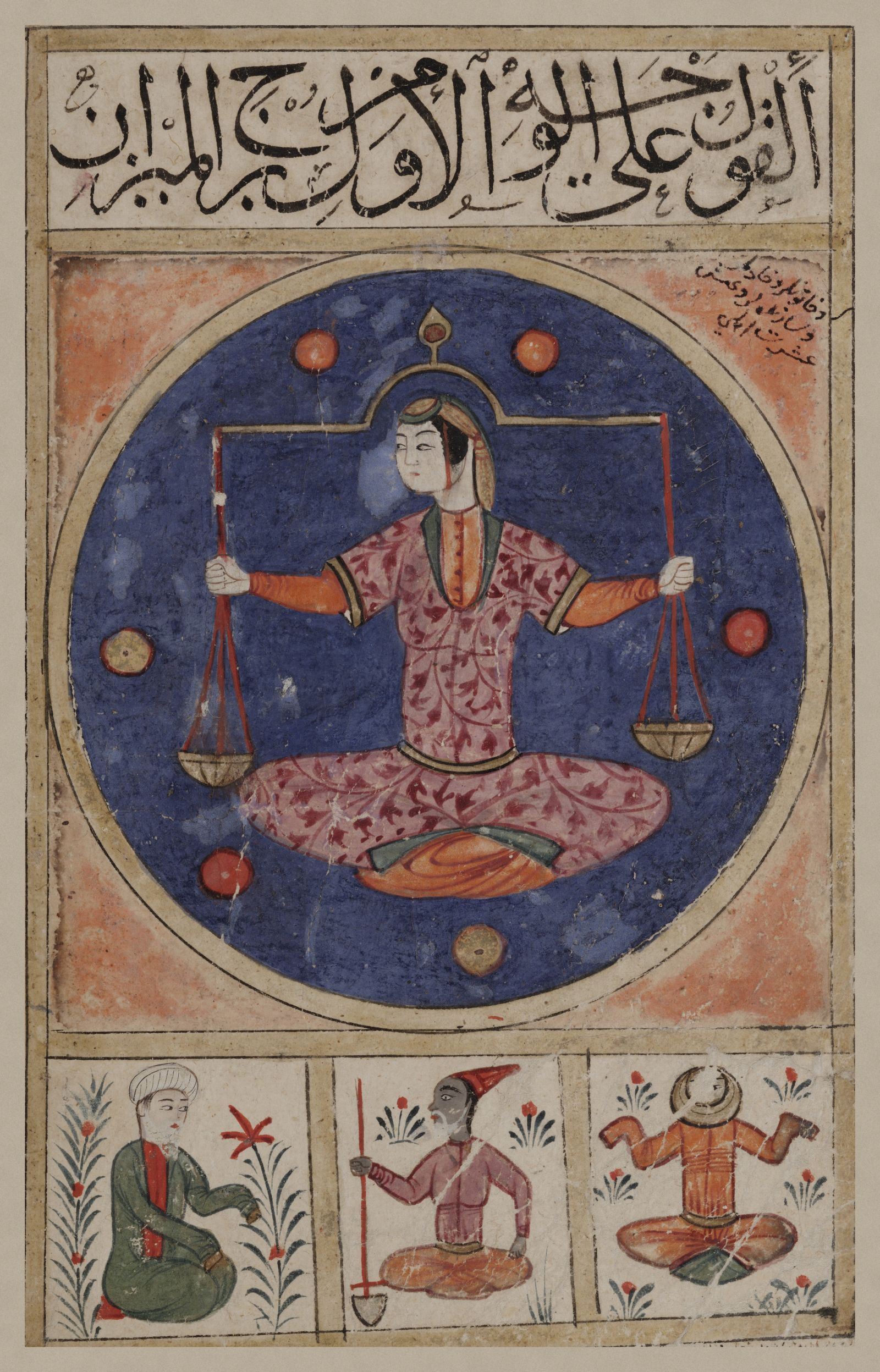
A Jalayirid painter in Baghdad, Libra with Venus, from the Kitāb al-Bulhān, late 14th century. Bodleian Library, Oxford (MS. Bodl. Or. 133). Complete composition. Restored by Surrealium at Vaxholm Fortress, Sweden.
Each sign in the Book of Wonders is painted with the planet that rules it. Libra belongs to Venus, so the sign is a woman sitting cross-legged in a deep blue roundel, holding up the scales. Three small figures sit in panels beneath her, and the title runs across the top in bold black script.
The calmest page in the book, and the one for anyone born under the scales.
See the print of Libra with Venus, from the Kitāb al-Bulhān
4. The Red King, from the Kitāb al-Bulhān
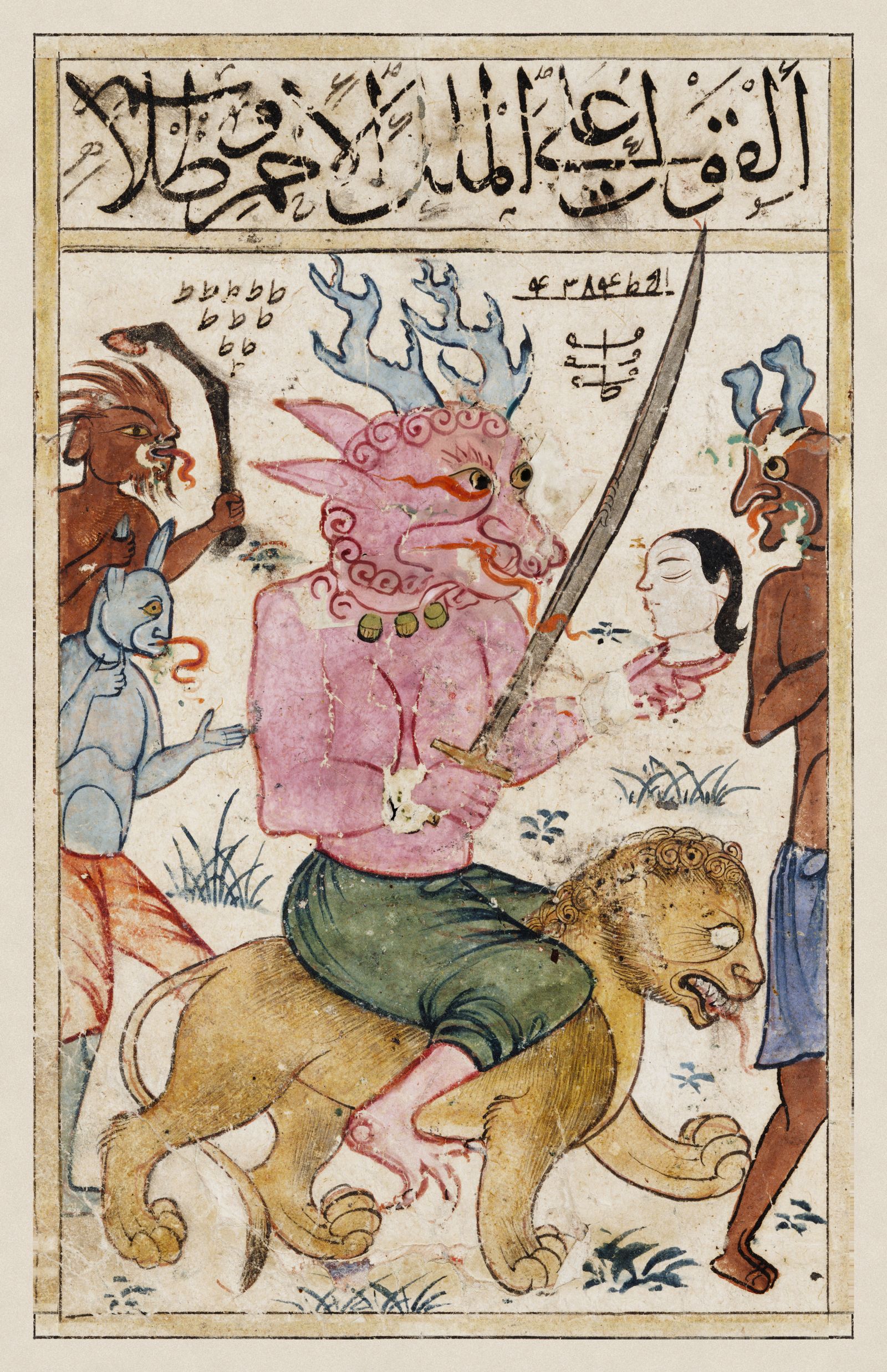
A Jalayirid painter in Baghdad, The Red King, from the Kitāb al-Bulhān, late 14th century. Bodleian Library, Oxford (MS. Bodl. Or. 133). Complete composition. Restored by Surrealium at Vaxholm Fortress, Sweden.
Astrology also ruled the days of the week, and each day had its planet. Tuesday belongs to Mars, and in the Book of Wonders its jinn king is the Red King: pink-faced, antlered and crowned, riding a lion with his sword raised while his attendants stand beside him. These are not maps; they are portraits of the forces astrologers believed ruled each day.
The strangest picture here, and the one people ask about.
See the print of The Red King, from the Kitāb al-Bulhān
5. Mandala of Surya, the Sun God
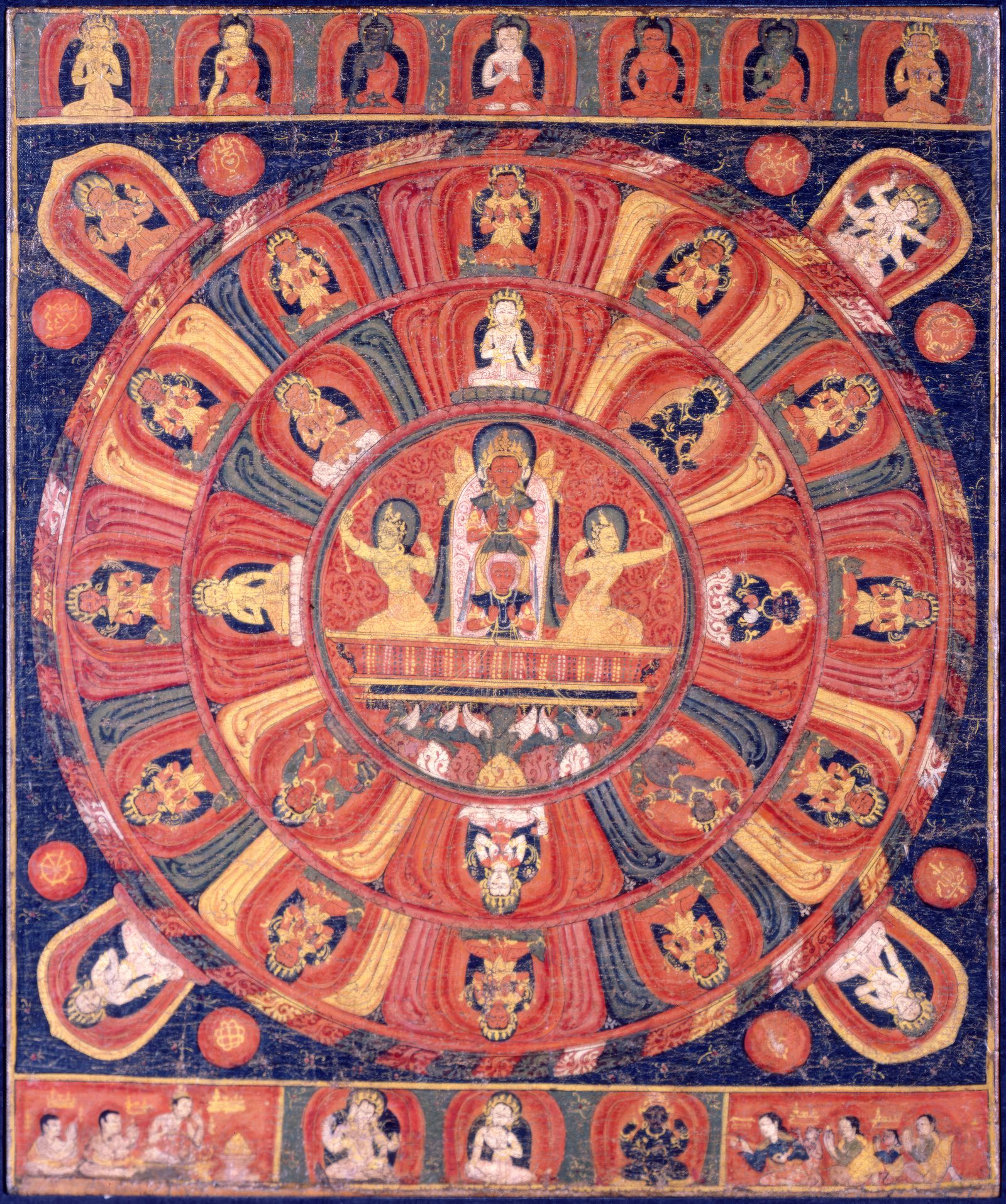
A Nepalese painter, Mandala of Surya, the Sun God, 16th century. Walters Art Museum, Baltimore. Complete composition. Restored by Surrealium at Vaxholm Fortress, Sweden.
In Indian and Nepalese astrology the planets are not distant lamps but persons, to be honoured and appeased. In this sixteenth-century painting on cloth from Nepal, the red-faced Sun God is enthroned at the centre between two goddesses of the dawn, who draw their bows against the dark, and the deities of his court sit in the red and gold petals that turn around him.
The richest colour in the series: vermilion, gold and lapis blue.
See the print of Mandala of Surya, the Sun God
6. The Moon and Her Children
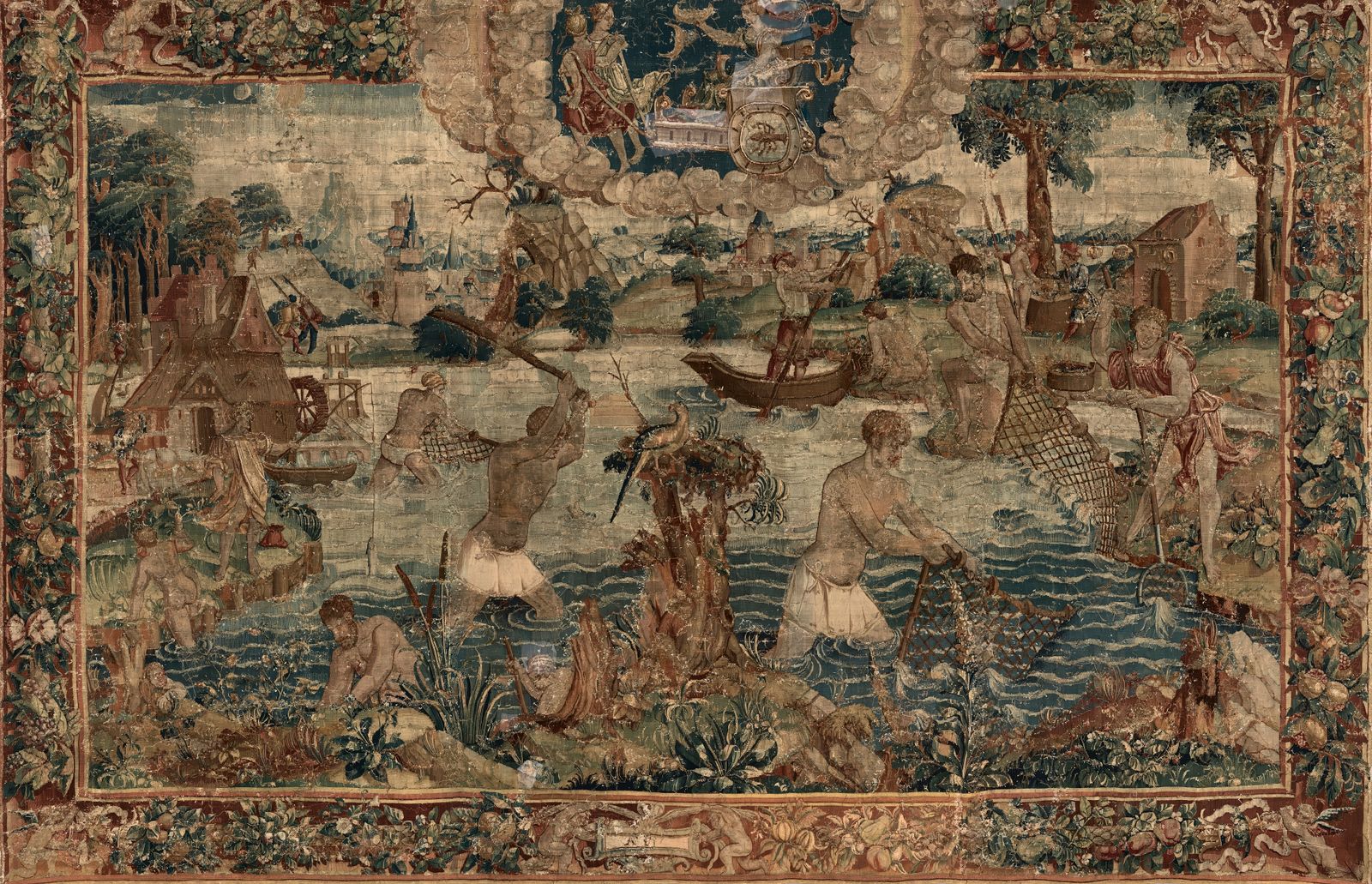
An unknown workshop, The Moon and Her Children, 16th century. The Metropolitan Museum of Art, New York. Complete composition. Restored by Surrealium at Vaxholm Fortress, Sweden.
Renaissance Europe believed that every planet had its children: the people born under it and the trades it governed. In this sixteenth-century tapestry the Moon rides through the clouds in her chariot, and below her the Moon's children are at work on the water, fishermen hauling nets, a boatman poling his boat, a mill turning on the bank.
A whole woven world in greens and russets, wide enough for a long wall.
See the print of The Moon and Her Children
7. Planisphaerium Braheum
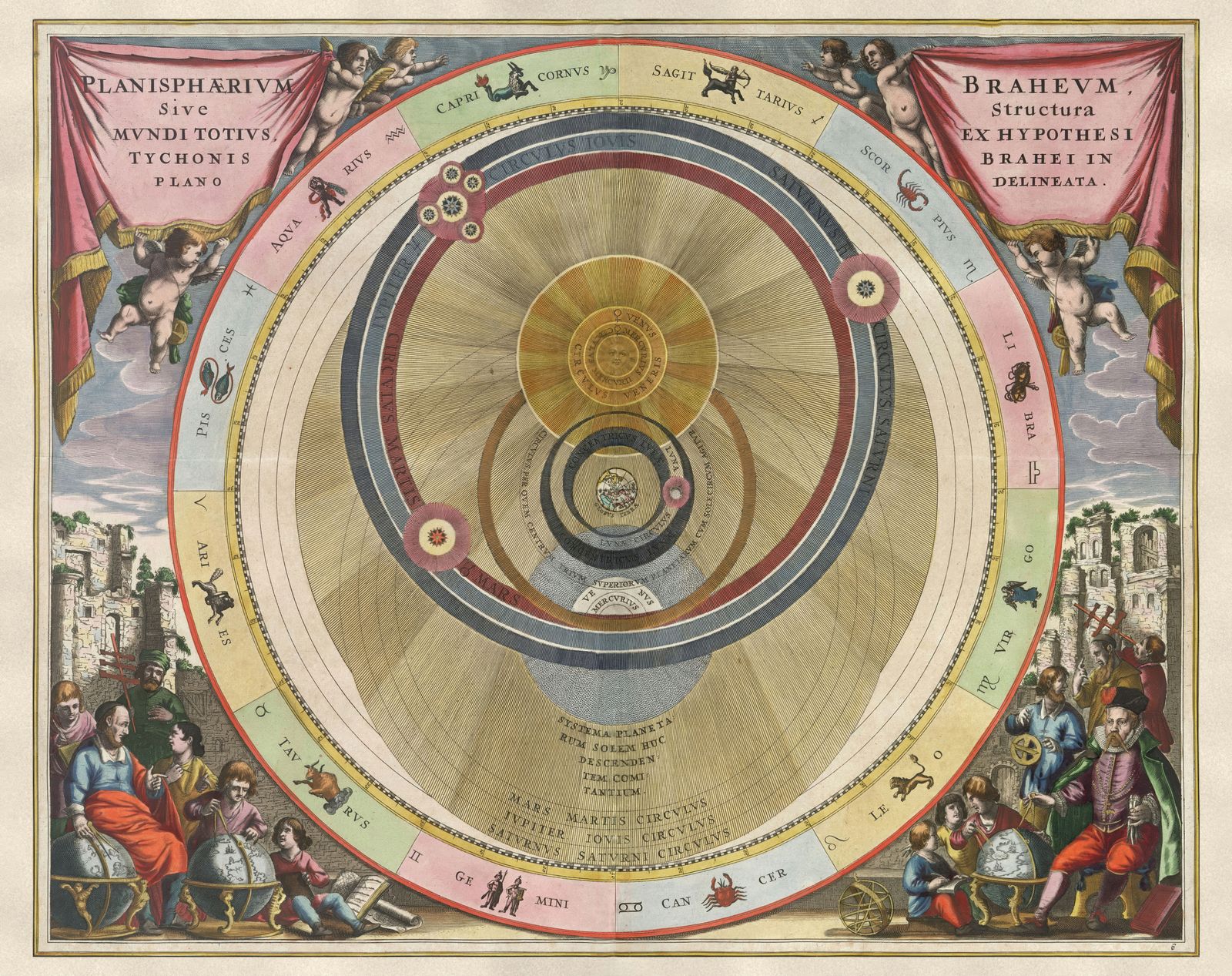
Andreas Cellarius, Planisphaerium Braheum, 1660. From Harmonia Macrocosmica, Amsterdam. Complete composition. Restored by Surrealium at Vaxholm Fortress, Sweden.
In 1660 the Amsterdam publisher Johannes Janssonius issued Andreas Cellarius's Harmonia Macrocosmica, the most beautiful star atlas ever printed. This plate shows the heavens as Tycho Brahe arranged them: the Earth at the centre, the Sun and Moon circling it, and the other planets circling the Sun. The twelve signs run around the edge in coloured panels, and astronomers sit with their books and globes in the lower corners.
Hand-coloured gold, rose and blue; it holds a wall like a window.
See the print of Planisphaerium Braheum
8. Scenographia Systematis Copernicani
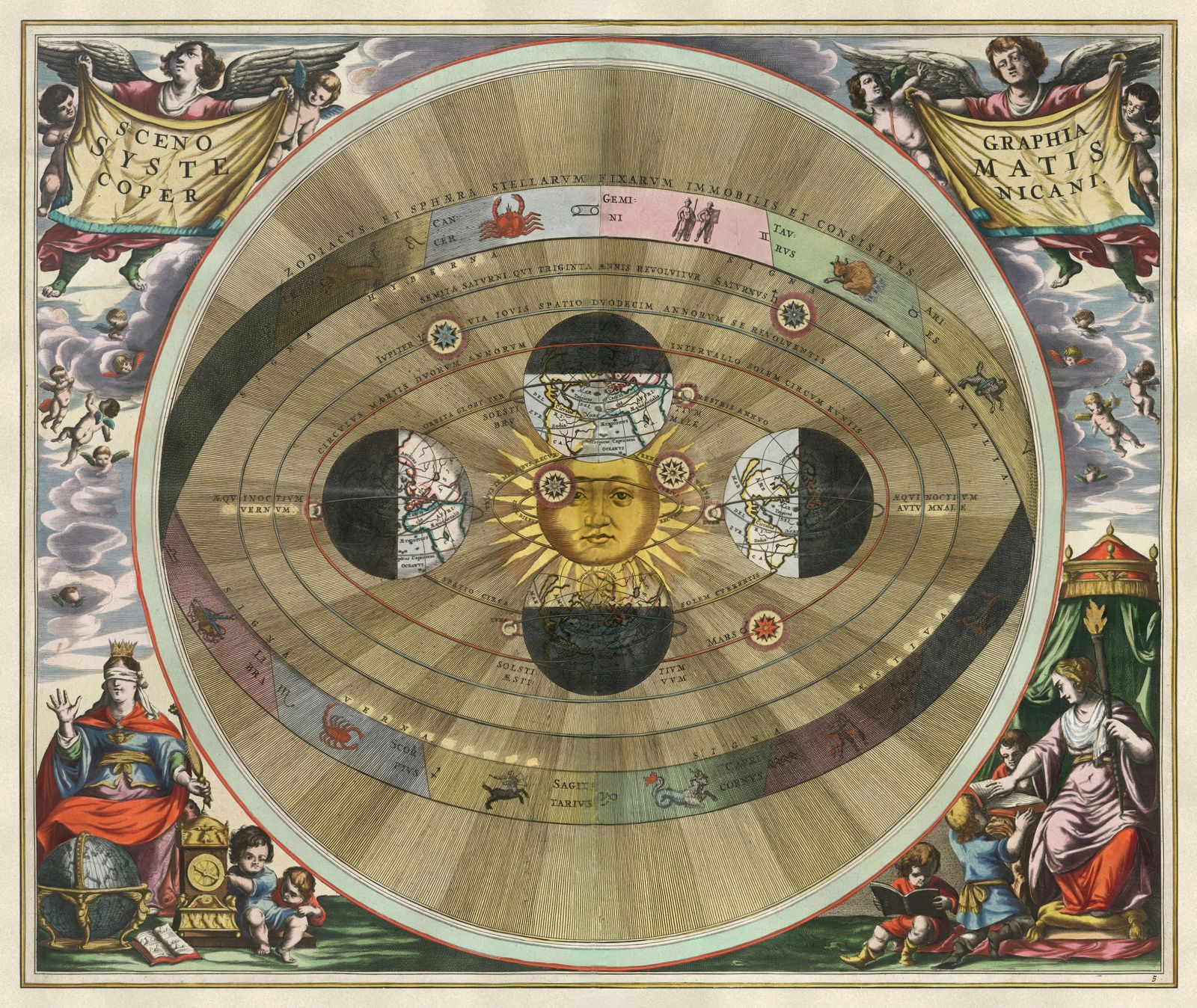
Andreas Cellarius, Scenographia Systematis Copernicani, 1660. From Harmonia Macrocosmica, Amsterdam. Complete composition. Restored by Surrealium at Vaxholm Fortress, Sweden.
Cellarius set the old heavens and the new side by side. Here the Sun sits at the centre with a face of its own, as Copernicus had placed it, and the Earth is drawn four times around it, once for each season, inside the band of the zodiac. Cherubs hold the title on blue banners above.
The plate that shows the moment the centre of the sky moved.
See the print of Scenographia Systematis Copernicani
9. Scorpio and Sagittarius
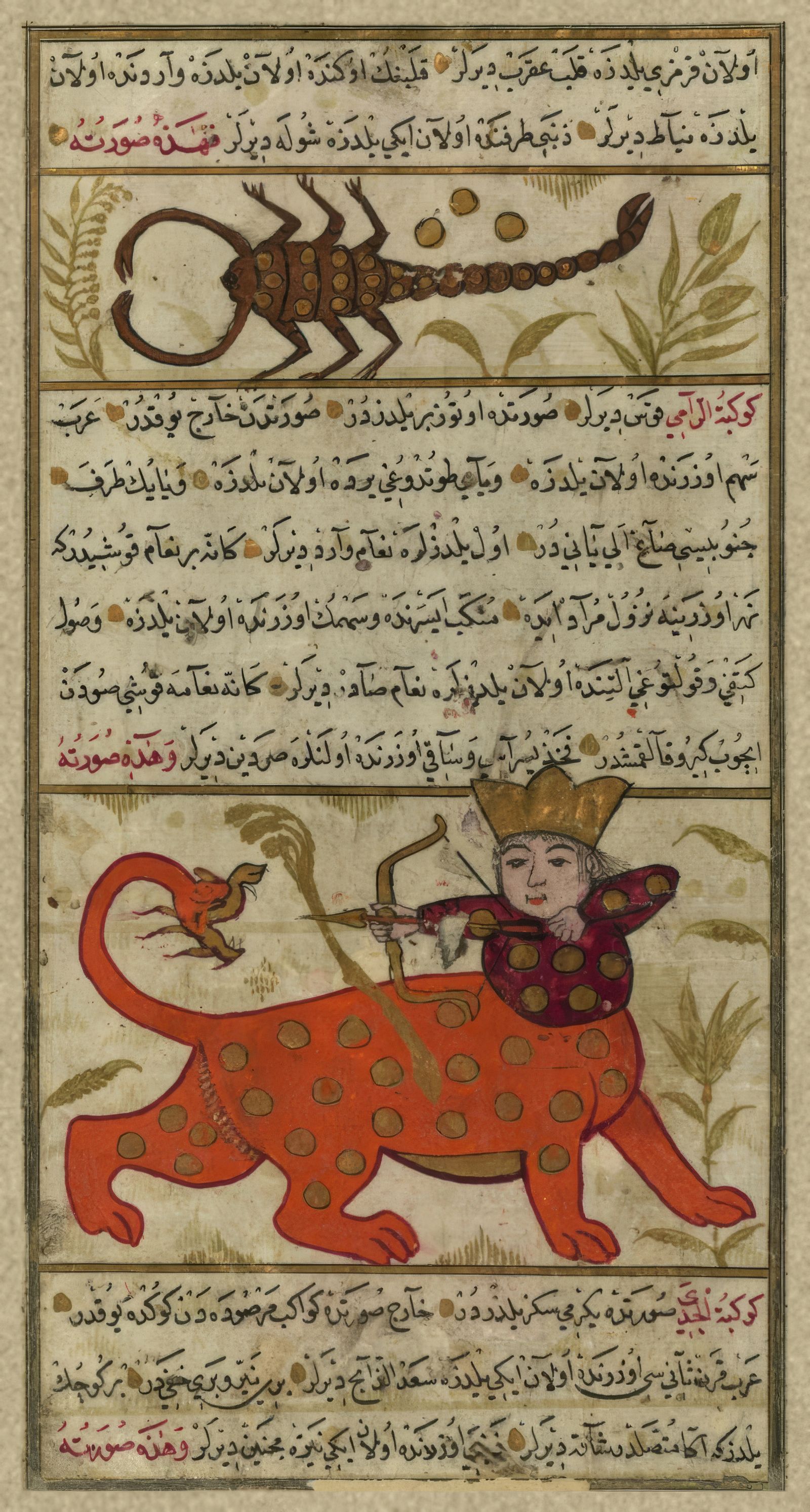
After Zakariya al-Qazwini, Scorpio and Sagittarius, 1717 (Ottoman copy). Walters Art Museum, Baltimore (W.659). Complete composition. Restored by Surrealium at Vaxholm Fortress, Sweden.
Zakariya al-Qazwini's thirteenth-century Wonders of Creation was copied for five hundred years. In this Ottoman copy of 1717 Scorpio is a gold-spotted scorpion, and Sagittarius a crowned archer riding a red, spotted beast whose tail ends in a dragon's head, the old Persian way of drawing the sign.
Two signs on one page, with the text kept whole around them.
See the print of Scorpio and Sagittarius
10. Sagittarius, from Drawings of the Zodiac
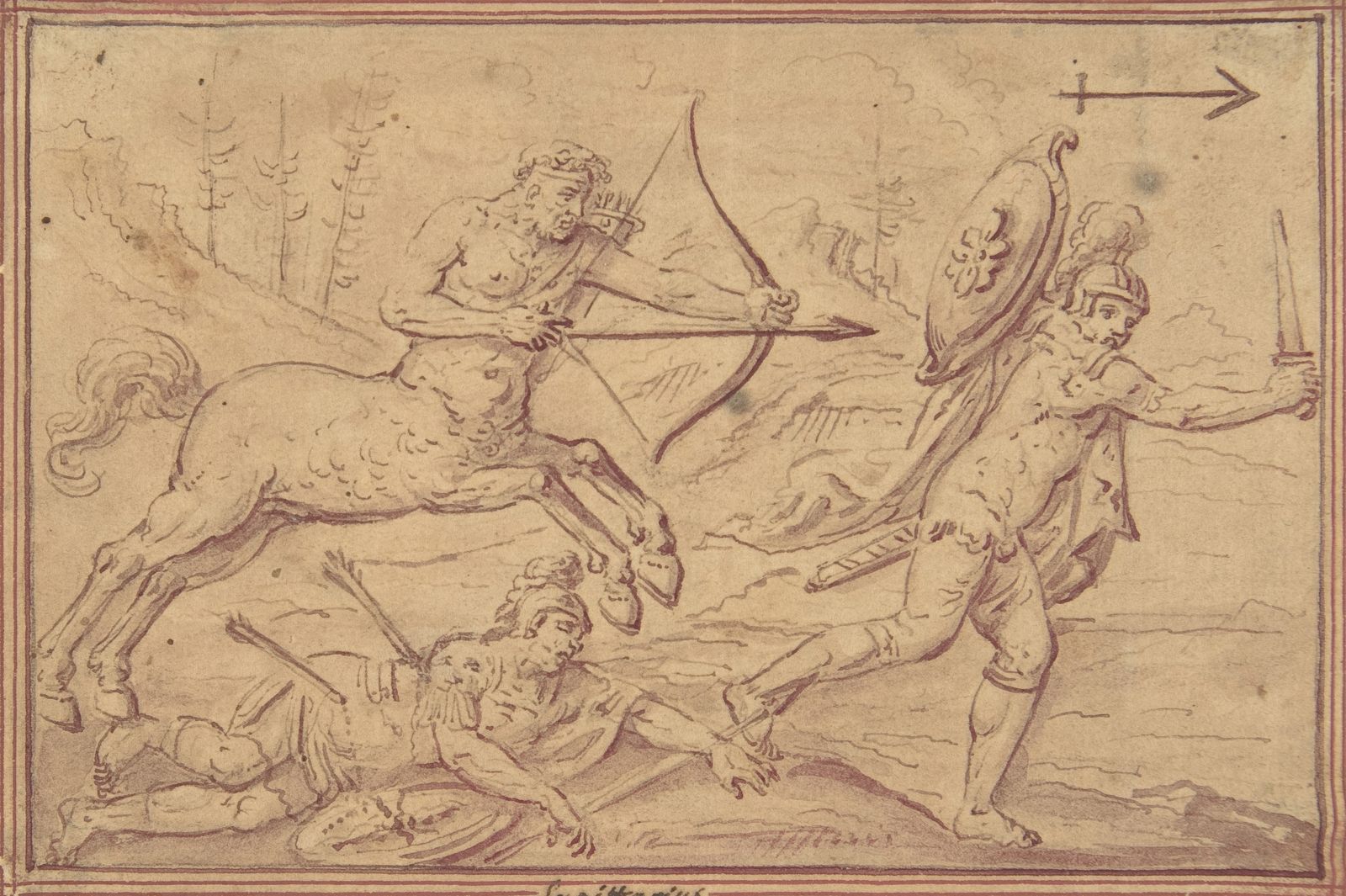
An unknown draughtsman, after the antique, Sagittarius, from Drawings of the Zodiac, 18th century. The Metropolitan Museum of Art, New York. Complete composition. Restored by Surrealium at Vaxholm Fortress, Sweden.
By the eighteenth century the signs had become a subject for classical drawing. In this sheet a centaur draws his bow at a soldier behind a shield, while a fallen man lies between them, all in pen and a warm red-brown wash, as if copied from a Roman relief.
Quiet and warm; a gift for a Sagittarius who prefers drawing to colour.
See the print of Sagittarius, from Drawings of the Zodiac
11. Ursa Major, from Urania's Mirror
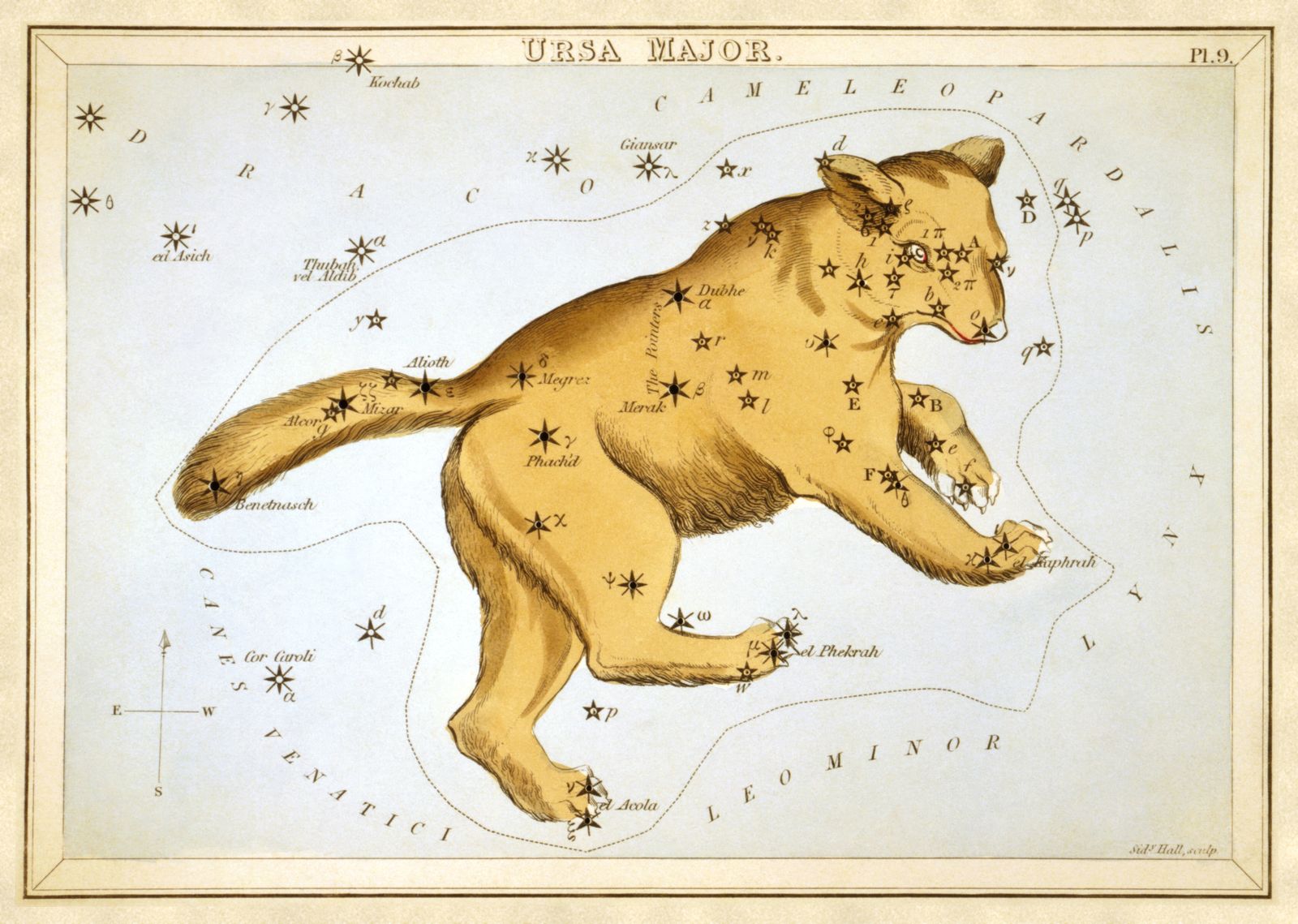
Sidney Hall, Ursa Major, from Urania's Mirror, 1824. Published in London by Samuel Leigh. Complete composition. Restored by Surrealium at Vaxholm Fortress, Sweden.
Urania's Mirror, published in London in 1824, was a box of thirty-two cards engraved by Sidney Hall, with holes pricked where the stars are, so that held up to a lamp each constellation shone through. On this card the Great Bear lumbers across the sky, its stars named and graded by size.
The friendliest constellation card ever made, and a classic in a child's room.
See the print of Ursa Major, from Urania's Mirror
12. Smith's New Moveable Planisphere
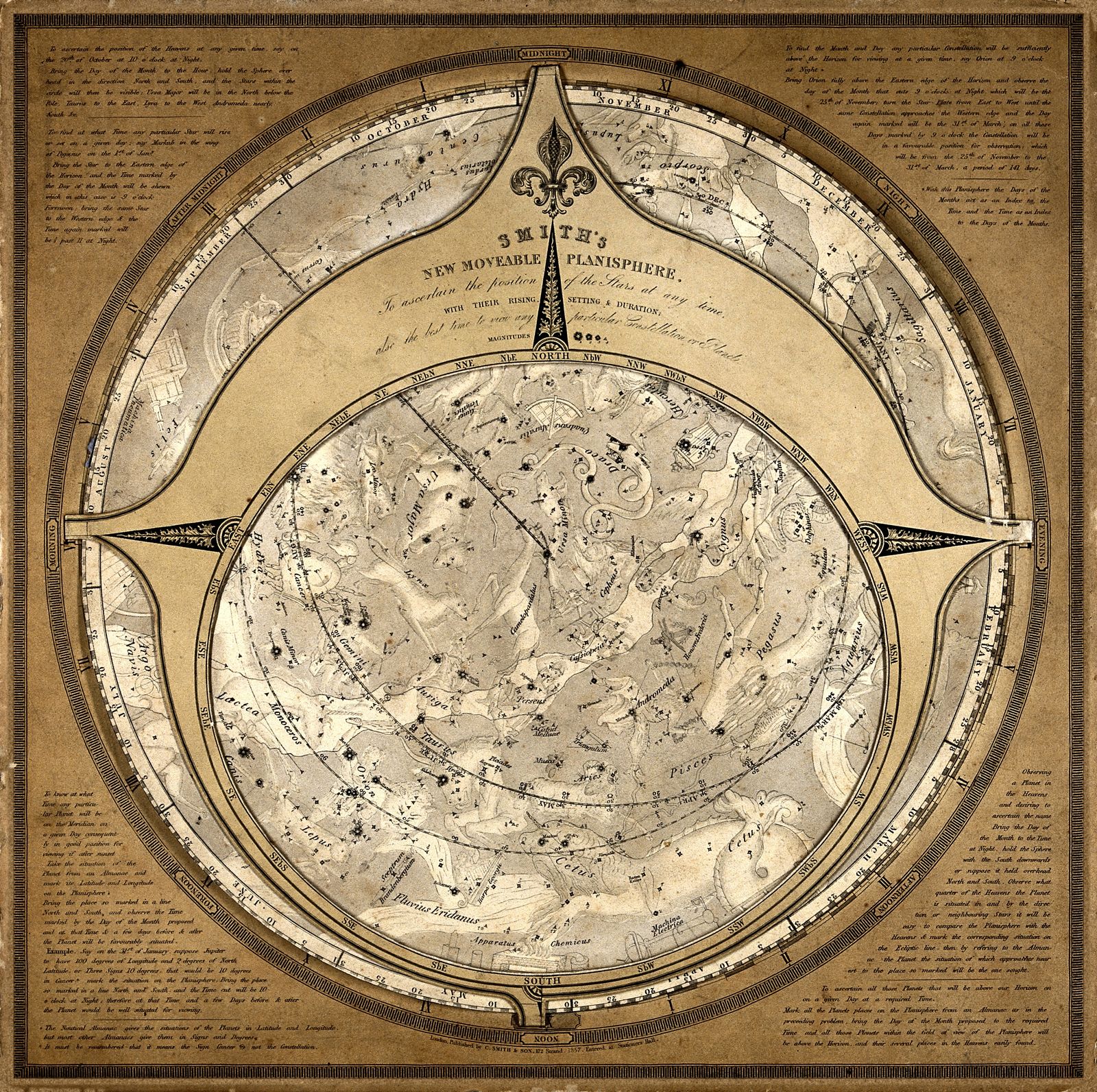
C. Smith & Son, Smith's New Moveable Planisphere, 1850s. Wellcome Collection. Complete composition. Restored by Surrealium at Vaxholm Fortress, Sweden.
A few decades later a London map-maker sold the sky as something to use. Smith's New Moveable Planisphere has a turning disc inside a printed frame: set it to the date and hour, and the opening shows which stars stand above you that night.
A beautiful working object, square and well suited to a pair.
See the print of Smith's New Moveable Planisphere
13. Libra, from a Persian zodiac album
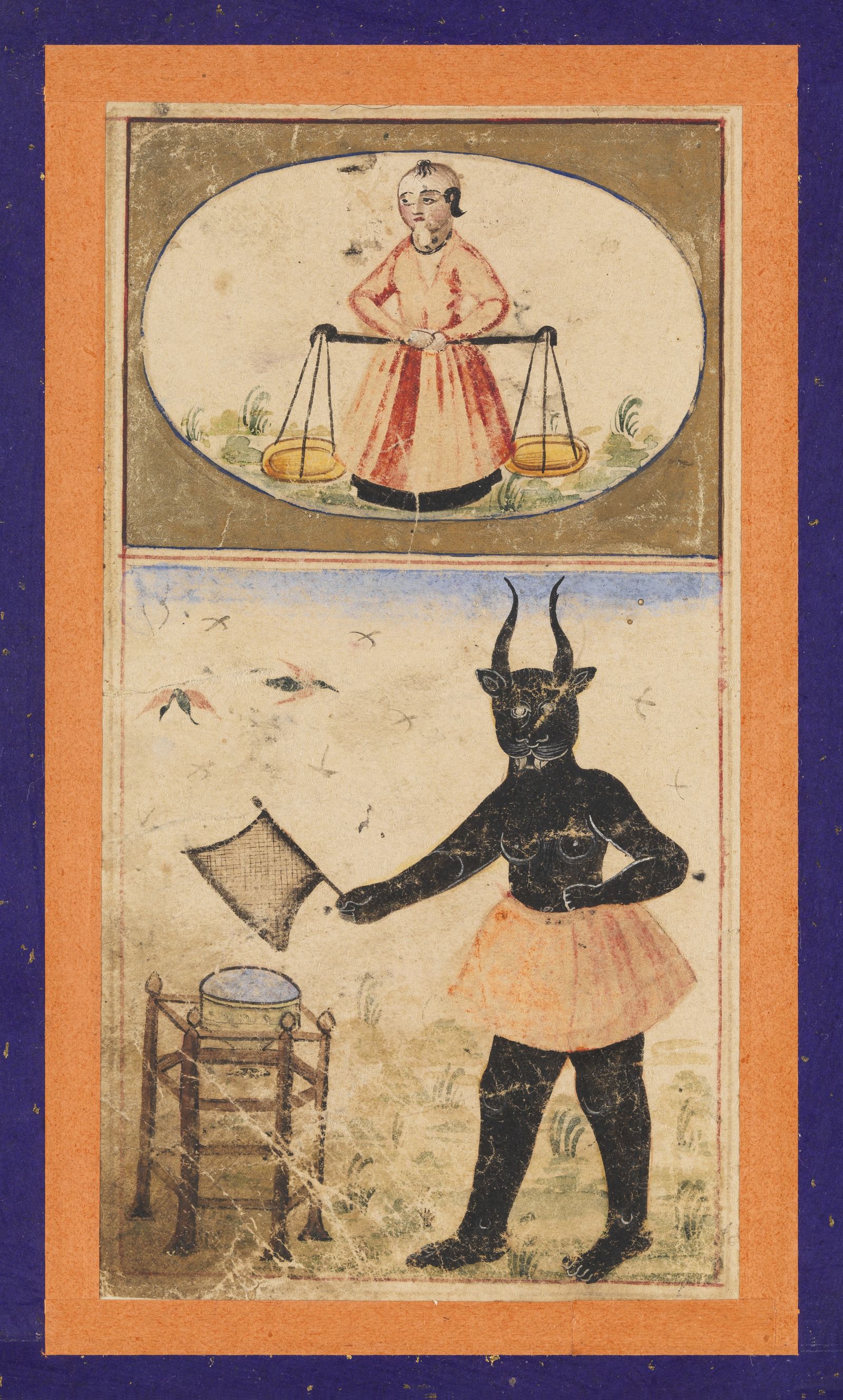
A Persian painter, Libra, from a Persian zodiac album, 19th century. Wellcome Collection. Complete composition. Restored by Surrealium at Vaxholm Fortress, Sweden.
In nineteenth-century Persia the signs were still painted as figures with characters of their own. In the upper panel of this album leaf a young man holds the scales; below him a black, horned demon stands with a raised cleaver, the darker side of the sign.
Orange and deep blue around a pale page; small, odd and memorable.
See the print of Libra, from a Persian zodiac album
14. Circle with the signs of the zodiac
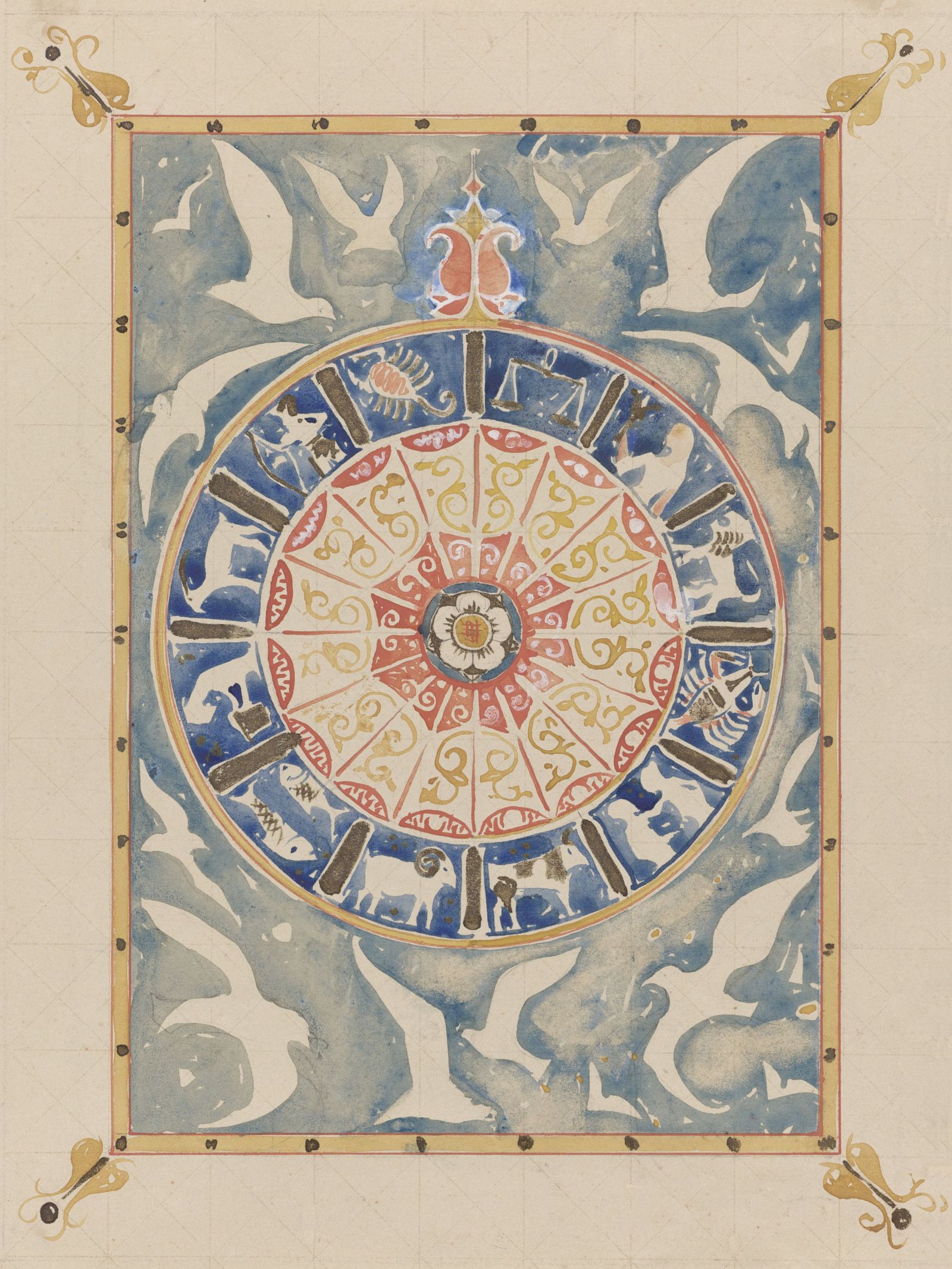
An unknown designer, Circle with the signs of the zodiac, 19th century. Rijksmuseum, Amsterdam. Complete composition. Restored by Surrealium at Vaxholm Fortress, Sweden.
A watercolour design in the Rijksmuseum sets the twelve signs in a blue ring around a red and gold rosette, with white birds flying through a marbled sky. Whatever each age believed about the stars, it kept drawing the same circle.
Soft blue and gold, and the most decorative picture in the series.
See the print of Circle with the signs of the zodiac
15. The November Meteors
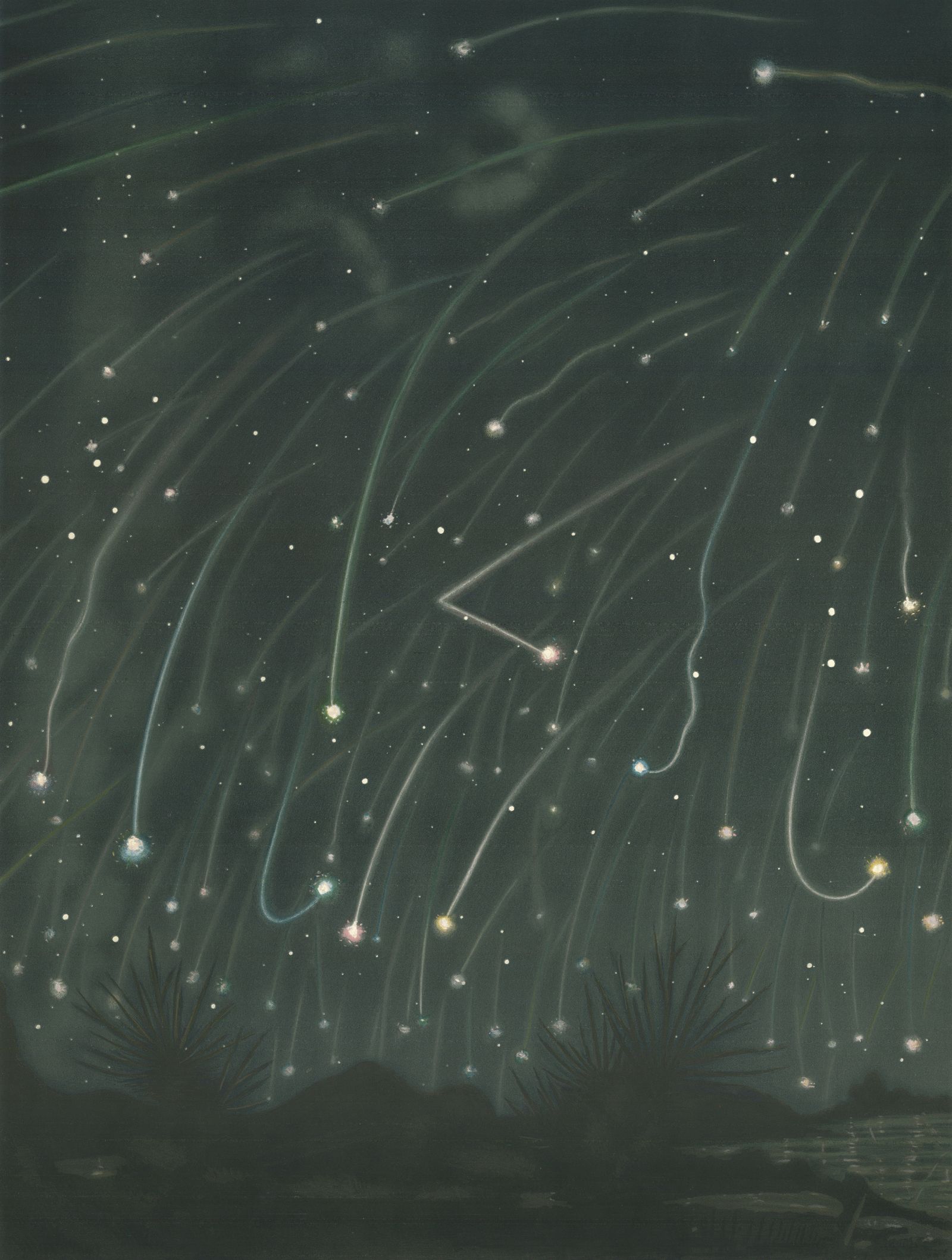
Étienne Léopold Trouvelot, The November Meteors, 1881–82. From The Trouvelot Astronomical Drawings, New York. Complete composition. Restored by Surrealium at Vaxholm Fortress, Sweden.
Étienne Léopold Trouvelot, a French-born artist who came to astronomy by way of moths, drew the night of 13 November 1868, when the Leonid meteors fell across the sky. He published it with fourteen other plates in 1881 and 1882. He was drawing the sky as it is, after centuries of drawing it as it means.
Dark and calm, with the streaks of light running corner to corner.
See the print of The November Meteors
16. Zodiac
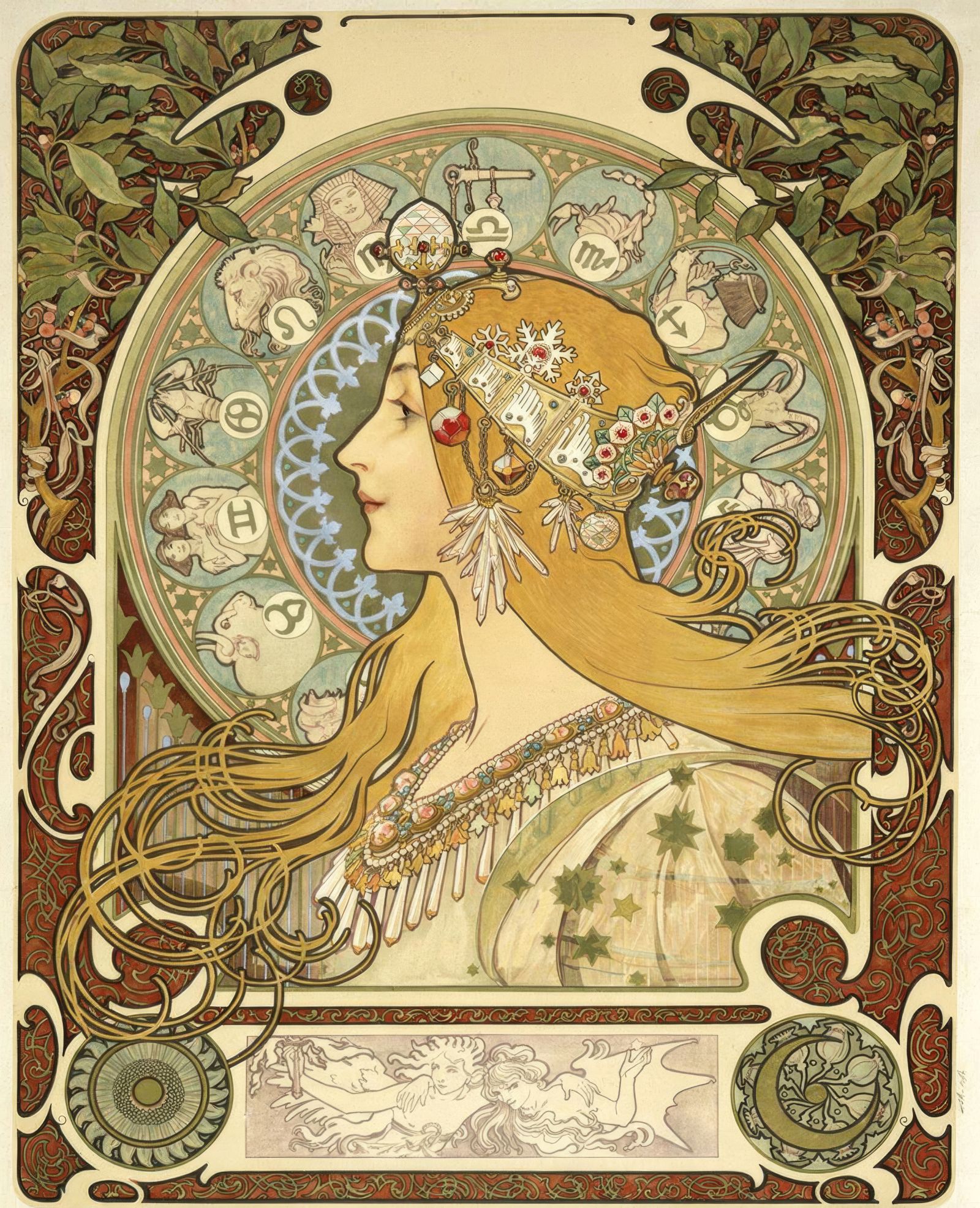
Alphonse Mucha, Zodiac, 1896. Victoria and Albert Museum, London. Complete composition. Prepared for print by Surrealium at Vaxholm Fortress, Sweden.
By 1896 the zodiac had become pure ornament. Alphonse Mucha's calendar design sets a woman in profile, jewelled and golden-haired, against a halo of the twelve signs, with the sun and the moon in the corners below. The sky that once ruled bodies, trades and days now crowns a face.
The best-known zodiac picture there is, and the one to end on.
All sixteen hang together in the Astrology through the ages series in Masterworks, oldest first, and in its own night-blue room on the Museum Walk. Every print is made to order from the restored file and arrives with its museum's credit on the back.