Saturn devouring his son: Goya’s unsettling world
Saturn devouring his son belongs to Goya’s Black Paintings. Its history is distinct from the earlier Goya works shown here.
Saturn devouring his son is one of Goya's Black Paintings, made on the walls of the house known as the Quinta del Sordo and later transferred to canvas. See the painting and its catalogue record at the Museo Nacional del Prado. It is discussed here but not reproduced: the images on this page are other Goya works available in Fable's collection, beginning with Witches' Flight. Their captions identify them separately so that the earlier paintings do not become misleading stand-ins for Saturn.
The distinction opens a useful question. How does Goya make an image unsettling before it reaches the extreme subject of the Black Paintings? A frightened figure, a crowd moving through winter or a child balanced on an animal can reveal different answers. The dark art reading room offers a wider route through difficult images; here the attention stays on Goya's particular choices.
A painting that began as part of a house
The Fundación Goya en Aragón dates Saturn to around 1820–23 and records its medium as oil on plaster transferred to canvas. That material history matters. The painting began as part of a room, not as a portable canvas made for an ordinary public commission. Its later removal and museum life changed the conditions in which viewers encounter it, even though the image remains attached to the place where it was first made.
Avoid pretending that we can reconstruct Goya's private intention from the subject alone. The house context offers evidence about location and medium, not a transcript of the artist's thoughts. A responsible account can distinguish the known object history from competing interpretations. That is especially useful with a work whose intensity encourages confident stories about fear, age, politics or the artist's state of mind.
The myth and the title
The familiar title connects the image with Saturn, associated in the Greco-Roman tradition with the father who consumes his children to prevent their overthrow of him. The painting's violence makes that story legible in a stark form, without the elaborate setting that another artist might use to identify a classical subject. It does not offer the viewer a comfortable distance from the act.
The subject has been painted by other artists, including Rubens, whose work should not be confused with Goya's in a search result. Artist, date and collection are necessary identifiers, particularly when the title is shared. Goya's picture belongs to the Black Paintings and to the early nineteenth century. A seventeenth-century Saturn with a different composition is not an alternative date or a different photograph of the same object.
Witches’ Flight: a body held above the ground
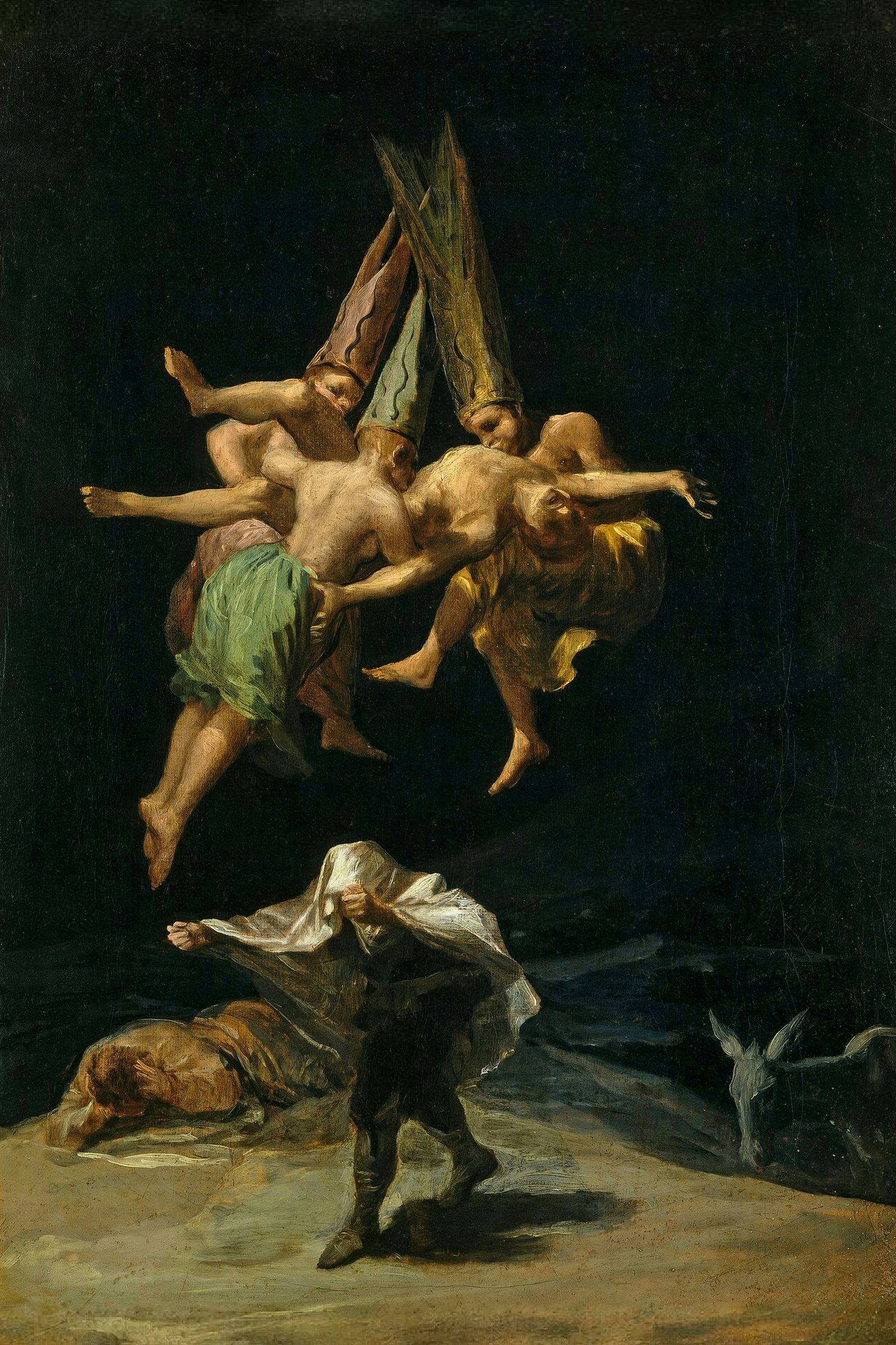
Witches' Flight · Francisco Goya, c. 1798 · Museo Nacional del Prado, Madrid. Prepared for print by Surrealium at Vaxholm Fortress, Sweden.
Witches' Flight, the painting shown here, dates to 1798 and belongs to the Prado. Several figures lift a body into a dark field while people below react in different ways. The separation between the airborne group and the ground gives the image its first disturbance: weight appears to be held in an impossible or unexplained relation to space. Tall headgear and pale flesh sharpen the silhouettes against the surrounding darkness.
The picture predates the Black Paintings by more than two decades. That gap matters because it prevents a single label from swallowing Goya's whole career. Witches' Flight offers its own staged encounter with superstition and fear. Look at the different directions of the lower figures before treating them as one audience; their separate reactions are part of the composition's unsettling rhythm.
Darkness as an arrangement, not a diagnosis
A dark ground can remove the ordinary information that makes a scene easy to place. We lose the reassuring scale of a room, the direction of a road or the distance to a horizon. In Witches' Flight, the bright bodies seem suspended in that lack of explanation. The image can feel disturbing because the viewer cannot easily establish the rules of the space.
That formal observation does not require a diagnosis of the painter or the figures. It is possible to discuss fear, irrationality and power while remaining precise about what supports the discussion. Ask which part of the image creates the effect: an impossible position, a concealed face, an object held too close to another body. The answer keeps interpretation connected to the work instead of turning the artist's life into a convenient explanation for every shadow.
The Bewitched Man: fear makes a theatre
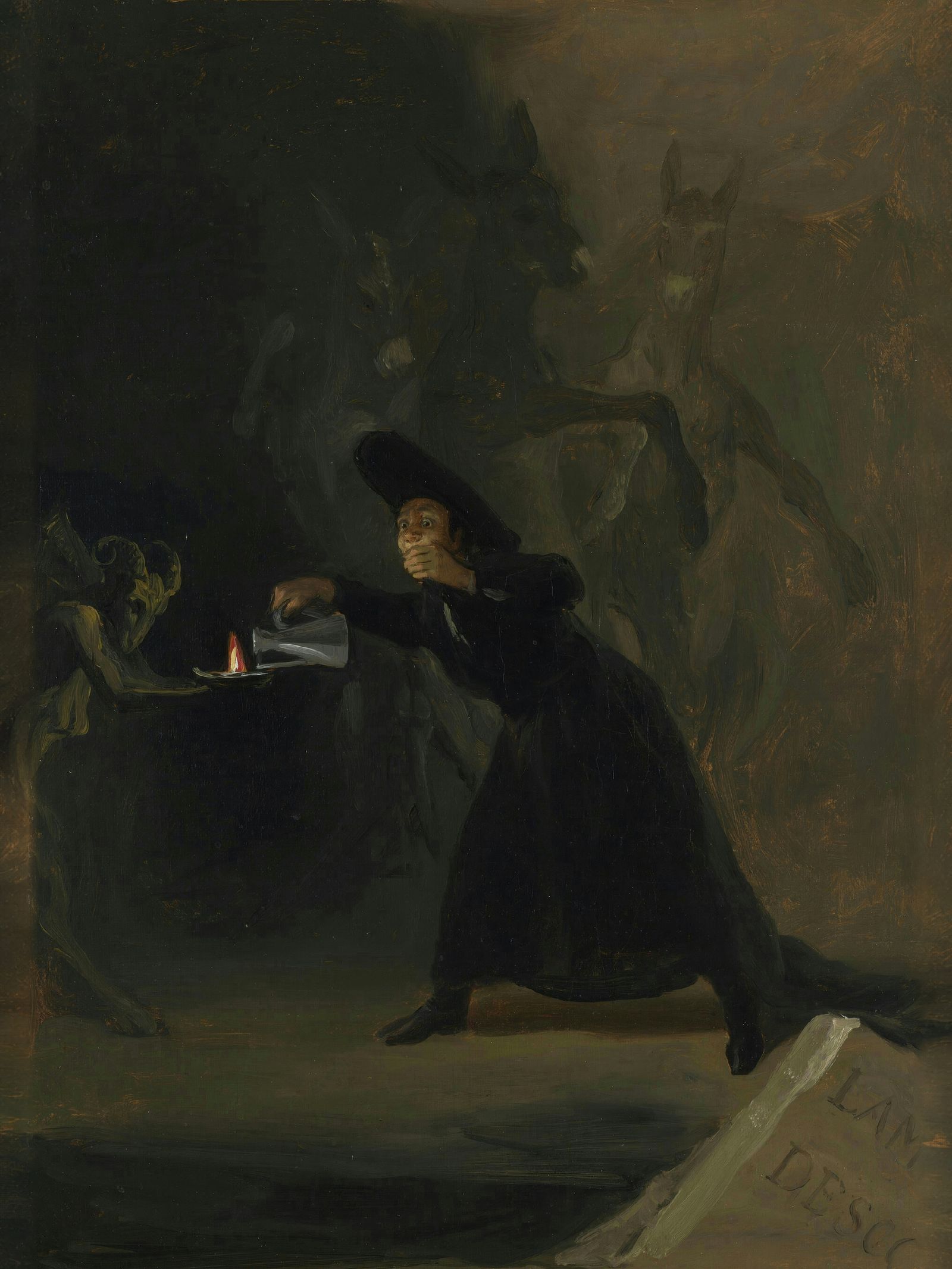
The Bewitched Man · Francisco Goya, 1798 · The National Gallery, London. Prepared for print by Surrealium at Vaxholm Fortress, Sweden.
The Bewitched Man places a frightened figure among strange forms in a dim interior. His extended posture and attention to a small light make the situation feel precarious, while the surrounding figures complicate the boundary between what he sees and what the viewer should believe. The painting is an earlier work associated with a theatrical subject, rather than one of the Black Paintings.
This difference helps us see how readily a frightening image can also involve performance. Costume, exaggerated posture and directed attention can make fear visible without presenting the scene as documentary evidence of supernatural events. The question is not whether the creatures are real, but how the picture stages belief. Goya gives the viewer enough distance to notice the arrangement even while the central figure appears caught inside it.
Winter Scene: unease without a monster
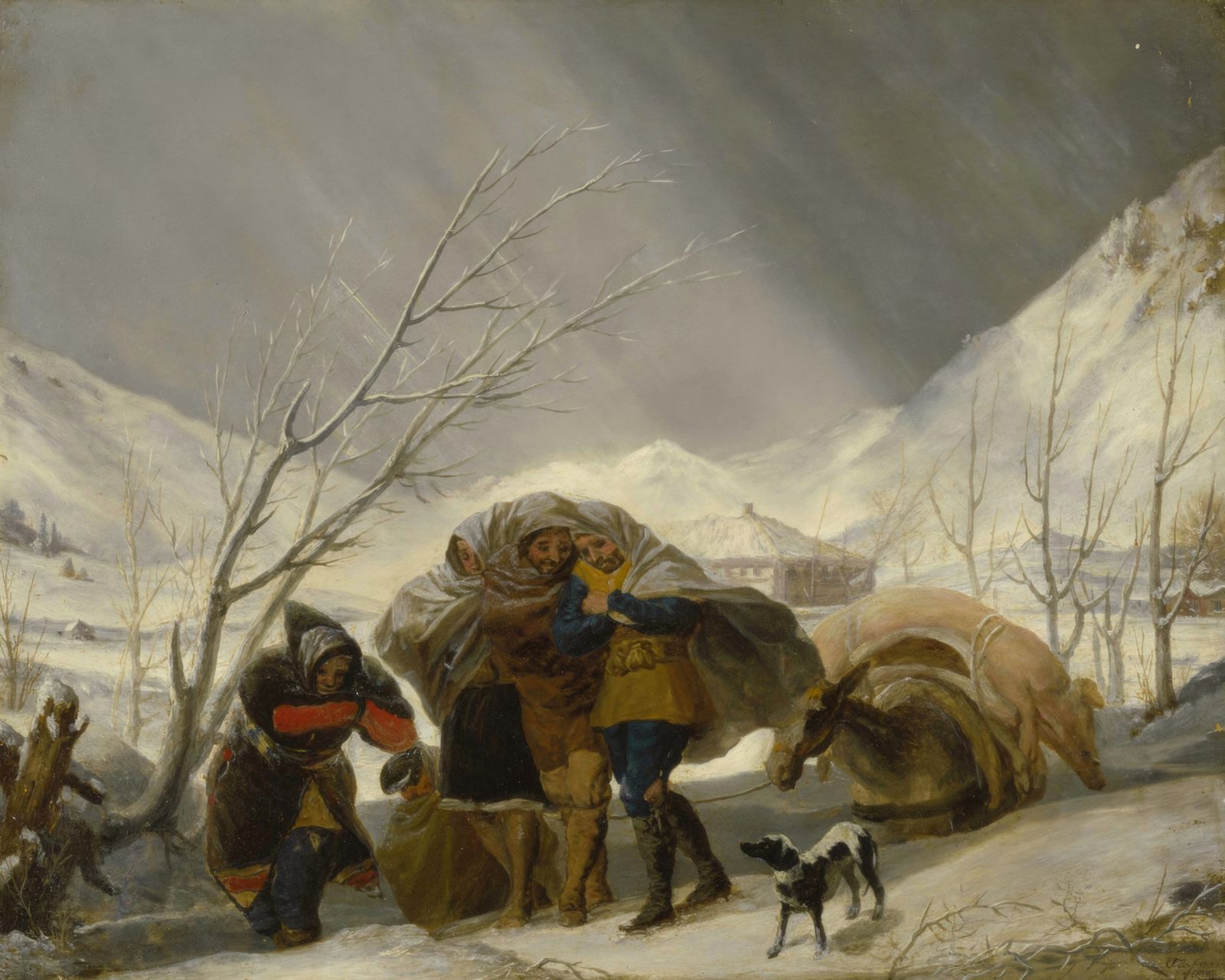
Winter Scene · Francisco José de Goya y Lucientes, c. 1786 · Art Institute of Chicago. Restored by Surrealium at Vaxholm Fortress, Sweden.
The Winter Scene shown here places bundled people in a cold landscape, with pale ground, bare branches and lowered bodies establishing the difficulty of movement. No mythological creature is needed. The environment presses on the figures through weather and exposure, and the small animal nearby does not turn the scene into an easy pastoral idyll.
Seen beside the supernatural subjects, this work broadens the meaning of a difficult Goya image. Discomfort can come from ordinary conditions as well as imagined threats. Look at how the bodies gather against the cold and how little shelter the landscape offers. The composition asks us to notice material circumstances, a useful corrective to the habit of describing everything sombre in Goya as an expression of private nightmare.
Boy on a Ram: another part of the same career
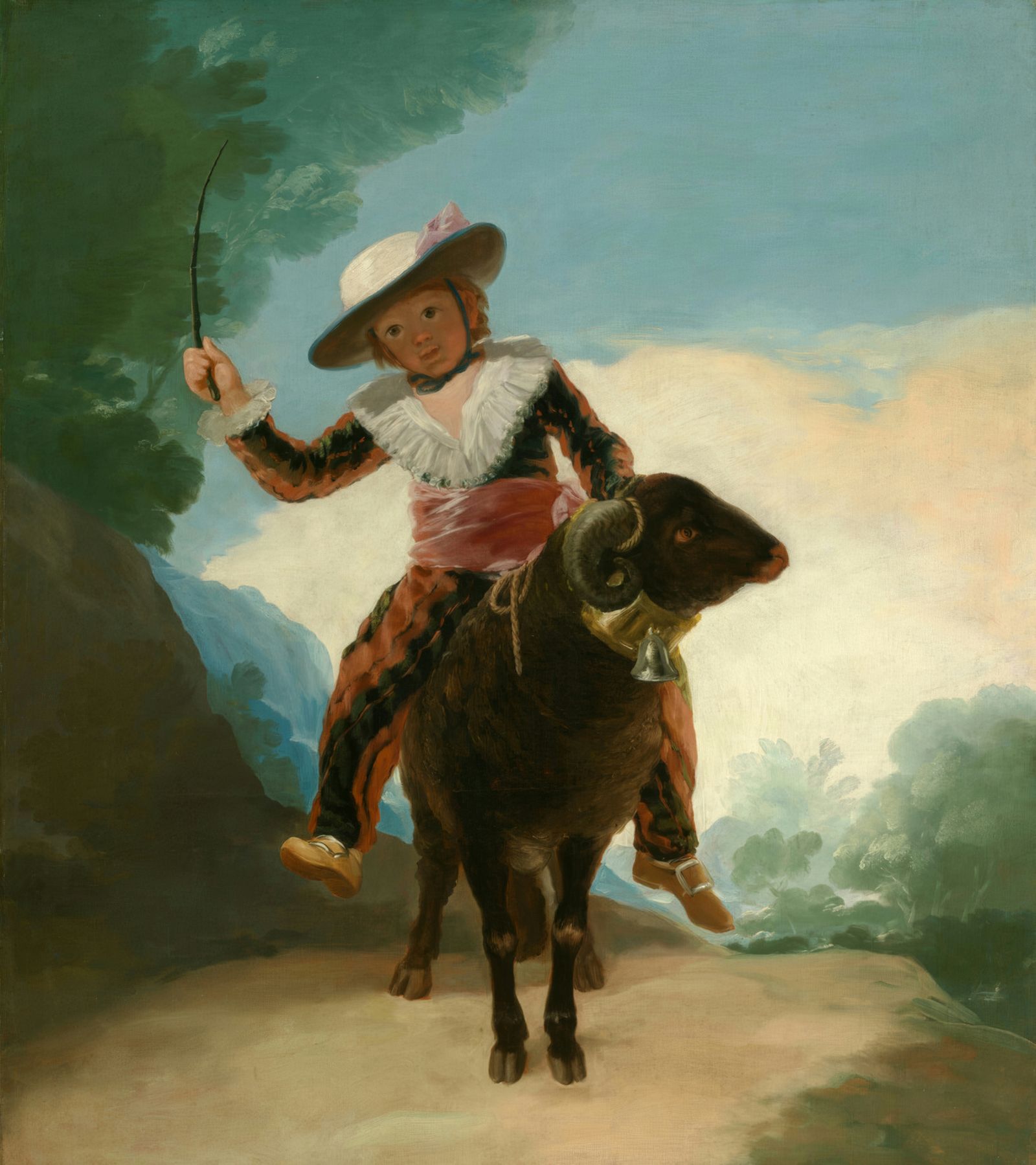
Boy on a Ram · Francisco José de Goya y Lucientes, 1786–87 · Art Institute of Chicago. Restored by Surrealium at Vaxholm Fortress, Sweden.
Boy on a Ram brings a child, an animal and a bright sky into an entirely different register. The raised arm, large hat and position on the ram give the image an immediate liveliness. It belongs here as a reminder that an artist's most famous disturbing work does not become the key to every other picture. The boy should not be made ominous simply because the same painter later made Saturn.
Compare the open landscape and distinct colours with the restricted spaces of the darker works. The difference is visible before it becomes a historical argument. Goya's career contains changing subjects, audiences and purposes, and a selection should let those differences remain. A fair introduction to an artist can make room for an image that interrupts the expected mood.
How to approach the Black Paintings now
Begin with the individual record, then separate three things: what the image depicts, what is known about the object and what a viewer proposes it means. The Fundación's record is a useful starting point for Saturn's dating and transfer, while looking at other Goya works helps prevent the Black Paintings from becoming the whole story. You do not have to enjoy a disturbing image to find its construction worth understanding.
For a further comparison, explore Greek mythology in painting and Odilon Redon's imagined beings. Witches' Flight sits in the Romantic collection, where the available work is clearly named. Choose from the works actually shown, keeping any interest in Saturn itself separate from a claim that it is offered on this page.
Goya's force comes partly from refusing one stable way of looking. A scene may be theatrical, mythological, ordinary or unexpectedly bright. Keeping the works distinct makes their differences more powerful, and gives Saturn a history more substantial than the label of a frightening picture.
- Where is Goya’s Saturn devouring his son?
- It is held by the Museo Nacional del Prado in Madrid. It began as a wall painting and was later transferred to canvas.
- When was it painted?
- The Fundación Goya en Aragón dates the work to approximately 1820–23, within the group known as the Black Paintings. The dating is approximate rather than a recorded single day or year.
- Is Witches’ Flight one of the Black Paintings?
- No. Witches’ Flight dates to 1798 and is an earlier work. It is the lead image here, clearly identified as a companion for discussion rather than as Saturn itself.