Greek mythology paintings: ten ways to tell a myth
Ten Greek mythology paintings, from riddles to dangerous invitations, with the names, visual clues and stories that distinguish them.
Greek mythology paintings are easier to read when you begin with the encounter rather than a list of gods. Who approaches whom? Who holds the object that changes the story? Who can leave? The answers distinguish a riddle from a seduction, a rescue from a threat, and an allegory from an episode in a poem. They also make clear how differently later European painters imagined the ancient world.
The ten works here span those approaches. Some use Roman names for figures whose stories have Greek counterparts: Venus for Aphrodite, Diana for Artemis, and Ulysses for Odysseus. Keep the museum title when identifying a painting, then explain the relationship instead of silently changing names. For help choosing a subject to live with, see mythological wall art. The engraved world of Le Temple des Muses offers another way to follow the same traditions through pictures.
1. Oedipus and the Sphinx: a question at close range
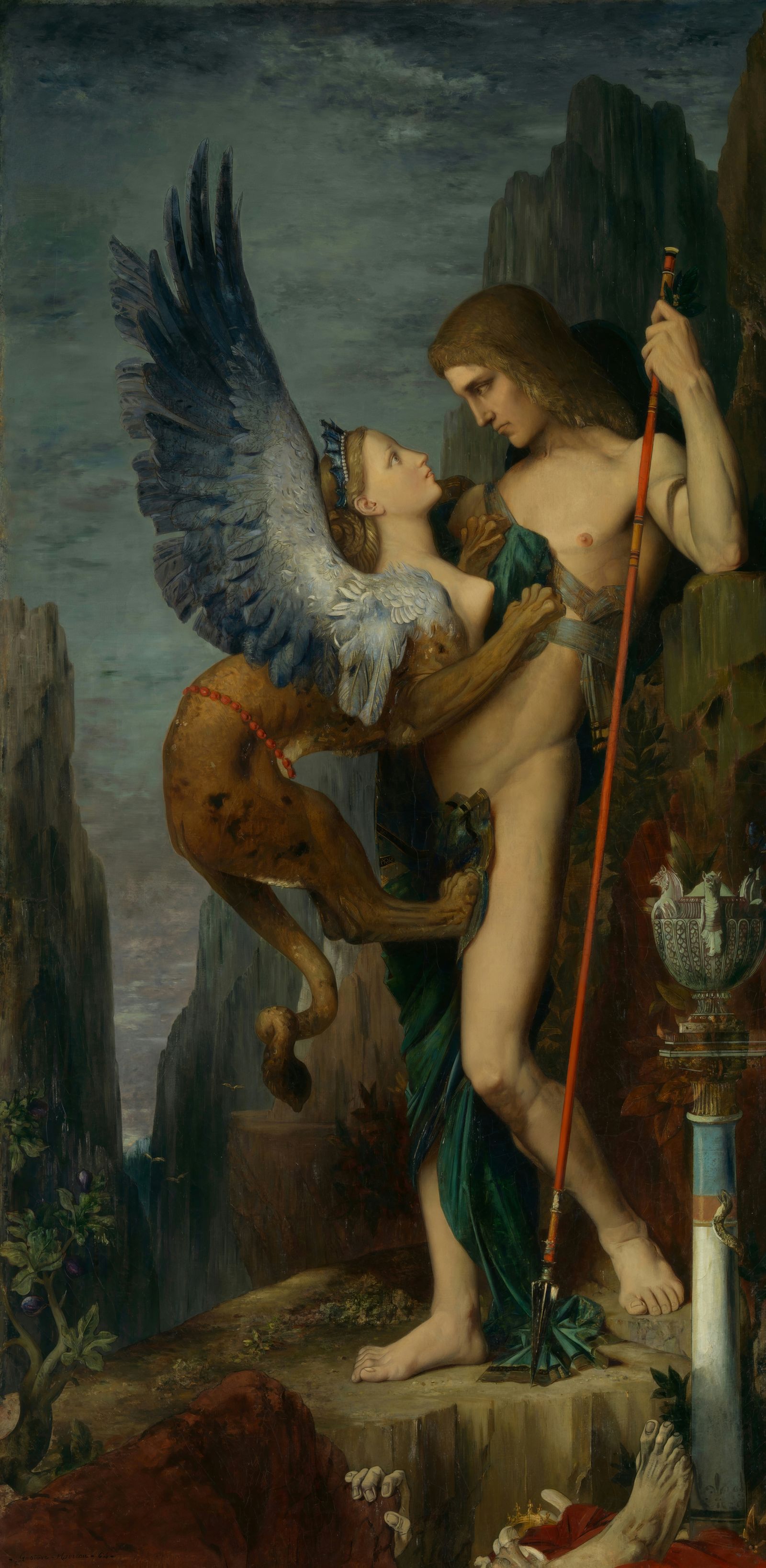
Oedipus and the Sphinx · Gustave Moreau, 1864 · The Metropolitan Museum of Art. Restored by Surrealium at Vaxholm Fortress, Sweden.
Moreau places the winged creature against Oedipus's body, making their exchange almost uncomfortably intimate before you know the riddle. In the Greek story, the Sphinx challenges travellers, and Oedipus survives by answering; the painter makes that contest of understanding feel physical through claws, wings and the locked meeting of eyes. The figures occupy a narrow vertical space, so give the whole composition room when looking at it rather than reducing the encounter to a decorative face.
2. Apollo and Marsyas: the contest before its cost
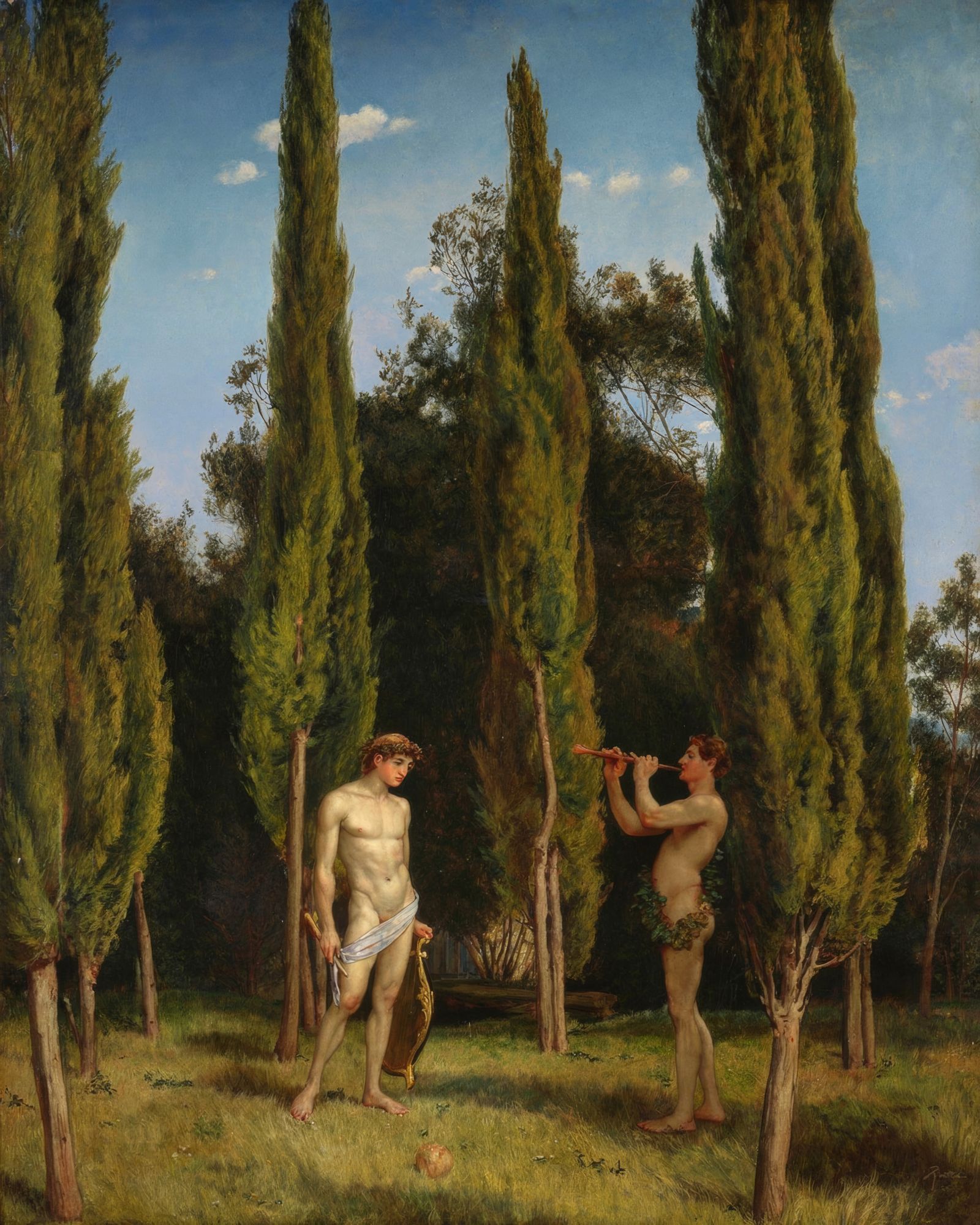
Apollo and Marsyas · Hans Thoma, 1888 · Art Institute of Chicago. Restored by Surrealium at Vaxholm Fortress, Sweden.
Hans Thoma sets the musicians beneath tall trees, with the landscape lending a stillness that the story itself does not deserve. Marsyas challenges Apollo in music and is punished with terrible cruelty, so the calm scene should not be mistaken for a friendly lesson. Notice how the space between the figures allows the viewer to weigh the encounter; the painting's restraint can make the imbalance of power more troubling once the narrative is known.
3. Diana and Cupid: the bow changes hands
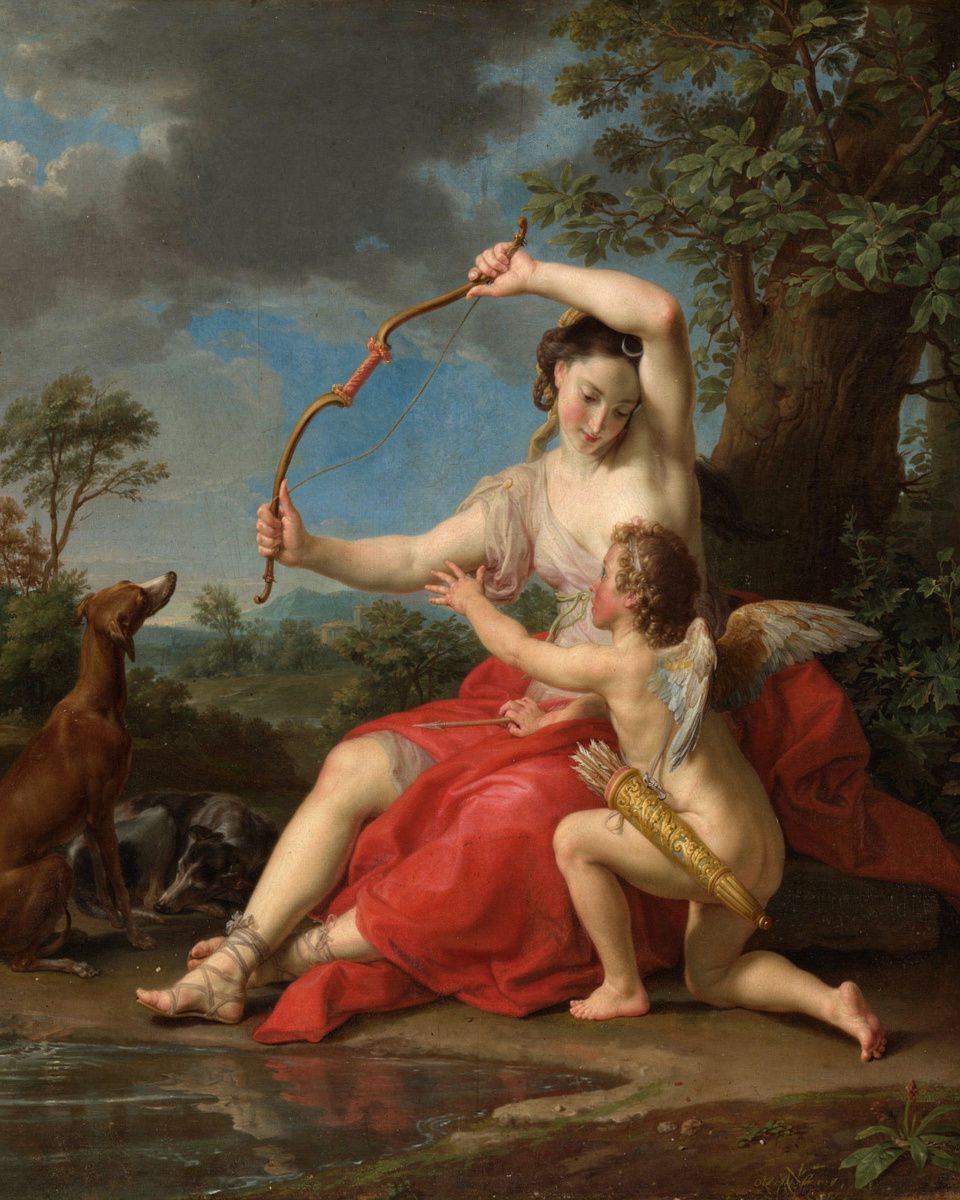
Diana and Cupid · Pompeo Batoni, 1761 · The Metropolitan Museum of Art. Restored by Surrealium at Vaxholm Fortress, Sweden.
Batoni brings a small winged Cupid close to Diana as she raises a bow, making the object the hinge between their bodies. Diana's association with hunting and chastity sits uneasily beside Cupid's association with desire, so this is a meeting of different powers rather than a generic mother-and-child scene. The red drapery and the extended arms keep the eye moving through the exchange, while the landscape gives the figures a place to act.
4. Venus and Cupid: an allegory needs its attribution
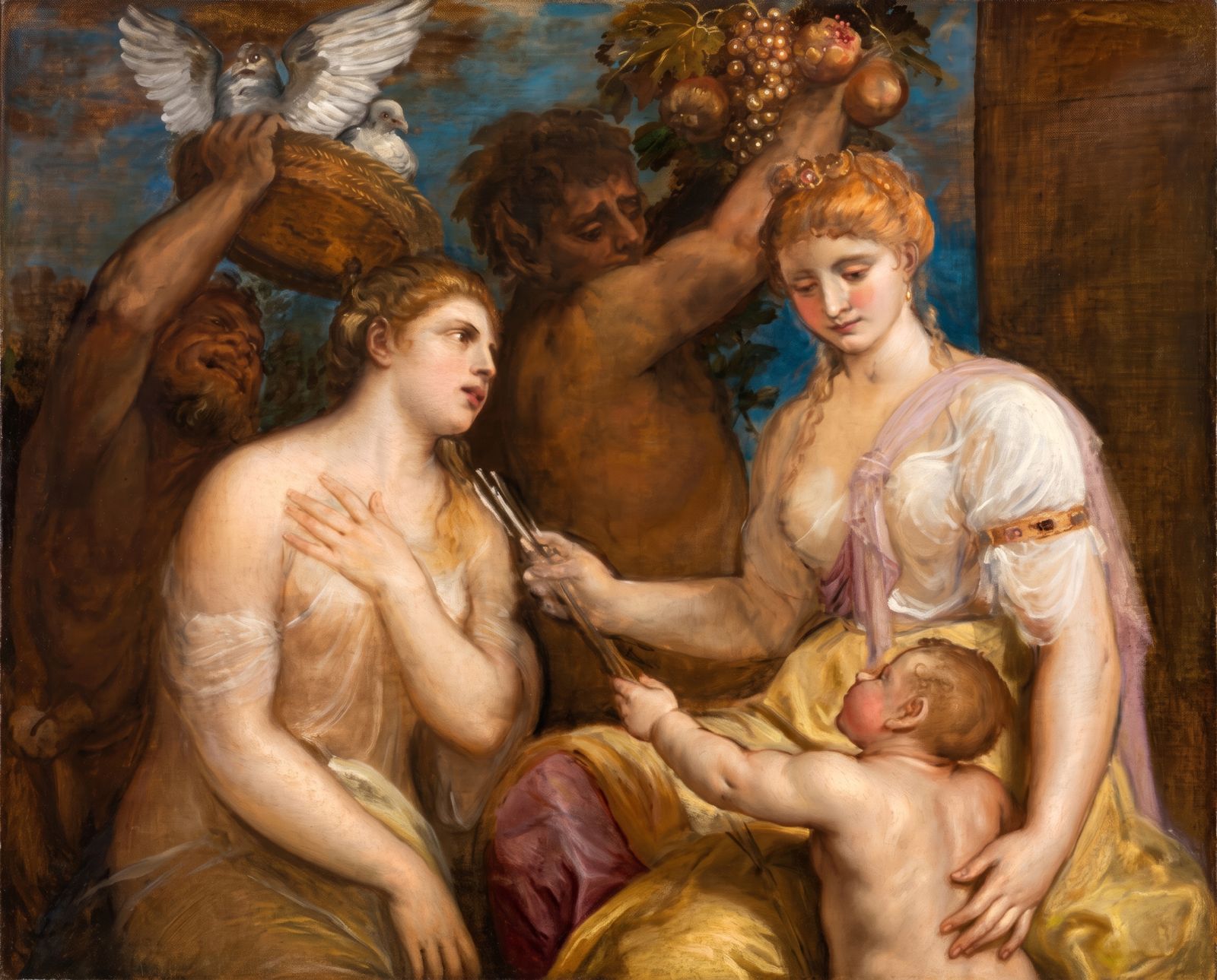
Allegory of Venus and Cupid · Imitator of Titian, c. 1600 · Art Institute of Chicago. Restored by Surrealium at Vaxholm Fortress, Sweden.
The catalogue attributes this work to an imitator of Titian, a distinction worth keeping because style and authorship are not the same thing. The crowded group, fruit and infant invite a reading around love and abundance, with bodies and objects pressed towards the front of the picture. Approach those associations as the work of an allegory rather than as proof that every visible detail belongs to one identifiable episode in Greek literature.
5. Fountain of Venus: mythology becomes a setting
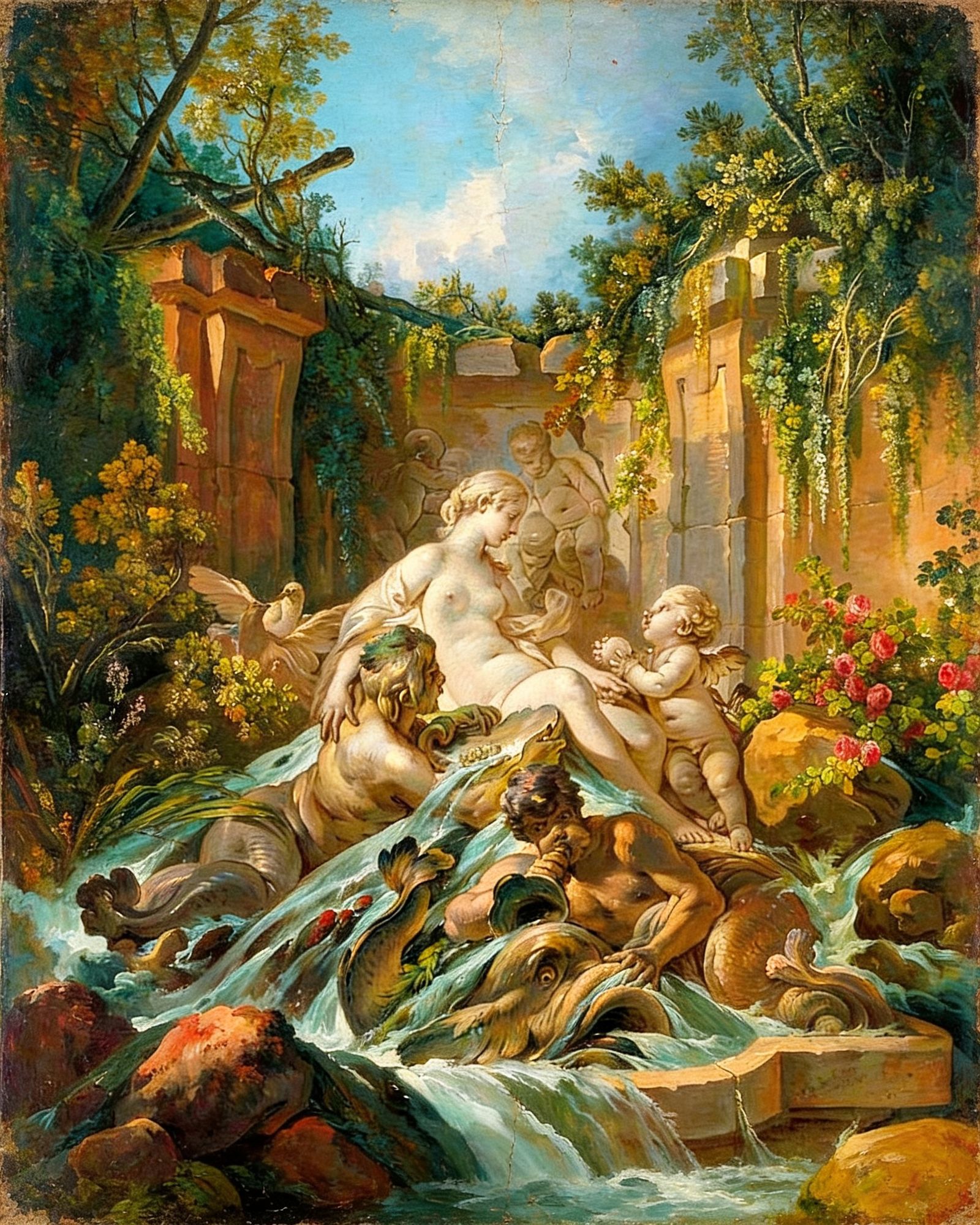
Fountain of Venus · François Boucher, 1756 · Cleveland Museum of Art. Restored by Surrealium at Vaxholm Fortress, Sweden.
Boucher places pale figures, flowers, architecture and moving water within an elaborate garden, turning Venus's world into an environment the eye can wander through. The picture demonstrates how a mythological subject can organise a decorative fantasy without illustrating a single moment from a text. If you want a work for a room, consider whether you enjoy that density of detail, and keep the full edges visible so the surrounding architecture remains part of its effect.
6. Circe offering the cup: the invitation faces us
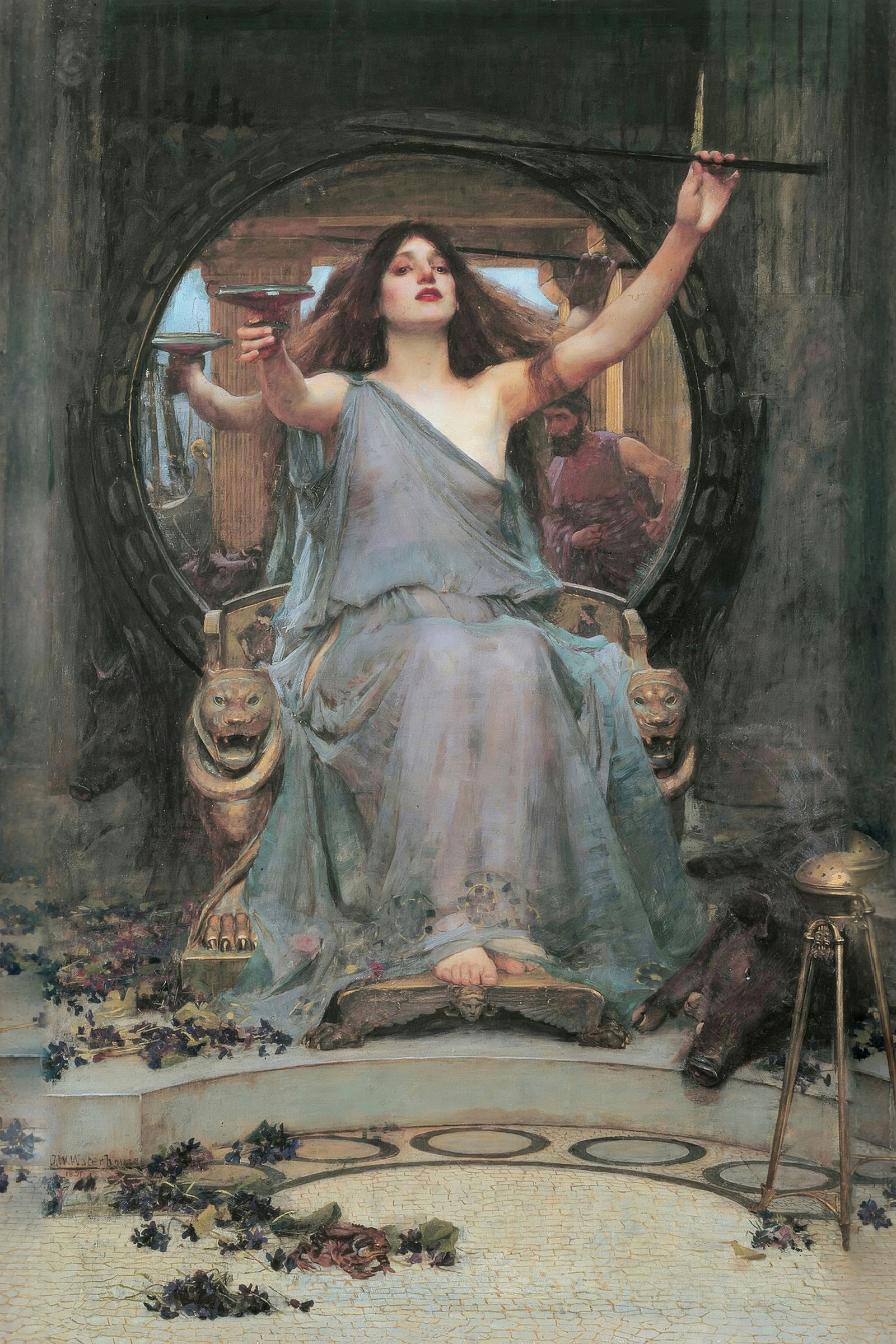
Circe Offering the Cup to Ulysses · John William Waterhouse, 1891 · Gallery Oldham. Prepared for print by Surrealium at Vaxholm Fortress, Sweden.
Waterhouse seats Circe before a round mirror, with one arm raising a wand and the other extending the cup towards the viewer's space. The arrangement makes the invitation feel direct, while the mirror adds another layer of looking behind the frontal figure. In the Odyssey, Circe's drink is part of the episode in which Odysseus's companions are transformed; the painting makes an apparently gracious gesture carry the possibility of danger.
7. Circe Invidiosa: the substance enters the water
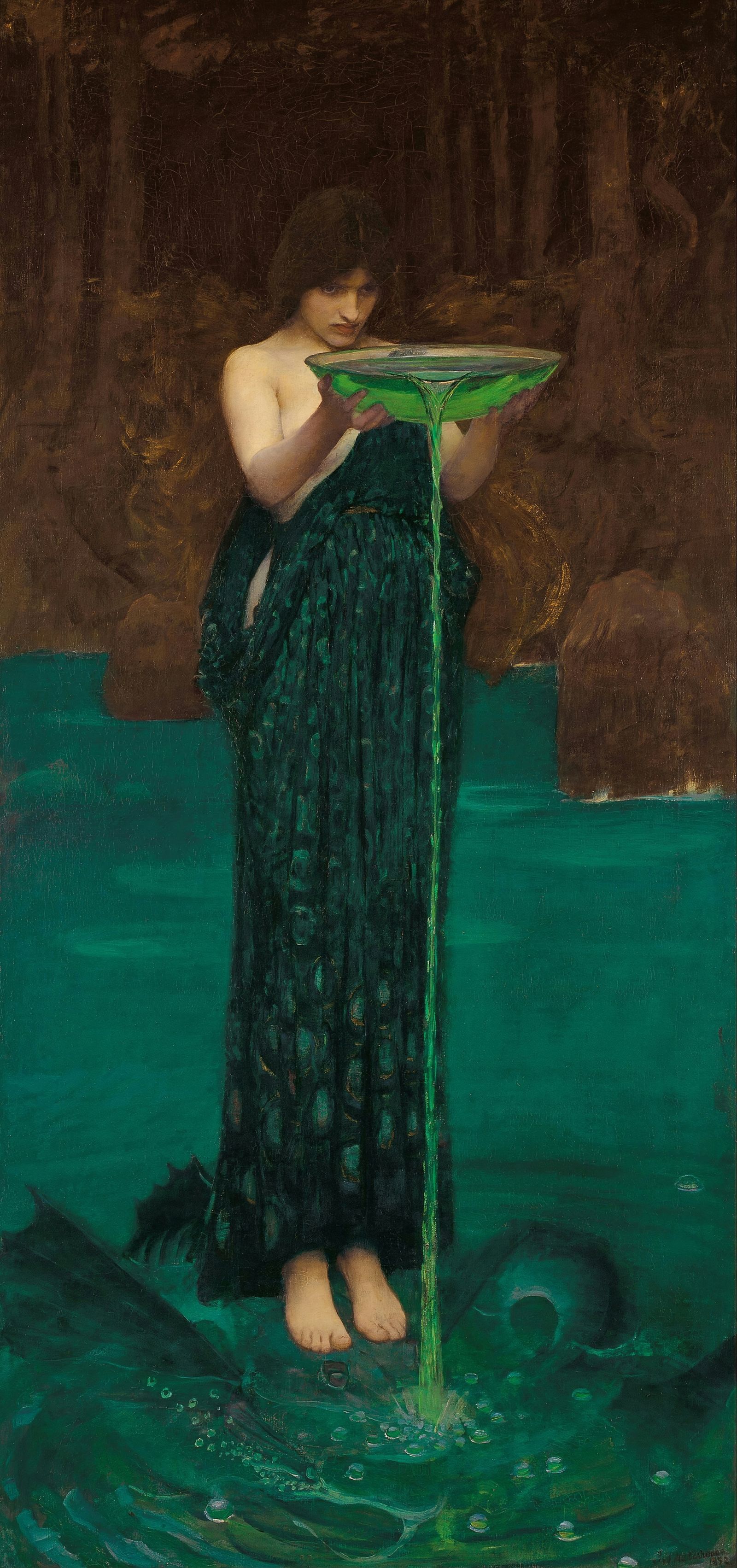
Circe Invidiosa · John William Waterhouse, 1892 · Art Gallery of South Australia, Adelaide. Prepared for print by Surrealium at Vaxholm Fortress, Sweden.
Here Waterhouse gives Circe a different action, pouring from a vessel into green water while her upright figure dominates a narrow composition. This is not the same scene as the cup offered to Ulysses: the title and narrative concern Circe's jealousy and the poisoning of the water associated with Scylla. The long fall of liquid connects hand, body and pool, so the painting rewards looking at the whole vertical movement rather than isolating its rich colour.
8. Hylas and the Nymphs: a lowered point of view
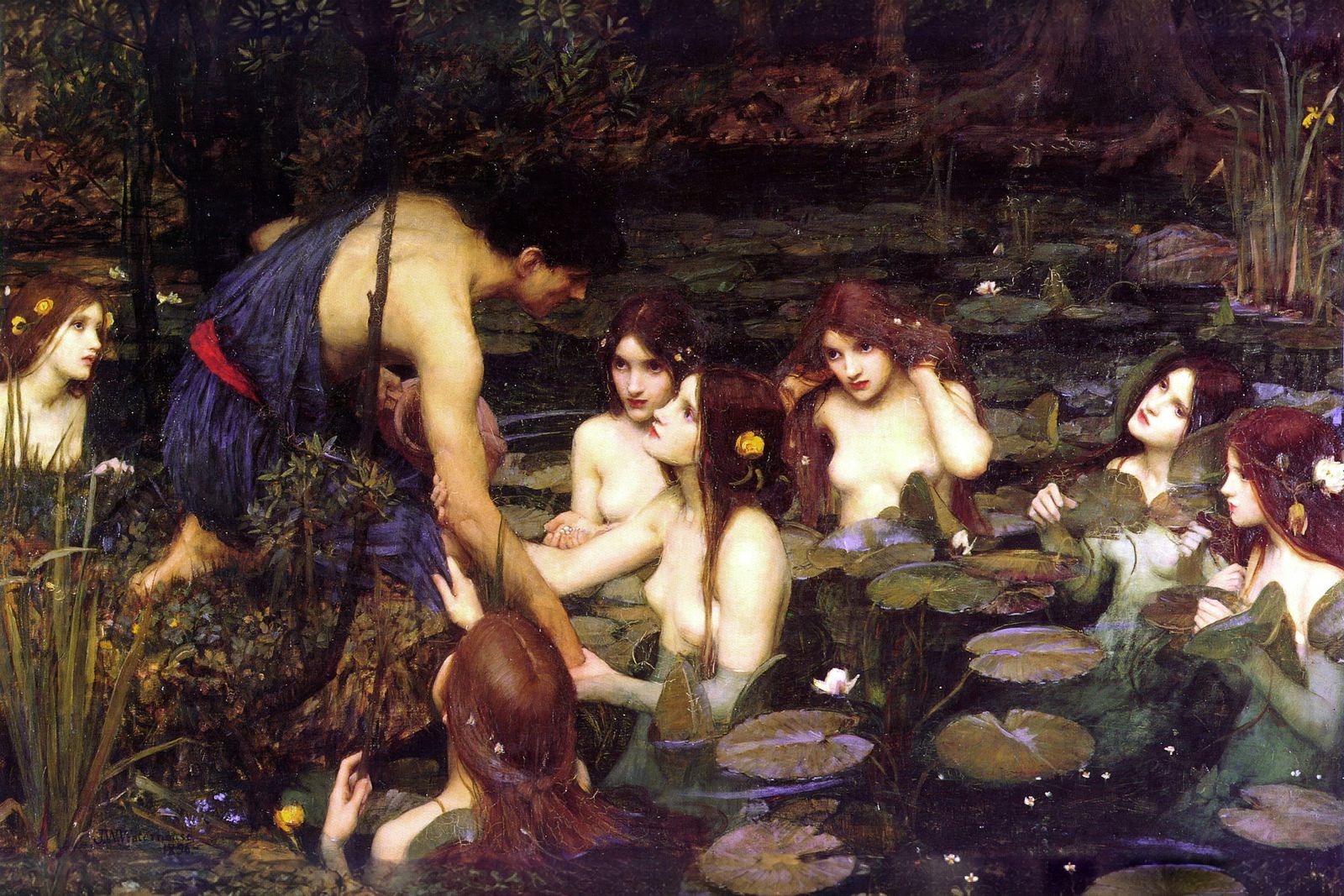
Hylas and the Nymphs · John William Waterhouse, 1896 · Manchester Art Gallery (1896.15). Prepared for print by Surrealium at Vaxholm Fortress, Sweden.
Waterhouse brings Hylas down towards the water, where pale faces and arms appear among dark leaves and lily pads. The story concerns the young companion of Heracles drawn away by water nymphs, but the painting's immediate effect depends on the meeting of gazes across the bank. Its beauty does not remove the uncertainty of the encounter; follow the reaching hands and the position of the vessel before deciding how secure the young man appears.
9. Ulysses and the Sirens: danger gathers around the mast
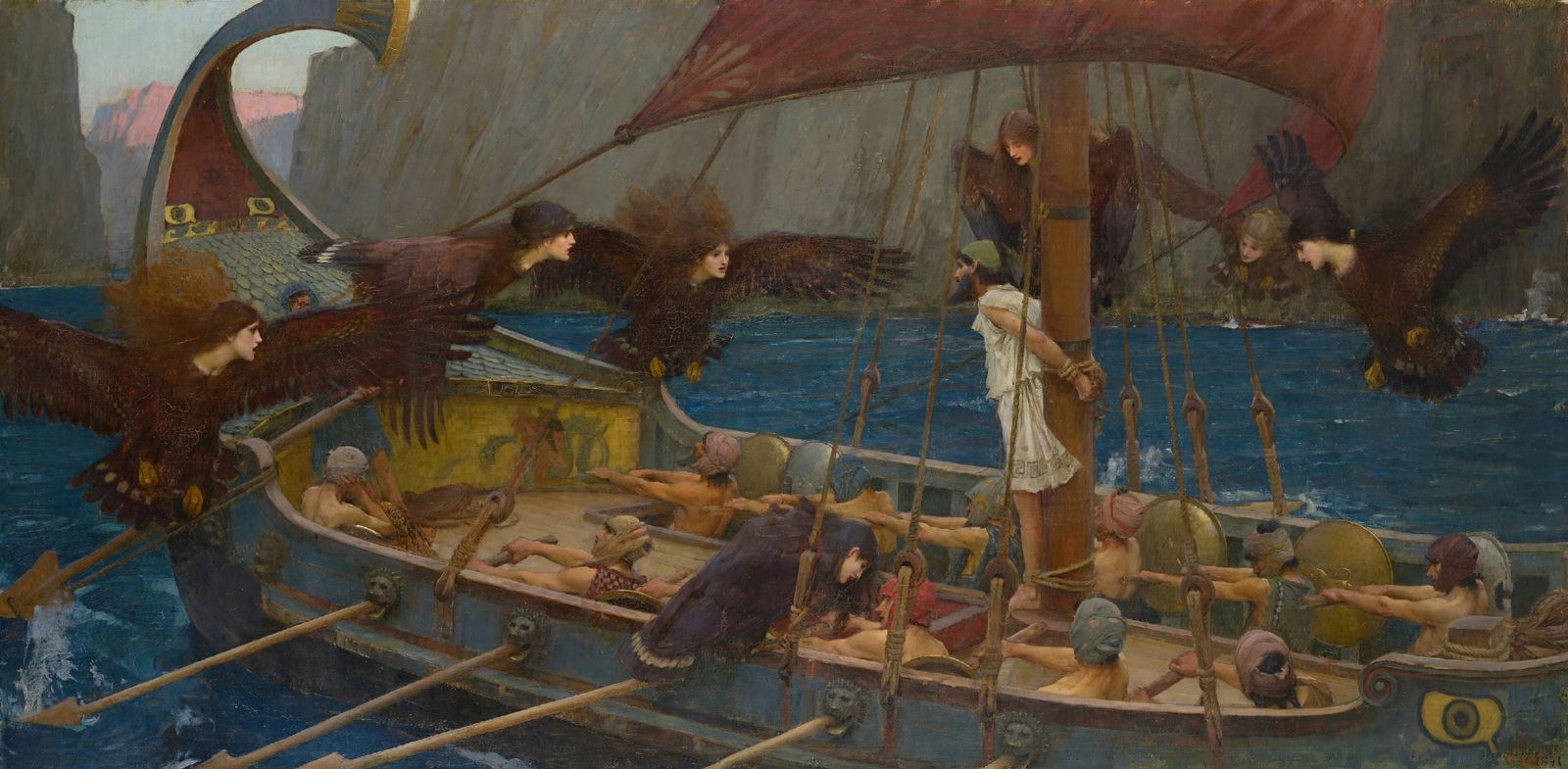
Ulysses and the Sirens · John William Waterhouse, 1891 · National Gallery of Victoria, Melbourne. Prepared for print by Surrealium at Vaxholm Fortress, Sweden.
The ship becomes a crowded stage as Waterhouse's bird-bodied Sirens surround the crew and the bound Ulysses. This choice differs from the familiar modern picture of mermaids, and it makes the wings an active pressure within the composition. The ropes, oars and mast are not incidental nautical decoration: they show how the sailors' planned protection has to hold while the hero hears what the others have blocked out.
10. Perseus rescuing Andromeda: three unequal positions
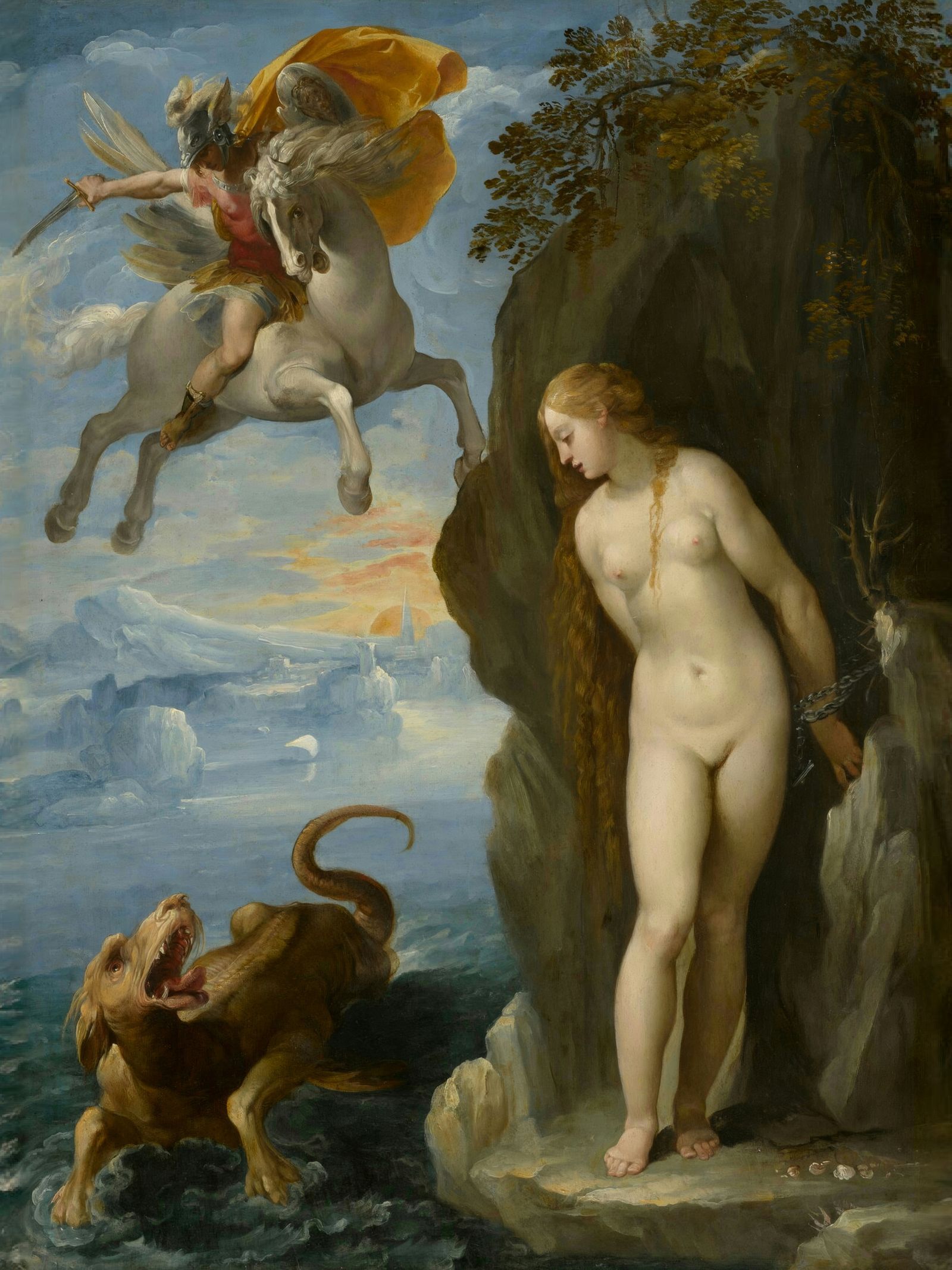
Perseus Rescuing Andromeda · Cavaliere d'Arpino, c. 1593–94 · Clark Art Institute, Williamstown (2010.7). Prepared for print by Surrealium at Vaxholm Fortress, Sweden.
Cavaliere d'Arpino separates the airborne rescuer, the chained figure and the creature below, giving each a different relation to the rock and sea. The familiar rescue narrative can be read first through those positions, before identifying every attribute. Notice that the viewer has a broad view of the event while Andromeda's freedom is restricted; preserving the whole picture keeps that difference legible instead of turning the work into an isolated study of a beautiful body.
A useful label should tell you whose painting you are seeing, which version of a story it addresses, and where interpretation begins. A familiar name alone cannot do all three jobs. Continue with Pre-Raphaelite painting for Waterhouse's wider visual company, or Symbolism for the charged encounters around Moreau. You can study Oedipus and the Sphinx within the Symbolist collection, then choose the myth whose particular tension you want to keep looking at.
- Are Greek and Roman mythology paintings the same thing?
- They often share stories and related figures, but names and traditions differ. Use the painting’s recorded title, then explain correspondences such as Aphrodite and Venus rather than treating every version as identical.
- How do I identify a mythological painting?
- Start with the recorded title and collection. Then look for a meaningful object, animal, action or relationship. A bow or a wing can help, but no single attribute replaces the work’s catalogue record.
- Are all mythology paintings illustrations of one text?
- No. Some depict a specific episode; others combine figures in an allegory or decorative setting. Keeping that distinction prevents an attractive invention from being presented as a literal account of an ancient source.