Sirens vs mermaids: the myth, the difference and what they mean
Where sirens came from, how they grew fish tails, what Odysseus did about them, and why the French still use one word for both.
Half woman, half bird. Or half woman, half fish. Or a pale girl in a wet dress, waiting by a river at night. The creatures that lure sailors into the water have changed shape many times in three thousand years, and the words we use for them have not kept up.
Here is where sirens and mermaids came from, how they became tangled together, and what they meant to the people who told their stories, with the questions people ask most about them. Each answer is paired with a painting, restored from its museum scan.
What is a siren?
In Greek mythology the sirens were singers who lived on an island and lured passing sailors to their death with their song. They first appear in Homer's Odyssey, written down around the eighth century BC, where the witch Circe warns Odysseus about them.
Homer never says what they look like. He describes a meadow where they sit and sing, heaped around with the bones and shrivelled skin of the men who stopped to listen. Their song does not promise love. It promises knowledge: the sirens tell Odysseus they know everything that happened at Troy and everything that happens on earth.
1. Ulysses and the Sirens
John William Waterhouse, Ulysses and the Sirens, 1891. National Gallery of Victoria, Melbourne.
Waterhouse based his sirens on a Greek vase of about 480 BC, now in the British Museum, which shows the same scene with bird-women diving at the ship.
What did sirens look like in Greek mythology?
For the Greeks a siren was a bird with a woman's head, and later a woman's arms and chest as well. That is how they appear on vases, on gravestones and as small bronze figures holding lyres and pipes. They were often placed on tombs, singing for the dead.
Ancient writers gave different accounts of where they came from. Most made them daughters of the river god Achelous and one of the Muses. The Roman poet Ovid says they were companions of Persephone, given wings so they could search for her after she was carried off to the underworld.
2. Sirin and Alkonost
Viktor Vasnetsov, Sirin and Alkonost, 1896. State Tretyakov Gallery, Moscow.
Russian folklore kept the Greek bird body. Vasnetsov's Sirin sings of sorrow and Alkonost of joy, two halves of the same old idea.
How did Odysseus survive the sirens?
Circe gives Odysseus the plan. He softens beeswax and presses it into the ears of his crew so they cannot hear. Then he has himself tied to the mast, so he can listen without being able to steer toward the singers. When the song begins he begs to be untied, and his men, following orders, bind him tighter and row on.
The sirens were beaten a second time in the story of Jason and the Argonauts. When their ship passed the island, the musician Orpheus played his lyre so loudly that he drowned out their song. Only one sailor, Butes, heard it and leapt overboard.
3. The Sirens and Ulysses
William Etty, The Sirens and Ulysses, 1837. Manchester Art Gallery.
Etty paints Homer's meadow exactly, bones and all, and lets the beauty of the singers make the danger worse.
Are sirens and mermaids the same thing?
Not originally. The Greek siren was half bird, while the mermaid, from the old English word mere for sea, is half fish. They began as separate creatures, but over the Middle Ages the siren moved into the water. A book of monsters written in England in the eighth century, the Liber Monstrorum, already describes sirens as maidens to the waist with the scaly tails of fish.
Some languages never separated them. In French a mermaid is still a sirène, in Italian and Spanish a sirena. English kept both words, and today a siren usually means the singer who lures sailors to their death, while a mermaid can be gentle, curious or dangerous depending on the story.
4. The Sea Maidens
Evelyn De Morgan, The Sea Maidens, 1885–86. De Morgan Foundation.
By De Morgan's time the two creatures had merged completely: these are sirens with fish tails, singing in the evening sea.
Are mermaids good or evil?
Both, depending on who tells the story. In old British and Scandinavian ballads, seeing a mermaid meant a shipwreck was coming. On the Rhine, the poets Clemens Brentano in 1801 and Heinrich Heine in 1824 made the Lorelei, a woman on a high rock whose singing sent boatmen onto the reef.
The gentler mermaid is younger. Hans Christian Andersen's The Little Mermaid of 1837 gave her a soul, a longing for the human world and a sacrifice, and most modern mermaids descend from her.
5. The Fisherman and the Syren
Frederic Leighton, The Fisherman and the Syren, c. 1856–58. Bristol Museum & Art Gallery.
Leighton illustrates Goethe's ballad The Fisherman of 1779, in which a water woman rises from the sea and draws a young man down. Half she pulled him, half he sank.
What is a rusalka?
In Slavic folklore a rusalka is the spirit of a young woman who drowned, often after an unhappy love. Rusalki have no fish tail. They live in rivers and lakes, come out on moonlit nights to comb their long hair and dance, and can tickle or lure a passer-by into the water.
They were most active in early summer, during what was called Rusalka week, when villagers left gifts at the water's edge. The idea later reached the stage in Antonín Dvořák's opera Rusalka of 1901, about a water spirit who falls in love with a prince.
6. The Mermaids (Rusalki)
Ivan Kramskoi, The Mermaids (Rusalki), 1871. State Tretyakov Gallery, Moscow.
Kramskoi painted his rusalki from Gogol's story May Night, where they gather by a pond under the moon. They are not monsters, only very sad.
What is the difference between a mermaid and a nymph?
Nymphs in Greek myth are nature spirits in the shape of young women, with human legs, not tails. Naiads live in springs, rivers and pools; nereids, the fifty daughters of the sea god Nereus, live in the sea. They are not usually dangerous, though the story of Hylas shows they could be.
Painters often blur the line, because a woman rising from water reads the same way whether she has a tail or not.
7. Hylas and the Nymphs
John William Waterhouse, Hylas and the Nymphs, 1896. Manchester Art Gallery.
Waterhouse's naiads look gentle, but the story is the same as the sirens': the young Argonaut Hylas goes to fetch water and is never seen again.
Are there male mermaids?
Yes. In Greek myth Triton, son of the sea god Poseidon, has a man's body and a fish's tail and blows a conch shell to raise or calm the waves. Later artists filled the sea with tritons, so the word came to mean any merman.
Northern Europe had its own. In Scandinavian folklore the nix or näck was a water spirit who played the fiddle in rivers and waterfalls, and could teach his music to anyone brave enough, or drown them.
8. Triton and Nereid
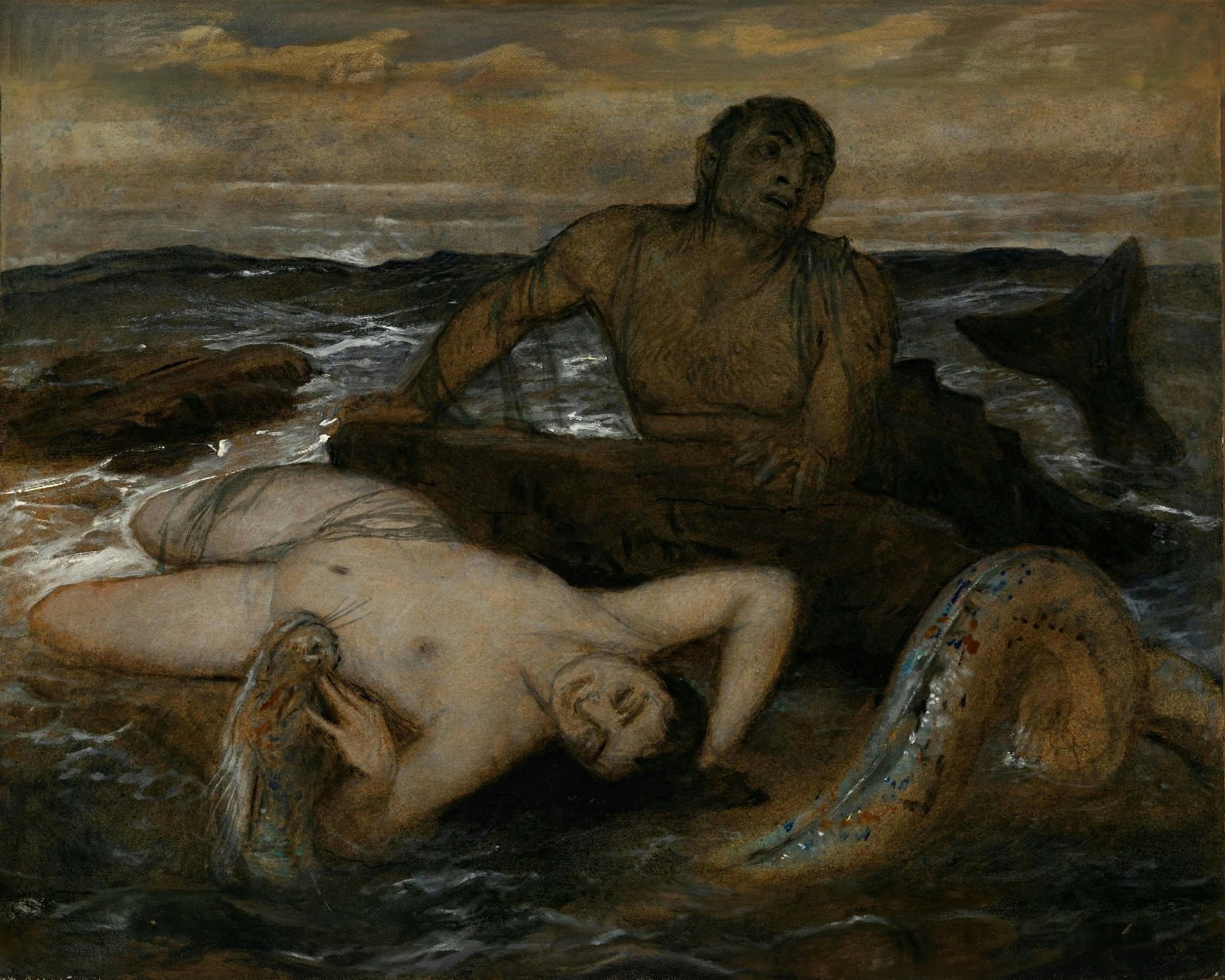
Arnold Böcklin, Triton and Nereid, 1873–74. Sammlung Schack, Munich.
Böcklin's merman is no prince: a weathered sea creature blowing his shell, with a nereid sunning beside him.
Did sailors really see mermaids?
They certainly believed they did. On 9 January 1493, near Hispaniola, Christopher Columbus wrote that he saw three sirens rise high out of the sea, and added that they were not as beautiful as they are painted. Historians think he saw manatees, slow sea mammals that can raise their heads and shoulders out of the water.
Naturalists of the sixteenth century went further, describing a sea monk caught off Denmark and a sea bishop off Poland. Seals, walruses, dugongs and wishful thinking probably explain most of them.
9. Physica Curiosa, plate II
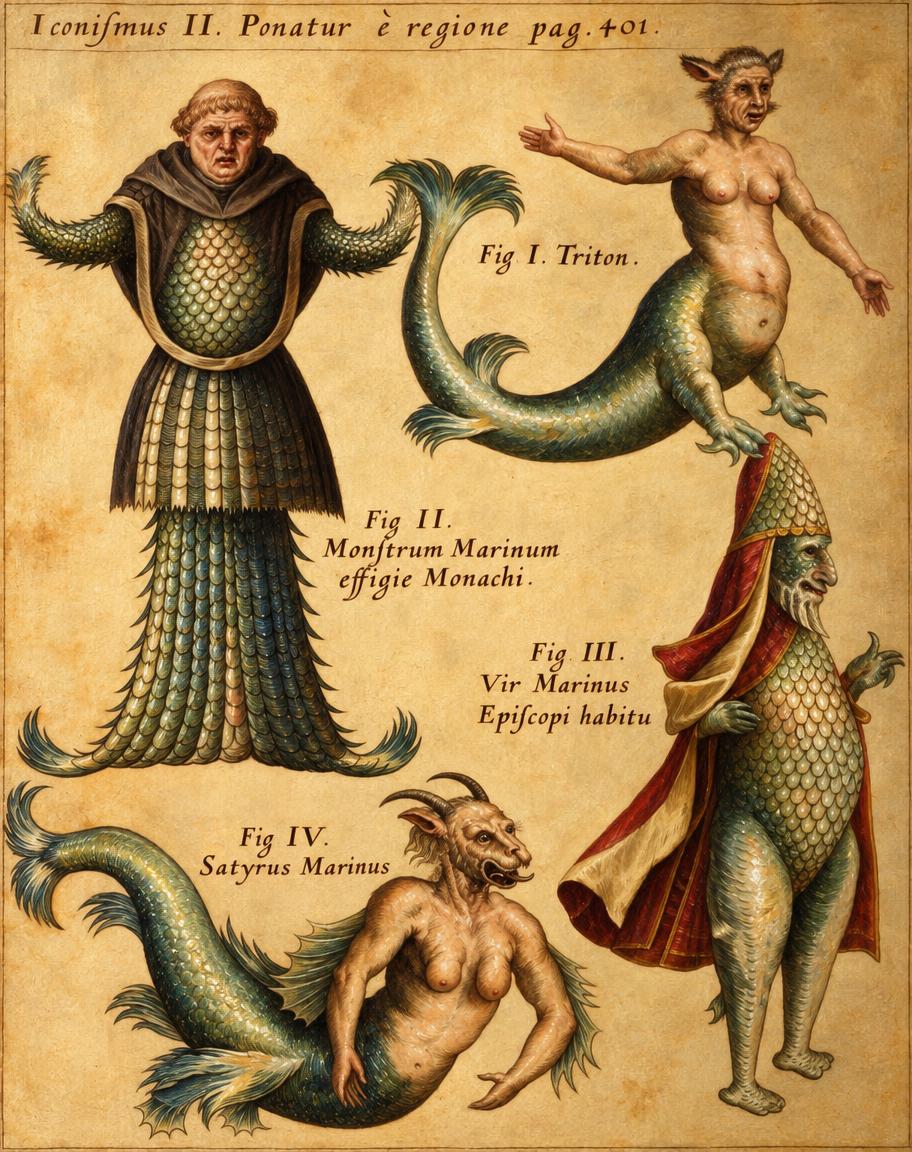
Gaspar Schott, Physica Curiosa, plate II: triton, sea monk, sea bishop and sea satyr, 1662.
Schott, a Jesuit scholar, collected these creatures from earlier naturalists in 1662, treating them as real animals with Latin names.
What does a siren symbolise?
From the start the siren stood for a temptation that is hard to refuse because it is beautiful. The early Church read Odysseus at the mast as a picture of the Christian tied to the cross, passing safely through the pleasures of the world.
The nineteenth century added love and art. Painters and poets used the siren for desire that ruins, and for the call of creative work itself. The word has even entered everyday life: in 1819 the French engineer Charles Cagniard de la Tour named his new sound-making machine a sirène because it could sing underwater, and every siren on an ambulance descends from it.
10. The Poet and the Siren
Gustave Moreau, The Poet and the Siren, 1893.
For Moreau the siren is the dangerous half of inspiration, the voice an artist cannot resist even when it destroys him.
Common questions
What is the difference between a siren and a mermaid?
In Greek mythology a siren was half bird and half woman and lured sailors to their death with her song. A mermaid is half woman and half fish. The two merged in the Middle Ages, when sirens began to be drawn with fish tails, which is why French and Spanish still use one word for both.
How many sirens were there?
Homer speaks of two, using a grammatical form for a pair. Later writers usually counted three and gave them names, most often Parthenope, Ligeia and Leucosia.
Where did the sirens live?
Homer only says they lived on an island with a flowery meadow. Later tradition placed them off the coast of southern Italy, on the small islands near Positano still called Li Galli, or the Sirenuse.
What happened to the sirens after Odysseus?
One story says the sirens threw themselves into the sea when a ship got past them. The body of Parthenope was said to have washed ashore where Naples now stands, and the first Greek settlement there was named after her.
What did the sirens' song promise?
Knowledge. In the Odyssey they tell Odysseus that they know everything the Greeks and Trojans suffered at Troy and everything that happens on the earth, and that whoever listens will sail on wiser.
Why is an emergency siren called a siren?
The French engineer Charles Cagniard de la Tour invented a sound-making device in 1819 and named it a sirène, after the singers of myth, because it could make its sound underwater. Warning sirens are its descendants.
Sirens and mermaids have survived because they hold two things at once: beauty and danger, a song worth hearing and a reason not to listen. Every painting here is restored from its museum scan and printed to order, and any of them can also become the setting for a portrait of your own. For fifteen of the greatest paintings of the deep, read our companion story, Sirens and sea monsters: the great paintings of the deep. All fifty-six restored works hang together in the Sirens and Sea Monsters series.