Sirens and sea monsters: the great paintings of the deep
Songs that wreck ships, mermaids on the rocks and the creatures sailors swore they saw, from Homer to Kuniyoshi.
For as long as people have sailed, they have filled the sea with voices and shapes. Homer's sirens sang from a meadow of bones. Medieval sailors brought home tales of sea monks and sea bishops. Painters kept returning to the water's edge, where beauty and danger look the same. These fifteen works, restored from museum scans for Fable's collection, follow that story in six chapters. Each one can hang on your wall as it is, or lend its sea light to a portrait of you.
Daughters of the sea
By the nineteenth century the sea's most dangerous women had long hair and fish tails, and painters could not leave them alone. A fisherman is drawn down by a ballad's syren, nymphs pull a young Argonaut into a pond, a merchant walks the halls of the sea king. The danger is still there, only softer.
1. The Fisherman and the Syren
Frederic Leighton, The Fisherman and the Syren, c. 1856–58. Bristol Museum & Art Gallery.
Leighton illustrates Goethe's ballad of a fisherman lured into the water. The syren wraps herself around him as the wave rises. It is tender, and it is the last thing he will see.
Buy as is Create your portrait in this style
2. Hylas and the Nymphs
John William Waterhouse, Hylas and the Nymphs, 1896. Manchester Art Gallery.
The young Argonaut Hylas kneels to fill his jar, and seven water nymphs rise among the lily pads. Their faces are almost alike, calm and curious. He never returns to the ship.
Buy as is Create your portrait in this style
3. The Sea Maidens
Evelyn De Morgan, The Sea Maidens, 1885–86. De Morgan Foundation.
Five mermaids hold hands in the evening sea, the sun setting behind them. De Morgan's sirens are sisters rather than hunters, at peace in their own element.
Buy as is Create your portrait in this style
The song that wrecks ships
The oldest sirens did not swim. In the Odyssey, Circe warns Ulysses of the sirens, whose song draws sailors to their death. He has his crew stop their ears with wax and tie him to the mast so he can listen and live. The Greeks pictured sirens as birds with women's heads, and Russian folklore kept them that way.
4. Ulysses and the Sirens
John William Waterhouse, Ulysses and the Sirens, 1891. National Gallery of Victoria, Melbourne.
Waterhouse follows the Greek vases: his sirens are birds with women's faces, circling a ship whose crew rows on with stopped ears. Ulysses strains at the mast. Look at the rowers' faces, set and frightened, while the only man who can hear is the one who cannot move.
Buy as is Create your portrait in this style
5. The Sirens and Ulysses
William Etty, The Sirens and Ulysses, 1837. Manchester Art Gallery.
Etty paints the meadow Homer describes, heaped with the bones of earlier sailors. The sirens sing beautifully above the dead, and the ship passes. It is a vast canvas, and its contrast of warm skin and grim shore is the whole story.
Buy as is Create your portrait in this style
6. Sirin and Alkonost
Viktor Vasnetsov, Sirin and Alkonost, 1896. State Tretyakov Gallery, Moscow.
Russian folklore kept the siren's bird body. Sirin, dark-winged, mourns; Alkonost, pale and radiant, sings of joy. Vasnetsov sets them side by side on one branch, a song of sorrow and a song of joy.
Buy as is Create your portrait in this style
Tritons and nereids at play
Not every creature of the sea wants to drown you. Arnold Böcklin painted its people as a rowdy family: tritons blowing conch shells, nereids sunning on rocks, children tumbling in the surf. The baroque painters before him turned the same crowd into a triumphal procession.
7. Triton and Nereid
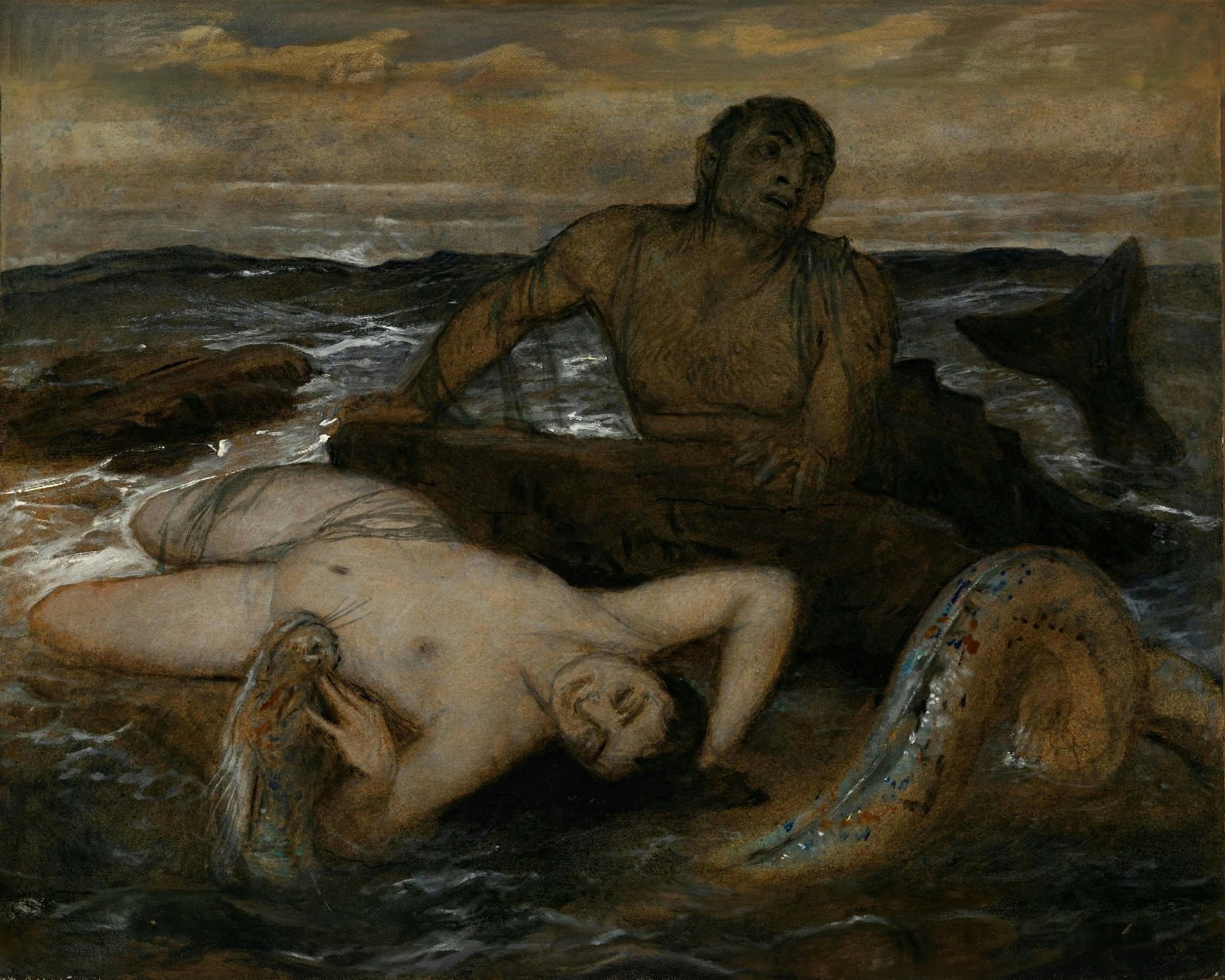
Arnold Böcklin, Triton and Nereid, 1873–74. Sammlung Schack, Munich.
A triton blows his shell on a rock while a nereid lounges with a sea serpent. Böcklin makes the gods of the sea look like they have been out in the weather all their lives.
Buy as is Create your portrait in this style
8. The Triumph of Neptune and Amphitrite
Nicolas Poussin, The Triumph of Neptune and Amphitrite, 1635–36. Philadelphia Museum of Art.
Poussin's sea is a procession: Amphitrite on her shell, tritons blowing horns, nereids on dolphins and putti scattering flowers overhead. Long called The Birth of Venus, it is a marriage parade of the sea.
Buy as is Create your portrait in this style
The monster at the rock
A young woman chained to a rock, a monster rising from the sea, a hero arriving from the sky. Ovid told it of Perseus and Andromeda, and Ariosto retold it of Roger and Angelica. For painters it was the perfect stage: a body, a beast and a rescue in one frame.
9. Perseus and Andromeda
Titian, Perseus and Andromeda, 1554–56. Wallace Collection, London.
Titian painted it for Philip II of Spain. Andromeda twists against her chains as Perseus dives head first at the monster, and the whole sea seems to tilt.
Buy as is Create your portrait in this style
10. Perseus and Andromeda
Frederic Leighton, Perseus and Andromeda, 1891. Walker Art Gallery, Liverpool.
Thirty years after his Fisherman and the Syren, Leighton returned to the sea for this: a black-winged dragon spreading over Andromeda, and Perseus as a small bright figure in the sky.
Buy as is Create your portrait in this style
11. Roger Freeing Angelica
Jean-Auguste-Dominique Ingres, Roger Freeing Angelica, 1819. Musée du Louvre, Paris.
From Ariosto's epic: the knight Roger, on a winged hippogriff, spears the sea monster that has come for Angelica. Ingres gives the armour a hard gleam against the night.
Buy as is Create your portrait in this style
Leviathan and the monsters on the map
The Bible's sea monster is the Leviathan, and its great fish swallows Jonah for three days. Painters from Lastman to Turner gave these creatures teeth, coils and a sunrise of their own. Meanwhile the scholars and mapmakers of the sixteenth and seventeenth centuries filled their books and oceans with sea monks, sea serpents and whales the size of islands, drawn as fact.
12. Sunrise with Sea Monsters
J. M. W. Turner, Sunrise with Sea Monsters, c. 1845. Tate, London.
In Turner's late haze of light, a fishy head and strange shapes stir in the water. Is it a monster or a catch of fish? Turner leaves it to the morning.
Buy as is Create your portrait in this style
13. Islandia
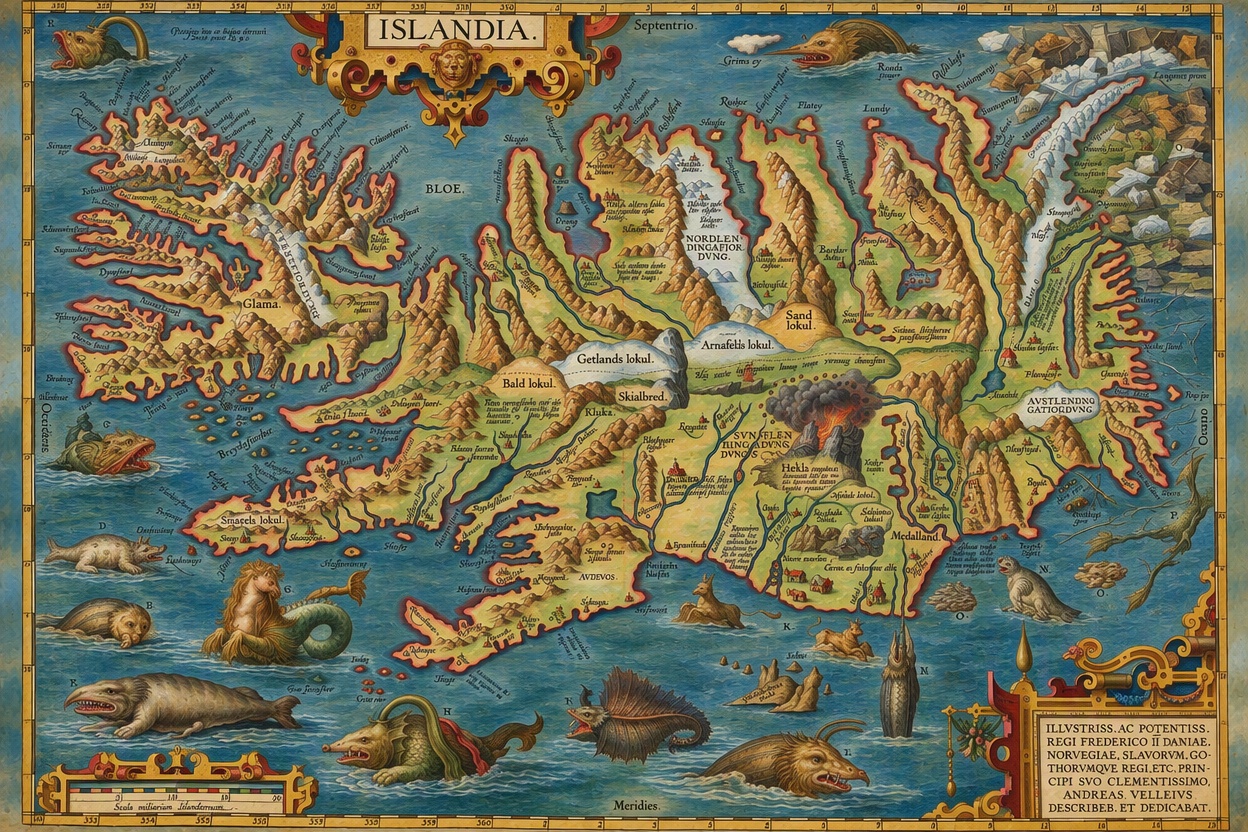
Abraham Ortelius, Islandia, 1590. From the Theatrum Orbis Terrarum.
Ortelius's map of Iceland fills the northern sea with monsters: whales the size of islands, a sea horse, a walrus and creatures no one has named since.
Buy as is Create your portrait in this style
Dragons of the eastern seas
In Japan the sea has a king: Ryūjin, the dragon who lives in a palace beneath the waves. Utagawa Kuniyoshi filled whole triptychs with his fish warriors, giant whales and boiling surf.
14. The Sea Bed at Daimotsu Bay
Utagawa Kuniyoshi, The Sea Bed at Daimotsu Bay, c. 1849–52.
The ghosts of the drowned Taira clan rise from the sea to attack Yoshitsune's ship. Kuniyoshi fills three sheets with swirling water and armoured dead.
Buy as is Create your portrait in this style
15. Miyamoto Musashi Attacking a Giant Whale
Utagawa Kuniyoshi, Miyamoto Musashi Attacking a Giant Whale, c. 1847–50.
The swordsman Musashi rides on the back of a whale so large it takes all three sheets of the print. It is one of the great images of the Japanese sea.
Buy as is Create your portrait in this style
Sirens and sea monsters work on a wall because they hold two moods at once: beauty and danger, calm water and something moving underneath. These fifteen are the heart of a larger collection: all 56 restored works hang together in the Sirens and Sea Monsters series, from Moreau's sirens to the sea monks of Physica Curiosa. Choose a restore to hang as it is, or begin a portrait of your own in the light of the sea. Buying a print keeps the selected catalogue artwork as restored; a portrait is a new creation from your photograph. Neither is the purchase of the historical original.