Odilon Redon: learning to look into the dark
Odilon Redon made impossible beings feel almost tangible. Two monochrome works reveal how his imagined creatures hold our attention.
Odilon Redon makes an impossible creature feel worth looking at before we have decided what it is. In A Singular Being, a human head belongs to a tapering, bristling body that seems to hang in space. The image is strange, but its strangeness is built patiently from line, shading and the pressure of dark against light. You can follow the drawing before trying to solve the creature.
This story begins with two of Redon's monochrome works held on Fable storage. His later colour is an important part of his career, but the pictures shown here keep their actual medium and appearance. A comparison with Moreau helps locate the difference between an invented being and a creature already named by myth. The wider guide to Symbolism in art introduces that territory without turning every image into a code with one answer.
A head that almost gives us an answer
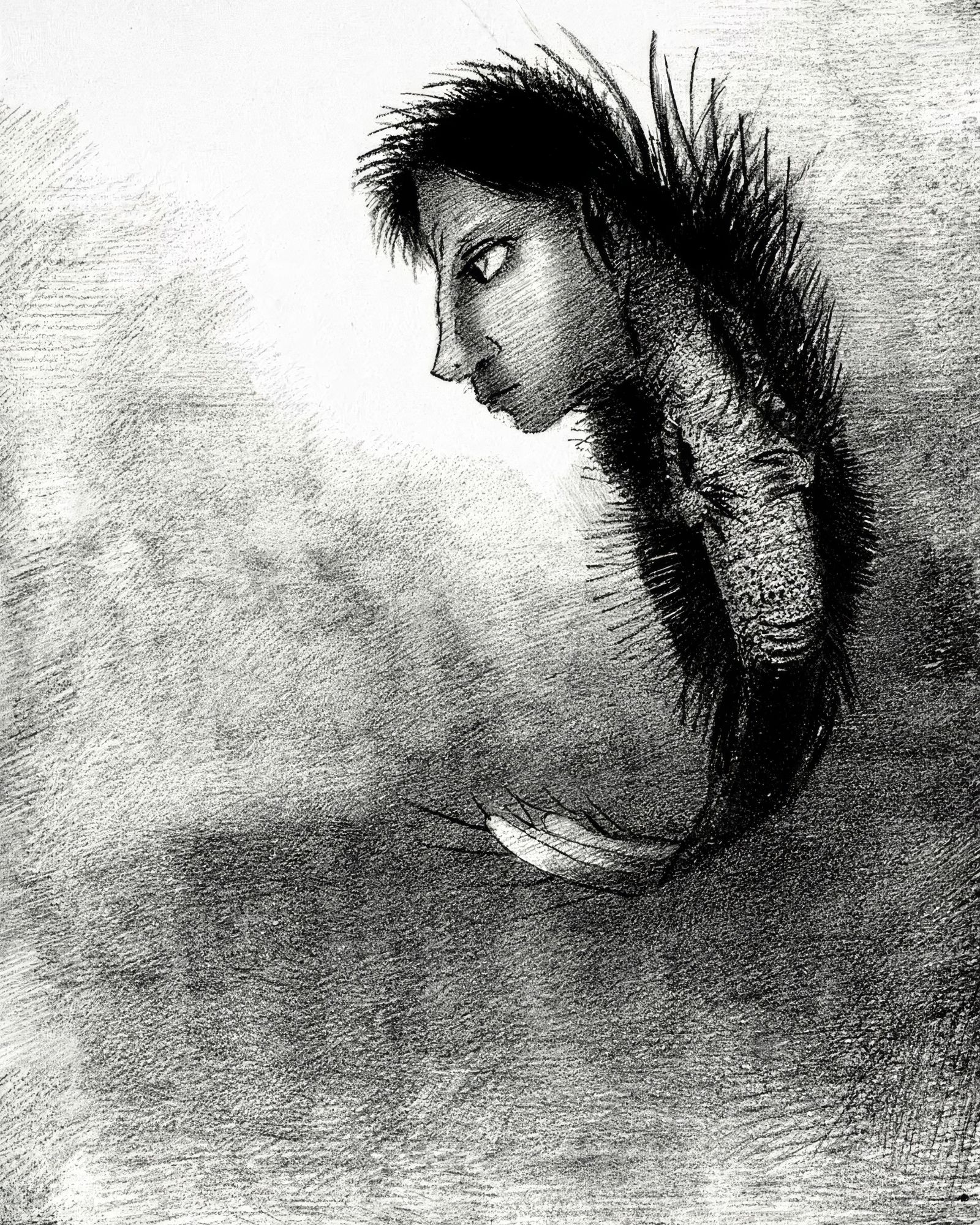
A Singular Being · Odilon Redon, 1888 · Art Institute of Chicago. Restored by Surrealium at Vaxholm Fortress, Sweden.
A Singular Being gives the viewer a recognisable human profile, then refuses the body that would normally explain it. The dark hair and bristles continue into a narrow form, while small appendages make the outline feel neither securely animal nor entirely plantlike. Around it, the paper's pale field leaves very little setting to consult. We cannot settle the question by locating the creature in a familiar landscape.
The work belongs to Redon's 1888 response to Flaubert's The Temptation of Saint Anthony, as the Art Institute's record identifies. That literary context matters, but it does not make the image a simple diagram of a sentence. Look at the downward tilt of the head and the way shadow gathers below the body. Those choices make the being seem present in space, even while its anatomy remains impossible.
The difference between a creature and a specimen
A specimen illustration usually tries to make its subject comparable: the body has legible parts, and the viewer can imagine identifying another example. Redon's figure resists that kind of use. The more closely we examine it, the more the familiar head and unfamiliar body pull in different directions. Its particularity increases without turning into a stable category.
That is one reason to avoid naming every appendage with too much confidence. A shape may resemble a claw or a stem without becoming one. In your own looking, try describing the contour first and offering an interpretation second. “A tapering dark body beneath a human head” preserves what the image shows. A declaration that it represents one precise psychological condition would tell us more about the viewer's theory than about the print's visible evidence.
The Smiling Spider has a face to meet
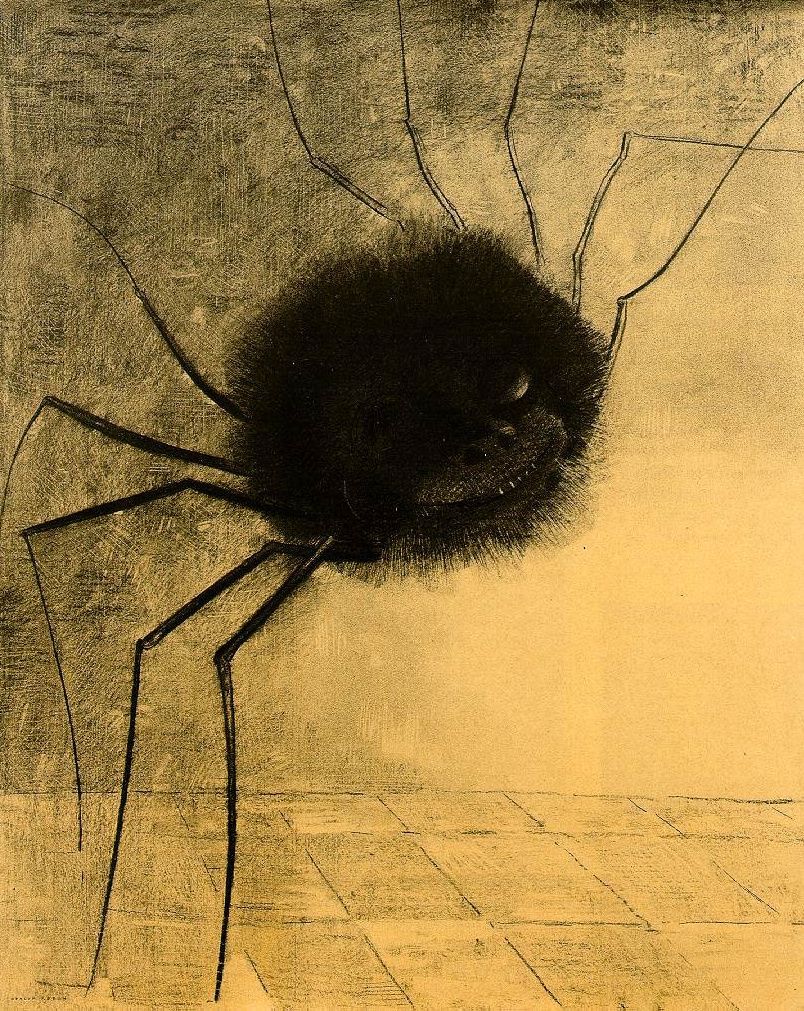
The Smiling Spider · Odilon Redon, 1881 · Kröller-Müller Museum, Otterlo. Prepared for print by Surrealium at Vaxholm Fortress, Sweden.
The Smiling Spider presents another impossible combination, but the relationship is different. A rounded dark body rests among long, thin legs, and a small face catches the eye within the shadow. The face creates a social encounter: a creature we might otherwise avoid appears capable of looking back. The humour does not remove the unease, because the legs still spread across the surrounding space with their own angular insistence.
The image shown is the historical charcoal drawing, rather than a later colour interpretation. The Kröller-Müller Museum holds the work. Its warm paper and black marks are part of the experience: the creature emerges through differences of tone, not through a brightly separated palette. Keep the whole sheet in view and notice how much room the legs need around the compact body.
What black can do besides describe night
Calling these works dark can be misleading if it suggests only a gloomy subject or a nocturnal setting. Black does several kinds of work. It gives hair a rough edge, makes a body seem dense, opens a space that may be shadow, and sharpens a small pale area into something like an eye. A large dark mass can hold both a creature and the uncertainty of how to see it.
Try covering neither the pale paper nor the darkest part while you look. The figure depends on their relationship, and a crop that leaves only the face changes the encounter. Redon's monochrome works reward a print scale at which texture remains visible, but they do not need to be made theatrically enormous. Their unsettling force can come from the intimacy of discovering a face within a small, carefully worked field.
A comparison with Moreau’s named monster
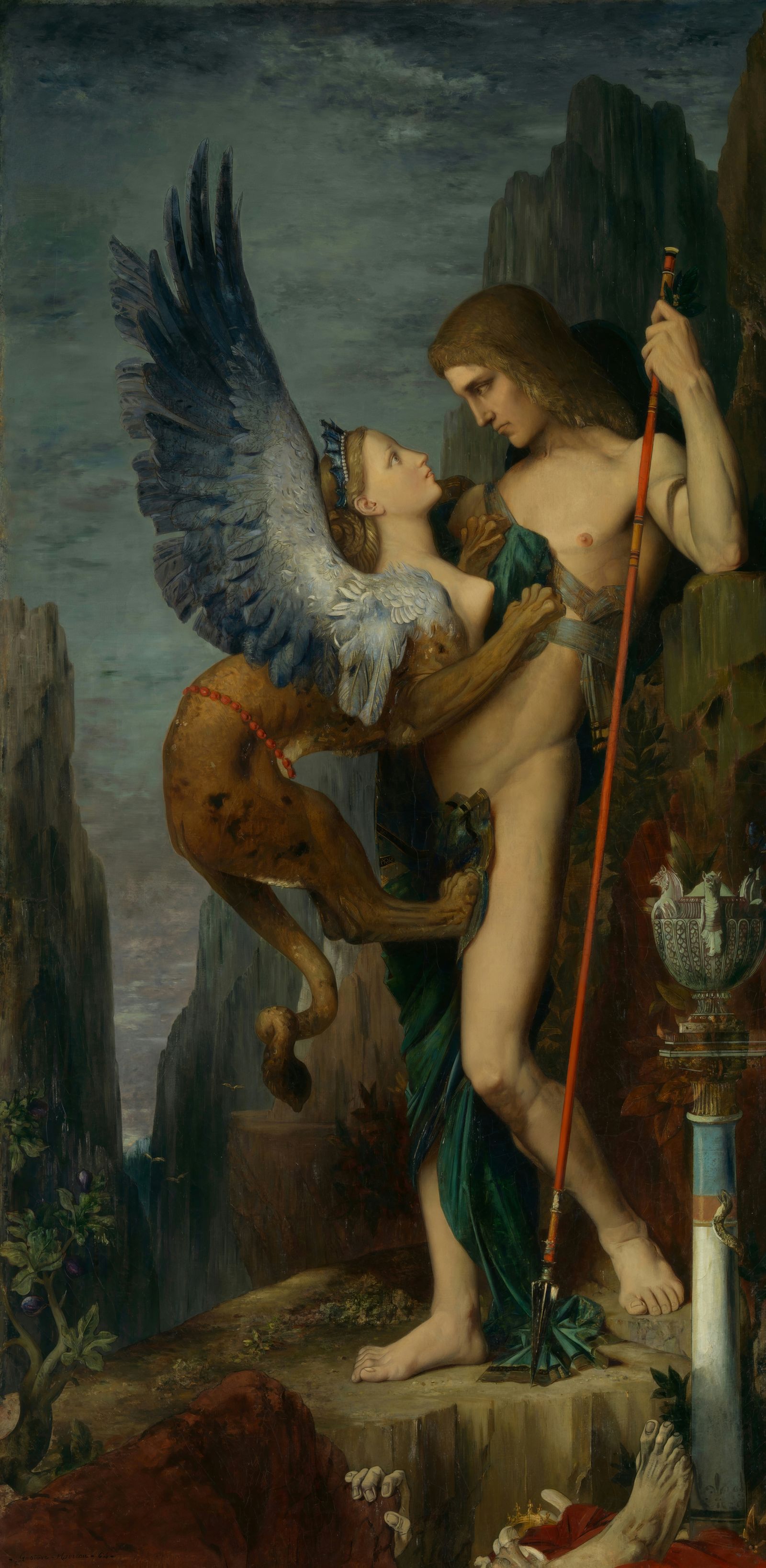
Oedipus and the Sphinx · Gustave Moreau, 1864 · The Metropolitan Museum of Art. Restored by Surrealium at Vaxholm Fortress, Sweden.
Moreau's Oedipus and the Sphinx gives us a creature whose identity is already supplied by a familiar myth. Wings, a woman's head and a lion's body belong to the Sphinx, and the meeting with Oedipus carries the narrative of a riddle. The bodies are close, the gaze is direct, and the surrounding landscape helps stage the encounter. Moreau's painting is shown here as a comparison, not as a work by Redon.
The comparison clarifies how much Redon withholds. His Singular Being has no visible human opponent and almost no setting, so the viewer cannot stand outside a clearly staged contest. We become the person trying to understand what has appeared. Both artists make recognition unstable, but one begins with a named myth while the other lets a hybrid form remain stubbornly difficult to classify.
From the noirs towards colour
Redon's career cannot be contained by these two images. The National Gallery's account describes his early imaginary and macabre subjects and his later turn towards oil and pastel. The label noirs is associated with the monochrome drawings and prints that established a particular part of that career. It is a useful historical term, provided it does not become a claim that he abandoned imagination when he used colour.
The more interesting continuity is the way an image can feel convincing without becoming ordinary. A face, a flower or a creature may be described with enough care to hold our attention while remaining detached from an everyday explanation. This selection stays with the black works because those are the historical pictures shown. It does not use an unrelated colourful image to stand in for a Redon flower painting that is absent from the page.
Living with an image that stays unresolved
A Singular Being · Odilon Redon, 1888 · Art Institute of Chicago. Restored by Surrealium at Vaxholm Fortress, Sweden.
A picture does not have to become reassuring in order to be worth living with. You may enjoy Redon's humour, the precision of his marks or the moment when a dark shape becomes a face. Those are more useful reasons to choose a work than the idea that every unusual room requires something labelled mysterious. The particular image should sustain your attention after the label has stopped doing the work.
Look at A Singular Being beside the broader Symbolist collection. Compare its spare field with the denser encounters in Greek mythology paintings, or with Goya's darker subjects. These are neighbouring ways of making an image difficult, not interchangeable versions of a single mood. Their differences are the reason to compare them.
A small exercise in description
Spend a minute writing only what the image lets you point to: the direction of the face, the length of a leg, the place where a dark edge softens. Then write one sentence about the feeling those choices create. Keep the two stages separate. You may find that a creature which first seemed threatening also looks hesitant, comic or absorbed in something beyond the viewer.
That change does not mean your first response was wrong. It shows how a carefully made image can hold more than one response without offering an instruction about which to prefer. Redon's creatures remain distinct because the formal decisions are precise even when the explanation is open. The dark gives the eye something to work with, and the imagined being survives our attempt to give it a final name.
Begin with the marks, then let the meaning take its time. Redon's images are generous to a viewer willing to notice how they are made, and resistant to a label that claims to explain them at once. Choose the work whose particular face, texture or silence keeps drawing you back.
- What is Odilon Redon known for?
- He is associated with Symbolism, including monochrome drawings and prints of imagined beings and later work in colour. The two Redon images shown here belong to the monochrome part of that practice.
- Is The Smiling Spider a painting?
- The historical work discussed here is a charcoal drawing. Its medium matters because the dark body and delicate legs depend on the behaviour of the marks on paper.
- Does every Redon creature have a fixed meaning?
- A literary source or title can provide context, but it does not settle every visual detail. Describe what is visible before treating an interpretation as an established fact.