Framed Christmas wall art that belongs in the room
Ten framed christmas wall art directions, from historic Christmas gatherings to winter landscapes you can keep up after December.
Choosing framed christmas wall art begins with deciding how seasonal you want the picture to be. A Christmas tree or gathering makes the occasion explicit. A winter landscape can stay on the wall through the colder months, or longer if it belongs to the room. Neither approach requires you to treat a historical work as temporary decoration.
The ten works below are shown as complete artworks. Follow each one into its own print options, then review the current frame choices rather than assuming every frame suits every image. Measure the place where the picture will hang and consider its shape as well as its dimensions. A frame should help a particular work belong in a particular room, not make every painting look the same.
1. Christmas in a recognisable domestic world
Christmas Eve · Carl Larsson · 1904 · Bonnier Portrait Collection
Carl Larsson’s Christmas Eve is a direct seasonal choice for someone who wants an artwork tied to the occasion. Consider where an explicit Christmas subject will live after the celebrations. If you plan to change the picture seasonally, make sure the chosen size and hanging place are practical for that routine rather than treating the frame as a one-month prop.
2. A historic Christmas tree
Queen Victoria's Christmas Tree · William Corden the Younger · 1850–51 · Royal Collection (RCIN 402566)
A tree subject can give a room its Christmas note without covering every surface in seasonal motifs. Open the artwork page and review the current reproduction choices. Keep the frame decision connected to the picture’s own proportions, and allow enough wall space around it. The historical image shown here is the artwork, not a photograph of a delivered framed order.
3. A gathering with a Christmas subject
Christmas Party · Lars Jorde · 1895–96 · Nasjonalmuseet, Oslo (NG.M.00475)
A festive gathering may suit a dining room or a place where people meet during December. Choose the location according to how you use the room rather than assuming the biggest gathering picture belongs above the biggest table. Review the actual artwork and available print sizes. Give the image enough space to be looked at when the room is in use.
4. A family visit with an individual story
Grandmamma's Christmas Visitors · George Adolphus Storey · 1873 · Sheffield Museums (VIS.1432)
An intergenerational subject can be a thoughtful seasonal choice for a household that gathers relatives at Christmas. Keep the title and catalogue attribution with the print so its historical identity remains clear. If you are buying it as a gift, ask about wall space or let the recipient choose the final presentation. A picture should be welcome in their room, not an obligation to rearrange it.
5. The quieter days around the celebration
Between Christmas and New Year (A Home) · Carl Larsson · 1899 · Nationalmuseum, Stockholm
A domestic work associated with the days between holidays offers a less emphatic seasonal direction. It may suit someone who prefers lived-in spaces to ceremonial festive scenes. Consider whether you want to look at it throughout the year; the title need not restrict the picture to December. Check the actual dimensions and frame options on the artwork’s own page.
6. A snowy road with life beyond the season
A Cart on the Snowy Road at Honfleur · Claude Monet · c. 1867 · Musée d’Orsay, Paris
A winter landscape can connect with Christmas while remaining useful long afterwards. Choose the work for its whole composition, then let the wall and available print formats guide scale. Do not crop a historical painting simply to make it match a nearby frame. If the room needs a different shape, choose another work rather than removing part of this one.
7. A winter field with a different rhythm
Stack of Wheat (Snow Effect, Overcast Day) · Claude Monet · 1890–91 · Art Institute of Chicago
A quieter winter subject may work where you want the room to feel seasonal without introducing a narrative Christmas scene. Open the artwork page to see the complete work and current choices. Compare it with the room in ordinary daylight as well as festive lighting. The picture will spend more time under your usual conditions than under the temporary glow of December decorations.
8. Snow in a Japanese print

Cranes on Branch of Snow-covered Pine · Katsushika Hokusai · late 1820s · The Metropolitan Museum of Art
A snow subject from a different artistic tradition can offer another direction for winter wall art. Keep the catalogue title, artist and collection accurate rather than reducing the image to a generic seasonal motif. Consider how its proportions sit on the intended wall. The current artwork page supplies the available reproduction choices; the picture itself should remain whole in any frame.
9. A village in winter
Village Street in Winter · Gustave Courbet · c. 1868 · Städel Museum, Frankfurt
A winter street subject can be an alternative to a Christmas interior, especially if you prefer a picture connected to place. Choose it because the artwork holds your attention, not merely because its season matches the calendar. Review the live print and frame choices, then measure the wall with the frame in mind. The finished object occupies more space than the image alone.
10. A winter sky for a restrained room
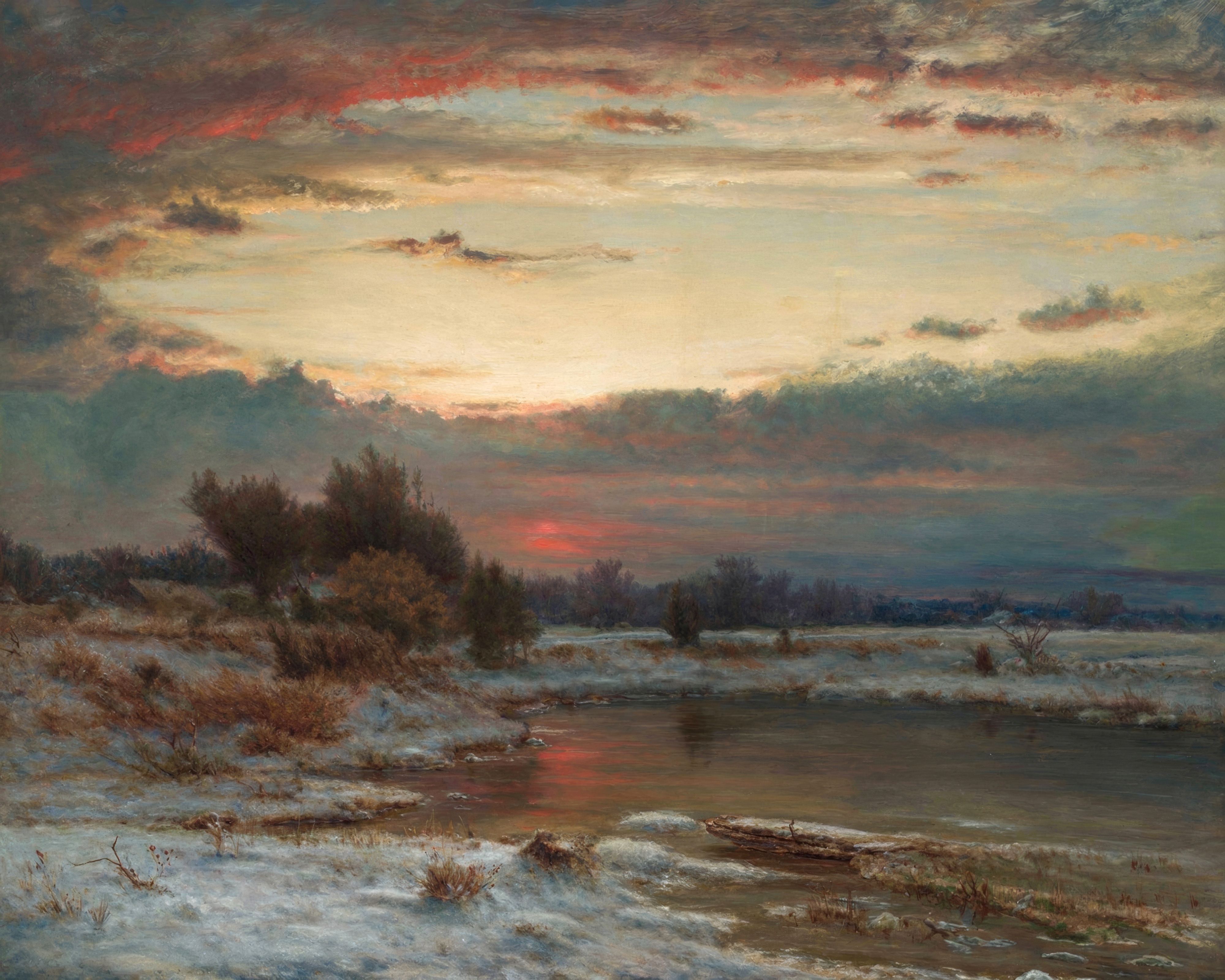
A Winter Sky · George Inness · 1866 · Cleveland Museum of Art
A sky-led winter direction can suit someone who wants a seasonal connection without an explicit Christmas symbol. Think about the picture’s role in the room: something to study nearby, or a view encountered from across the space. Let that use guide the format offered on the artwork page. A calm choice can still feel deliberate and generous.
Choose an artwork you want to live with, open its print page and review the current presentation choices. Use the frame guide if you need help comparing the available directions, then return to the work itself to finish shopping. Keep the full composition visible and measure the intended wall. Christmas may be the reason you first look for the picture; it need not be the only time the picture belongs there.