Isle of the Dead: a boat at the edge of silence
Read Böcklin’s Isle of the Dead through its 1880 New York version, then compare two other landscapes of enclosure and distance.
Isle of the Dead places a small boat before an island that seems almost closed to the world. A white figure stands beside a draped form, dark trees rise between pale-edged rocks, and the water offers very little distraction. The picture is immediately recognisable, yet its effect depends on details that can disappear when it is reduced to a tiny emblem of mystery.
The work shown here is the 1880 version in The Metropolitan Museum of Art, the second of Böcklin’s five versions of the subject. Identifying the version matters: the familiar title refers to several related paintings, not one image that always looks exactly the same. This guide follows the visible arrangement of the New York work, then compares The Island of Life and Villa by the Sea.
For a broader introduction to the artist, read Arnold Böcklin’s mood and mystery. The aim here is to slow down before supplying an interpretation, and to distinguish what the painting shows from the associations we bring to it.
Begin with the small boat
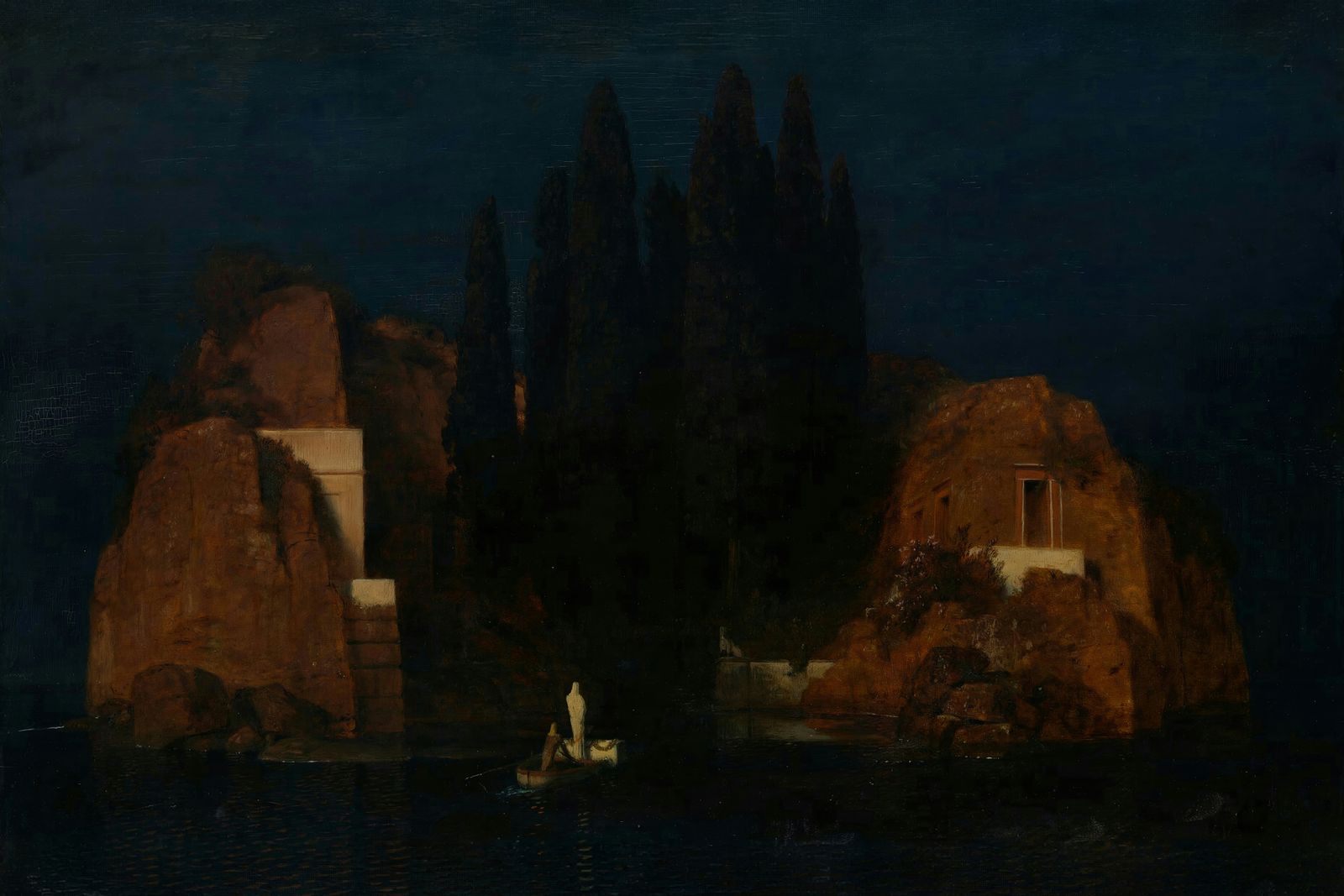
Isle of the Dead · Arnold Böcklin, 1880 · The Metropolitan Museum of Art, New York; second version. Prepared for print by Surrealium at Vaxholm Fortress, Sweden.
The boat occupies a very small part of the picture, but its pale standing figure gives the eye a clear point of entry. A darker figure bends lower towards the water, while the covered form lies before the standing figure. Their scale makes the island feel substantial without requiring a panoramic view of a vast landscape.
Follow the boat’s direction towards the opening between the rocks. The composition brings the viewer close to an arrival while withholding what will follow it. That is a visual effect you can describe without deciding that the island depicts one exact real place or that every detail translates into a fixed allegorical code. The small human presence and the larger enclosing forms establish the encounter before any outside story is added.
Know which version you are looking at
The Met identifies its painting as a work commissioned by Marie Berna in 1880 after she saw an unfinished version in Böcklin’s studio. Its account connects the draped coffin and shrouded figure to her memorial request. That documented commission is useful context, but it does not settle every association a viewer may find in the landscape.
Böcklin made five versions between 1880 and 1886. Differences in the rocks, light and proportions mean that a caption should identify the collection rather than attaching a date to an unspecified reproduction. The image here is the New York version, not the first version in Basel or the later Berlin painting. When comparing an interpretation with a picture, check that both concern the same object before treating a particular detail as evidence.
Notice how the island closes around the eye
Isle of the Dead · Arnold Böcklin, 1880 · The Metropolitan Museum of Art, New York; second version. Prepared for print by Surrealium at Vaxholm Fortress, Sweden.
The rocks form substantial masses on either side, while the dark cypresses fill the central space above the boat’s destination. Small architectural openings suggest that the island has been shaped or inhabited, but they do not make it feel openly accessible. The limited light leaves the deeper interior difficult to read.
This structure helps explain why the scene can feel both inviting and resistant. The boat gives us a route, while the trees and stone limit our view beyond it. Calling the picture mysterious is a reasonable first response, but describing those visible decisions makes the response more precise. Look at where the brightest edges occur and where the image allows one dark form to merge with another; the uncertainty is built into the organisation of the view.
Let stillness remain an observation
The water is comparatively quiet, and the upright trees resist the restless movement often associated with a stormy landscape. The figures do not produce a large visible action. Together these features make the moment seem suspended, as though an arrival has been held just before its completion.
A viewer may associate that pause with mourning, contemplation or the passage between life and death. Those readings fit the title and the documented memorial context, but they remain interpretations of a painting rather than statements about an actual afterlife. The Symbolist art guide explores how images can invite such associations without becoming diagrams with one compulsory answer. It is worth preserving that openness while still being exact about the forms and sources that support a particular reading.
Compare The Island of Life
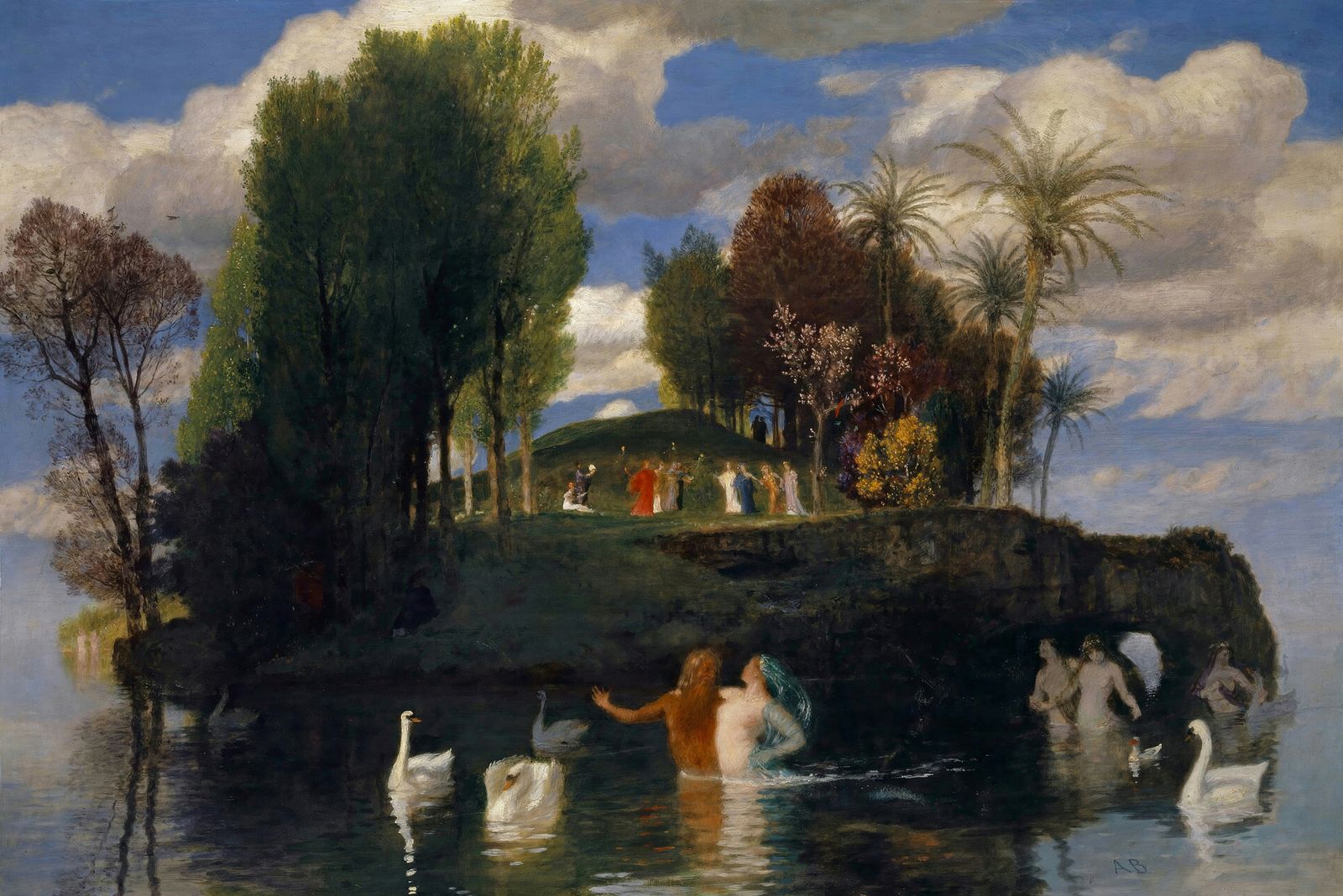
The island of life · Arnold Böcklin, 1888 · Kunstmuseum Basel. Prepared for print by Surrealium at Vaxholm Fortress, Sweden.
The Island of Life offers a much more active gathering around water, with pale birds, figures and a greener island under a lighter sky. The change is visible before the titles are compared. Where Isle of the Dead concentrates attention on a small approaching boat, this picture distributes life around the shore and the surface of the water.
The 1888 work belongs to Kunstmuseum Basel. It is useful as a comparison within Böcklin’s own art, but it should not be treated as an illustrated explanation that cancels the ambiguity of the earlier picture. Compare the distribution of figures, the openness of the shore and the movement of light. Those differences show how an island motif can carry very different moods when the artist changes what happens around its edges.
Look for mood in a different coastal setting
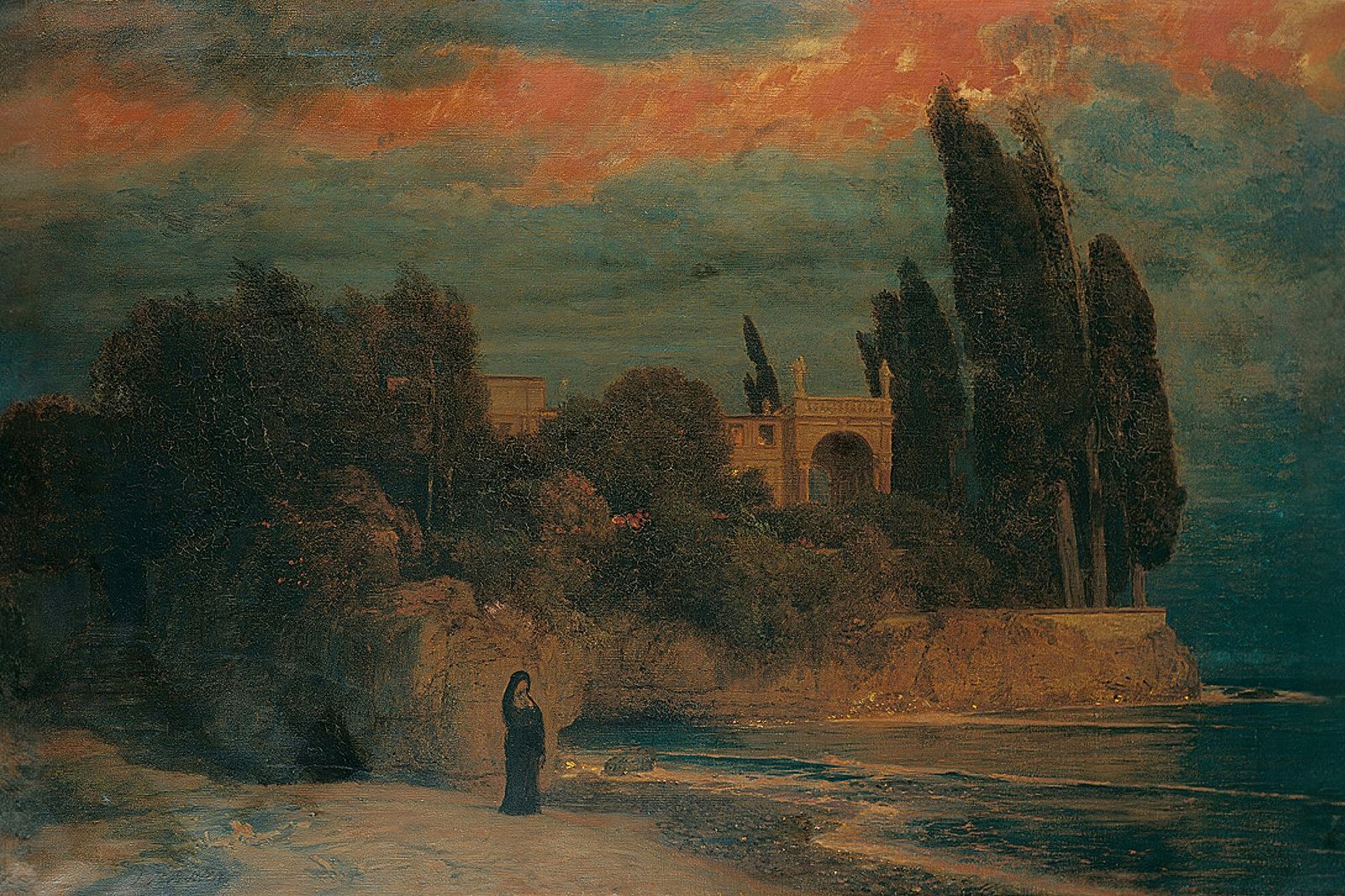
Villa by the Sea III · Arnold Böcklin, 1871–74 · Städel Museum, Frankfurt am Main. Prepared for print by Surrealium at Vaxholm Fortress, Sweden.
Villa by the Sea places a solitary figure near the shore, with a substantial building and tall trees above. The red and darkened sky gives the setting a different pressure from the quiet blue-black atmosphere of Isle of the Dead. The Städel Museum dates this third version of the villa subject to 1871–74 and describes the figure’s situation as deliberately open to interpretation.
The comparison helps separate a recurring visual vocabulary from a single narrative. A shore, a building, cypresses and a figure can return without always telling the same story. Look at the scale of the person against the architecture and at the way the water meets the land. The scene’s emotional force can arise from those relationships even when we cannot name the figure or explain why she waits there.
Compare distance with Friedrich
A useful neighbouring work is Wanderer above the Sea of Fog. Friedrich gives the viewer a prominent figure looking into a landscape, while Böcklin’s boat remains small before the island. In one image, a body stands firmly near us; in the other, the human presence approaches a destination from which we remain separated.
Neither arrangement tells us exactly what its figures think. Both give the viewer a position from which to imagine an encounter with a larger space. Comparing them can sharpen the difference between looking out and moving towards, or between an open distance and an enclosing destination. Those are pictorial relationships, not proof that the artists intended one identical philosophy of landscape. Let the comparison clarify the images without flattening their differences.
Give the complete composition room
Isle of the Dead · Arnold Böcklin, 1880 · The Metropolitan Museum of Art, New York; second version. Prepared for print by Surrealium at Vaxholm Fortress, Sweden.
The Isle of the Dead masterwork depends on the relationship between the island, the surrounding water and the small boat. A crop that enlarges the white figure may make the subject easier to recognise at a glance while weakening the scale that gives the encounter its force. Keep the whole image visible when judging a reproduction.
For a home, consider whether you want a work whose details emerge slowly. The dark passages are an active part of the composition, not empty areas to be removed. Compare the Symbolist-era collection with the quieter landscapes of Gustave Courbet if you are deciding between imagined atmosphere and a more materially specific view of place. The choice can begin with how you want to spend time looking. The wider Böcklin collection lets you compare his islands with the other imagined places and mythological figures he painted.
Return to the boat after looking at the other landscapes. Its small pale figure now sits within a more particular arrangement of rock, tree and water, and the title no longer has to do all the work. Böcklin leaves the arrival unresolved. A good reproduction preserves the space in which that unresolved moment can continue to hold the eye.
- How many versions of Isle of the Dead did Böcklin make?
- He made five versions between 1880 and 1886. The work pictured in this guide is the 1880 second version in The Metropolitan Museum of Art, New York.
- Is the island an exact picture of a real place?
- The painting is an imagined landscape. Its visual elements can recall Mediterranean settings, but the guide does not identify the island as a single documented location.
- Does the painting have only one meaning?
- The title and memorial commission support themes of death and mourning, while the arrangement leaves room for different responses. Distinguish documented context from a personal interpretation of its atmosphere.