Wanderer above the Sea of Fog: a view held open
Look closely at Friedrich’s Wanderer above the Sea of Fog, from the figure’s stance to the landscape that refuses a complete view.
Wanderer above the Sea of Fog places a man on a rocky height with his back towards us. Mist separates the visible peaks, while the figure stands close enough for his coat, hair and walking stick to give the scene a human scale. The painting offers a view and, at the same time, makes the act of looking part of its subject.
Caspar David Friedrich’s work belongs to the Hamburger Kunsthalle. The museum’s current project dates it to around 1817, although 1818 is still frequently encountered in general accounts. Keeping the collection and its dating attached to the title is more useful than treating the image as an anonymous symbol of individual triumph.
The Romanticism paintings guide gives a wider setting for the work. Here we will follow what is visible: a firm stance, an obscured distance and the relationship between the person near us and the landscape beyond. Those features leave room for several responses without requiring us to know exactly what the figure is thinking.
Stand behind the figure before looking past him
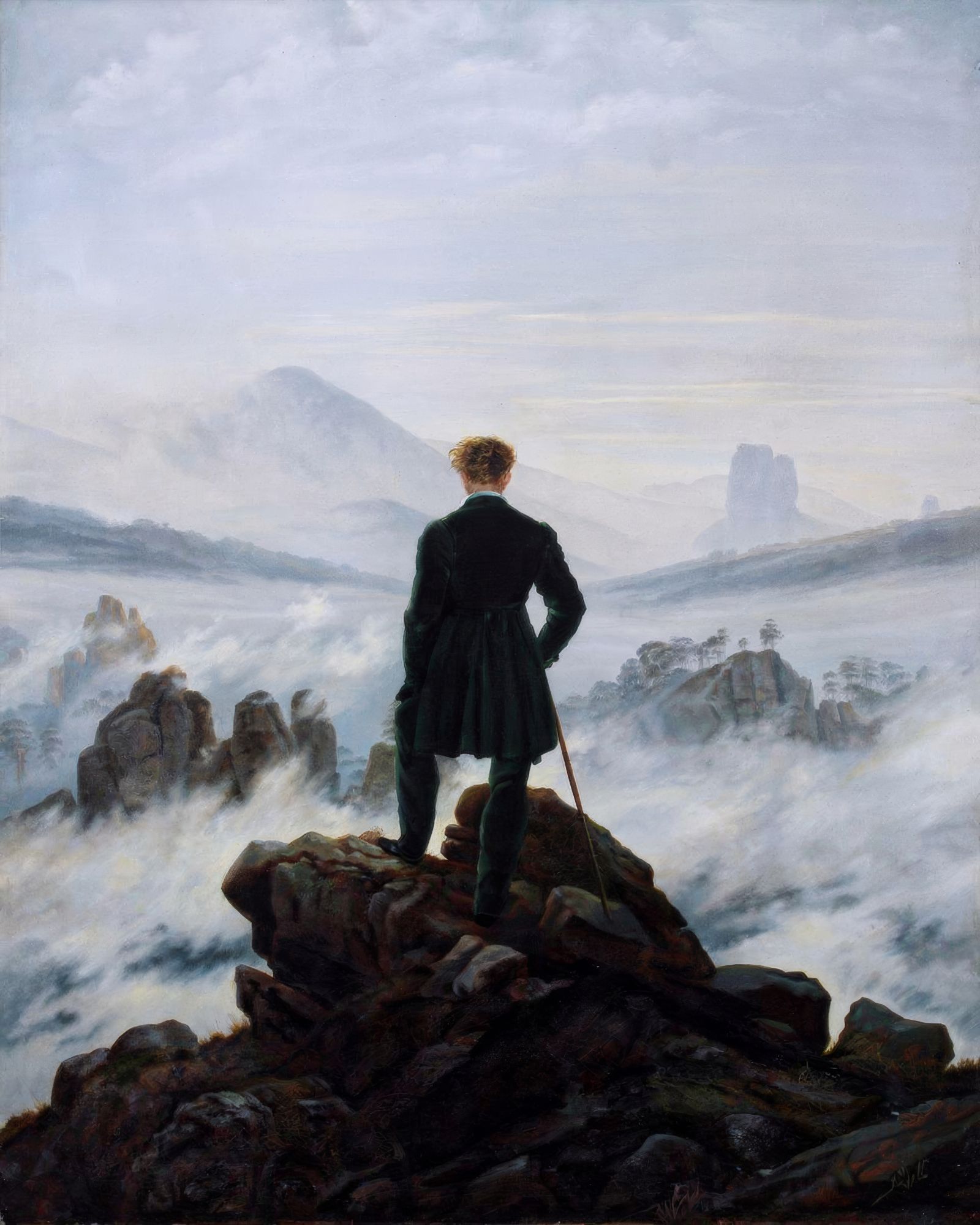
Wanderer above the Sea of Fog · Caspar David Friedrich, c. 1817 · Hamburger Kunsthalle. Restored by Surrealium at Vaxholm Fortress, Sweden.
The man occupies the central foreground, his legs separated across uneven rock and one hand associated with the walking stick at his side. His dark coat makes a strong shape against the pale mist. The position gives the viewer a near bodily presence before the eye moves towards the distant peaks.
Because the face is turned away, we cannot read a conventional portrait expression. We are invited to share a direction of attention without sharing the figure’s private thoughts. That difference is important. The image may suggest confidence to one viewer and uncertainty to another, but neither response can be confirmed by an expression we cannot see. Start with the stance and the visible support of the rock, then consider how the surrounding space changes the impression they create.
Let the mist interrupt the landscape
The fog conceals the ground between the nearer rocks and the more distant peaks. It does not simply soften a complete map of the terrain. The missing passages make it difficult to measure the distances or imagine one continuous route from the foreground to the farthest visible forms.
That interruption gives the painting much of its openness. The man stands in a definite place, but the landscape does not become fully available to him or to us. A reading based only on conquest overlooks the amount that remains hidden. Follow the edges where rock emerges from mist and where it disappears again. The scene keeps offering recognisable fragments while refusing to make the entire space equally clear, and that uneven visibility is more interesting than a single slogan attached to the figure.
Compare another rear-facing view by Friedrich
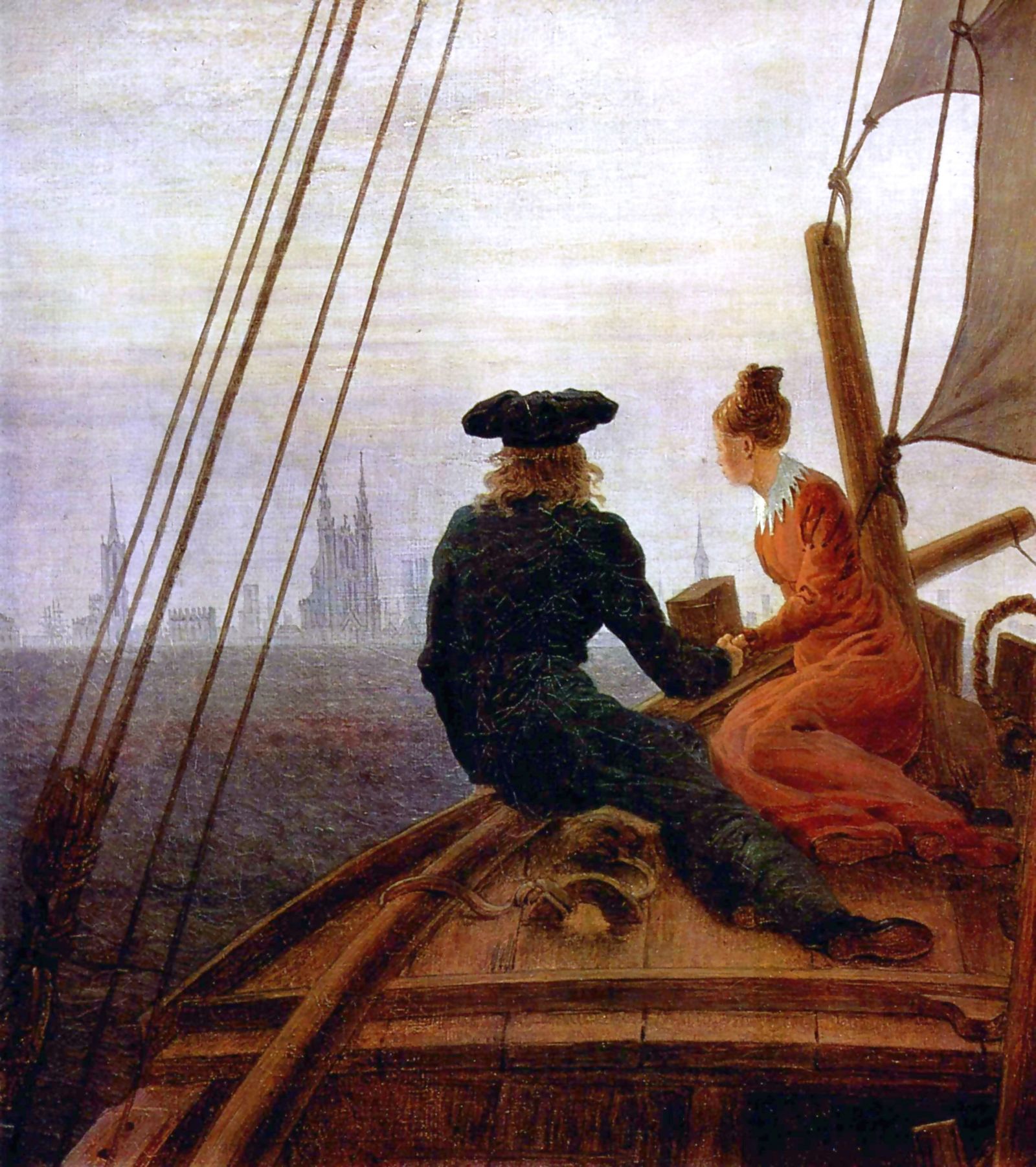
On the Sailing Boat · Caspar David Friedrich, 1818 · Hermitage, St Petersburg. Prepared for print by Surrealium at Vaxholm Fortress, Sweden.
On the Sailing Boat places two seated figures before a distant horizon, with the boat’s wooden surface and rigging creating a structure around them. Their backs also turn towards the viewer, but the shared vessel changes the encounter. Instead of one figure fixed on a height, we see two people carried within a space that implies movement towards a destination.
The comparison makes the device of the rear-facing figure more specific. It can establish companionship as well as solitude, movement as well as a pause. Neither painting gives us direct access to the figures’ expressions. The viewer’s role is to notice how bodies, direction and setting work together. A repeated pictorial idea does not have to repeat one emotional meaning, even within the work of the same artist.
Avoid inventing a complete biography for the man
The figure’s appearance can prompt questions about identity, travel and intention. Those are reasonable questions, but an imagined answer should not be presented as established fact simply because it makes a satisfying story. The painting’s effect does not depend on naming the man with certainty or reconstructing a particular morning’s walk.
The museum’s Wanderer research project offers a source for the work’s history and changing reception. In a close reading, it is enough to say that the figure stands on a rocky summit facing mist and distant peaks. Interpretations can then be built openly from that observation. A clear distinction between what is shown, what a source documents and what a viewer infers makes the picture richer rather than less interesting.
Compare Courbet’s closer ground
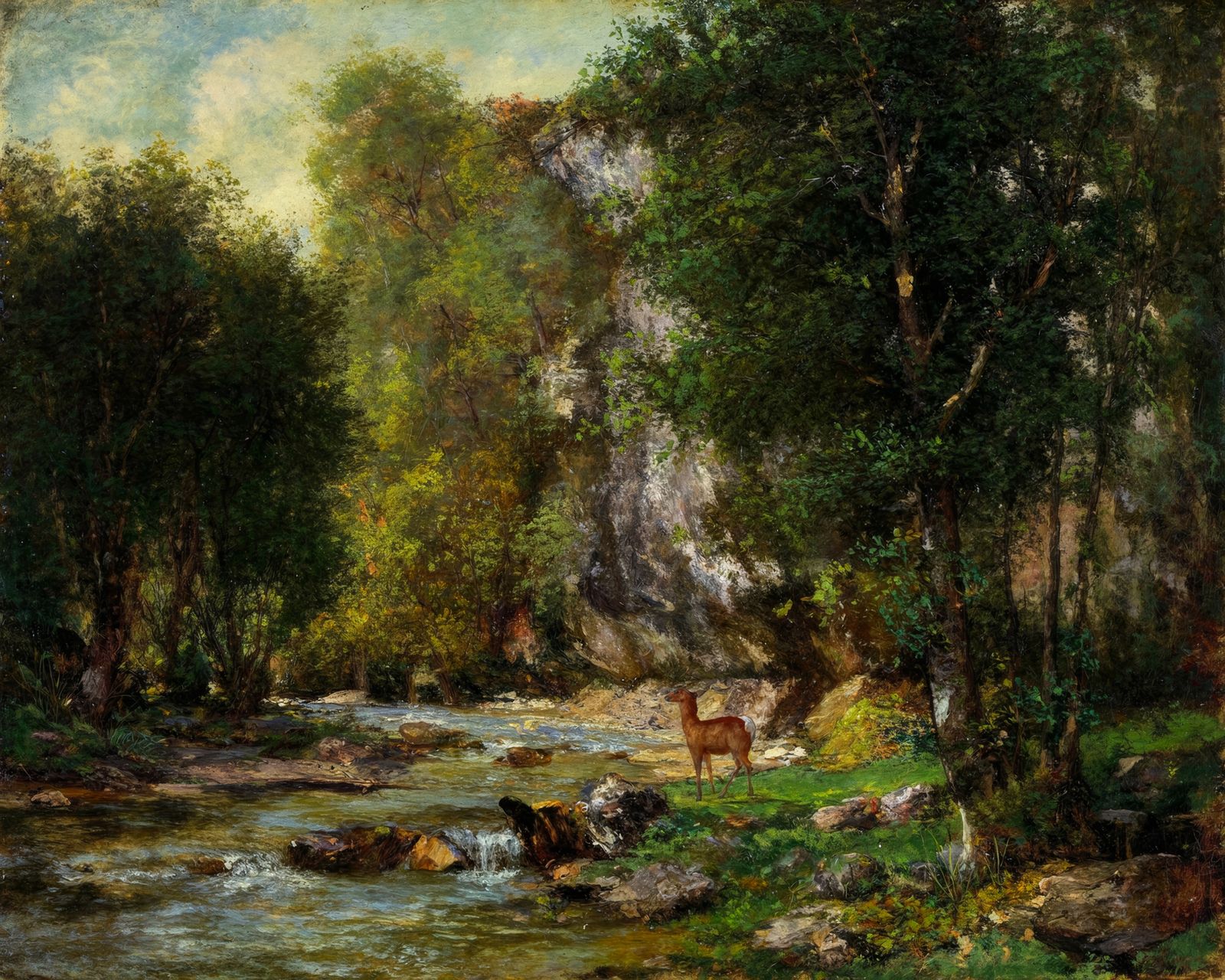
The Brook of Les Puits-Noir · Gustave Courbet, c. 1855 · Art Institute of Chicago. Restored by Surrealium at Vaxholm Fortress, Sweden.
Courbet’s Brook of Les Puits-Noir gives water, rocks and trees a dense, material presence at a much more immediate scale. The viewer encounters a stream among obstacles rather than a figure looking over a wide obscured distance. The comparison is between different artists and approaches, not a claim that one painting supplies the key to the other.
Follow the water through Courbet’s scene, then return to Friedrich’s fog. One image offers a route through nearby surfaces; the other hides the passages between its visible peaks. The Gustave Courbet guide develops that attention to material place. Setting the works beside one another can clarify why the Wanderer’s space feels so difficult to possess, despite the firmness of the body standing in its foreground.
Read the dark figure and pale distance together
The coat’s dark silhouette separates the man clearly from the mist, while the lighter sky and distant forms allow the composition to open around him. The figure is prominent, but he does not fill the whole image. There is enough surrounding space for the landscape to remain an encounter rather than a decorative backdrop to a portrait.
This balance is easily altered by cropping. Enlarging the figure and removing the side passages can make the scene feel more like an emblem of a single person. The complete Wanderer masterwork preserves the relationship between the foreground rock, the body and the interrupted distance. When comparing reproductions, judge the whole vertical composition rather than only the recognisable head and shoulders.
Compare the shore in Böcklin’s Villa by the Sea
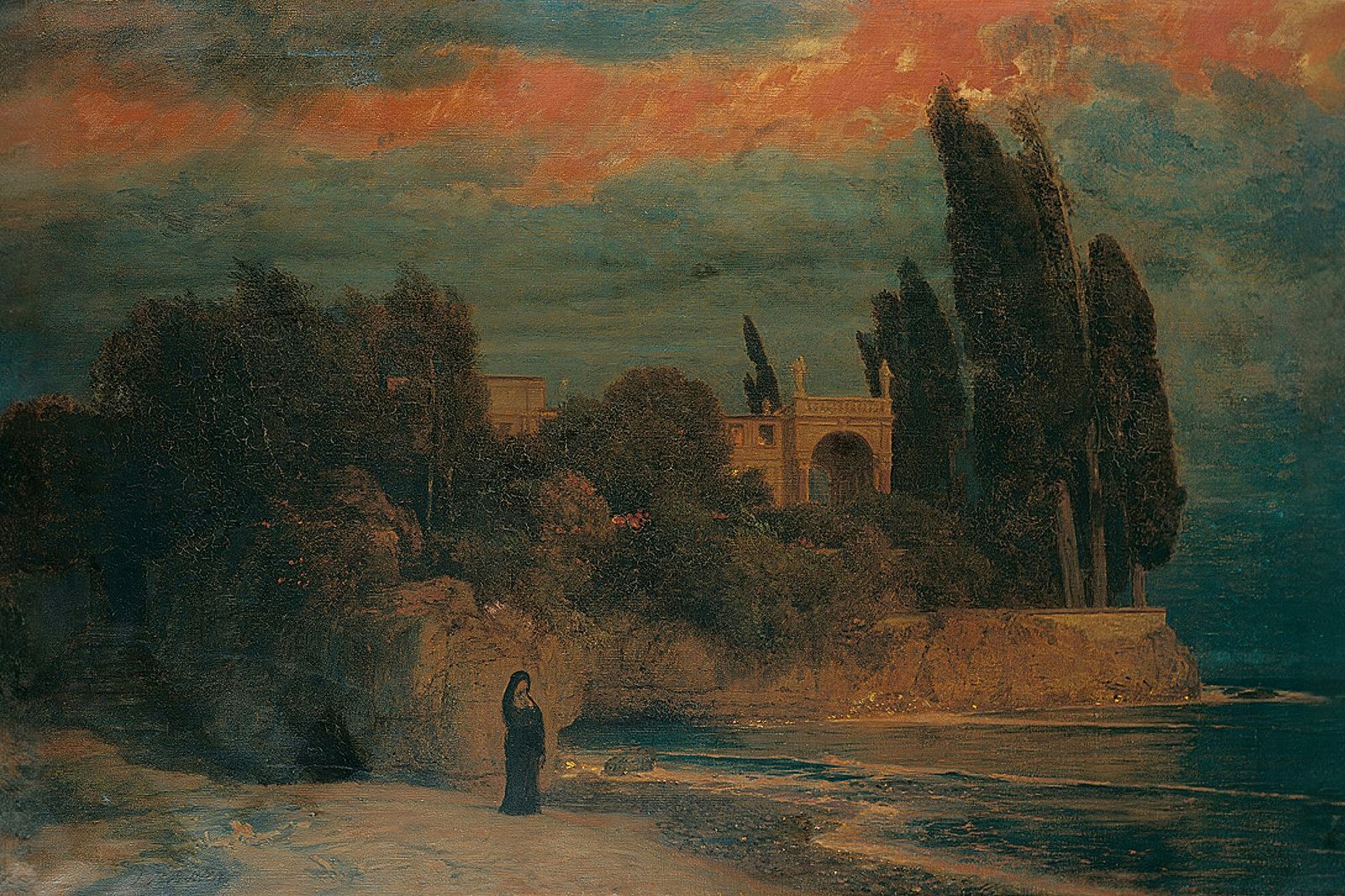
Villa by the Sea III · Arnold Böcklin, 1871–74 · Städel Museum, Frankfurt am Main. Prepared for print by Surrealium at Vaxholm Fortress, Sweden.
Böcklin’s Villa by the Sea places a small solitary figure near a shore, with architecture and tall trees occupying much of the view. The person’s scale is very different from Friedrich’s central wanderer, and the darkening sky gives the surrounding place a more enclosing atmosphere. The Städel identifies the pictured third version as dating to 1871–74.
The comparison helps you see that a lone figure does not automatically mean the same thing in every landscape. Placement, scale and the amount of visible space alter the relationship. In Böcklin, the building and shore press into the encounter; in Friedrich, mist opens and withholds the distance. The story of Isle of the Dead follows another of Böcklin’s ways of placing a small human presence before a larger destination.
Choose a reading that remains answerable to the image
You might respond to the Wanderer as a picture of possibility, hesitation, solitude or the limits of vision. Test that response against the visible arrangement. Which feature supports it? Which feature complicates it? A useful interpretation can acknowledge both the firm stance and the obscured ground without forcing one to cancel the other.
The Romantic-era collection provides other works to compare, but the painting itself should remain the centre of the discussion. Resist turning it into a promise about how a person ought to feel when facing a difficult future. A landscape painting can give form to an experience without prescribing the viewer’s response. The enduring interest lies partly in that freedom to return and find the same arrangement asking a slightly different question.
Look once more at the meeting of the boot, the rock and the mist. The body has a place to stand, while the world beyond it remains only partly visible. That relationship is enough to sustain the picture without a fixed moral. Give the complete composition room, and let the view remain open rather than reducing it to one borrowed message.
- Who painted Wanderer above the Sea of Fog?
- Caspar David Friedrich painted it. The work is in the Hamburger Kunsthalle, whose current research project dates it to around 1817.
- Why does the figure face away from the viewer?
- The rear-facing position lets us share the direction of his attention while withholding a readable facial expression. It creates a relationship between viewer, figure and landscape without telling us exactly what he thinks.
- Does the painting simply celebrate conquering nature?
- That is one possible response to the strong stance, but the fog conceals much of the terrain. A close reading should also account for the uncertainty and limits of the view.