Japanese woodblock prints: 20 ukiyo-e masterpieces
Hiroshige’s snow and fireworks, Utamaro’s beauties, Harunobu’s lovers and Kuniyoshi’s warriors: twenty Japanese woodblock prints, how they were made, and how to hang them.
Ukiyo-e means pictures of the floating world: the theatres, teahouses, festivals and famous views of Edo, the city we now call Tokyo. From the late 1600s to the late 1800s, publishers turned out these pictures as woodblock prints. An artist drew the design, a carver cut a separate block of cherry wood for every colour, and a printer laid the colours down one by one with a baren, a flat pad rubbed over the back of the paper.
They were cheap, popular and everywhere, and when they reached Europe they changed painting there too. Monet hung them all over his house, and Van Gogh copied two of Hiroshige’s prints in oil. The twenty below come from the Art Institute of Chicago, the Cleveland Museum of Art, the Met and the V&A. Each can be ordered as a print from the museum’s scan.
1. Plum Garden at Kameido
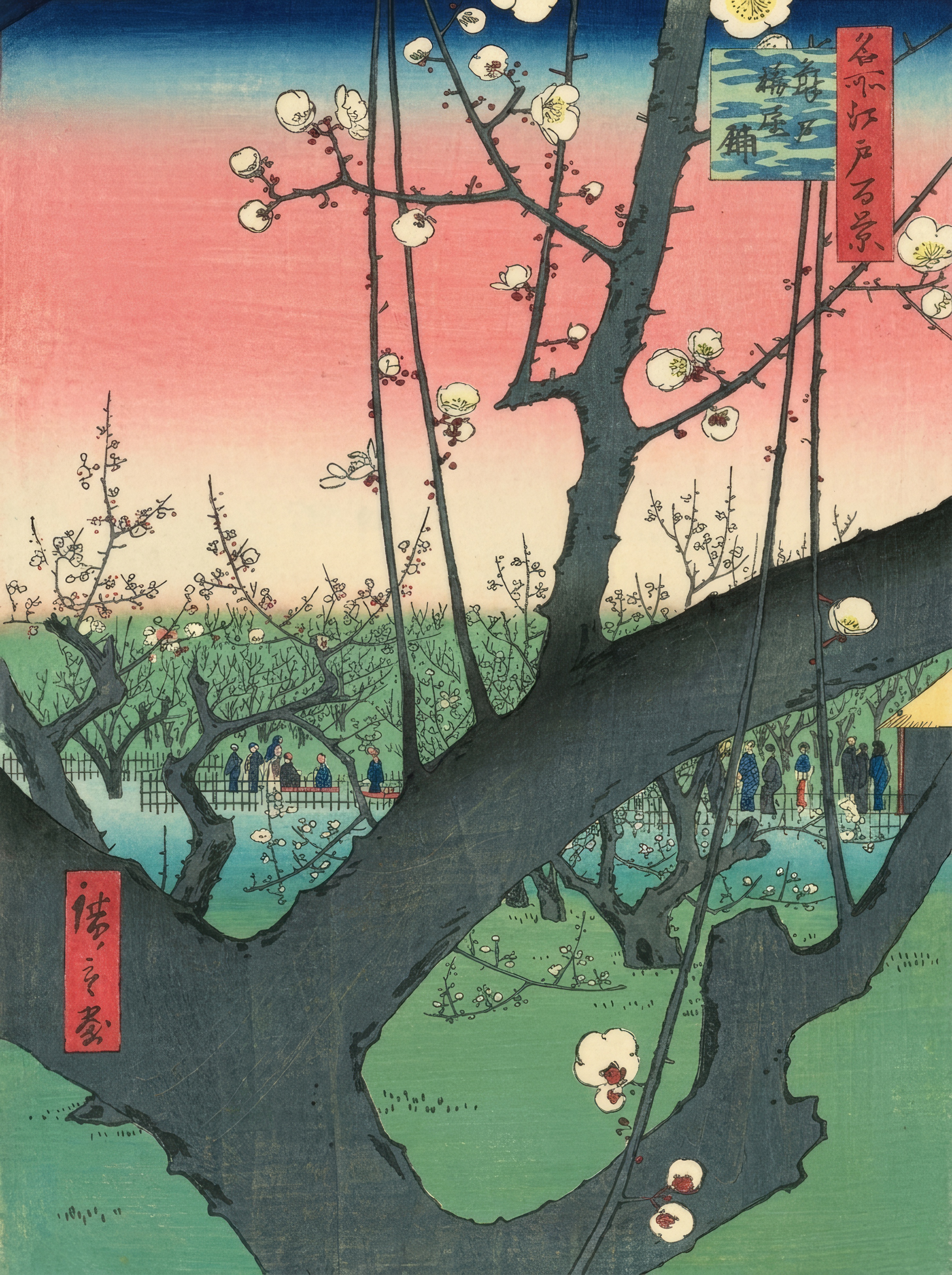
Utagawa Hiroshige, Plum Garden at Kameido, 1857. Color woodblock print; ōban. Art Institute of Chicago.
From Hiroshige’s last great series, One Hundred Famous Views of Edo. The gnarled branch of a famous plum tree fills the foreground and the visitors shrink to tiny figures behind it. Van Gogh copied this print in oil in 1887, and its bold cut-off composition still looks startlingly modern.
2. Fireworks at Ryōgoku
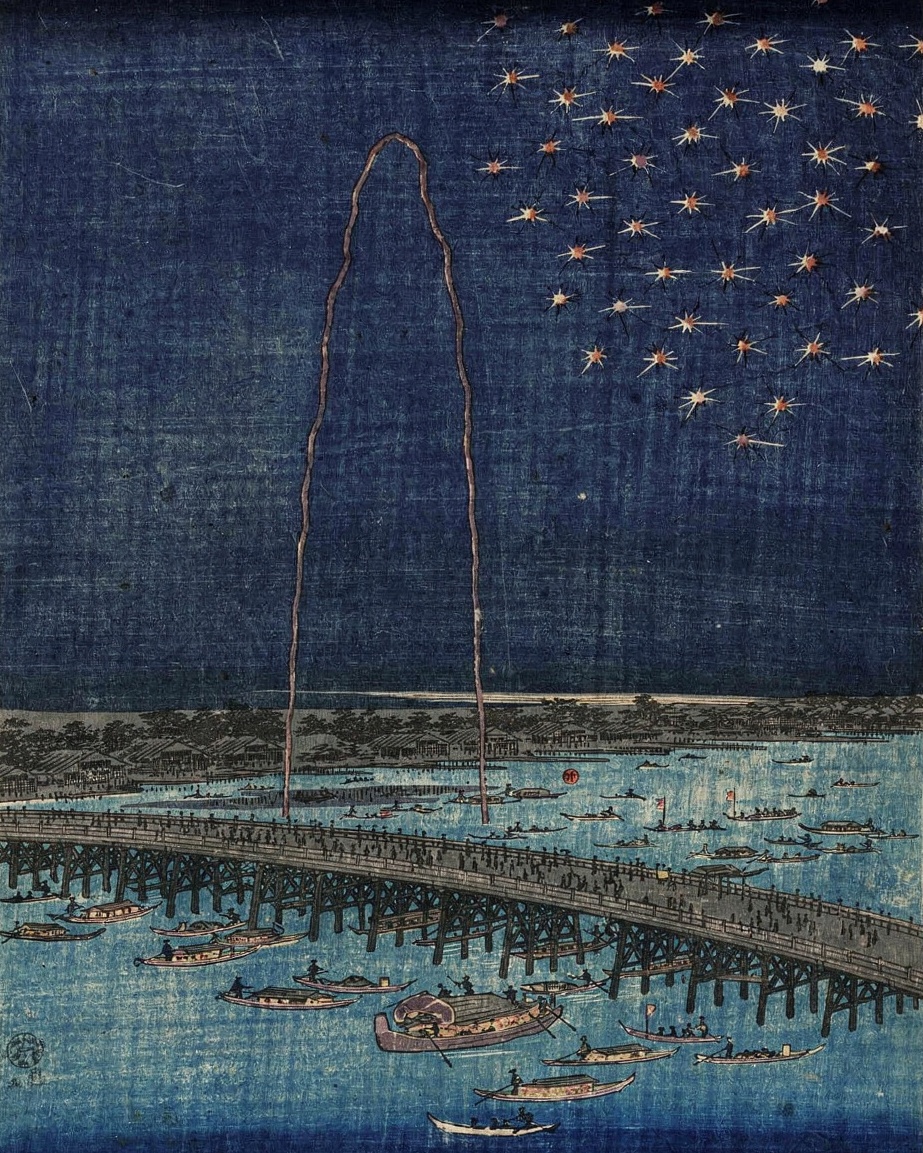
Utagawa Hiroshige, Fireworks at Ryōgoku, 1858. Color woodblock print. Cleveland Museum of Art.
Every summer the people of Edo crowded onto Ryōgoku Bridge and the river below to watch fireworks. Hiroshige shows one rocket bursting in a sky of deep indigo, with the crowd tiny underneath. It is one of the most atmospheric night scenes in all of Japanese art.
3. Snow at the Gion Shrine
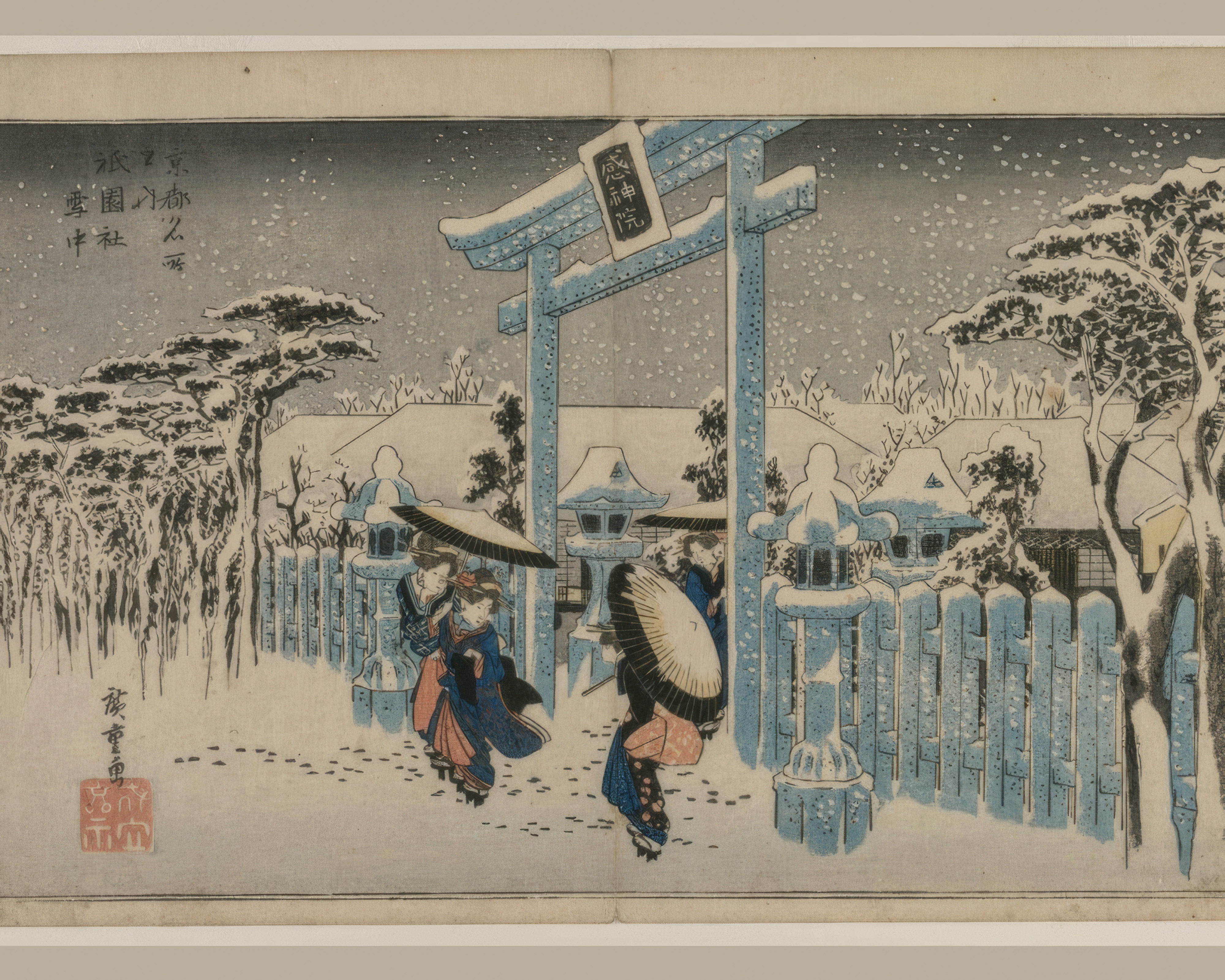
Utagawa Hiroshige, Snow at the Gion Shrine, mid-1830s. Color woodblock print. Cleveland Museum of Art.
Hiroshige was the master of weather, and his snow scenes are among his most loved prints. Here visitors bend under their umbrellas on the way to the Gion Shrine in Kyoto, with the white snow left as bare paper.
4. Seba Crossing
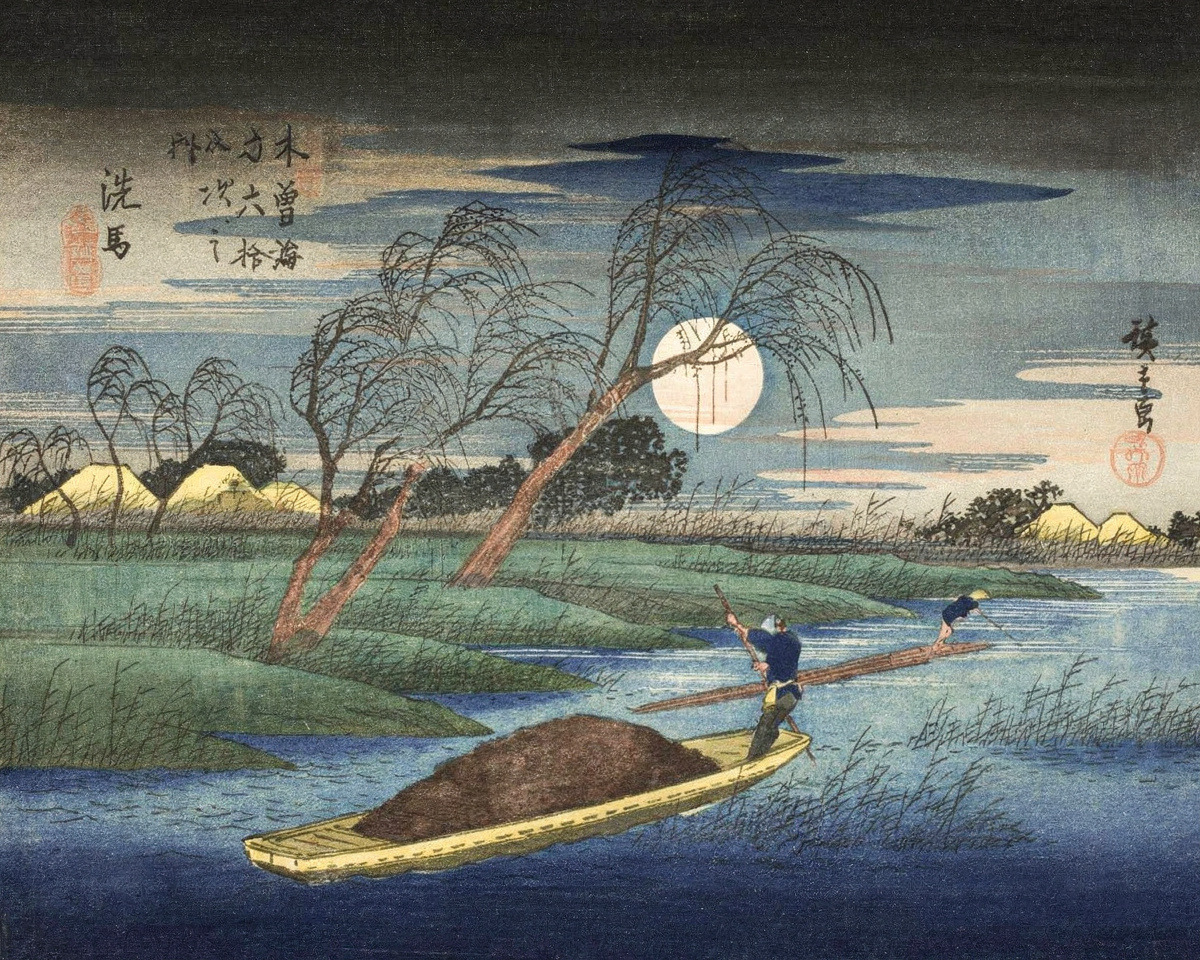
Utagawa Hiroshige, Seba Crossing, c. 1835/38. Color woodblock print; oban. Art Institute of Chicago.
The Kisokaidō was the inland road from Edo to Kyoto, through the mountains, and Hiroshige drew its sixty-nine post stations. At Seba, travellers file across a long bridge in calm daylight, a picture of the journey itself.
5. The Ferry at Imagiri
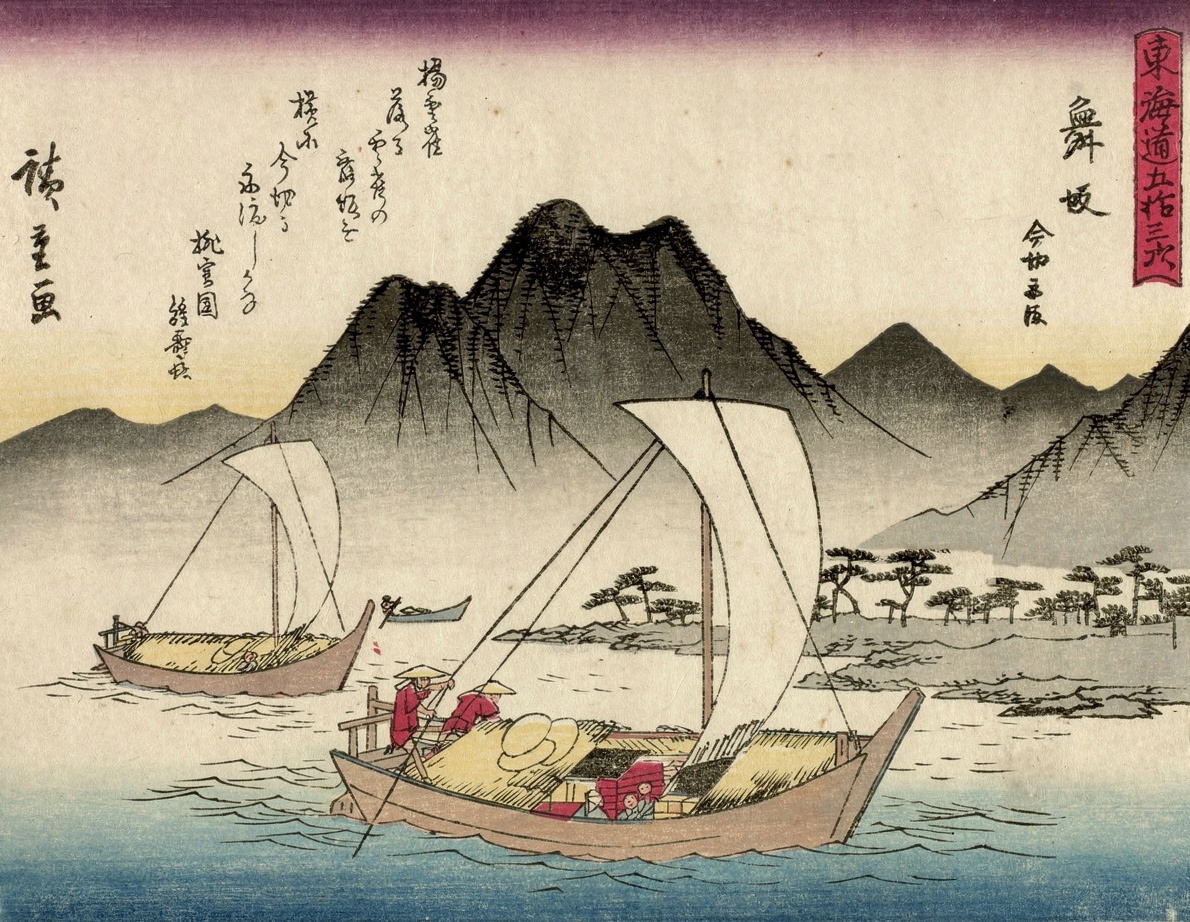
Utagawa Hiroshige, The Ferry at Imagiri, c. 1837/42. Color woodblock print; chuban. Art Institute of Chicago.
On the great coastal road, the Tōkaidō, travellers had to take a ferry across the lake inlet at Imagiri. Hiroshige shows the boat pitching in the swell, the blues of the water printed in graded colour.
6. Kingfisher and Chinese Bellflowers
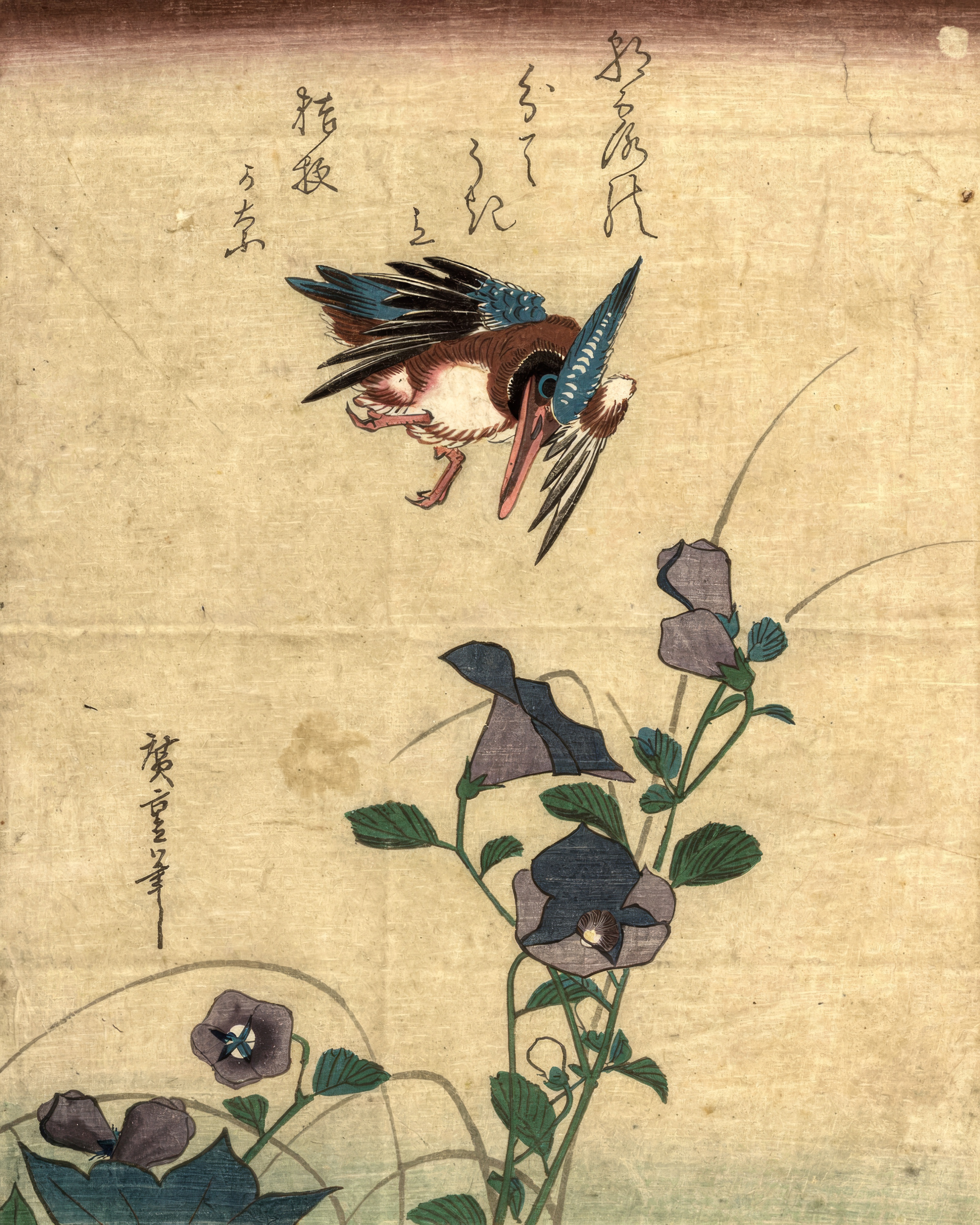
Utagawa Hiroshige, Kingfisher and Chinese Bellflowers, early or mid-1830s. Color woodblock print. Cleveland Museum of Art.
Bird and flower prints were the gentle side of ukiyo-e, and Hiroshige made them small, poetic and precise. A kingfisher flashes down above a spray of Chinese bellflowers, an autumn flower, in a print that is almost all empty space.
Bird and flower prints are tall and narrow, which makes them perfect for the strip of wall beside a window or a door.
7. Bush Warbler on a Plum Tree in Moonlight
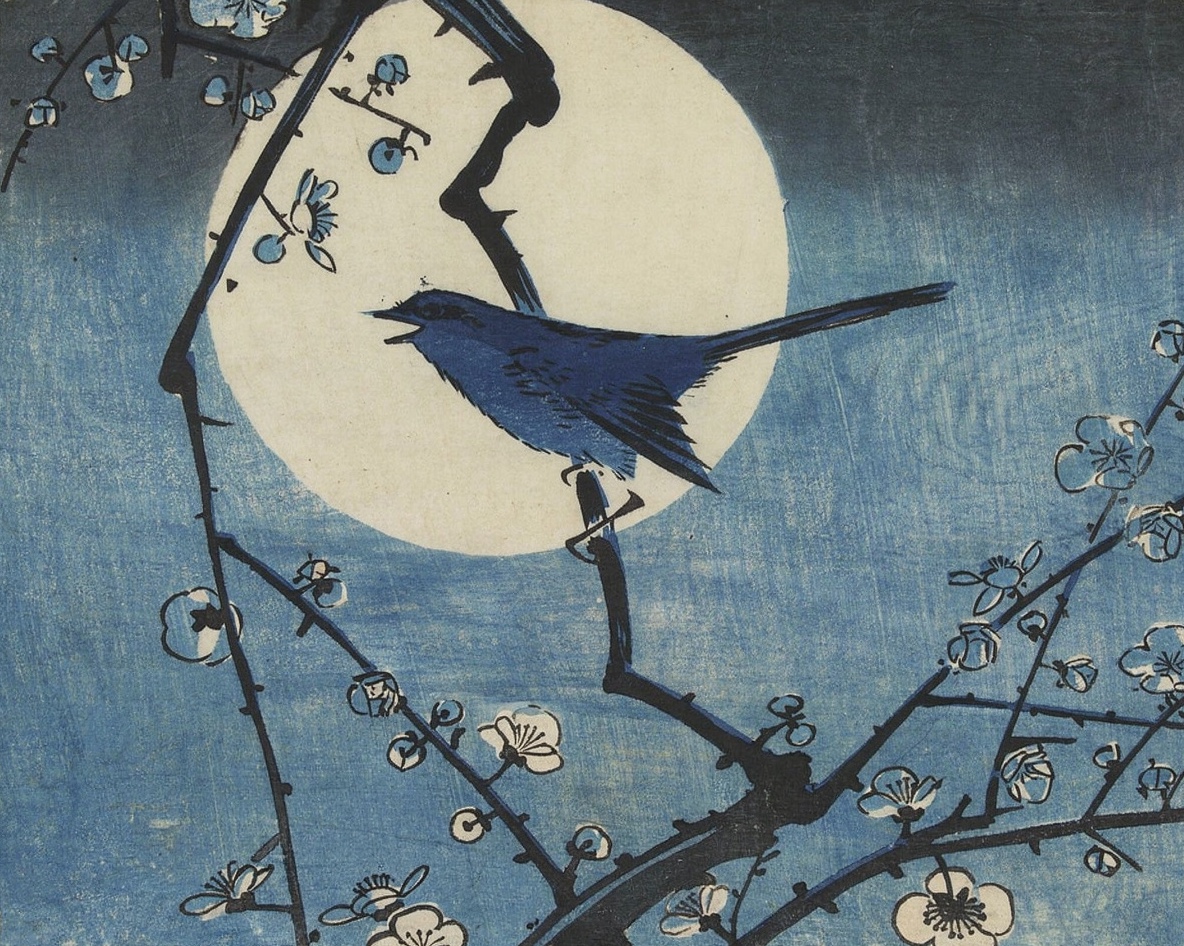
Utagawa Hiroshige, Bush Warbler on a Plum Tree in Moonlight, ca. 1840-1842. Victoria and Albert Museum, London.
The bush warbler’s song and the first plum blossoms meant the end of winter in Japan. Hiroshige puts both under a full moon, one of the most quietly beautiful prints of its kind.
8. Peacock and Peonies (Kujaku ni botan)
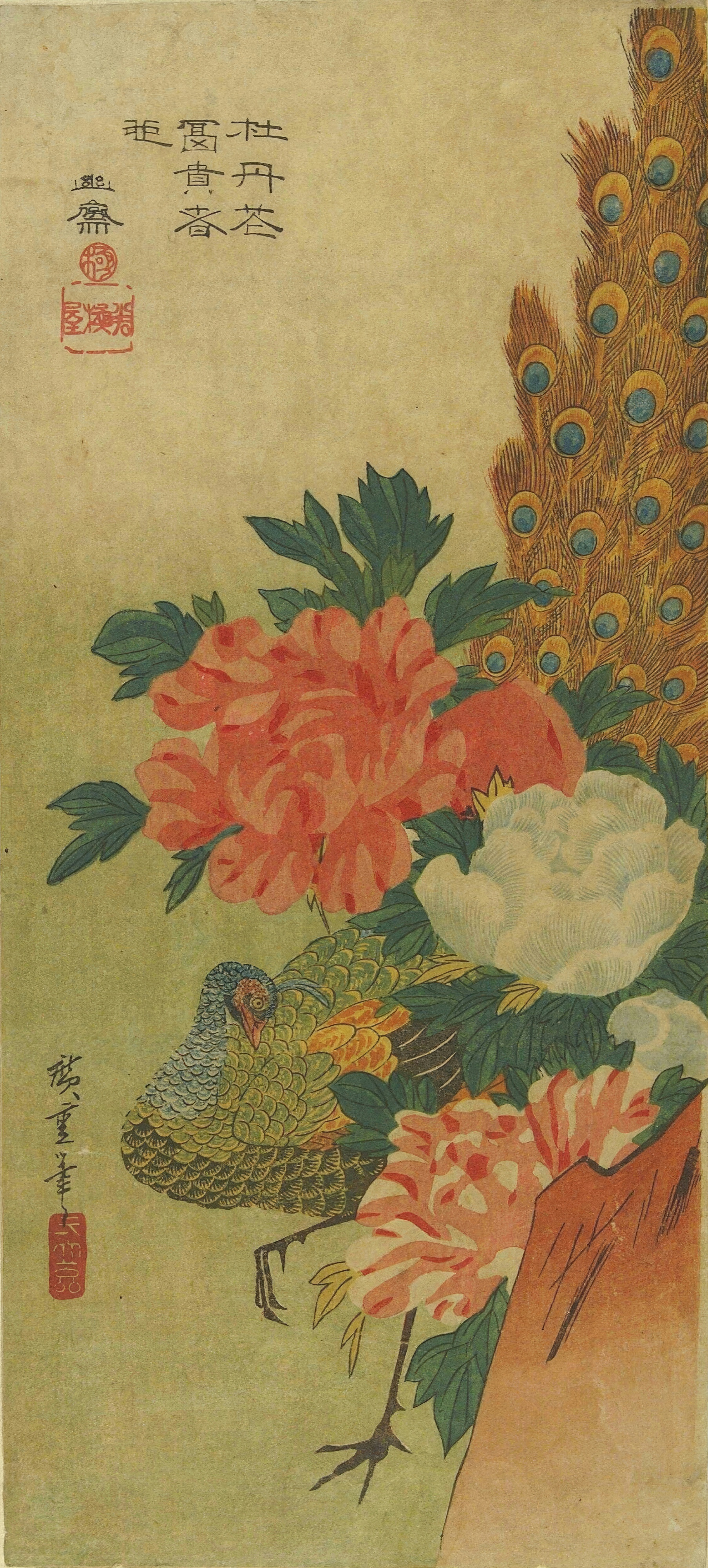
Utagawa Hiroshige, Peacock and Peonies (Kujaku ni botan), 1830s. Victoria and Albert Museum, London.
The peacock and the peony were both symbols of splendour, and here Hiroshige sets them side by side. The bird turns its head in profile above the flowers, its tail feathers printed with fine graded colour.
9. Hinazuru of the Keizetsuro
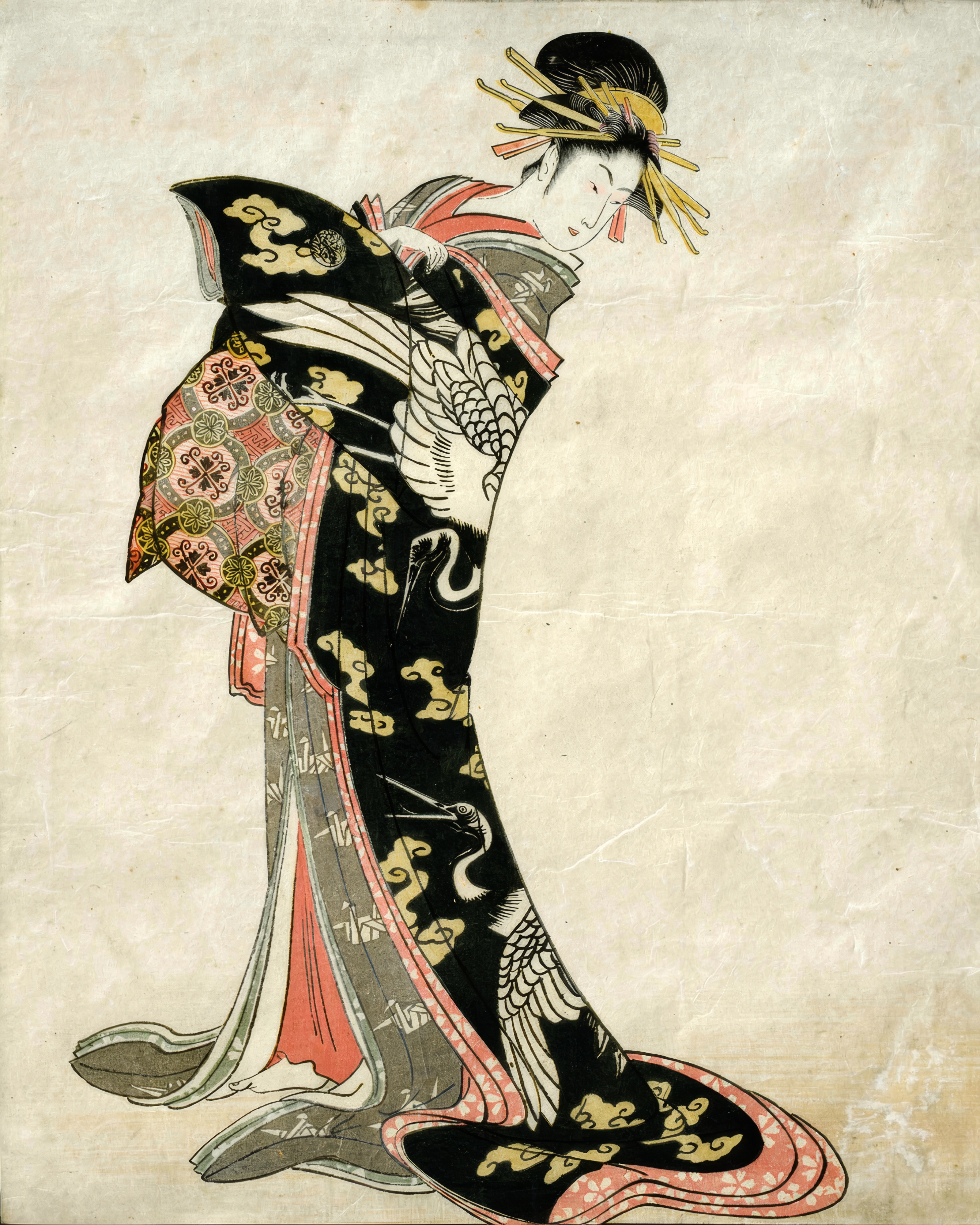
Kitagawa Utamaro, Hinazuru of the Keizetsuro, c. 1795. Color woodblock print; aiban. Art Institute of Chicago.
Utamaro changed how women were drawn in Japan. Instead of full figures he came close, to the head and shoulders, and gave each beauty a personality. Hinazuru was a famous courtesan of her day, and he draws her with a few confident lines and a background of mica-dusted cream.
10. Woman Holding a Tortoise-shell Hair-comb
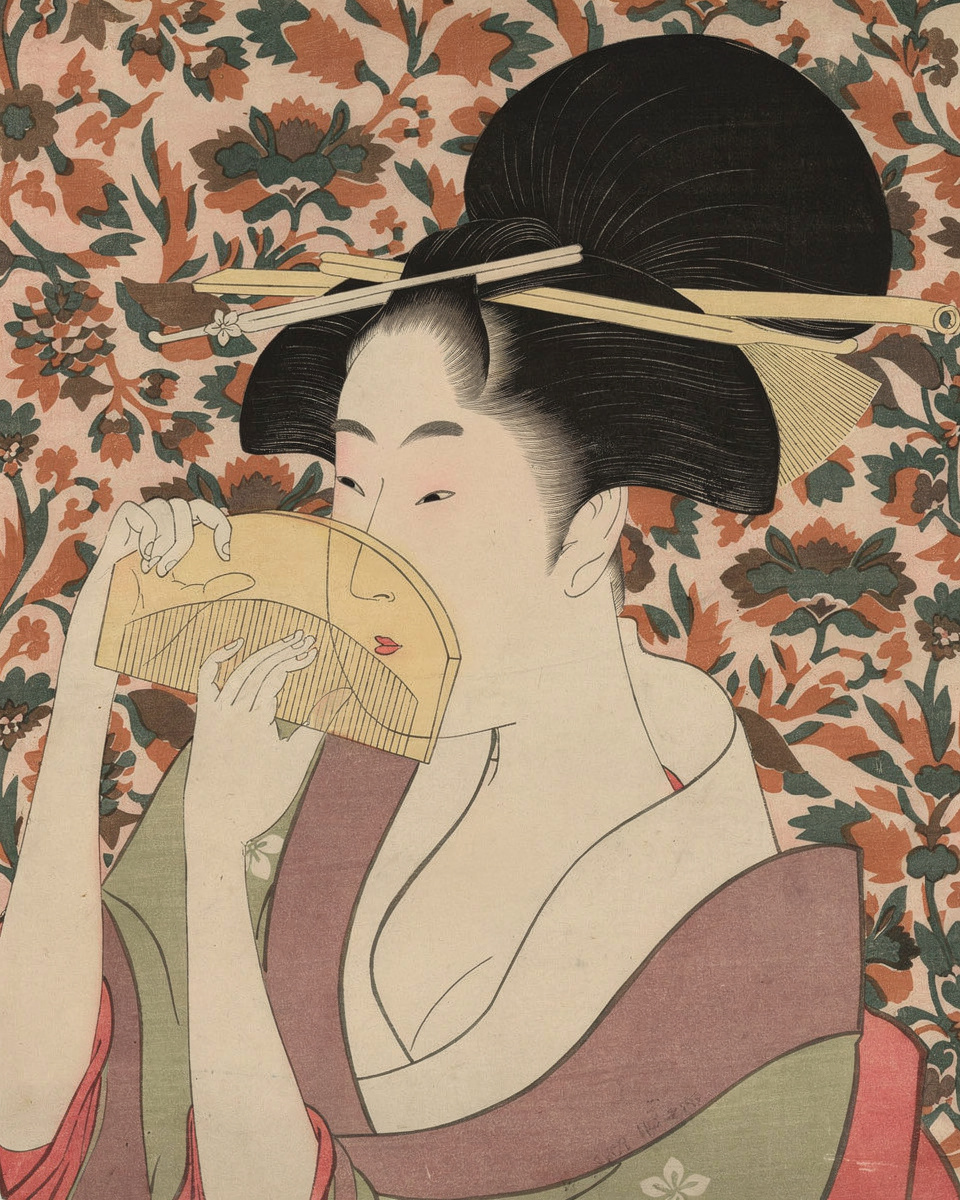
Kitagawa Utamaro, Woman Holding a Tortoise-shell Hair-comb, c. 1795/96. Color woodblock print; oban. Art Institute of Chicago.
A private moment: a woman looks at the comb she is about to put in her hair. Utamaro’s close-up portraits made the most ordinary gestures feel intimate, and fashion-conscious Edo bought them like magazine covers.
11. Mother and Child
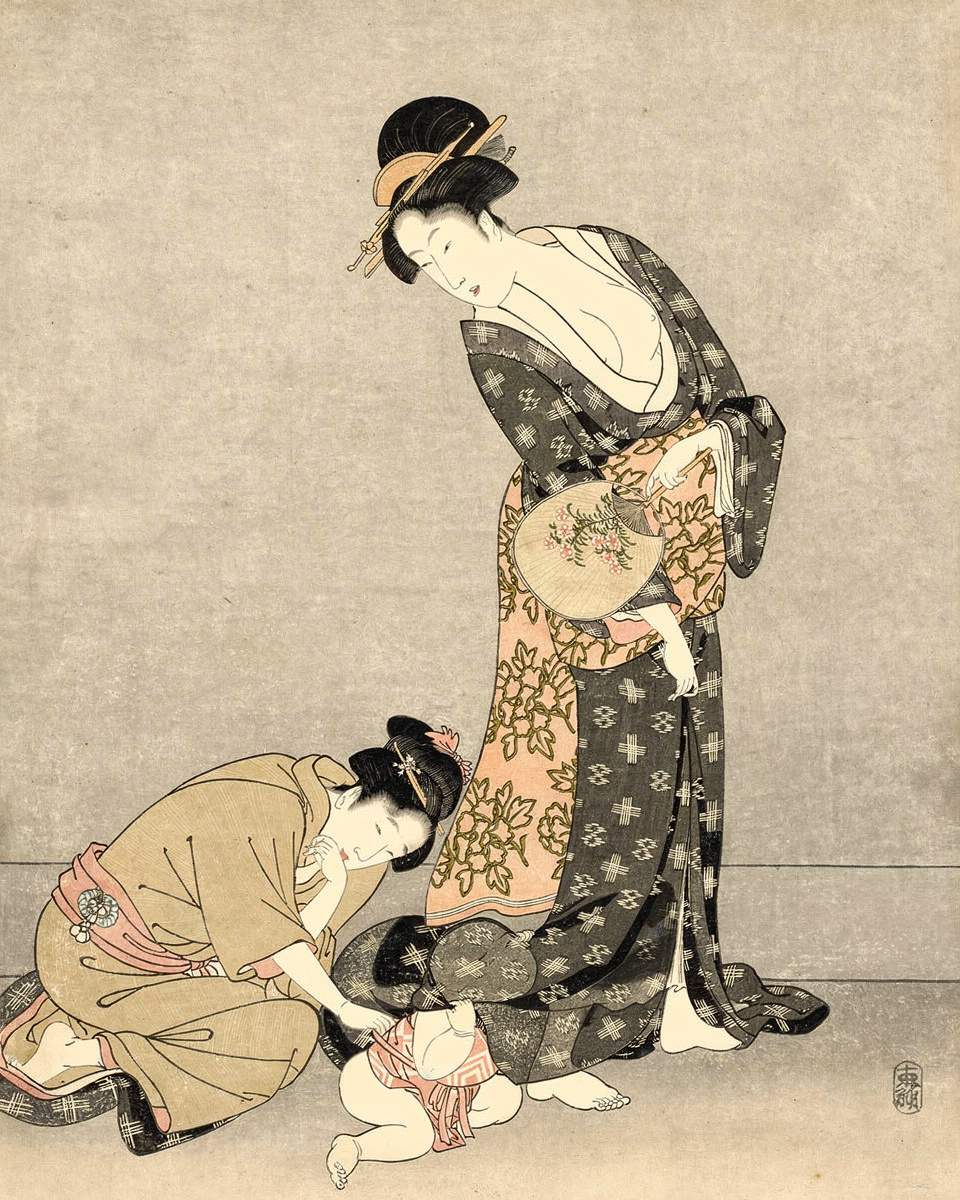
Kitagawa Utamaro, Mother and Child, c. 1800. Color woodblock print; naga-oban. Art Institute of Chicago.
Later in his career Utamaro turned to mothers and children, and these prints are among his tenderest. Here mother and child lean their heads together, drawn with almost no background at all.
12. Lovers Beneath an Umbrella in the Snow
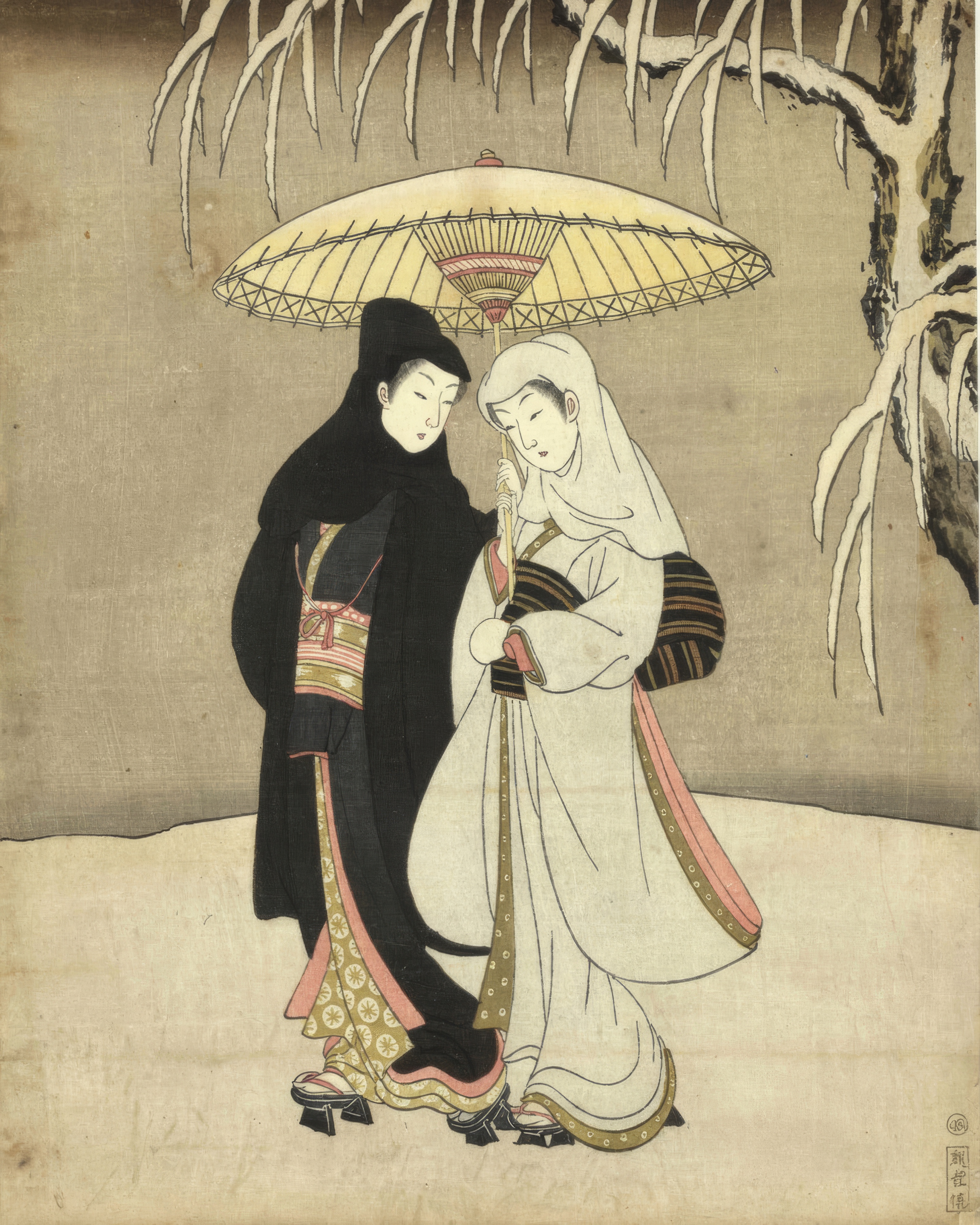
Suzuki Harunobu, Lovers Beneath an Umbrella in the Snow, c. 1767. Color woodblock print; chuban. Art Institute of Chicago.
Suzuki Harunobu invented the full-colour print in 1765, and his figures are slender, young and dreamlike. Here two lovers share an umbrella in the snow, one in black and one in white, in one of the most famous images of the eighteenth century.
A beautiful print for a couple, and a lovely winter wedding or anniversary picture.
13. Woman Admiring Plum Blossoms at Night
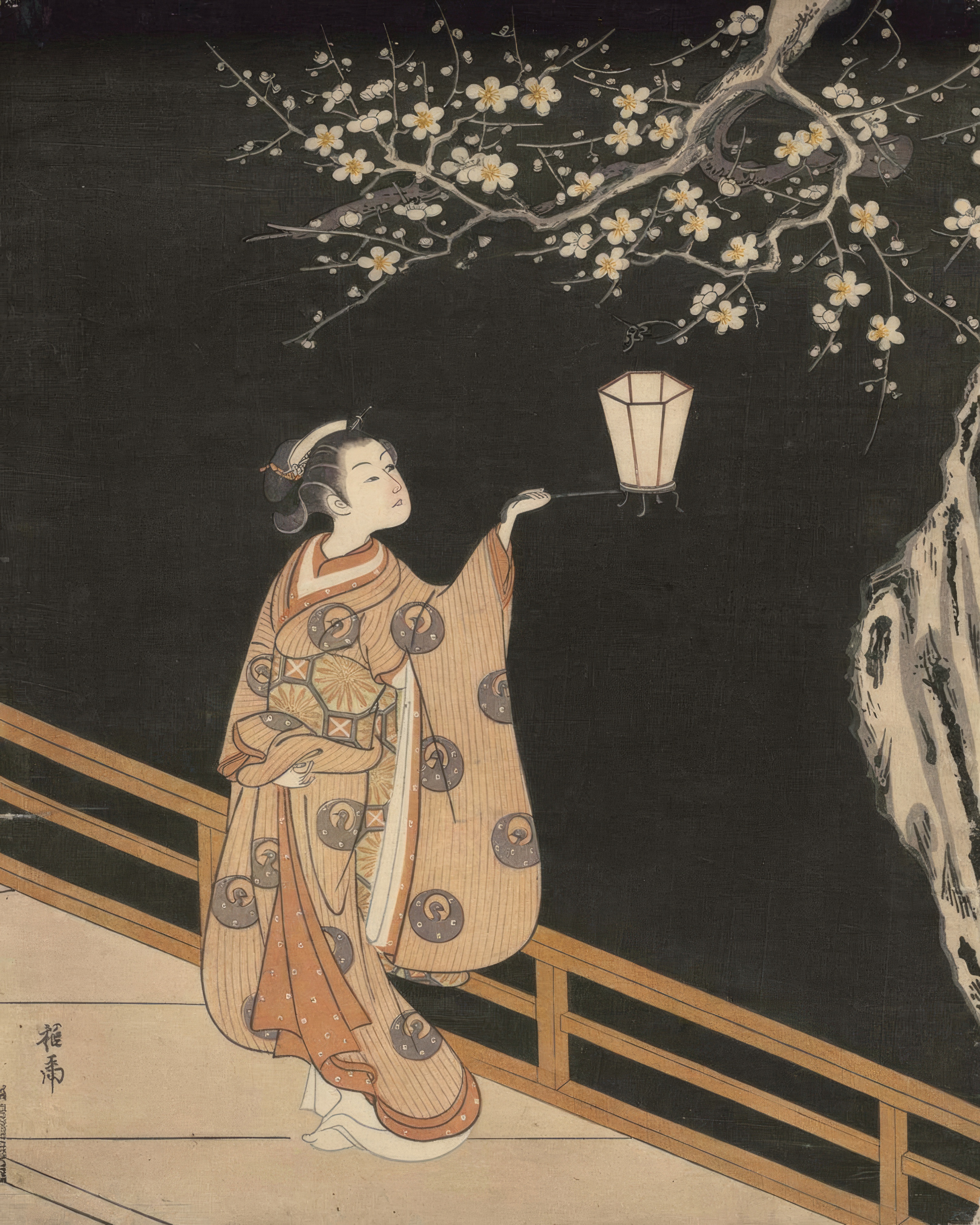
Suzuki Harunobu, Woman Admiring Plum Blossoms at Night, ca. 1766. Woodblock print (nishiki-e) with embossing (karazuri); ink and color on paper. The Metropolitan Museum of Art, New York.
A woman steps onto a veranda to look at plum blossoms in the dark, and her young companion lifts a lantern to light them. Harunobu printed the night sky solid black, so the blossoms and the figures glow out of it.
14. The Jewel River of Plovers
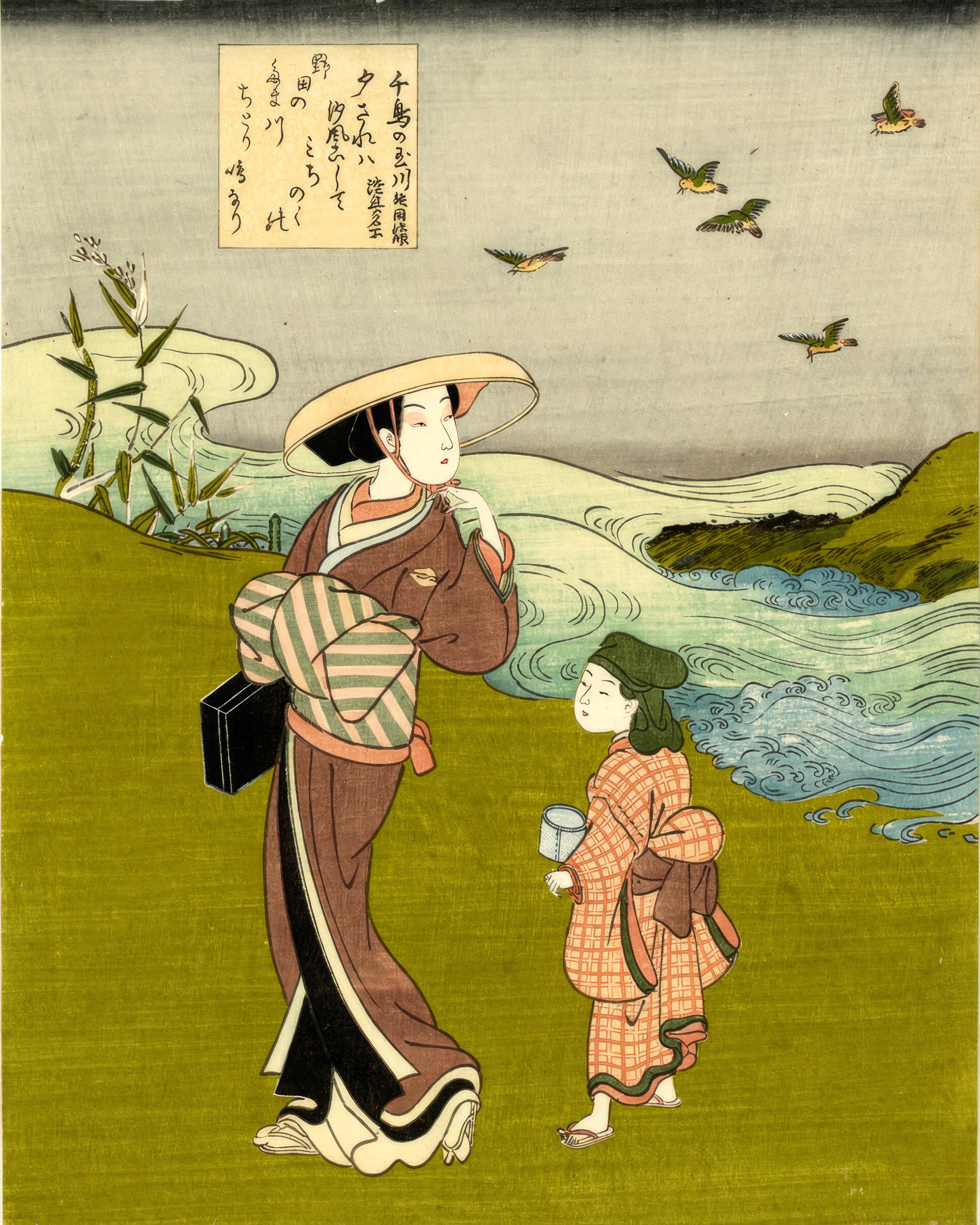
Suzuki Harunobu, The Jewel River of Plovers, c. 1767. Color woodblock print; chuban. Art Institute of Chicago.
Japan had six rivers called Tamagawa, each linked with a famous poem. This is the river of plovers, and Harunobu shows a group on the bank watching the little birds fly. A print that rewards a long look.
15. Rival Actors
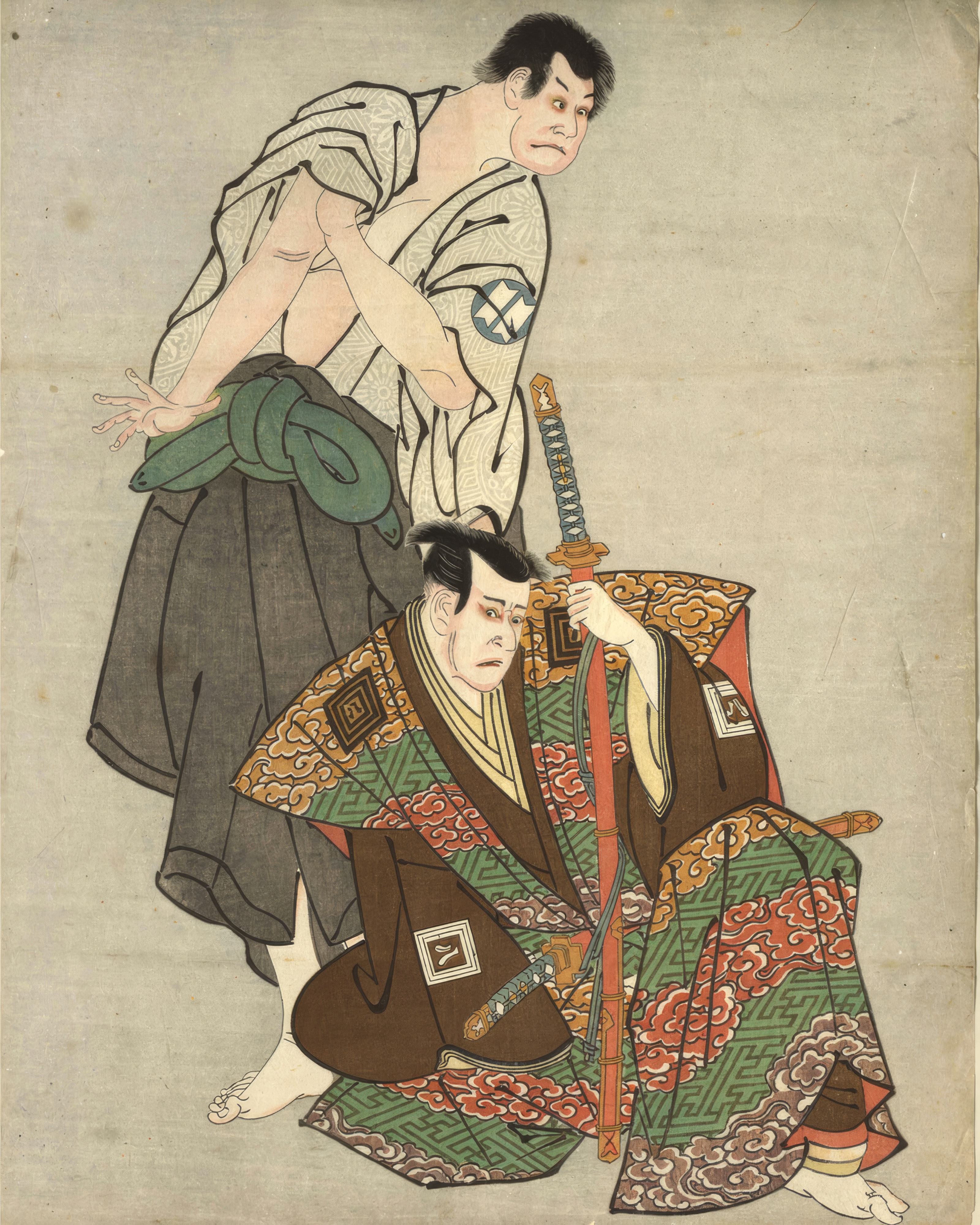
Toshusai Sharaku, Rival Actors, 1794. Color woodblock print; oban. Art Institute of Chicago.
Sharaku made all of his roughly 140 prints in ten months in 1794 and 1795, then vanished. Nobody knows who he was. His actors are almost caricatures, with fierce eyes and clenched hands, and they are among the most sought-after prints in the world.
16. Tsukahara in Snow
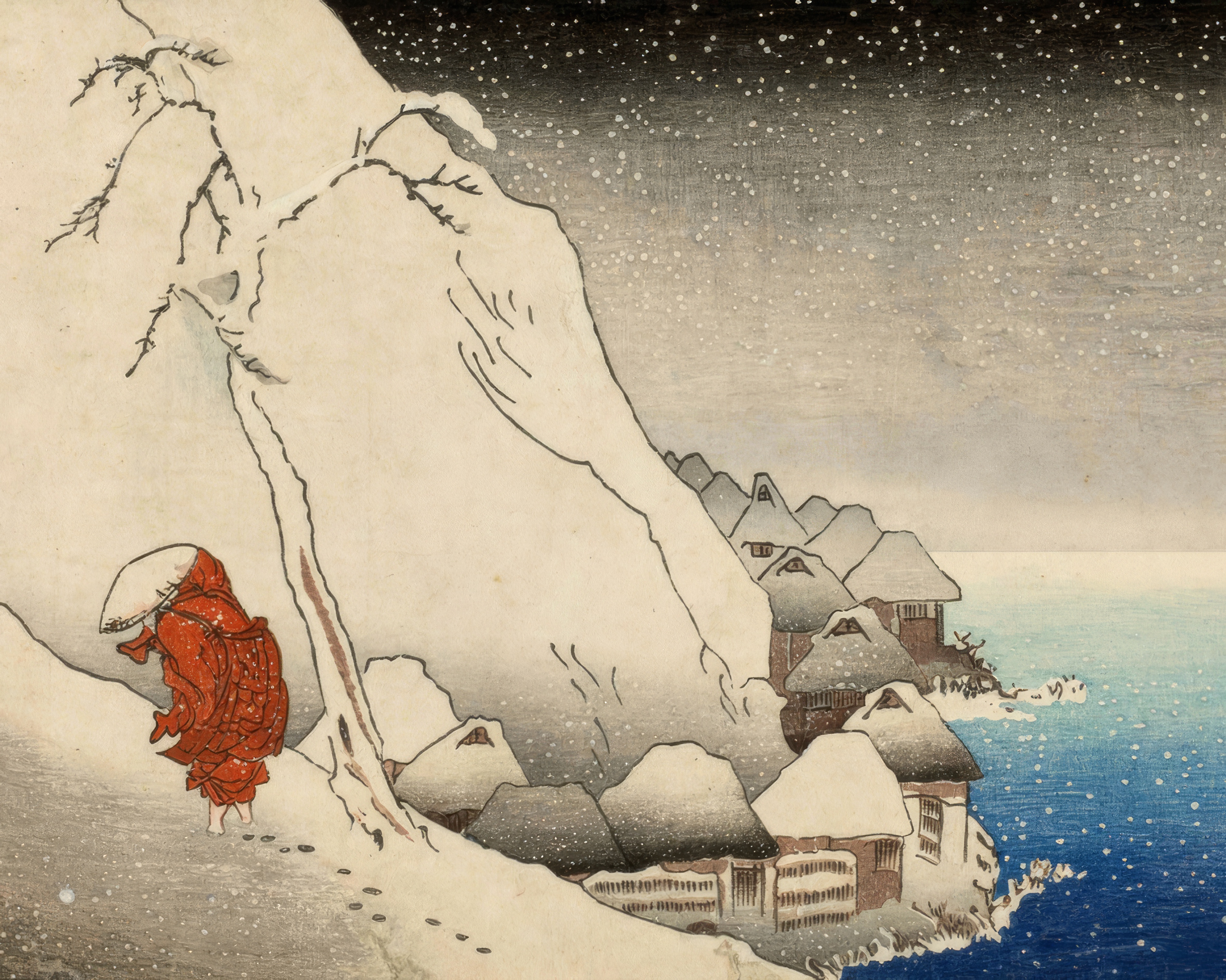
Utagawa Kuniyoshi, Tsukahara in Snow, c. 1830/35. Color woodblock print; oban. Art Institute of Chicago.
Kuniyoshi’s series on the life of the monk Nichiren includes this scene of his exile on Sado Island, struggling through a blizzard. The swirling snow and the deep Prussian blue make it one of the most dramatic landscapes in ukiyo-e.
17. The Black Whirlwind, Li Kui
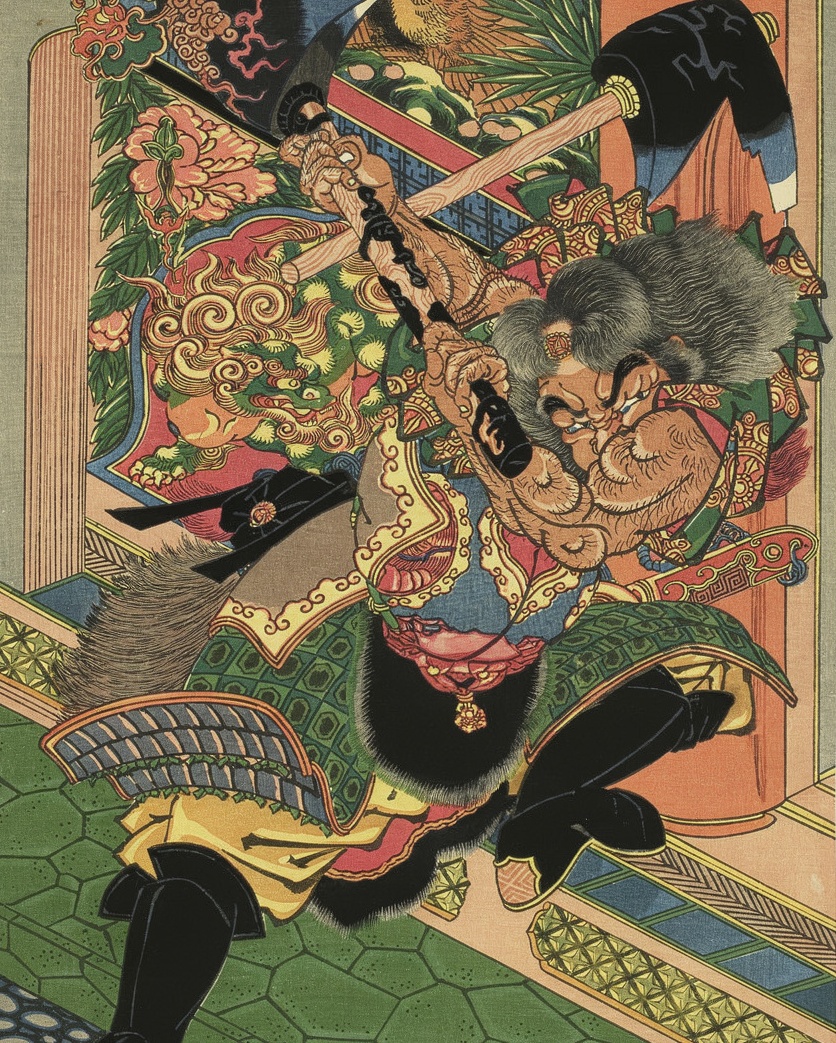
Utagawa Kuniyoshi, The Black Whirlwind, Li Kui, c. 1827. Color woodblock print; oban. Art Institute of Chicago.
Kuniyoshi’s series of heroes from the Chinese novel The Water Margin made him famous overnight in 1827. Li Kui, the Black Whirlwind, bursts across the sheet in a riot of pattern and muscle. These prints still inspire tattoo artists today.
18. Moon of Enlightenment
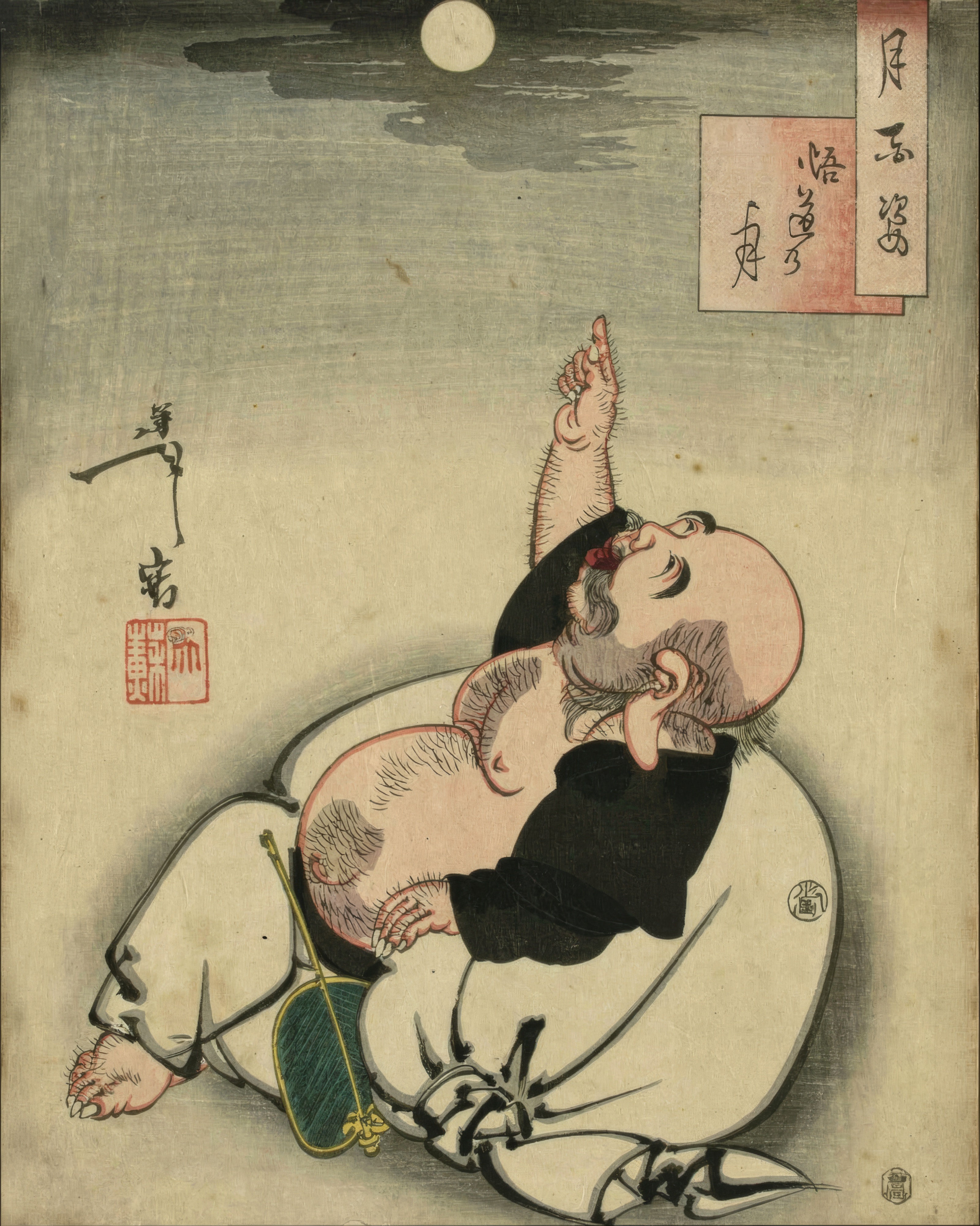
Tsukioka Yoshitoshi, Moon of Enlightenment, 1881. Color woodblock print; oban. Art Institute of Chicago.
Yoshitoshi was the last great master of the woodblock print, working as photography and Western printing arrived in Japan. His One Hundred Aspects of the Moon is his masterpiece; here a monk finds enlightenment by the light of the full moon.
19. Lantern of the Four Seasons
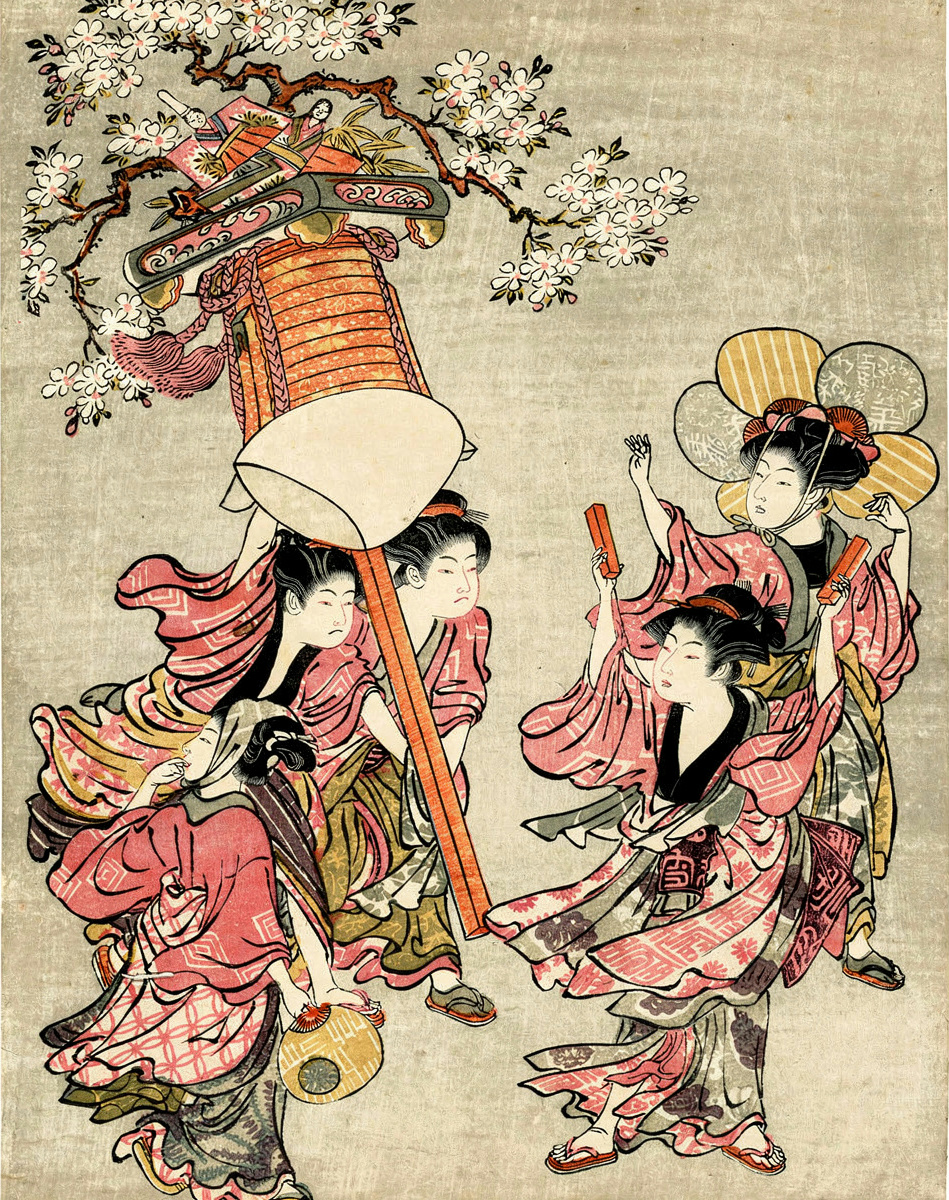
Torii Kiyonaga, Lantern of the Four Seasons, 1780. Color woodblock print; chuban. Art Institute of Chicago.
Torii Kiyonaga drew tall, graceful women walking through Edo, and his prints were the height of fashion in the 1780s. Two of them carry a festival lantern painted with flowers from all four seasons.
20. The Demon at Modori Bridge
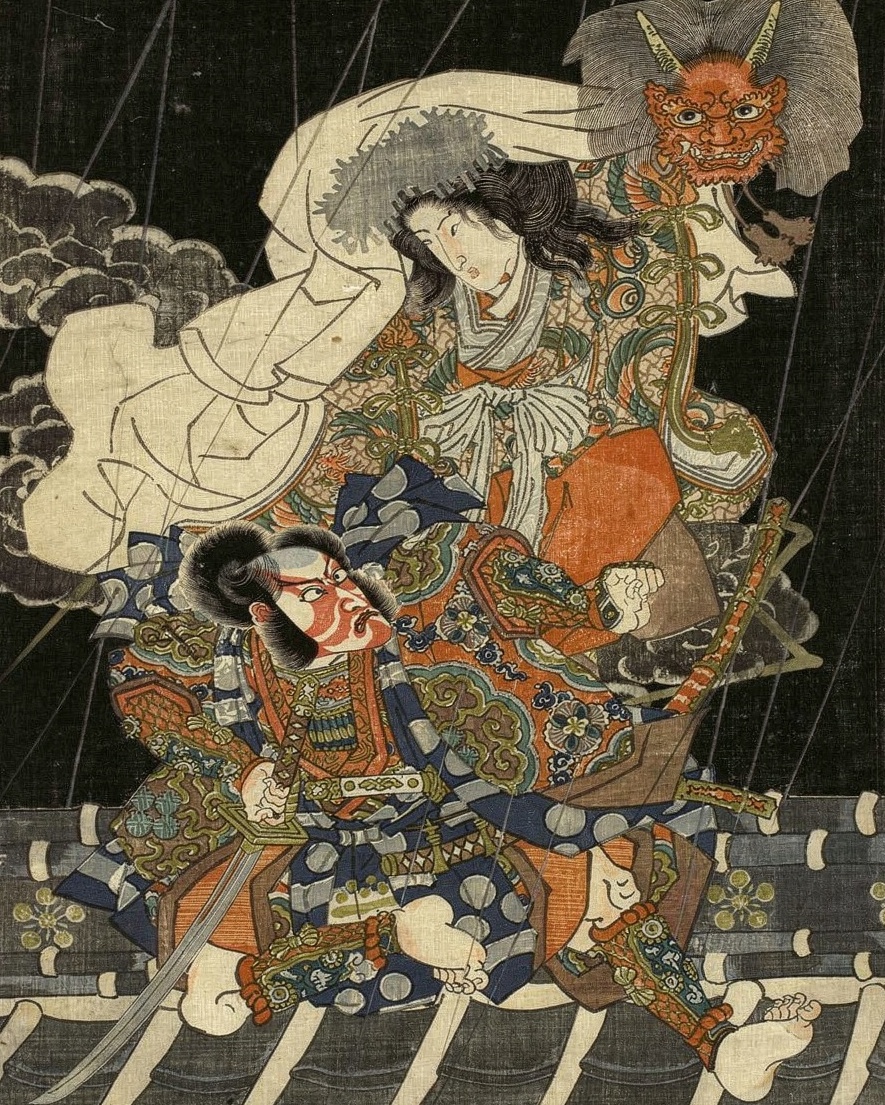
Utagawa Kunisada, The Demon at Modori Bridge, 1833. Color woodblock print; surimono. Art Institute of Chicago.
Surimono were luxury prints made privately for poetry clubs, printed with metallic inks and embossing. Kunisada shows the legend of the warrior Watanabe no Tsuna meeting a demon disguised as a woman on Modori Bridge, played by two star actors of the day.
Japanese prints are small, flat and graphic, which makes them unusually easy to hang. Two or three together in a row suit a hallway or the wall above a low sideboard; a single landscape by Hiroshige suits a study or a bedroom. Give them plenty of white mount around the picture, the way the original sheets had margins. For more of the greatest name in Japanese art, read Hokusai beyond the Great Wave.
Questions
What is a Japanese woodblock print?
A print made by carving a design into blocks of wood, one block for each colour, then inking the blocks and pressing paper onto them by hand. Most famous Japanese prints were made this way in the Edo period, between about 1680 and 1868.
What does ukiyo-e mean?
Pictures of the floating world. The floating world was the pleasure quarter of Edo, with its theatres, teahouses and fashion, and the name came to cover all popular prints of the period, including landscapes and birds and flowers.
Who are the most famous ukiyo-e artists?
Katsushika Hokusai and Utagawa Hiroshige for landscapes, Kitagawa Utamaro and Suzuki Harunobu for beautiful women, Toshusai Sharaku for actors, Utagawa Kuniyoshi for warriors, and Tsukioka Yoshitoshi, the last great master of the form.
How should I hang Japanese prints?
With a wide pale mount and a thin frame, at eye level, out of direct sunlight. They look best in pairs or rows, because they were designed in series.