Birds, flowers and gold: the world of Kanō Mitsunobu
A closer look at Japanese screen painting, seasonal movement and the gold ground in Birds and Flowers, attributed to Kanō Mitsunobu and Kanō Shōei.
A landscape that travels across a room
A folding screen asks you to look differently from a small framed picture. Its landscape travels sideways. Trees, birds and open intervals are arranged across a surface that also changes the room around it. In the pair shown in Fable’s catalogue, the upper and lower screens form two long passages through a golden world. Follow the branches before concentrating on a single bird: the larger rhythm is what gives each small encounter its place.
A school, an atelier, a tradition
The Metropolitan Museum of Art’s history of the Kanō school describes generations of professional painters working for powerful patrons. Bold brushwork, decorative colour and gold grounds became important in large-scale interiors. This was an adaptable workshop tradition, rather than one painter repeating one formula. That context matters when reading an attribution: the school’s shared vocabulary could pass between relatives, pupils and studios.
Reading Birds and Flowers
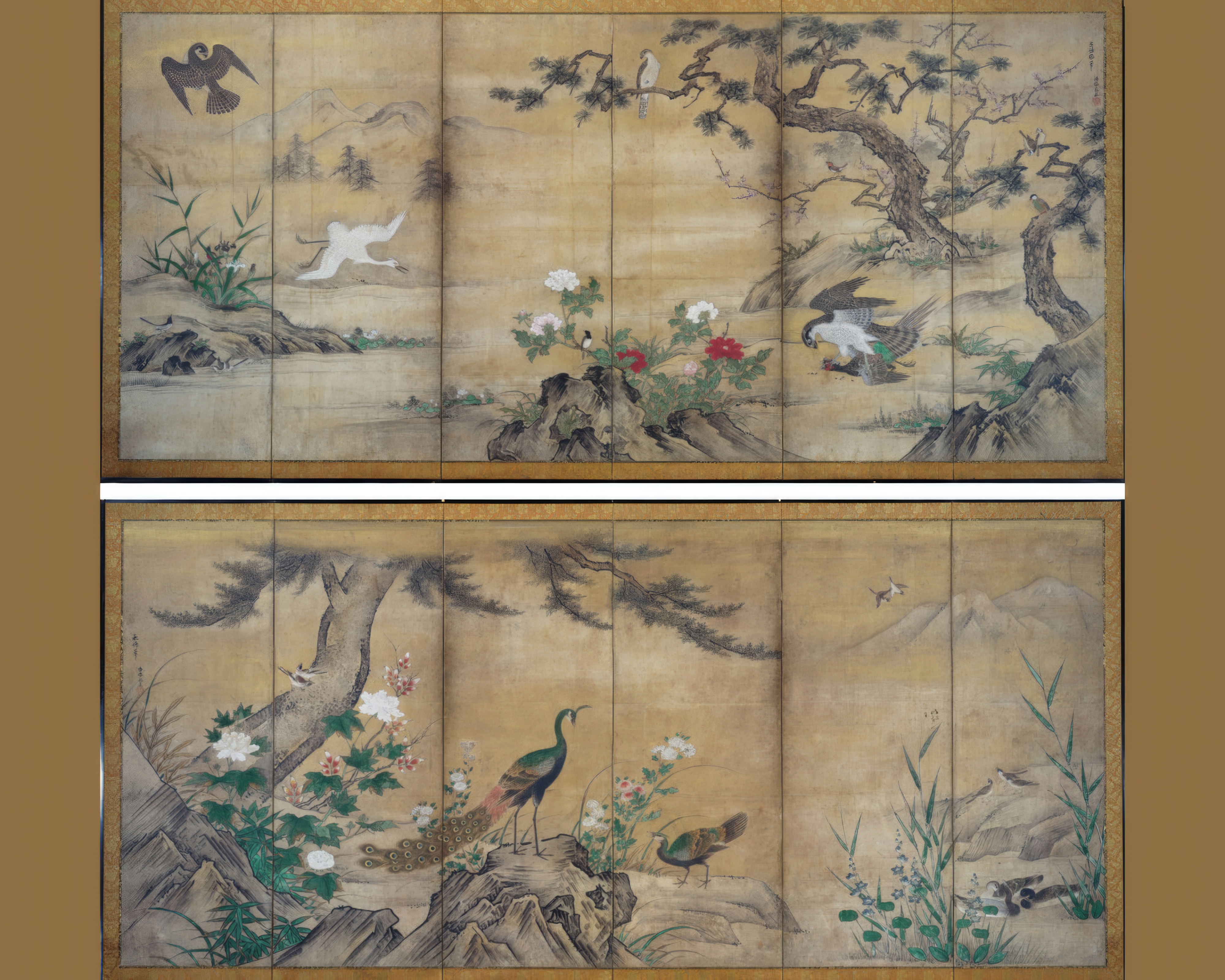
Fable catalogue edition after the historical work.
The Cleveland Museum of Art record identifies a pair of six-panel screens from the late 1500s. Its account links the work to Kanō Mitsunobu and Kanō Shōei; attribution is part of the historical record, not a reason to flatten the work into a certainty. The related screen record describes a seasonal progression, with birds and flowers distributed through the landscape. Here the complete Fable catalogue composition presents the pair together, one above the other. A print of this arrangement is not a physical folding screen.
What the gold does
Look at the space between the trees. The gold-coloured ground holds those open passages together, allowing distant landscape and close foliage to share the same decorative surface. It can read as atmosphere without behaving like a literal blue sky. On the historical screens, gold is a material as well as a colour. In a reproduction, the image represents its appearance; it does not acquire the original’s metallic surface simply because the pictured ground is gold.
A lesson in leaving room
The image offers a useful way to think about creating with nature. Choose a few forms with different jobs: a branch to carry movement, a bird to arrest attention, an open area to let the eye rest. A new botanical scene does not need to fill every interval. Start from this work in Fable Artist, or keep the existing composition through its Masterworks print page. For another approach to nature as an imaginative world, continue to Palmer’s garden.