John Constable: weather, water and a particular place
John Constable’s landscapes are built from particular places and changing weather. Four works show how sky, trees and water share the picture.
John Constable can make a familiar landscape feel unsettled by a change of cloud. At Branch Hill Pond, the ground is rough, the sky expansive and the light uneven. The picture does not offer an ideal countryside emptied of work and weather. It gives the viewer a place in which several kinds of movement continue, even when the canvas itself is still.
The four works shown here range from an open view at Hampstead to a house, a waterside building and a later river landscape. Their differences help explain why “English countryside” is too broad a description on its own. Begin with the wider guide to famous landscape paintings, then look at how each Constable work distributes attention between ground, sky, water and the signs of people living there.
Branch Hill Pond: the sky changes the ground
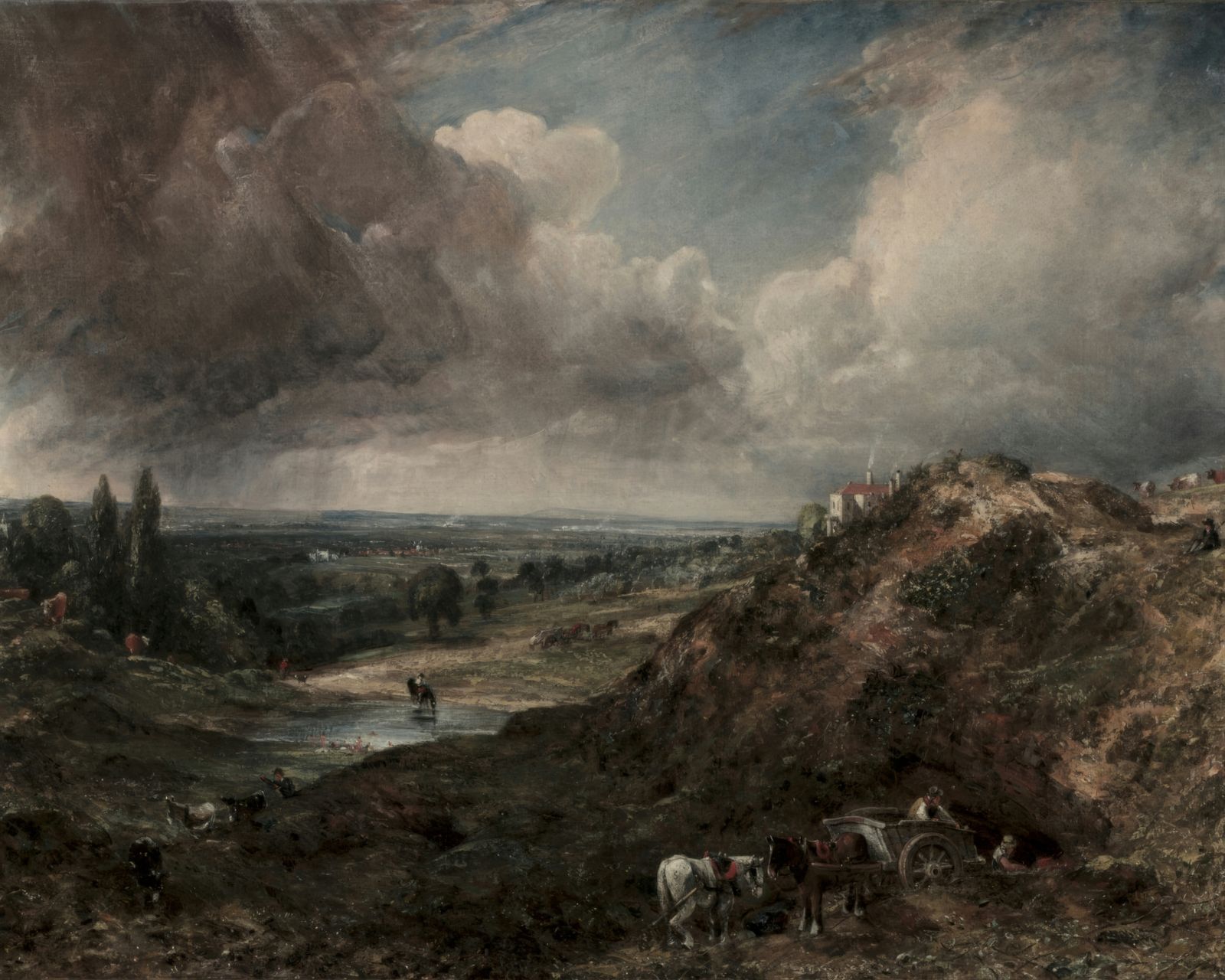
Branch Hill Pond, Hampstead · John Constable, 1828 · Cleveland Museum of Art. Restored by Surrealium at Vaxholm Fortress, Sweden.
At Branch Hill Pond, Hampstead, a broad mass of cloud hangs above a landscape broken by tracks, uneven banks and small figures. The dark area in the sky does not remain separate from the earth: it changes how we read the lighter distance and the nearer ground. The painting's open view is therefore also a study in interruption, with brightness moving unevenly through the scene.
The Cleveland Museum of Art records this work as 1828. Look at the difference between the scale of the clouds and that of the people and animals below. The figures give the ground a measure, but they do not control the weather. That imbalance makes the picture feel larger than its immediate subject without requiring an invented story about a storm that the catalogue has not promised.
Observation does not mean a neutral transcription
Constable is closely associated with the study of nature, including skies and changing atmospheric conditions, as the Victoria and Albert Museum's account explains. Yet observation and composition are not opposites. A painter still decides where a horizon sits, which part of a tree interrupts it and how much space the sky receives. A convincing landscape is made through those choices rather than by the simple accumulation of details.
This matters when looking at a reproduction. You can admire a cloud for its apparent truth while also noticing its role in the arrangement of the picture. Does it lead towards a building, darken one side or open a pale passage in the distance? The question moves us beyond checking whether the weather looks realistic and towards seeing how the painter makes the whole scene hold together.
The Quarters behind Alresford Hall: a small architecture of water
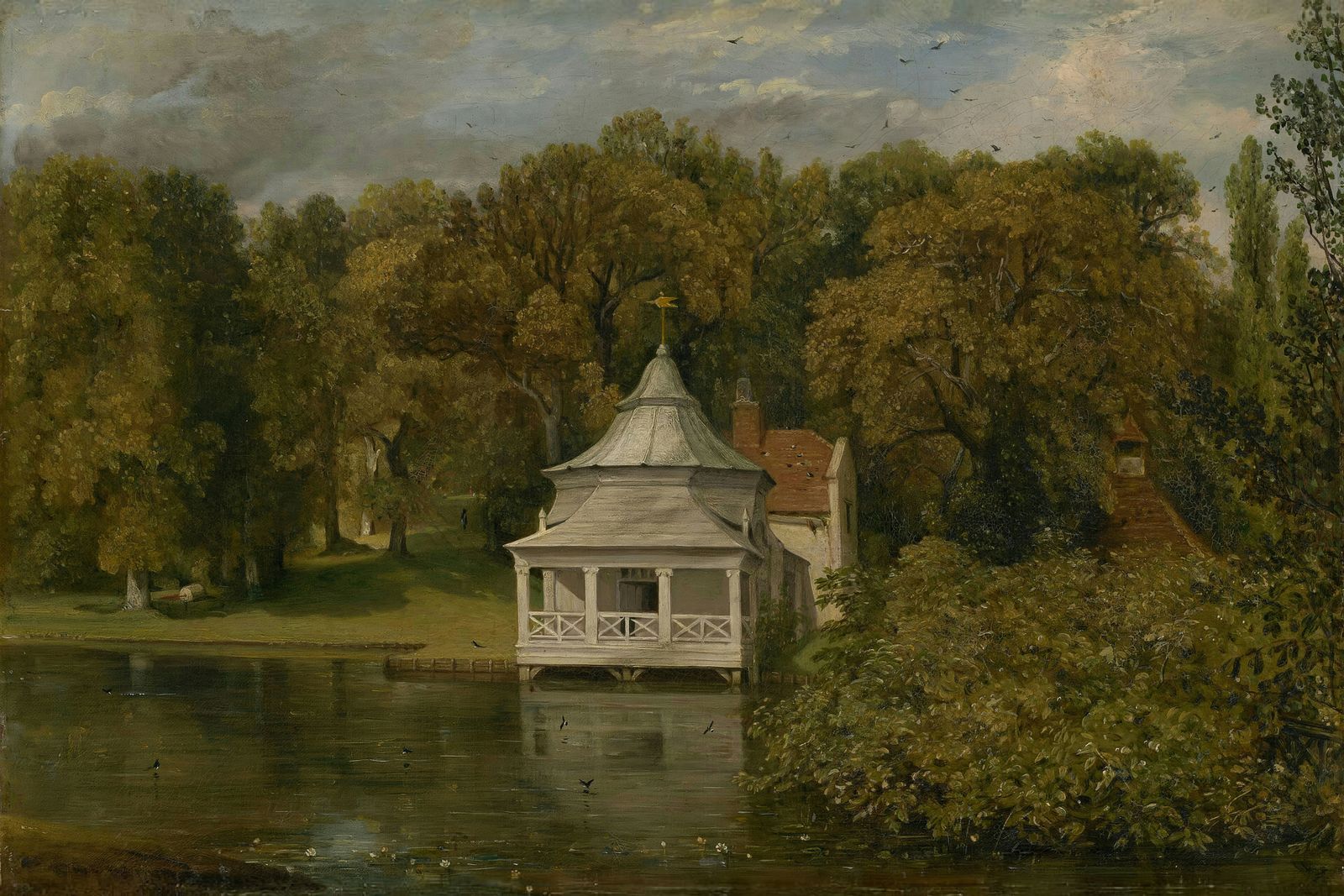
The Quarters behind Alresford Hall · John Constable, 1816 · National Gallery of Victoria, Melbourne. Prepared for print by Surrealium at Vaxholm Fortress, Sweden.
The waterside building in The Quarters behind Alresford Hall sits within trees, its pale walls and roof making a compact shape above the reflection. The water gives that shape a second, less stable version. Dark foliage surrounds the structure without closing it off entirely, and the eye moves between the built object and the surface beneath it.
Compared with Branch Hill Pond, the view feels more contained. We are not asked to survey a broad distance so much as to attend to a small relation between architecture, bank and water. That change of scale is useful when choosing a landscape to live with. A picture can offer quiet concentration rather than a panoramic escape, and a modest building can be enough to organise a whole field of looking.
Trees are structures as well as subjects
In these landscapes, trees do more than identify a rural setting. They frame a view, hold a dark area against the sky, interrupt the edge of a building or create a passage towards water. Their forms can be irregular without being arbitrary. A branch reaching across a light patch changes how the eye moves through the entire picture.
Try following the gaps between leaves as carefully as the leaves themselves. Those openings connect foreground to distance and prevent a mass of foliage from becoming a flat wall. Constable's pictures often reward that kind of slow attention. You do not have to identify every species to see the role a tree plays, although a specific botanical identification should come from a reliable record rather than a confident guess at a small reproduction.
Malvern Hall: the house belongs to the grounds
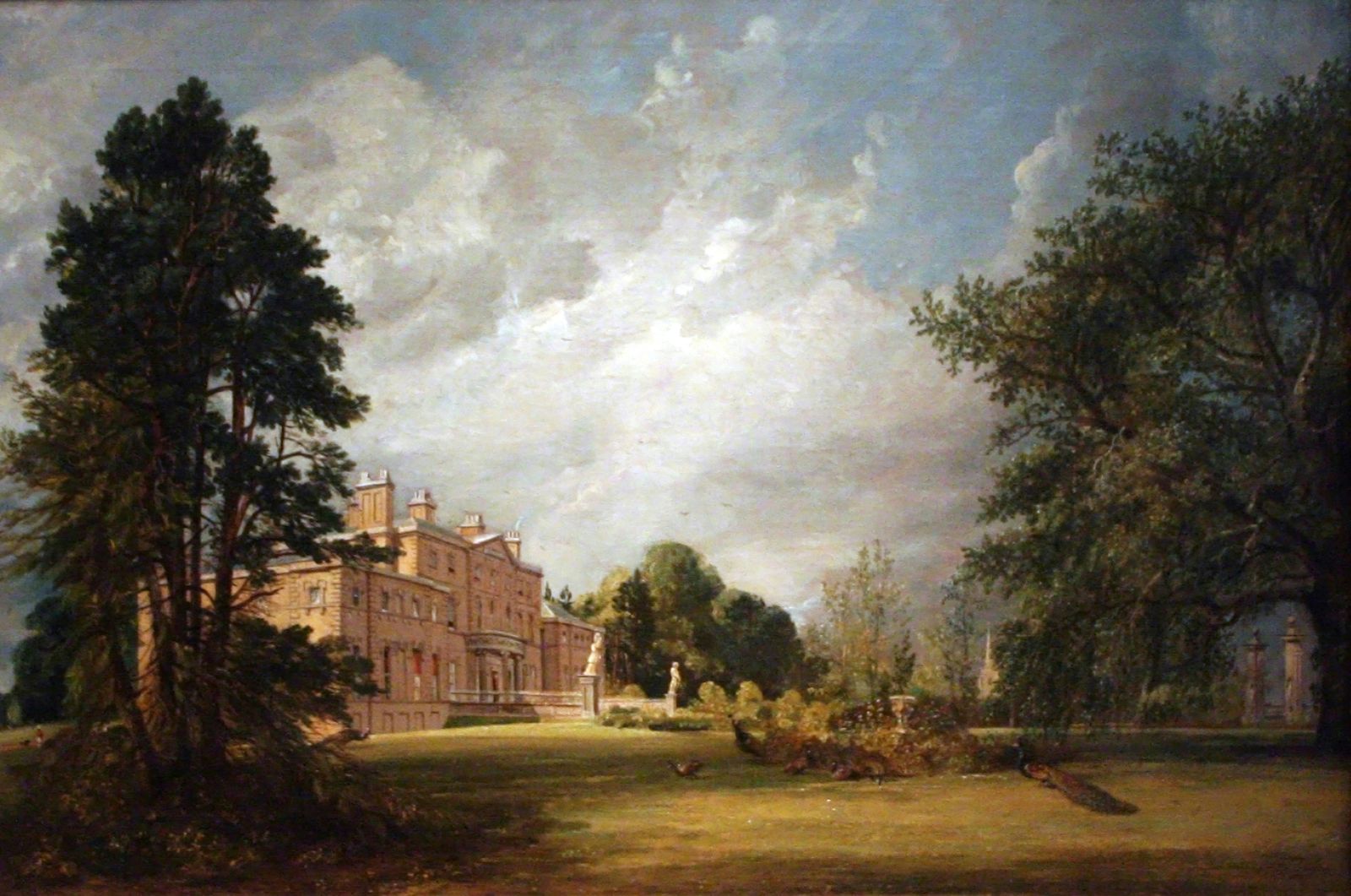
Malvern Hall · John Constable, 1821 · Clark Art Institute. Prepared for print by Surrealium at Vaxholm Fortress, Sweden.
Malvern Hall is presented with a broad lawn, enclosing trees and a sky that shares the view with the architecture. The house is clearly important, but it does not occupy the whole image. Its position among living forms makes it part of a landscape rather than an isolated elevation. The contrast between the building's repeated windows and the uneven trees gives the composition a quiet order.
This is a useful picture to compare with the smaller waterside structure. Both include architecture, but they distribute scale differently. One invites attention to a compact building reflected in water; the other allows grounds and sky to establish a larger setting. A title that names a house tells us the subject, while the full composition shows the painter's decision about how that subject should be encountered.
A country scene can contain work
It is easy to turn landscape painting into an image of leisure for the modern viewer. Yet tracks, boats, fields, buildings and animals often point towards use and labour. The countryside is not simply a place waiting to be admired. In Constable's pictures, these signs can be small enough to disappear in a thumbnail, but they help explain why the land has the shape it does.
Look for routes through a scene. Where could a person walk, where would a boat move, and which bank appears accessible? These questions do not turn the painting into a map, but they restore a practical dimension to the view. A landscape can be beautiful because it is particular, including the marks of people living and working in it, rather than because it has been cleared of their presence.
The Valley Farm: a view gathered around water
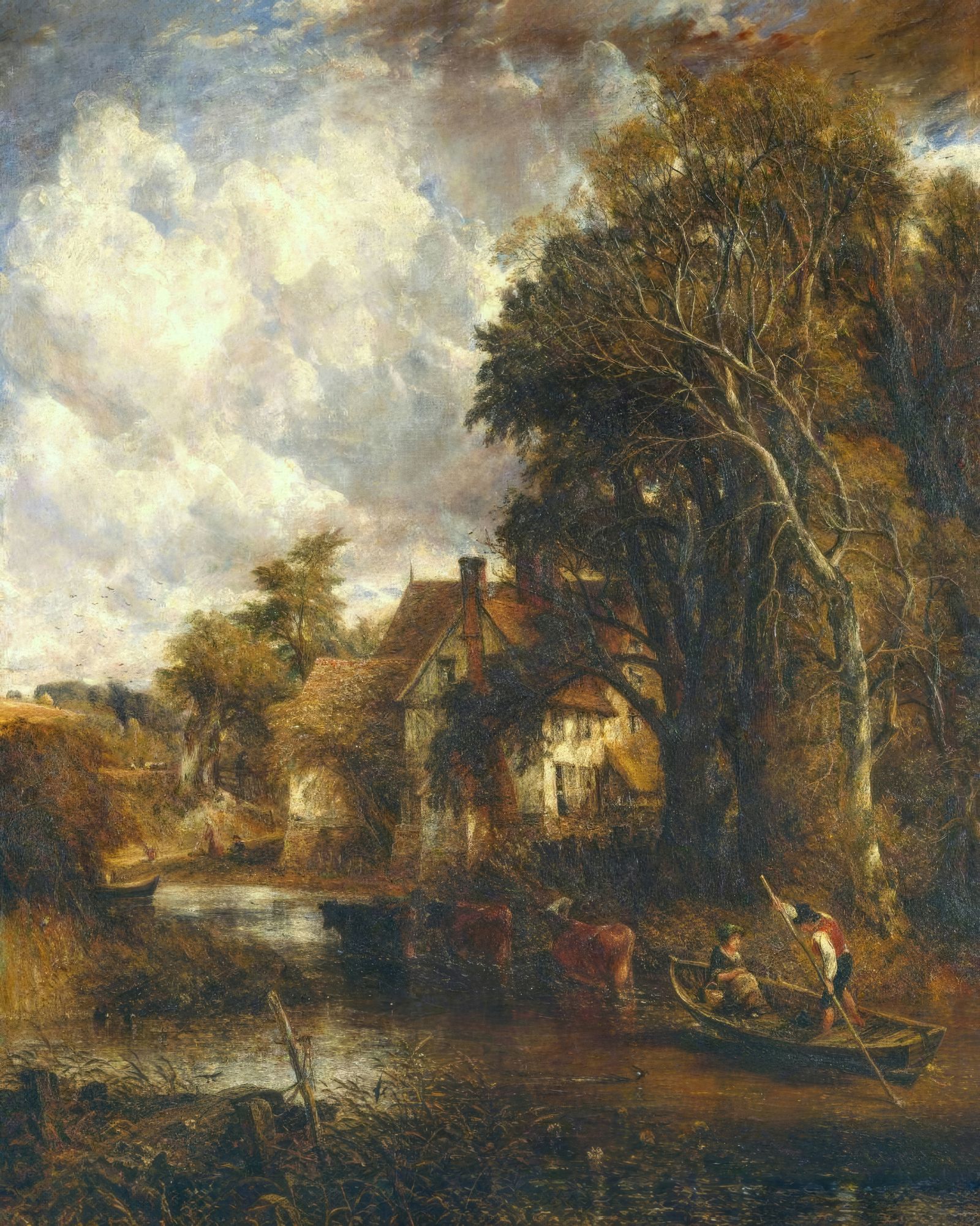
The Valley Farm · John Constable, 1835 · Tate, London. Prepared for print by Surrealium at Vaxholm Fortress, Sweden.
The Valley Farm brings a house, trees and a boat into a dense arrangement beside water. Light breaks through the foliage and sky, while the river surface provides a lower, shifting field of reflection. The work's richness comes from the relations among those elements rather than from one object presented on its own. The building feels embedded within the place.
Compare the near water with the lighter spaces farther back. The eye has to find a route through the density, and that route is part of the pleasure. A crop that isolates the house would make the work easier to name but less interesting to see. Keep the complete painting visible, allowing the darker edges and small details to contribute to the atmosphere instead of treating them as expendable surroundings.
Comparing Constable with other landscapes
The guide to Impressionist paintings offers later approaches to light and surface, while Winslow Homer's waters show another way to make weather and working places central. The point of comparison is not to decide which painter observed nature most faithfully. It is to notice different decisions about distance, marks, figures and the amount of sky a picture can carry.
Begin with Branch Hill Pond in the Romantic collection, then return to the more enclosed views. Ask which kind of attention you enjoy: the broad weather of an open landscape or the concentrated relation of a building to water. Constable's particular places offer both, and their differences remain visible when we resist gathering them under a single pastoral mood.
A Constable landscape can feel familiar while continuing to change under the eye. Cloud alters the ground, water unsettles a reflection and a small path reminds us that the view is used. Choose the whole arrangement, not merely the name of the place or the promise of calm.
- What is John Constable known for?
- He is known for landscape painting and close attention to weather, light and particular places. His work includes both studies and more developed compositions, so observation and deliberate arrangement belong together.
- Are all Constable landscapes peaceful?
- No. Changing clouds, rough ground and strong contrasts can make a view feel unsettled. Even a quiet scene may contain labour and practical routes through the land.
- How should I look at a Constable sky?
- Notice its relation to the ground: where light falls, how cloud balances trees and how much of the picture the sky occupies. Its compositional role matters as much as identifying a weather condition.